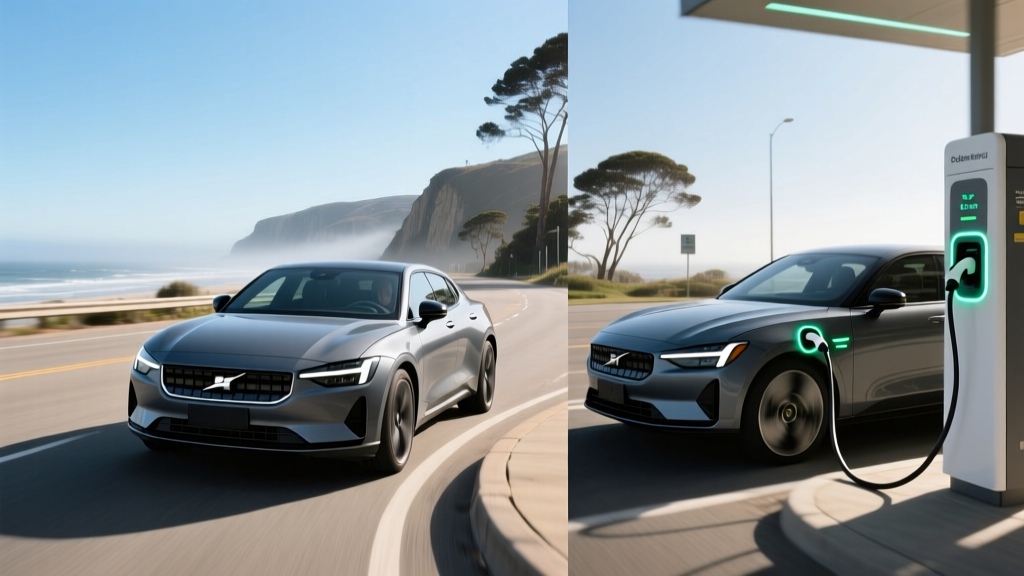
The Polestar 2 occupies a distinct space in the American EV market: a Scandinavian-designed, Chinese-manufactured electric liftback that prioritizes driving dynamics and minimalist design over the crossover-utility trend dominating US showrooms. For the 2026 model year, Polestar has streamlined the lineup around its 82 kWh battery platform, improved DC fast-charging speeds, and expanded the Google-based infotainment ecosystem. But with US pricing starting near $50,000 and federal tax credit eligibility hinging on complex battery-sourcing rules, buyers need hard numbers before signing.
This review covers the Polestar 2 as sold in the United States, with exact EPA figures, real-world range observations, charging-curve behavior, and a detailed breakdown of ownership costs. If you're cross-shopping against the Tesla Model 3, BMW i4, or Hyundai Ioniq 6, this is the data you need.
Range, Battery, and Efficiency: The Real Numbers
The 2026 Polestar 2 is available in two powertrain configurations in the US market, both sharing the same 82 kWh usable battery capacity (88 kWh gross) built on a 400-volt architecture with NMC (nickel manganese cobalt) cell chemistry supplied primarily by LG Energy Solution and CATL depending on production batch.
| Trim / Drivetrain | EPA Range | MPGe (City/Hwy/Combined) | kWh/100 mi |
|---|---|---|---|
| Long Range Single Motor (RWD, 299 hp) | 320 miles | 124 / 107 / 116 MPGe | 29 |
| Long Range Dual Motor (AWD, 421 hp) | 291 miles | 109 / 94 / 102 MPGe | 33 |
Efficiency is competitive but not class-leading. The Hyundai Ioniq 6 SE Long Range achieves 361 miles EPA on a 77.4 kWh battery thanks to its slippery 0.21 drag coefficient, while the Tesla Model 3 Long Range RWD posts 363 miles on roughly 82 kWh. The Polestar 2's liftback silhouette, while practical for cargo, creates more aerodynamic drag than these sedan rivals, which shows up at highway speeds.
Charging Speed: DC Fast Charge and Home Level 2
Charging infrastructure access remains the top concern for US EV buyers, and the Polestar 2's 400-volt architecture means it doesn't match the peak speeds of 800-volt rivals like the Hyundai Ioniq 5 or Kia EV6. Still, Polestar has improved the charge curve for 2026, raising peak DC fast-charging capability to 205 kW.
| Charging Level | Power / Rate | Time / Miles Added |
|---|---|---|
| Level 1 (120V household) | ~1.4 kW | ~4 miles per hour |
| Level 2 (240V home/public AC) | 11 kW (onboard charger) | ~37 miles per hour; 0–100% in ~8 hrs |
| DC Fast Charge (peak) | 205 kW (CCS1 / NACS via adapter) | 10–80% in ~27 minutes |
| DC Fast Charge (sustained avg) | ~130–140 kW avg to 80% | Expect taper above 80% SoC |
The 205 kW peak figure is only achievable between roughly 10% and 30% state of charge at an adequately powered CCS1 or NACS-equipped station (Polestar provides a NACS adapter for Tesla Supercharger access). Beyond 50% SoC, the charge curve tapers progressively—by 80%, you're typically seeing 60–80 kW. This is typical 400V behavior, but it means the 10–80% time of approximately 27 minutes trails the Ioniq 5's 18-minute 10–80% sprint on 800V hardware.
For home charging, the 11 kW onboard AC charger is a strong point. On a 48-amp Level 2 home station (hardwired, 240V), you'll add roughly 37 miles of range per hour—enough to fully replenish the 82 kWh battery overnight in about 8 hours. Most owners charging from a daily 20–80% cycle will wake to a full battery every morning.
Preconditioning is critical: when you navigate to a DC fast charger using the Polestar's built-in Google Maps routing, the battery thermal management system will warm or cool the pack to optimal temperature before you arrive. Skipping this step—especially in cold weather—can add 10+ minutes to your charging session as the battery limits charge rate to protect cell health.
Performance and Drivetrain
| Specification | Single Motor (RWD) | Dual Motor (AWD) |
|---|---|---|
| Horsepower | 299 hp | 421 hp |
| Torque | 361 lb-ft | 546 lb-ft |
| 0–60 mph | 5.9 seconds | 4.2 seconds |
| Drivetrain | Rear-wheel drive | All-wheel drive |
| Top Speed | 100 mph (limited) | 127 mph (limited) |
| Towing Capacity | Not rated | Not rated |
The Single Motor RWD variant is the volume seller and the sweet spot for most buyers. At 299 hp and 5.9 seconds to 60 mph, it's genuinely quick for daily driving, and the rear-drive layout gives the Polestar 2 a more engaging, balanced feel than most front-drive EV crossovers. The steering is weighted and communicative—rare in the EV segment—and the optional Performance Pack ($5,000) adds Öhlins dampers, Brembo brakes, and 20-inch forged wheels that transform the chassis on back roads.
The Dual Motor AWD is a brute at 421 hp, but the 29-mile range penalty and higher price make it harder to justify unless you need all-weather traction in snow-belt states. Even then, the RWD model with quality winter tires is a viable alternative that preserves more range.
Pricing, Tax Credits, and Ownership Cost
| Trim | Base MSRP | As-Tested (Typical Options) | §30D Credit Eligibility |
|---|---|---|---|
| Long Range Single Motor | $49,900 | $52,000–$56,000 | Up to $7,500 (see rules below) |
| Long Range Dual Motor | $53,900 | $56,000–$62,000 | Up to $7,500 (see rules below) |
Federal tax credit eligibility for the Polestar 2 is nuanced and changes as battery sourcing and IRS guidance evolve. Under current IRS §30D rules, the Polestar 2 may qualify for up to $7,500, but buyers must satisfy all of the following:
- MSRP cap: The Polestar 2 qualifies as a sedan (not an SUV/truck), so the MSRP cap is $55,000. The base Single Motor at $49,900 clears this; the Dual Motor at $53,900 also qualifies, but heavily optioned Dual Motor builds may push past the threshold.
- Buyer income cap: Modified adjusted gross income must not exceed $150,000 (single), $225,000 (head of household), or $300,000 (married filing jointly).
- Battery sourcing: At least a percentage of critical minerals must be extracted or processed in the US or a free-trade-agreement country, and battery components must meet domestic-content thresholds. The Polestar 2's CATL- and LG-sourced cells have faced scrutiny under the "foreign entity of concern" (FEOC) rules. Credit eligibility can vary by production batch and model year—verify with your dealer and a tax professional before purchase.
- Point-of-sale transfer: Since 2024, eligible buyers can transfer the credit to the dealer at purchase, reducing the vehicle's price directly rather than waiting to claim it at tax time.
Destination charges add approximately $1,400. Popular options include the Plus Pack ($4,000: panoramic roof, Harman Kardon audio, heat pump), Pilot Pack ($3,500: Pilot Assist with adaptive cruise, 360° camera), and the aforementioned Performance Pack ($5,000). A well-equipped Single Motor with Plus and Pilot lands around $57,300 before any credit.
For the latest eligibility status, always cross-reference the official fueleconomy.gov tax credit database and consult IRS Publication 5905.
Interior, Cargo, and Technology
The Polestar 2's cabin is an exercise in Scandinavian restraint. The 11.2-inch portrait touchscreen runs Google built-in (Google Maps, Google Assistant, Google Play Store), which remains one of the most capable native infotainment platforms in any EV. Voice commands via "Hey Google" handle navigation, climate, and media reliably, and wireless Apple CarPlay is standard for those who prefer iOS integration.
Materials are a standout: Polestar offers a fully vegan interior with WeaveTech synthetic upholstery as standard, and the optional Nappa leather package includes ventilated front seats. Build quality is excellent, with tight panel gaps and solid switchgear—a clear step above Tesla's inconsistent fit and finish.
| Measurement | Specification |
|---|---|
| Front legroom | 42.2 inches |
| Rear legroom | 35.6 inches |
| Cargo (rear seats up) | 14.4 cu ft |
| Cargo (rear seats folded) | 38.7 cu ft |
| Frunk (front trunk) | 1.4 cu ft (cable storage) |
Cargo space is where the liftback design pays dividends. The 14.4 cubic feet behind the rear seats beats most sedans, and the wide hatch opening makes loading bulky items easy. However, the rear seat is best suited for two adults—three across is tight—and headroom is compromised by the sloping roofline for passengers over 6'2".
Driver-assistance tech includes Polestar's Pilot Assist (SAE Level 2), which provides adaptive cruise control with lane centering. It works well on highways but requires hands on the wheel—this is not a hands-free system like GM's Super Cruise or Ford's BlueCruise. Automatic emergency braking, blind-spot monitoring, and rear cross-traffic alert are standard. The Polestar 2 earned a TOP SAFETY PICK+ rating from IIHS and a 5-star Euro NCAP score.
Warranty and Long-Term Ownership
| Coverage Area | Term |
|---|---|
| Limited Vehicle Warranty | 4 years / 50,000 miles |
| Battery & Drive Unit Warranty | 8 years / 100,000 miles |
| Battery Capacity Retention Guarantee | 70% minimum at 8 yr / 100,000 mi |
| Corrosion Perforation | 12 years / unlimited miles |
| Roadside Assistance | 4 years / 50,000 miles |
The battery warranty's 70% capacity retention threshold is standard for the segment—Tesla, Hyundai, and BMW all use similar benchmarks. Real-world NMC degradation data from early Polestar 2 owners (2021–2023 models) suggests approximately 5–8% capacity loss over the first 60,000 miles, with the curve flattening thereafter. Routine use of DC fast charging and frequent charging to 100% will accelerate degradation; Polestar recommends a daily charge limit of 80–90% for optimal longevity, reserving 100% for long trips.
Maintenance costs are minimal—no oil changes, no spark plugs, brake pad life extends well beyond 80,000 miles thanks to regenerative braking. Cabin air filter replacement every 2 years and brake fluid checks are the primary scheduled items. Insurance premiums run 10–20% higher than comparable gas sedans, consistent with EV industry averages.
Who Should Buy the Polestar 2?
Best for: Design-conscious commuters and couples who want a premium EV with European driving dynamics, Google-native tech, and strong build quality. The 320-mile EPA range handles daily driving and weekend trips of 200+ miles comfortably, and home charging covers 95% of needs.
Less ideal for: Families needing spacious rear seating, road-trippers in charging-desert regions (the 27-minute 10–80% time and 400V architecture add time on long hauls), or buyers who need hands-free highway driving. If rear-seat space or maximum range are top priorities, the Tesla Model 3 Long Range or Hyundai Ioniq 6 offer more. If you need an SUV form factor, the Polestar 3 or Tesla Model Y are better fits.
Pros
- Engaging RWD chassis; optional Öhlins suspension is superb
- Google built-in infotainment is fast, intuitive, and well-integrated
- Premium vegan interior with excellent build quality
- 320-mile EPA range (RWD) is competitive
- 11 kW AC onboard charger enables fast home charging
- NACS adapter included for Tesla Supercharger access
- IIHS TOP SAFETY PICK+ rating
Cons
- 27-min 10–80% DC charge trails 800V rivals (Ioniq 5: 18 min)
- Rear seat is tight for three adults; headroom limited for tall passengers
- No hands-free driving mode (Pilot Assist requires hands on wheel)
- Federal tax credit eligibility uncertain due to battery sourcing rules
- Price climbs quickly with option packs ($52K–$62K as-tested)
- No towing rating
- US service center network still expanding—rural owners may face long drives for warranty work
Frequently Asked Questions
What is the real-world range of the Polestar 2?
The EPA rates the Long Range Single Motor at 320 miles and the Dual Motor AWD at 291 miles. In real-world highway driving at 70–75 mph, expect 265–285 miles for the RWD and 240–260 miles for the AWD. In cold weather below freezing, subtract another 15–25%, bringing winter highway range to roughly 210–240 miles (RWD).
How fast does the Polestar 2 charge?
On DC fast charging, the Polestar 2 peaks at 205 kW and charges from 10–80% in approximately 27 minutes, though sustained average power is closer to 130–140 kW due to charge-curve taper. At home on a 48-amp Level 2 charger, the 11 kW onboard charger adds about 37 miles of range per hour, filling the battery in roughly 8 hours.
Does the Polestar 2 qualify for the $7,500 federal EV tax credit?
It may, but eligibility depends on your income (under $150K single / $300K joint), the specific vehicle's MSRP (must be under $55,000 for sedans), and battery-component and critical-mineral sourcing compliance with IRS FEOC rules. Because Polestar sources cells from both LG and CATL, credit eligibility can vary. Verify with your dealer and a tax professional, and check IRS.gov for current guidance.
Is the Polestar 2 worth buying over the Tesla Model 3 or Hyundai Ioniq 6?
Choose the Polestar 2 if you value Scandinavian design, build quality, an engaging chassis, and Google-native tech—and you're willing to accept slightly slower DC charging and a tighter rear seat. Choose the Model 3 Long Range if maximum range (363 mi EPA), Supercharger network convenience, and lower pricing matter most. Choose the Ioniq 6 SE if you want 800V fast-charging (18-min 10–80%) and the longest EPA range (361 mi) at a lower price. The Polestar 2 wins on driving feel and interior craftsmanship; its rivals win on efficiency and charging speed.
What is the Polestar 2's battery warranty?
Polestar covers the high-voltage battery and drive units for 8 years or 100,000 miles, whichever comes first, guaranteeing at least 70% capacity retention over that period. The limited vehicle warranty is 4 years / 50,000 miles.