Quick Verdict: Who the Polestar 2 Is Really For
The Polestar 2 occupies a specific niche in the 2026 EV landscape: it's a premium electric fastback for drivers who want Scandinavian design, engaging dynamics, and Google-built infotainment — without defaulting to a Tesla. With an EPA-estimated 276 miles of range on the Long Range Single Motor trim, up to 205 kW DC fast charging, and a starting MSRP around $49,900, it competes directly with the Tesla Model 3, BMW i4, and Hyundai Ioniq 6. But its real-world range, charging curve behavior, and federal tax credit eligibility tell a more nuanced story than the spec sheet alone.
This review breaks down every number that matters — from usable battery kWh and sustained charge rates to cargo dimensions and §30D credit qualification — so you can decide whether the Polestar 2 earns a spot in your driveway.
Range, Battery, and Real-World Efficiency
The 2026 Polestar 2 Long Range Single Motor carries an 82 kWh battery pack (78 kWh usable) using NMC (nickel manganese cobalt) chemistry. NMC offers higher energy density than LFP, which helps the Polestar 2 achieve its EPA-estimated 276 miles on a single charge. The Long Range Dual Motor variant drops slightly to an EPA-estimated 258 miles due to the added weight and power draw of the second motor.
EPA Estimate: 276 miles (Long Range Single Motor) / 258 miles (Long Range Dual Motor)
Highway driving (70-75 mph): Expect approximately 230–250 miles. The fastback shape helps aero, but sustained highway speeds consume more energy than the EPA mixed cycle suggests.
Cold weather (below 32°F): Plan for 190–220 miles. NMC chemistry loses roughly 20–30% capacity in freezing temps without preconditioning. The Polestar 2's heat pump (standard on Long Range trims) mitigates this somewhat, but physics is physics.
City/commuter driving: You'll see close to or slightly above the EPA number thanks to regenerative braking and lower average speeds.
Efficiency lands at 107 MPGe combined (Long Range Single Motor) per fueleconomy.gov, which translates to roughly 31 kWh per 100 miles. That's competitive with the BMW i4 eDrive40 but a step behind the Tesla Model 3 Long Range (132 MPGe) and Hyundai Ioniq 6 (140 MPGe). If maximizing miles per kWh is your top priority, the Polestar 2 isn't the segment leader.
| Spec | LR Single Motor | LR Dual Motor | LRDM Performance |
|---|---|---|---|
| EPA Range | 276 mi | 258 mi | 250 mi |
| Battery (usable) | 78 kWh (NMC) | 78 kWh (NMC) | 78 kWh (NMC) |
| Horsepower | 299 hp | 421 hp | 476 hp |
| 0-60 mph | 5.9 sec | 4.3 sec | 3.9 sec |
| Drivetrain | RWD | AWD | AWD w/ Öhlins |
| MPGe (combined) | 107 | 100 | 96 |
| Base MSRP | $49,900 | $54,400 | $59,900 |
Charging Speed: DC Fast Charge and Home Level 2
Charging speed is where the Polestar 2 shows meaningful improvement over its 2022–2023 predecessors. The 2026 model supports a peak DC fast-charge rate of 205 kW on CCS1-equipped vehicles (Polestar has confirmed NACS adoption for 2025+ models, so late-2026 builds may ship with a native NACS port or include a CCS-to-NACS adapter for Tesla Supercharger access).
| Charging Level | Power / Rate | Time / Miles Added |
|---|---|---|
| Level 1 (120V household) | ~1.4 kW | ~3–4 miles per hour |
| Level 2 (240V, 48A home charger) | 11 kW | ~30 miles per hour; full charge in ~8 hours |
| DC Fast Charge (peak) | 205 kW | 10–80% in approximately 27 minutes |
| DC Fast Charge (sustained avg 10-80%) | ~150 kW | Actual session avg; peak tapers above 60% SoC |
A critical note on the charging curve: the Polestar 2 hits peak 205 kW only between roughly 15–40% state of charge. Above 60%, the rate tapers significantly — dropping to around 80–100 kW by 75% SoC, and below 40 kW past 85%. This is standard behavior for NMC packs managed conservatively for longevity, but it means your real-world 10–80% session averages closer to 150 kW than the headline 205 kW number. On a road trip, plan stops around 25–30 minutes at a 350 kW-capable Electrify America or EVgo station for a meaningful charge.
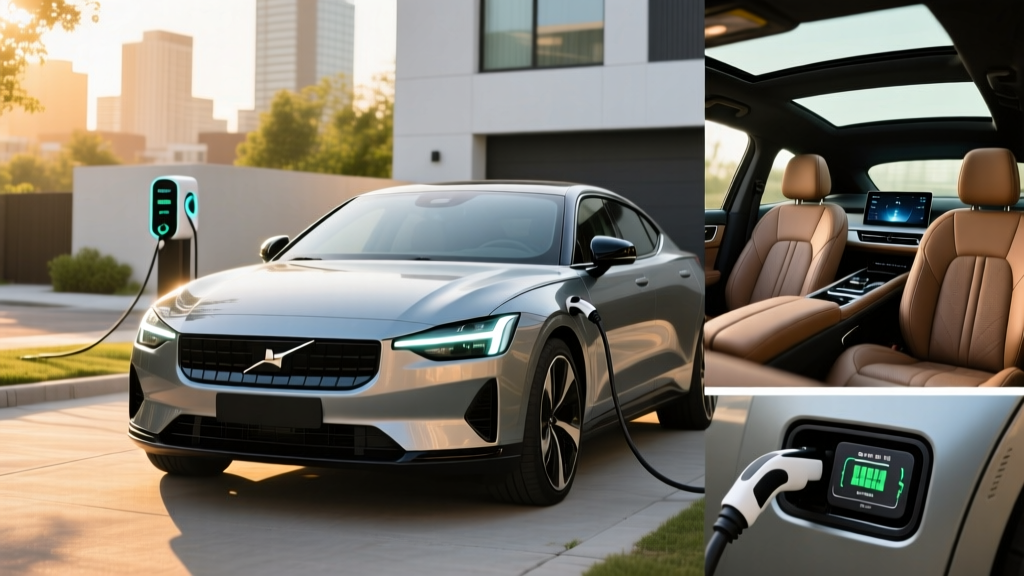
For home charging, the 11 kW onboard charger is competitive. A full overnight charge from 10% to 100% takes about 8 hours on a 48-amp Level 2 wallbox (like a ChargePoint Home Flex or Emporia Level 2). Polestar recommends preconditioning the battery via the app before DC fast charging — this warms the NMC cells to optimal temperature and can shave 5–8 minutes off your 10–80% time, particularly in cold weather.
Performance and Driving Dynamics
The Polestar 2's performance story depends heavily on which trim you choose. The Long Range Single Motor sends 299 horsepower to the rear wheels, achieving a 5.9-second 0–60 mph time. That's adequate for merging and passing but won't pin you to the seat.
The Long Range Dual Motor is where the Polestar 2 finds its personality: 421 hp, 4.3 seconds to 60, and standard all-wheel drive. The Performance Pack (available on the dual motor) adds Öhlins dual-valve dampers, Brembo 4-piston front brakes, and a software bump to 476 hp / 3.9 seconds to 60. These are legitimate upgrades — the Öhlins suspension transforms the car from compliant cruiser to genuinely engaging sport sedan on back roads.
One-pedal driving is available with adjustable regen levels, and the brake feel is among the best in the EV segment — firm, progressive, and without the mushy blending that plagues some competitors. The low center of gravity (battery pack under the floor) and 50/50-ish weight distribution make the Polestar 2 feel planted in corners, though it's heavier than a Model 3 at roughly 4,680 lbs for the dual motor variant.
Pricing, Trims, and Federal Tax Credit Eligibility
The 2026 Polestar 2 lineup starts at $49,900 for the Long Range Single Motor and tops out around $59,900 for the Dual Motor with Performance Pack (before destination and options). Here's the pricing breakdown and how the federal §30D tax credit factors in:
| Trim | Base MSRP | As-Tested (typical) | §30D Credit Eligibility |
|---|---|---|---|
| Long Range Single Motor | $49,900 | $52,000–$54,000 | Partial — depends on battery sourcing & buyer income |
| Long Range Dual Motor | $54,400 | $57,000–$60,000 | Partial — same caveats |
| LRDM w/ Performance Pack | $59,900 | $63,000–$66,000 | Eligible (under $55K sedan cap? No — sedan MSRP cap is $55,000) |
- MSRP cap: Sedans must be priced at or below $55,000 to qualify. The LR Single Motor ($49,900 base) clears this; the Dual Motor trims ($54,400+) may not once options are added.
- Income cap: Buyer AGI must not exceed $150,000 (single) / $300,000 (joint) / $225,000 (head of household).
- Battery sourcing: The credit is split into two halves ($3,750 each) — one for critical minerals sourcing and one for battery component manufacturing. Polestar (a Volvo/Geely brand) sources cells from LG Energy Solution and CATL depending on market; qualifying for the full $7,500 depends on current-year critical mineral and component requirements per IRS §30D guidelines.
- Point-of-sale transfer: As of 2024+, you can transfer the credit to the dealer at purchase, reducing your out-of-pocket cost immediately rather than waiting for tax filing.
Always verify current eligibility with a tax professional and the IRS before purchasing. Sourcing requirements tighten annually.
Realistically, the Long Range Single Motor at base MSRP is the most likely trim to qualify for at least a partial credit ($3,750). The full $7,500 is possible but depends on Polestar's supply chain compliance for the specific model year and build month. Check the fueleconomy.gov tax credit tracker for the latest VIN-level eligibility.
Interior, Cargo, and Daily Practicality
The Polestar 2 interior is where the Scandinavian design philosophy shows most clearly: minimalist, material-forward, and tech-integrated without being ostentatious. The 11.2-inch portrait touchscreen runs Polestar's Google Automotive OS — essentially full Google Maps, Google Assistant, and the Play Store built into the dash. It's responsive, familiar to any Android user, and includes native EV route planning with charging stops.
However, the fastback silhouette comes with trade-offs:
- Cargo volume: 14.4 cu ft behind the rear seats (liftback style, so opening is wide). That's less than a Model 3 trunk (19.8 cu ft) and far less than a crossover. A week's groceries for a family of four fits; a full Costco run gets tight.
- Rear legroom: 34.0 inches. Adequate for adults under 6 feet, but the sloping roofline cuts headroom noticeably. Tall passengers will feel the compromise vs. a Model 3 (35.3 in) or Ioniq 6 (35.0 in).
- Frunk: 1.4 cu ft — enough for charging cables and a small bag, not much more.
- Front seats: Firm, well-bolstered, and vegan textile standard (Nappa leather is a $4,000 option on Performance trims). Heated front seats and steering wheel are standard; ventilated seats require the Plus Pack.
The liftback hatch is genuinely useful for loading bulkier items compared to a traditional sedan trunk, and the 60/40 split rear seats fold nearly flat for longer cargo.
Driver Assistance, Tech, and Warranty
The Polestar 2 comes standard with Polestar's Pilot Pack: adaptive cruise control with stop-and-go, lane centering, blind-spot monitoring, rear cross-traffic alert, and a 360-degree camera (on Plus and Performance trims). This is a solid SAE Level 2 driver-assist system — it requires your hands on the wheel and eyes on the road at all times. It is not self-driving, and Polestar does not market it as such.
Compared to Tesla's Autopilot or GM's Super Cruise, Polestar's system is competent but conservative. Lane centering is reliable on well-marked highways, but it lacks the hands-free capability of Super Cruise or the assertive lane-change behavior of FSD Supervised. If advanced driver assist is a top priority, the Polestar 2 trails the segment leaders here.
Warranty coverage:
- Battery: 8 years / 100,000 miles (whichever comes first), with a capacity retention threshold of 70%. If your battery drops below 70% SoH within that window, Polestar covers repair or replacement.
- Powertrain: 4 years / 50,000 miles.
- Bumper-to-bumper: 4 years / 50,000 miles.
- Roadside assistance: 4 years / unlimited miles.
The 70% battery warranty threshold is standard for the industry (Tesla uses the same), but some competitors like Hyundai offer 10 years / 100,000 miles. If long-term battery longevity is a concern, note that NMC chemistry with conservative thermal management (the Polestar 2 uses liquid cooling) typically degrades 10–15% over 8 years / 100,000 miles in moderate climates based on industry fleet data.
Polestar 2 vs. Key Competitors
| Spec | Polestar 2 LR SM | Tesla Model 3 LR | BMW i4 eDrive40 | Hyundai Ioniq 6 SEL |
|---|---|---|---|---|
| EPA Range | 276 mi | 341 mi | 301 mi | 361 mi |
| Battery | 78 kWh NMC | ~75 kWh NMC | 81.5 kWh NMC | 77.4 kWh NMC |
| DC Fast Charge (peak) | 205 kW | 250 kW | 205 kW | 235 kW |
| 0-60 mph | 5.9 sec | 4.2 sec | 5.5 sec | 5.1 sec |
| Base MSRP | $49,900 | $47,740 | $57,900 | $42,750 |
| MPGe (combined) | 107 | 132 | 109 | 140 |
| Cargo | 14.4 cu ft | 19.8 cu ft | 16.6 cu ft | 12.3 cu ft |
Choose the Polestar 2 if: You prioritize design, build quality, and driving feel over maximum range. You want Google Automotive OS without relying on phone projection. You prefer a non-Tesla brand and value the liftback practicality. You'll mostly charge at home and take road trips 2–3 times per year.
Look elsewhere if: Range is your #1 priority (Ioniq 6 and Model 3 dominate). You need maximum rear-seat space for tall passengers. You want hands-free Level 2+ driving (GM Super Cruise or Ford BlueCruise). You're budget-conscious and want the lowest cost-per-mile of range (Ioniq 6 wins decisively).
Pros and Cons
- Premium Scandinavian design and interior materials
- Google Automotive OS is fast, intuitive, and EV-aware
- Engaging driving dynamics, especially with Öhlins Performance Pack
- Liftback cargo versatility uncommon in the sedan/fastback segment
- Strong brake feel with well-tuned regen blending
- Heat pump standard on Long Range trims
- Efficiency lags rivals (107 MPGe vs. 132–140 for Model 3/Ioniq 6)
- Real-world highway range drops to ~230 miles
- Rear headroom compromised by fastback roofline
- Driver assist is competent but not class-leading (no hands-free mode)
- Charging curve tapers hard above 60% SoC
- Tax credit eligibility uncertain for higher trims due to MSRP cap
Frequently Asked Questions
What is the real-world range of the 2026 Polestar 2?
The EPA rates the Long Range Single Motor at 276 miles, but real-world highway driving at 70–75 mph typically yields 230–250 miles. In freezing weather without preconditioning, expect 190–220 miles. City commuting with regen braking can match or slightly exceed the EPA number.
How fast does the Polestar 2 charge at home and on the road?
On a 48-amp Level 2 home charger, the Polestar 2 adds roughly 30 miles per hour and fully charges in about 8 hours. On a DC fast charger, it peaks at 205 kW and reaches 10–80% in approximately 27 minutes, though the sustained average is closer to 150 kW due to tapering above 60% SoC.
Does the Polestar 2 qualify for the $7,500 federal EV tax credit?
The Long Range Single Motor at $49,900 base MSRP falls under the $55,000 sedan cap, making it potentially eligible. However, qualification depends on battery critical-mineral sourcing, component manufacturing origin, and buyer income limits ($150K single / $300K joint). Many Polestar 2 builds qualify for at least $3,750 (half credit). Verify at IRS.gov before purchasing.
Is the Polestar 2 worth buying over a Tesla Model 3 or Hyundai Ioniq 6?
If you value design, build quality, and driving engagement over raw range and efficiency, yes. The Model 3 offers 65 more miles of EPA range and charges faster. The Ioniq 6 delivers 361 miles of range at a lower price. The Polestar 2 wins on interior materials, liftback practicality, and chassis feel — particularly with the Performance Pack.
What is the Polestar 2 battery warranty?
Polestar covers the battery for 8 years or 100,000 miles with a 70% capacity retention threshold. If state of health drops below 70% within that period, Polestar covers repair or replacement. The general powertrain warranty is 4 years / 50,000 miles.
Does the Polestar 2 have a NACS port for Tesla Superchargers?
Polestar began transitioning to NACS for 2025+ model years. For 2026, check your specific build — some vehicles ship with a native NACS port, while others include a CCS-to-NACS adapter. Either way, Tesla Supercharger network access is available. Confirm connector type with your dealer before delivery.