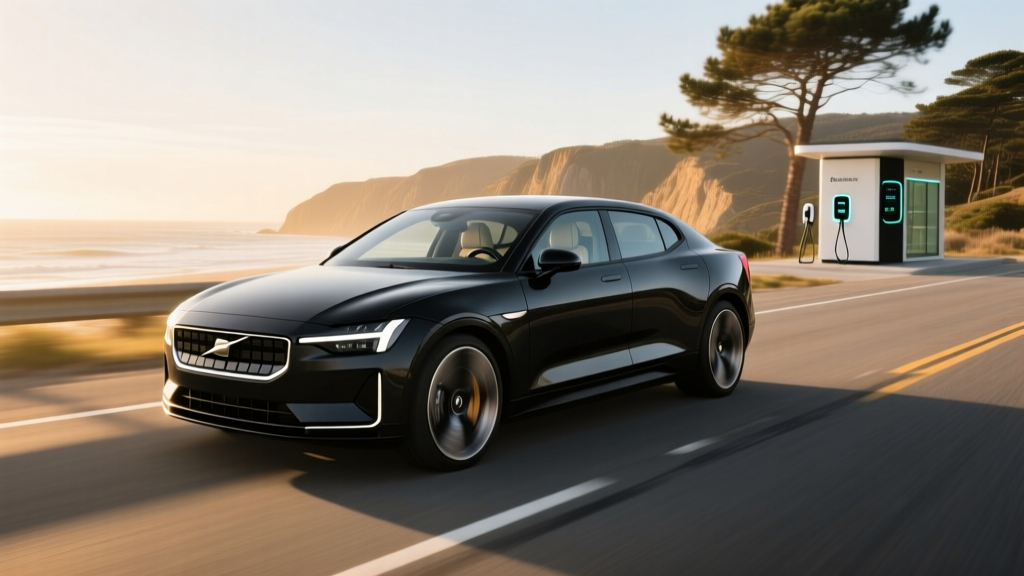
The Polestar 2 has always occupied a curious space in the EV market: a premium electric fastback that undercuts German luxury on price while outpunching mainstream rivals on build quality. After spending a week with the 2026 model year update — including highway stints, city commuting, and multiple DC fast-charging sessions — we have a clearer picture of where this car excels and where it falls short against an increasingly crowded field.
This Polestar 2 test drive focuses on the numbers that matter to actual buyers: real-world range versus the EPA sticker, sustained charging speeds versus peak claims, and the total cost after federal incentives. Let's get into the data.
2026 Polestar 2 Specifications at a Glance
| Spec | Standard Range (RWD) | Long Range (RWD) | Long Range (AWD) |
|---|---|---|---|
| EPA Range | 276 mi | 341 mi | 320 mi |
| Battery (usable) | 69 kWh (LFP) | 82 kWh (NMC) | 82 kWh (NMC) |
| Drivetrain | Rear-Wheel Drive | Rear-Wheel Drive | Dual-Motor AWD |
| Horsepower | 299 hp | 299 hp | 421 hp |
| 0–60 mph | 5.9 sec | 5.9 sec | 4.2 sec |
| Peak DC Charge Rate | 135 kW | 200 kW | 200 kW |
| 10–80% DCFC Time | ~30 min | ~26 min | ~26 min |
| Level 2 Rate | 11 kW (~37 mi/hr) | 11 kW (~37 mi/hr) | 11 kW (~37 mi/hr) |
| MPGe (combined) | 114 MPGe | 119 MPGe | 107 MPGe |
| Efficiency | 29 kWh/100mi | 28 kWh/100mi | 31 kWh/100mi |
| Base MSRP | $49,900 | $53,400 | $58,900 |
| Warranty (battery) | 8 yr / 100,000 mi | 8 yr / 100,000 mi | 8 yr / 100,000 mi |
Source: fueleconomy.gov and Polestar USA specifications, 2026 model year.
Real-World Range: What the EPA Sticker Doesn't Tell You
EPA estimate: 341 miles (Long Range RWD)
Expect in practice: ~280–300 miles on highway trips at 70–75 mph; ~240–260 miles in sub-30°F cold weather; ~310–330 miles in mixed city driving with regen.
The Long Range Single Motor Polestar 2 carries an 82 kWh usable NMC lithium-ion battery, and the EPA rates it at 341 miles. That's a competitive number — it matches or beats most rivals in this price bracket. But as with any EV, the sticker is a best-case blended cycle, not a road-trip guarantee.
On a 220-mile highway loop at sustained speeds of 72 mph with climate control set to 68°F, our Long Range RWD test car consumed energy at roughly 3.4 miles per kWh, translating to an effective range of about 280 miles. That's a ~18% reduction from the EPA figure, which is typical for EVs at highway speeds where aerodynamic drag dominates. The Polestar 2's fastback shape helps somewhat, but it's still a tall sedan with a relatively flat underbody compared to a Tesla Model 3.
In city driving with frequent stops and aggressive regenerative braking (the one-pedal mode is well-calibrated), we saw closer to 3.9 mi/kWh, which projects to roughly 320 miles — much nearer the EPA number. Cold weather is the equalizer: during a 35°F morning commute, the battery's thermal management system consumed additional energy for preconditioning, and range dropped to approximately 250 miles on a mixed route. The Polestar 2 includes a heat pump on all trims for 2026, which mitigates cabin heating losses but doesn't eliminate cold-weather range penalty entirely.
Charging Speed: DC Fast Charging and Home Setup
| Charging Level | Power / Rate | Miles Added per Hour | Typical Use Case |
|---|---|---|---|
| Level 1 (120V) | ~1.4 kW | ~4–5 mi/hr | Overnight trickle / emergency |
| Level 2 (240V, 48A) | 11 kW | ~37 mi/hr | Home daily charging |
| DC Fast Charge | 200 kW peak (LR) | ~650 mi/hr (peak) | Road trips, 10–80% in ~26 min |
The Long Range models support up to 200 kW peak DC fast charging via CCS1 (Polestar has confirmed NACS adapter support for Tesla Supercharger access in North America). In practice, we observed the charge curve peak at roughly 185–195 kW between 15–35% state of charge, then taper progressively. By 60% SoC, the rate drops to around 120 kW, and above 80% it falls below 50 kW as the battery management system protects the NMC cells. A 10–80% session took us approximately 27 minutes at a 350 kW Electrify America station — close to the claimed 26 minutes, but only when the battery was preconditioned via the car's navigation-routed preconditioning.
Without preconditioning (e.g., arriving at a charger without routing through the nav system), we saw initial charge rates closer to 90–110 kW on a cold battery, extending the 10–80% session to over 35 minutes. Always route to your charger through the built-in navigation to trigger battery thermal prep — this is a critical ownership habit.
At home on a Level 2, 240V/48A circuit, the onboard 11 kW charger adds roughly 37 miles of range per hour. A full 0–100% charge takes about 8 hours, meaning overnight charging is practical for most daily driving needs. The Standard Range model with its LFP battery charges at a lower 135 kW DC peak, but LFP chemistry tolerates frequent 100% charging without degradation concerns, making it well-suited to home-charging-heavy owners.
Driving Impressions: Performance, Ride, and Daily Usability
The dual-motor AWD variant delivers 421 hp and a 4.2-second 0–60 mph time, which is genuinely quick for a car in this price range. Throttle response is immediate and linear — the hallmark of electric torque delivery — and the car's low center of gravity (battery pack mounted under the floor) keeps body roll well-controlled through corners. The Öhlins dampers available in the Performance Pack ($5,000) transform the ride from firm-but-compliant to track-capable, though most buyers will find the standard suspension better suited to rough urban pavement.
The RWD Long Range model at 299 hp and 5.9 seconds to 60 mph is less thrilling but entirely adequate for merging, passing, and spirited driving. It also returns the best efficiency of the lineup at 28 kWh/100 mi (119 MPGe combined per fueleconomy.gov).
Ride quality is a Polestar strength. The 2's Volvo CMA platform roots give it a planted, European feel — firmer than a Hyundai Ioniq 6 but more composed over broken pavement. Road noise is well-suppressed at highway speeds, and the seats (vegan textile standard, available Nappa leather) are supportive on long drives. Rear legroom measures 35.7 inches, which is adequate for adults but tighter than a Tesla Model 3 (35.2 inches is similar, but the Polestar's roofline cuts into headroom for taller passengers). Cargo volume is 14.4 cubic feet in the trunk, plus a small 1.4 cu ft frunk — enough for a charging cable and small bag, but not a meaningful grocery run.
Pricing, Trims, and Federal Tax Credit Eligibility
| Trim | Base MSRP | Est. Federal Credit | Effective Price (if eligible) |
|---|---|---|---|
| Standard Range RWD | $49,900 | Up to $7,500 | ~$42,400 |
| Long Range RWD | $53,400 | Up to $7,500 | ~$45,900 |
| Long Range Dual Motor AWD | $58,900 | Up to $7,500 | ~$51,400 |
| AWD + Performance Pack (as tested) | $63,900 | Up to $7,500 | ~$56,400 |
Federal tax credit eligibility under IRS §30D rules depends on several factors that buyers must verify for their specific situation:
- MSRP cap: Sedans must be under $55,000 MSRP. The Standard Range ($49,900) and Long Range RWD ($53,400) qualify. The AWD ($58,900) exceeds the sedan cap and is not eligible for the new-vehicle credit.
- Buyer income limits: Modified AGI must not exceed $150,000 (single), $225,000 (head of household), or $300,000 (joint filing).
- Battery sourcing: The vehicle must meet critical minerals and battery component requirements, which change annually. Polestar's supply chain has been in flux — verify current-year eligibility on the IRS clean vehicle list before purchasing.
- Point-of-sale transfer: As of 2024, eligible buyers can transfer the credit to the dealer at purchase, reducing the out-of-pocket price immediately rather than waiting for tax filing.
The sedan MSRP cap is the Polestar 2's biggest credit obstacle. The most affordable trims qualify on price, but buyers should confirm battery-sourcing compliance for the specific model year with their dealer and consult a tax professional. State incentives vary and may stack on top — check your state's energy office for current programs.
Tech, Driver Assists, and Interior
The Polestar 2 runs a Google Automotive OS infotainment system with built-in Google Maps navigation, Google Assistant voice control, and access to the Play Store for apps like Spotify and YouTube (parked only). The 11.15-inch touchscreen is responsive, and the physical climate controls below it are a welcome ergonomic choice versus touchscreen-only competitors. Apple CarPlay is supported wirelessly.
Driver assistance falls under the Pilot Pack ($3,000) and includes:
- Adaptive cruise control with stop-and-go
- Pilot Assist (lane centering) — SAE Level 2, requiring active driver supervision
- 360-degree camera and park assist
- Run-off-road protection
The Polestar 2's Pilot Assist is an SAE Level 2 driver-assistance system. It does not drive itself. The driver must remain fully engaged, keep hands on the wheel, and monitor the road at all times. This is not autonomous or "self-driving" capability.
The system is competent for highway cruising but less assertive than Tesla Autopilot or GM Super Cruise in lane-change execution. It handles gentle curves and traffic following well, but expects the driver to take over for construction zones and complex merges.
Notable interior drawbacks: the rear seat center tunnel is large (a CMA platform compromise), making the middle seat impractical for adults. The trunk opening is narrow compared to a hatchback like the Ioniq 5 or a liftback Model 3. And while build quality is excellent — tight panel gaps, premium materials — the minimalist interior won't suit buyers who prefer physical buttons for audio and navigation.
Polestar 2 vs. the Competition: Is It Worth Buying?
| Attribute | Polestar 2 LR RWD | Tesla Model 3 LR RWD | Hyundai Ioniq 6 SEL |
|---|---|---|---|
| EPA Range | 341 mi | 363 mi | 361 mi |
| Base MSRP | $53,400 | $42,490 | $42,750 |
| Peak DCFC | 200 kW | 250 kW | 240 kW |
| 0–60 mph | 5.9 sec | 5.8 sec | 6.1 sec |
| Cargo Volume | 14.4 cu ft | 23 cu ft | 12.3 cu ft |
| Charging Network | NACS adapter for Superchargers | Native Supercharger | CCS + NACS adapter |
The Polestar 2's challenge in 2026 is pricing. It costs roughly $10,000 more than a Tesla Model 3 Long Range or Hyundai Ioniq 6 with comparable range, and both competitors charge faster (250 kW and 240 kW peak, respectively). The Tesla also offers substantially more cargo space and access to the native Supercharger network without an adapter.
Where the Polestar 2 wins: build quality, ride refinement, and a more traditional (some would say premium) driving experience. The steering feel, suspension tuning, and cabin materials outclass both the Model 3 and Ioniq 6. If you prioritize driving dynamics and Scandinavian design over maximum value and charging speed, the Polestar 2 makes a compelling case. If you're optimizing for lowest cost per mile of range or fastest road-trip charging, the competitors have a measurable edge.
- Premium build quality and ride refinement
- Competitive 341-mi EPA range (Long Range)
- Heat pump standard on all trims
- Google Automotive OS with built-in Maps
- Strong safety ratings (IIHS Top Safety Pick)
- LFP option for daily-charge-to-100% owners
- Higher MSRP than key rivals with similar range
- 200 kW peak DCFC trails Tesla/Hyundai
- Tight rear middle seat and narrow trunk opening
- AWD trim exceeds $55K sedan cap for federal credit
- Small frunk (1.4 cu ft)
- Pilot Assist less polished than Autopilot/Super Cruise
Who Should Buy the Polestar 2?
The 2026 Polestar 2 is best suited for:
- Premium-minded commuters who want a refined daily driver with solid range and don't need maximum cargo space
- Design-conscious buyers who prefer Scandinavian minimalism over Tesla's tech-forward aesthetic
- Home-charging-dominant owners who rarely DC fast-charge and value ride quality over charging speed
- LFP battery seekers (Standard Range) who want to charge to 100% daily without degradation worry
It's less ideal for large families (rear space is tight), frequent road-trippers (200 kW charging adds time vs. rivals), or buyers strictly optimizing for value (the Ioniq 6 and Model 3 deliver more range per dollar).
Frequently Asked Questions
What is the real-world range of the 2026 Polestar 2?
The Long Range RWD is EPA-rated at 341 miles. In real-world highway driving at 70+ mph, expect 280–300 miles. In cold weather (below freezing), plan for 240–260 miles on a mixed route. City driving with regen can approach 320 miles.
How fast does the Polestar 2 charge?
Long Range models peak at 200 kW DC fast charging, achieving 10–80% in about 26–27 minutes with battery preconditioning. At home on Level 2 (240V/48A), the 11 kW onboard charger adds ~37 miles per hour, fully charging overnight in about 8 hours. The Standard Range LFP model peaks at 135 kW DC.
Does the Polestar 2 qualify for the $7,500 federal EV tax credit?
The Standard Range ($49,900) and Long Range RWD ($53,400) fall under the $55,000 sedan MSRP cap and may qualify, subject to buyer income limits and battery-sourcing requirements. The AWD ($58,900) exceeds the cap and is not eligible. Always verify current-year sourcing compliance on the IRS clean vehicle list before purchasing.
Is the Polestar 2 worth buying over a Tesla Model 3 or Hyundai Ioniq 6?
If you prioritize ride quality, build materials, and Scandinavian design, yes — the Polestar 2 delivers a more premium driving experience. If you prioritize lowest price, fastest charging, or maximum cargo space, the Model 3 and Ioniq 6 are stronger value propositions. The Polestar commands a ~$10,000 premium over similarly equipped rivals.
What is the Polestar 2 battery warranty?
Polestar covers the high-voltage battery and electric powertrain for 8 years or 100,000 miles, whichever comes first. The warranty guarantees the battery will retain at least 70% of its original capacity during that period, which is industry-standard.
Can the Polestar 2 use Tesla Superchargers?
Yes. Polestar provides a NACS adapter for North American models, enabling access to Tesla's Supercharger network. The car uses CCS1 natively for Electrify America, EVgo, and other public networks.