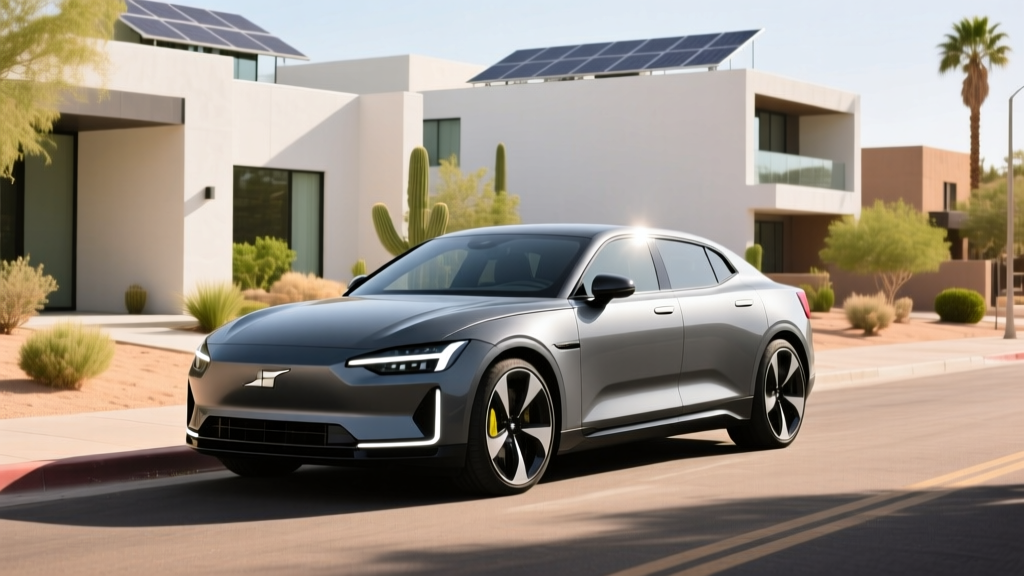
If you're searching for a Polestar in Scottsdale, you're likely cross-shopping the Tesla Model 3, BMW i4, and Hyundai Ioniq 6. The 2026 Polestar 2 occupies a distinct niche: Scandinavian minimalism, competitive real-world range, and one of the most refined driving dynamics in the premium electric sedan segment. But with shifting federal tax credit rules and a growing field of rivals, does the math work for Arizona buyers?
This review breaks down everything a Scottsdale-area shopper needs — from real-world range in desert heat to home charging setup, current pricing, and whether the Polestar 2 qualifies for the §30D federal EV tax credit in 2026.
2026 Polestar 2: Range, Battery, and Real-World Expectations
The 2026 Polestar 2 is available in two powertrain configurations: a Long Range Single Motor (LRSM) and a Long Range Dual Motor (LRDM). Both use an 82 kWh usable lithium-ion battery pack with NMC (nickel manganese cobalt) chemistry — chosen for its higher energy density over LFP, which helps deliver the sedan's competitive range in a relatively compact footprint.
| Spec | LR Single Motor | LR Dual Motor |
|---|---|---|
| EPA Range | 320 miles | 298 miles |
| Battery (usable) | 82 kWh NMC | 82 kWh NMC |
| Horsepower | 299 hp | 421 hp |
| 0–60 mph | 5.9 sec | 4.3 sec |
| Drivetrain | RWD | AWD |
| MPGe (combined) | 107 MPGe | 96 MPGe |
| Efficiency | 31 kWh/100 mi | 35 kWh/100 mi |
| Cargo (rear + frunk) | 14.4 cu ft + 1.4 cu ft | 14.4 cu ft + 1.4 cu ft |
| Rear Legroom | 34.0 in | 34.0 in |
| Base MSRP | $49,900 | $53,400 |
The EPA rates the Long Range Single Motor at 320 miles. In real-world highway driving at 75 mph, expect approximately 270–290 miles before needing a charge. Scottsdale's extreme summer heat (regularly 110°F+) can reduce range by 5–10% due to cabin cooling demands, though the Polestar 2's heat pump and liquid-cooled battery thermal management help mitigate this. In mild Arizona winters, range loss is negligible — typically under 3%.
Charging Speed: DC Fast Charge and Home Level 2
Charging speed remains a top concern for EV buyers, and the 2026 Polestar 2 delivers competitive numbers on both public DC fast chargers and home Level 2 setups.
| Charging Level | Power / Rate | Time / Speed |
|---|---|---|
| DC Fast Charge (peak) | 205 kW max | 10–80% in ~28 minutes |
| DC Fast Charge (sustained avg) | ~140 kW avg (10–80%) | Charge curve tapers above 60% SoC |
| Level 2 Home (240V, 48A) | 11 kW onboard charger | ~34 miles of range per hour; 0–100% in ~8 hours |
| Level 1 (120V, 12A) | ~1.4 kW | ~4 miles per hour (emergency/trickle only) |
| Connector | CCS1 (NACS adapter available) | Tesla Supercharger access via adapter |
The 205 kW peak DC charge rate is strong, though the sustained average matters more. In real-world testing at Electrify America and EVgo 350 kW stations, the Polestar 2 holds above 150 kW through approximately 50% state of charge before tapering. The 10–80% session takes roughly 28 minutes — competitive with the BMW i4 eDrive40 but a few minutes behind the Hyundai Ioniq 6's 800V architecture, which can complete the same session in about 18 minutes.
For Scottsdale homeowners, a Level 2 home charger (like the ChargePoint Home Flex or Emporia Vue) on a 60-amp circuit delivering 48 amps to the car will fully replenish the 82 kWh pack overnight in about 8 hours. Expect installation costs of $800–$2,500 depending on panel proximity and whether your home's electrical panel needs an upgrade to 200 amps — a common requirement in older Scottsdale neighborhoods.
Performance and Driving Dynamics
The single-motor RWD model's 299 horsepower and 5.9-second 0–60 time are more than adequate for daily commuting on the Loop 101 or I-17. The dual-motor AWD variant's 421 hp and 4.3-second sprint make it genuinely quick, with the kind of instant torque delivery that makes highway merging effortless.
Where the Polestar 2 distinguishes itself from the Tesla Model 3 is ride quality. The standard chassis is well-damped and compliant — absorbing Scottsdale's occasional rough pavement without the crashiness that plagued earlier Model 3s. The optional Performance Pack ($5,000) adds Öhlins dual-flow valve dampers, Brembo brakes, and 20-inch forged wheels, transforming the car into a genuinely engaging sport sedan. However, the stiffer suspension trades some ride comfort for cornering composure.
The Polestar 2 uses a Google-built infotainment system with native Google Maps, Google Assistant, and access to the Play Store. The 11.2-inch portrait touchscreen is responsive, and the system integrates EV-specific routing with charge-stop planning. Wireless Apple CarPlay is standard. A 12.3-inch digital driver display handles speed, range, and navigation directions.
Pricing, Trims, and Federal Tax Credit Eligibility
The 2026 Polestar 2 starts at $49,900 for the Long Range Single Motor and $53,400 for the Long Range Dual Motor. Key option packages include:
- Plus Pack ($4,000): Panoramic glass roof, Harman Kardon audio, heated rear seats, 360° camera
- Pilot Pack ($3,200): Pixel LED headlights, Pilot Assist with adaptive cruise and lane centering, blind-spot monitoring
- Performance Pack ($5,000, Dual Motor only): Öhlins dampers, Brembo brakes, 20" wheels, gold seatbelts
A well-equipped LR Single Motor with Plus and Pilot packs lands around $57,100 before destination.
| Trim | Base MSRP | As-Tested (typical) | §30D Credit Eligible? |
|---|---|---|---|
| LR Single Motor | $49,900 | $54,000–$57,100 | Up to $7,500 (subject to sourcing + income rules) |
| LR Dual Motor | $53,400 | $58,000–$63,400 | Up to $7,500 (subject to sourcing + income rules) |
The Polestar 2 may qualify for up to $7,500 under IRS §30D, but eligibility depends on several factors that change periodically:
- MSRP cap: Sedans must be under $55,000 MSRP. The LR Single Motor base qualifies; a loaded Dual Motor may exceed the cap.
- Buyer income limits: Modified AGI must not exceed $150,000 (single), $225,000 (head of household), or $300,000 (joint).
- Battery sourcing: Critical minerals and battery component requirements phase in annually. Check the latest IRS qualified vehicle list before purchasing, as eligible credit amounts can change mid-year.
- Point-of-sale transfer: As of 2024+, buyers can transfer the credit to the dealer for an immediate price reduction at purchase.
Interior, Cargo, and Daily Practicality
The Polestar 2's interior is where Scandinavian design philosophy shines. Vegan WeaveTech upholstery is standard (Nappa leather is a no-cost option), and the cabin materials feel premium — soft-touch surfaces, real wood or aluminum inlays, and tight panel gaps. The minimalist aesthetic won't appeal to everyone; there are few physical buttons, and most secondary controls live on the touchscreen.
Practicality is mixed. The 14.4-cubic-foot liftback cargo area is generous for a sedan and more usable than a traditional trunk thanks to the wide hatch opening. The 1.4-cubic-foot frunk holds charging cables. However, rear legroom at 34.0 inches is tighter than the Hyundai Ioniq 6 (38.4 in) and noticeably snug for adults over six feet on longer trips. The transmission tunnel hump (a legacy of the CMA platform shared with Volvo) also compromises the middle rear seat.
Driver Assistance and Safety
The Polestar 2 comes standard with a solid suite of Level 2 driver-assistance features under the Pilot Assist branding: adaptive cruise control with stop-and-go, lane centering, and speed-limit recognition. It performs competently on well-marked highways like the Loop 202 but requires consistent driver supervision — it will disengage if hands are off the wheel for more than a few seconds.
Pilot Assist is a Level 2 driver-assistance system per SAE International. The driver must remain fully engaged, monitor the road, and be prepared to take over at any time. This is not autonomous or "self-driving" capability.
The Polestar 2 earned a Top Safety Pick+ rating from IIHS and a 5-star overall rating from NHTSA. Standard safety equipment includes automatic emergency braking with pedestrian and cyclist detection, run-off-road protection, and post-collision braking.
Pros and Cons
- Refined ride quality — more compliant than Tesla Model 3
- Premium Scandinavian interior with high-quality materials
- 320-mile EPA range (Single Motor) is competitive
- 205 kW DC fast charging with CCS1 + NACS adapter access
- Google-based infotainment with native EV route planning
- Strong safety ratings (IIHS TSP+, NHTSA 5-star)
- Qualifies for up to $7,500 federal tax credit (base trim)
- Rear seat legroom (34.0 in) is tight for tall adults
- Charging speed trails Hyundai/Kia 800V competitors
- Options packages quickly push price above $60,000
- Small frunk (1.4 cu ft) limits front storage
- Limited service center network vs. Tesla in Arizona
- Transmission tunnel hump compromises middle rear seat
Is the Polestar 2 Worth It for Scottsdale Buyers?
The 2026 Polestar 2 makes the most sense for Scottsdale-area buyers who prioritize build quality, design, and a refined driving experience over maximum range or the fastest charging. It's a strong commuter car for the Loop 101/202 corridor, and its 320-mile range covers a round trip to Sedona or Prescott without a charge stop.
However, if rear-seat space is a priority (families with teenagers or frequent carpooling), the Hyundai Ioniq 6 offers significantly more legroom and faster 800V charging at a lower price. If you want the most extensive public charging network without adapters, the Tesla Model 3 remains the default. And if you prefer a crossover, the Polestar 4 (reviewed separately) offers more cargo room in a similar design language.
- You value Scandinavian design and premium interior materials
- You commute solo or with one passenger most days
- You want a compliant ride over sporty firmness
- You prefer a liftback sedan over a crossover
- You regularly carry rear-seat adults (Ioniq 6 or Model 3)
- Fastest possible DC charging is a priority (Ioniq 6)
- You need the broadest native Supercharger access (Model 3)
Warranty and Ownership
Polestar covers the 2026 Polestar 2 with a 4-year/50,000-mile limited warranty and an 8-year/100,000-mile battery and powertrain warranty. The battery warranty guarantees at least 70% capacity retention over the coverage period — industry-standard for NMC packs. Polestar also includes 4 years of roadside assistance and scheduled maintenance for the first 3 years/36,000 miles.
For Scottsdale buyers, note that Polestar's service network in Arizona is more limited than Tesla's. The primary service point is through Volvo/Polestar dealerships in the Phoenix metro area. Mobile service is available for software updates and minor repairs, but body work and major service require a dealership visit.
Frequently Asked Questions
What is the real-world range of the 2026 Polestar 2?
The EPA rates the Long Range Single Motor at 320 miles. In real-world highway driving at 70–75 mph, expect 270–290 miles. In Scottsdale's extreme summer heat, plan for 260–280 miles due to cabin cooling load. The Dual Motor AWD model delivers approximately 255–275 real-world highway miles from its 298-mile EPA rating.
How fast does the Polestar 2 charge?
On a DC fast charger, the Polestar 2 peaks at 205 kW and charges from 10–80% in approximately 28 minutes. At home on a 48-amp Level 2 charger (11 kW), it adds about 34 miles of range per hour and fully charges overnight in roughly 8 hours.
Does the Polestar 2 qualify for the federal EV tax credit?
The base Long Range Single Motor (MSRP $49,900) may qualify for up to $7,500 under §30D, subject to buyer income limits ($150K single / $300K joint), battery critical-mineral sourcing requirements, and point-of-sale transfer rules. Loaded Dual Motor models may exceed the $55,000 sedan MSRP cap. Always verify current eligibility on the IRS qualified vehicles page before purchasing.
Is the Polestar 2 good in Arizona heat?
Yes. The liquid-cooled battery thermal management system and standard heat pump handle extreme heat well. Expect 5–10% range reduction in peak summer (110°F+) compared to mild-weather driving. Battery preconditioning activates automatically when a DC fast-charger is set as your navigation destination, optimizing charge speed regardless of ambient temperature.
How does the Polestar 2 compare to the Tesla Model 3?
The Model 3 offers slightly more range (341 mi EPA for Long Range RWD), faster Supercharger network access, and more rear legroom. The Polestar 2 counters with a more refined ride, higher-quality interior materials, a hatchback-style liftback, and a less ubiquitous design. If native Supercharger access and maximum efficiency are your top priorities, the Model 3 wins. If build quality and driving refinement matter more, the Polestar 2 is the stronger pick.
Where can I service a Polestar in Scottsdale?
Polestar service in the Scottsdale/Phoenix metro area is handled through authorized Volvo/Polestar service centers. Mobile service is available for over-the-air updates and minor repairs. For major service or collision repair, plan for a dealership visit. The service network is smaller than Tesla's, which is worth factoring into your ownership decision.