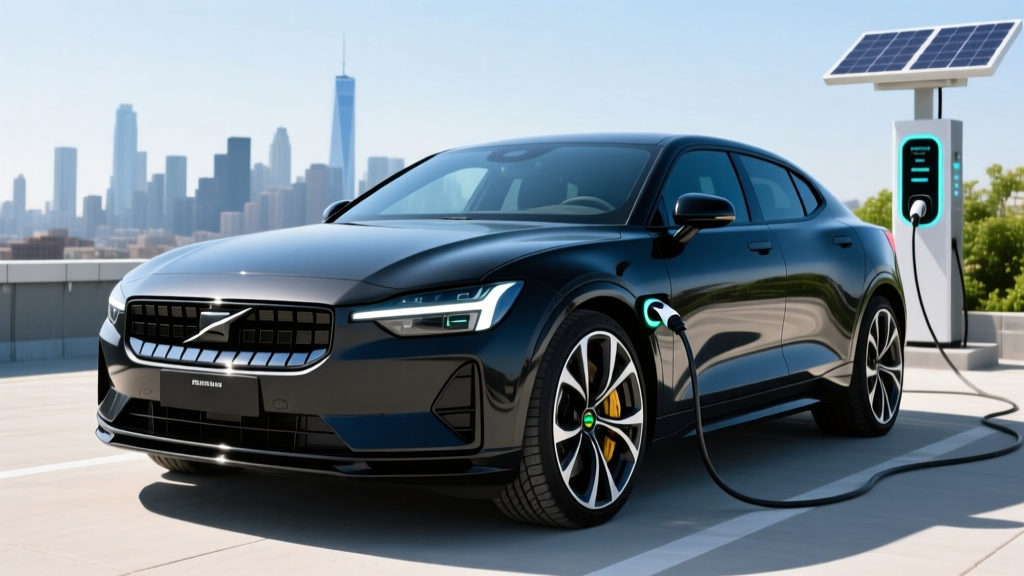
The Polestar 2 has always occupied a distinct lane in the premium EV sedan market: Scandinavian minimalism, Google-powered tech, and driving dynamics that punch above its price class. For 2026, the Polestar 2 Performance Pack variant sharpens that formula further, pairing a dual-motor all-wheel-drive powertrain with Öhlins dampers, Brembo brakes, and a software-unlocked output boost. But performance upgrades mean nothing if the fundamentals — range, charging speed, daily usability — don't hold up. We break down every spec that matters, from real-world highway range to IRS §30D tax credit eligibility, so you can decide whether this EV earns a spot in your garage.
2026 Polestar 2 Performance Pack: Core Specifications
| Specification | Value |
|---|---|
| Powertrain | Dual-motor AWD |
| Horsepower (w/ Performance Pack) | 476 hp |
| Torque | 502 lb-ft |
| 0–60 mph | 4.1 seconds |
| Battery (usable) | 79 kWh, NMC (nickel manganese cobalt) |
| EPA Range (Long Range Dual Motor w/ Perf. Pack) | 276 miles |
| EPA Efficiency | 92 MPGe combined / 36 kWh/100 mi |
| Max DC Fast Charge | 205 kW (peak) |
| 10–80% DC Charge Time | ~27 minutes |
| Level 2 Home Charge Rate | 11 kW onboard charger (~37 mi/hr) |
| Base MSRP (LRDM w/ Performance Pack) | ~$56,950 |
| Battery & Powertrain Warranty | 8 years / 100,000 miles |
The Performance Pack is an option on the Long Range Dual Motor trim. It adds the power upgrade (from the standard 421 hp to 476 hp), manually adjustable Öhlins Dual Flow dampers, 20-inch forged alloy wheels, Brembo 4-piston front calipers with gold accents, and Swedish gold seatbelts. It's a $5,500 add to the Long Range Dual Motor base, and it does reduce EPA range slightly compared to the non-Performance variant due to stickier tires and larger wheels.
Real-World Range: What the EPA Sticker Doesn't Tell You
Real-World Expectation: ~240–255 mi highway (70–75 mph); ~265–275 mi mixed city/suburban; ~210–230 mi in freezing temperatures (below 32°F) with cabin heating.
The 276-mile EPA figure for the Long Range Dual Motor with the Performance Pack is a reasonable baseline, but EPA tests include significant low-speed and city driving where regenerative braking recovers energy. On a sustained 75-mph highway run in moderate temperatures (60–75°F), expect to use roughly 340–360 Wh/mi, which translates to about 240–255 miles before the battery buffer kicks in.
Cold weather is the bigger variable. The Polestar 2 uses a liquid thermal management system and includes a heat pump (standard on 2025+ models), which mitigates some winter losses. Still, NMC chemistry loses efficiency in freezing conditions — plan on 210–230 miles of usable range at 20°F with the heater running. Preconditioning the battery while plugged in (via the Polestar app) is essential for preserving range and enabling optimal DC fast-charge speeds in cold weather.
According to fueleconomy.gov, the Long Range Dual Motor achieves 92 MPGe combined. In our experience, mixed driving in temperate conditions yields around 33–36 kWh/100 mi, consistent with that rating. If you live in a mild climate and commute at moderate speeds, hitting the EPA number is realistic. Road-trippers and cold-climate owners should budget conservatively.
Charging Speed: DC Fast, Level 2, and the Charge Curve Reality
| Charging Level | Power / Rate | Speed |
|---|---|---|
| Level 1 (120V household) | ~1.4 kW | ~4–5 miles per hour |
| Level 2 (240V home, 48A circuit) | 11 kW (onboard max) | ~37 miles per hour |
| DC Fast Charge (peak) | 205 kW | 10–80% in ~27 min |
The 2026 Polestar 2 Long Range Dual Motor peaks at 205 kW on a capable DC fast charger (350 kW Electrify America or equivalent). Here's what that actually looks like in practice: the car sustains roughly 190–205 kW from about 10% to 35% state of charge, then tapers to ~150 kW through 55%, and drops further to ~80–90 kW approaching 80%. The 10–80% time of approximately 27 minutes is competitive with rivals like the BMW i4 xDrive40 but trails the Hyundai Ioniq 6's blistering 18-minute 10–80% window on its 800V architecture.
For home charging, the 11 kW onboard charger is a strong point. On a 48-amp Level 2 circuit (hardwired Wallbox, ChargePoint Home Flex, or Tesla Universal Wall Connector with the J1772 adapter), a full 10–100% charge takes roughly 7.5 hours — easily an overnight session. A standard 32-amp Level 2 setup (7.7 kW) extends that to about 10.5 hours. Most owners charging nightly from 30% to 80% will see a full replenishment in 3–4 hours.
The Polestar 2 uses the CCS1 connector natively. With the industry's shift toward NACS (Tesla's connector), Polestar has confirmed that 2025+ models include a NACS charge port option or a CCS-to-NACS adapter for Supercharger access. Verify with your dealer at purchase, as this is critical for road-trip charging network coverage.
Performance and Driving Dynamics
The Performance Pack's headline number is 476 hp and 502 lb-ft of torque, delivered through dual permanent-magnet motors (one front, one rear). The 0–60 mph sprint takes 4.1 seconds — quick enough to merge aggressively and overtake without drama, though a Tesla Model 3 Long Range AWD (4.2 seconds) and BMW i4 M50 (3.7 seconds) bracket it closely.
Where the Performance Pack genuinely differentiates itself is in the chassis hardware. The Öhlins Dual Flow dampers are manually adjustable (22 positions front and rear) and offer a compliance-and-control balance that most electronically controlled adaptive dampers can't match. Set them soft, and the Polestar 2 absorbs highway expansion joints with a solidity that belies its 4,680-lb curb weight. Stiffen them for canyon roads, and body roll is minimal with sharp turn-in from the 20-inch Continental SportContact tires.
The Brembo 4-piston front brakes provide confident, fade-free stopping power, and the gold calipers add visual distinction. Regenerative braking offers adjustable levels (off, low, high) through the infotainment system, though the Polestar 2 does not offer true one-pedal driving to a complete stop — you'll still need the friction brakes at very low speeds.
Interior, Cargo, and Daily Usability
The Polestar 2's cabin is a study in Scandinavian restraint. The 11.2-inch portrait-oriented touchscreen runs Android Automotive OS with Google Maps, Google Assistant, and the Play Store built in — no phone mirroring required for navigation or voice commands. The 12.3-inch digital driver display is clean and configurable. Wireless Apple CarPlay is available for those who prefer it.
Practicality is where the sedan form factor imposes limits:
- Rear legroom: 33.4 inches — adequate for adults on shorter trips, tight for anyone over 6 feet on long drives
- Cargo (rear seats up): 14.4 cu ft (liftback design makes loading easier than a traditional trunk)
- Cargo (rear seats folded): 38.7 cu ft
- Frunk (front trunk): 1.4 cu ft — enough for charging cables, not much else
The liftback-style hatch is a genuine advantage over competitors with conventional sedan trunks (the BMW i4, for instance). The opening is wide, and the load floor is flat with the seats folded. However, compared to a Tesla Model 3 (which offers 23 cu ft rear cargo with seats folded) or any compact electric SUV, the Polestar 2 is a compromise for families needing stroller or gear space.
Standard driver-assistance features include adaptive cruise control, lane-keeping assist, blind-spot monitoring with rear cross-traffic alert, and a 360-degree camera. The Pilot Pack (optional, ~$3,200) adds Pilot Assist — a Level 2 SAE system combining adaptive cruise and lane centering on highways. It works well on well-marked interstates but requires hands-on-wheel supervision at all times. This is not a self-driving system.
Pricing, Trims, and Federal Tax Credit Eligibility
| Trim / Configuration | MSRP (2026) |
|---|---|
| Long Range Single Motor | ~$49,950 |
| Long Range Dual Motor | ~$52,950 |
| Long Range Dual Motor + Performance Pack | ~$56,950 |
| As-tested (Perf. Pack + Plus & Pilot Packs) | ~$63,000–$65,000 |
The Performance Pack is a $5,500 option on the Long Range Dual Motor trim. Most buyers also add the Plus Pack (~$3,500, adding a panoramic roof, Harman Kardon audio, heated rear seats, and a heat pump) and the Pilot Pack (~$3,200). A well-equipped example easily reaches $63,000–$65,000 before incentives.
- The Polestar 2 is assembled in China (Luqiao plant), which disqualifies it from the full $7,500 new EV credit under current battery-sourcing and final-assembly requirements.
- It may qualify for a partial credit or no credit depending on the specific battery-component and critical-mineral sourcing percentages for the model year. Check the latest fueleconomy.gov tax credit listings and IRS §30D guidance before purchasing.
- MSRP cap for sedans: $55,000. The Long Range Dual Motor with Performance Pack exceeds this cap at ~$56,950 MSRP, which is a separate disqualifying factor for the new-vehicle credit.
- Buyer income caps apply: Modified AGI ≤ $150,000 (single), $225,000 (head of household), $300,000 (joint).
- The used EV credit (up to $4,000 or 30% of sale price, whichever is lower) may apply if you purchase a qualifying pre-owned Polestar 2 at $25,000 or below from a dealer — a scenario that becomes realistic on 2023–2024 models by late 2026.
This is a critical consideration: the Polestar 2's assembly location and MSRP create real obstacles for federal credit eligibility. Competitors like the Tesla Model 3 (assembled in Fremont, CA) and certain Hyundai/Kia models (assembled in Georgia) have clearer paths to the full $7,500 credit. Factor this into your total cost comparison.
Polestar 2 Performance Pack vs. Key Competitors
| Spec | Polestar 2 Perf. Pack | Tesla Model 3 LR AWD | BMW i4 M50 | Hyundai Ioniq 6 Limited AWD |
|---|---|---|---|---|
| EPA Range | 276 mi | 341 mi | 269 mi | 270 mi |
| 0–60 mph | 4.1 sec | 4.2 sec | 3.7 sec | 5.1 sec |
| Horsepower | 476 hp | 346 hp | 536 hp | 320 hp |
| Peak DC Charge | 205 kW | 250 kW | 205 kW | 240 kW (800V) |
| 10–80% Time | ~27 min | ~25 min | ~31 min | ~18 min |
| MSRP (comparable trim) | ~$56,950 | ~$47,740 | ~$69,900 | ~$52,600 |
| Federal Credit Likely? | Unlikely (MSRP cap + assembly) | Yes ($7,500) | No (MSRP cap + assembly) | Possible (varies by sourcing) |
The Polestar 2 Performance Pack occupies a narrow niche. It can't match the Tesla Model 3 on range or price, and the BMW i4 M50 is quicker and more luxurious (but significantly more expensive). The Hyundai Ioniq 6 charges far faster and costs less, though it lacks the Polestar's chassis sophistication.
The Polestar's advantage is driving feel. If you value a sedan that communicates through the steering wheel, brakes with authority, and absorbs rough pavement with composure, the Öhlins-equipped Polestar 2 is in a class of its own at this price. If range, charging speed, or tax credit maximization are your top priorities, the Model 3 or Ioniq 6 make stronger financial cases.
Pros and Cons
✓ Pros
- Öhlins dampers and Brembo brakes deliver class-leading ride and handling balance
- 476 hp and 4.1-sec 0–60 provide effortless acceleration
- Android Automotive OS with native Google Maps is responsive and well-integrated
- 11 kW onboard charger enables fast Level 2 home charging
- Liftback hatch offers better cargo access than conventional sedans
- Distinctive Scandinavian design inside and out
- 8-year / 100,000-mile battery and powertrain warranty
✗ Cons
- 276-mile EPA range trails key rivals; real-world highway range ~240–255 mi
- 205 kW peak DC charging is adequate but not class-leading
- Unlikely to qualify for $7,500 federal tax credit (MSRP cap + China assembly)
- Rear seat legroom (33.4 in) is tight for tall passengers
- No true one-pedal driving to a full stop
- Frunk is tiny (1.4 cu ft) — barely fits cables
- Pilot Assist (Level 2) is competent but unremarkable vs. Tesla Autopilot or GM Super Cruise
Who Should Buy the Polestar 2 Performance Pack?
The 2026 Polestar 2 with the Performance Pack is best suited for:
- Enthusiast commuters who prioritize driving dynamics over maximum range and want a sedan that's genuinely engaging on back roads
- Design-conscious buyers who want something distinctive in a sea of Tesla Model 3s and generic crossovers
- Home chargers with reliable Level 2 access who can top up overnight and don't depend on public fast-charging for daily use
- Couples or small households without frequent rear-seat passengers or large cargo needs
It's a less ideal fit for:
- High-mileage road-trippers who need 300+ miles of real-world range and the fastest possible DC charging
- Families with children who need generous rear-seat space and cargo room
- Tax-credit maximizers who want the full $7,500 federal incentive to offset purchase price
- Towing users — the Polestar 2 is not rated for towing
Frequently Asked Questions
What is the real-world range of the Polestar 2 Performance Pack?
The EPA rates it at 276 miles, but expect roughly 240–255 miles on sustained highway driving at 70–75 mph in moderate temperatures, and 210–230 miles in freezing conditions. City and suburban driving with regenerative braking recovers more energy, allowing you to approach the EPA figure.
How fast does the Polestar 2 charge at home and on DC fast chargers?
On a 205 kW DC fast charger, the 10–80% charge takes approximately 27 minutes with a tapering charge curve above 55% SoC. At home on a 48-amp Level 2 circuit (11 kW), you'll add roughly 37 miles of range per hour, and a full charge takes about 7.5 hours.
Does the 2026 Polestar 2 qualify for the federal EV tax credit?
Likely not for the Performance Pack variant. The $56,950 MSRP exceeds the $55,000 sedan cap under IRS §30D, and the vehicle is assembled in China, which affects final-assembly eligibility. Always verify current eligibility on fueleconomy.gov and consult a tax professional, as battery-sourcing rules evolve.
Is the Polestar 2 Performance Pack worth it over a Tesla Model 3?
If driving dynamics, build quality, and distinctive design matter more to you than maximum range, charging speed, and price, yes. The Model 3 Long Range AWD offers 341 miles of range, faster charging, a lower price (~$47,740), and a clear path to the $7,500 tax credit. The Polestar 2 counters with a far superior chassis (Öhlins dampers, Brembo brakes), a more premium interior, and a less ubiquitous design. It's a values choice, not a spreadsheet choice.
What is the battery warranty on the Polestar 2?
Polestar covers the high-voltage battery and electric powertrain for 8 years or 100,000 miles, whichever comes first. The warranty guarantees that the battery will retain at least 70% of its original capacity during that period — consistent with industry norms from BMW, Hyundai, and Tesla.
Does the Polestar 2 have one-pedal driving?
Not quite. The regenerative braking system offers adjustable levels (off, low, high), and the high setting provides strong deceleration for most situations. However, the car will creep at very low speeds rather than holding completely stationary, so you'll need to use the friction brake pedal for full stops.