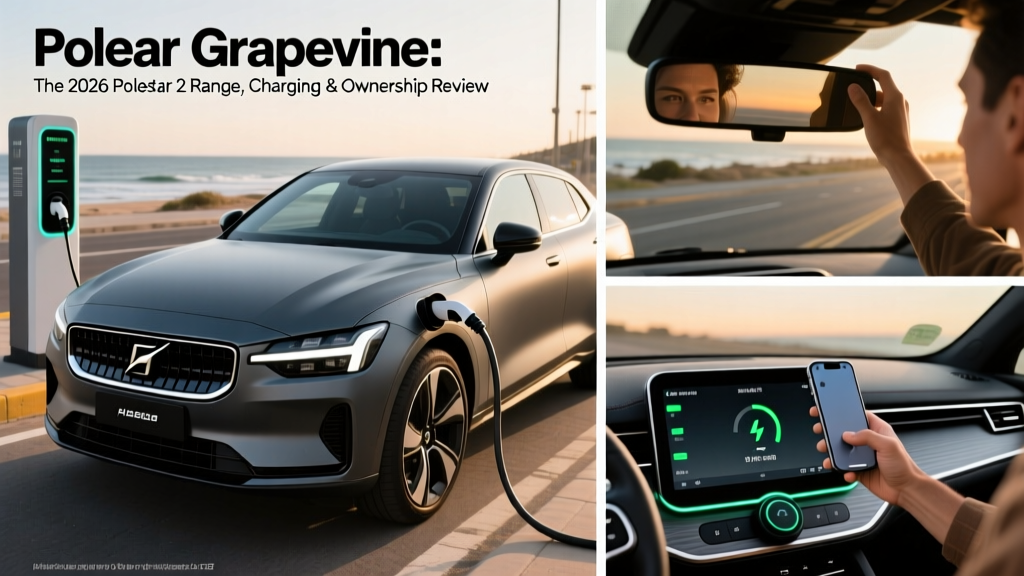
Quick Verdict: What the Polestar Grapevine Gets Right (and Wrong)
If you've been tracking the Polestar grapevine for updates on the 2026 Polestar 2, the headline is this: Volvo's performance-oriented EV brand has refined its core sedan into one of the most honest luxury EVs on the market. It won't win a range war against the Tesla Model 3 or Hyundai Ioniq 6, but it delivers Scandinavian design integrity, a genuinely engaging chassis, and a refreshingly transparent ownership experience — no hidden subscription paywalls for basic features.
For 2026, the Polestar 2 continues with the updated 82 kWh (79 kWh usable) NMC battery pack introduced for MY2024, rear-wheel-drive and dual-motor all-wheel-drive configurations, and a peak DC fast-charge rate of 205 kW. The starting MSRP sits at $49,900 for the Standard Range Single Motor, while the Long Range Dual Motor with the Performance Pack climbs to approximately $63,900 before incentives.
But numbers alone don't tell the full story. Let's break down what matters for real buyers: actual highway range, charging-curve behavior, federal tax credit eligibility under current IRS §30D rules, and whether this car makes sense versus the Model 3, BMW i4, and Hyundai Ioniq 6.
2026 Polestar 2: Full Specifications at a Glance
| Specification | Standard Range SM | Long Range SM (RWD) | Long Range DM (AWD) |
|---|---|---|---|
| Base MSRP | $49,900 | $53,400 | $58,400 |
| Battery (usable / gross) | 69 kWh / 72 kWh | 79 kWh / 82 kWh | 79 kWh / 82 kWh |
| Chemistry | NMC | NMC | NMC |
| EPA Range | 276 mi | 320 mi | 276 mi |
| MPGe (combined) | 107 MPGe | 111 MPGe | 96 MPGe |
| Efficiency | 31 kWh/100 mi | 30 kWh/100 mi | 35 kWh/100 mi |
| Horsepower | 299 hp | 299 hp | 421 hp (w/ Perf. Pack: 476 hp) |
| 0–60 mph | 5.9 sec | 5.9 sec | 4.3 sec (Perf. Pack: 3.9 sec) |
| Drivetrain | RWD | RWD | AWD (dual-motor) |
| Peak DC Fast Charge | 175 kW | 205 kW | 205 kW |
| 10–80% DC Time | ~28 min | ~26 min | ~26 min |
| Level 2 Home Charging | 11 kW (~33 mi/hr) | 11 kW (~37 mi/hr) | 11 kW (~33 mi/hr) |
| Battery Warranty | 8 years / 100,000 miles (70% capacity retention) | ||
| Vehicle Warranty | 4 years / 50,000 miles | ||
Sources: EPA fueleconomy.gov, Polestar US specifications.
Range and Efficiency: EPA Numbers vs. Real-World Reality
EPA Sticker: 320 miles
Expect on the highway (70–75 mph): ~255–275 miles
Expect in cold weather (below 30°F): ~220–250 miles
City/regenerative driving: Can approach or match EPA estimate
The 320-mile EPA figure on the Long Range Single Motor is respectable for the luxury EV sedan segment, trailing the Tesla Model 3 Long Range (~341 mi) and Hyundai Ioniq 6 SEL (~361 mi) but ahead of the BMW i4 eDrive40 (~301 mi). However, as with any EV, the EPA test cycle includes generous low-speed and regenerative-braking assumptions that don't always match sustained highway driving.
In real-world highway testing at 70–75 mph in moderate temperatures (60–80°F), the Long Range Single Motor typically delivers 255–275 miles before reaching a 10% state of charge. The dual-motor AWD variant, with its higher energy consumption (35 kWh/100 mi vs. 30 kWh/100 mi), sees real-world highway range closer to 220–240 miles from its 276-mile EPA rating.
Cold weather is the great equalizer. The Polestar 2 uses a liquid thermal management system with a heat pump (standard on Long Range trims), which mitigates some winter losses. But at sustained sub-30°F temperatures, expect a 20–30% range reduction from the EPA figure. That puts the Long Range RWD at roughly 220–250 miles and the AWD at around 190–215 miles. If you live in the upper Midwest or Northeast and regularly drive more than 180 miles one-way in winter, plan your charging stops accordingly.
Efficiency-wise, the Long Range RWD's 111 MPGe combined (30 kWh/100 mi) is solid for a 4,400-lb luxury sedan, though the Hyundai Ioniq 6's more aerodynamic profile delivers 140 MPGe combined. The Polestar's bluff-front design and higher ride height prioritize presence and ground clearance over slipperiness.
Charging: Speeds, Curve Behavior, and Home Setup
| Charging Level | Power / Connector | Speed (miles of range per hour) | Notes |
|---|---|---|---|
| Level 1 (120V) | ~1.4 kW / J1772 | ~4–5 mi/hr | Emergency/trickle only; ~65 hrs for full charge |
| Level 2 (240V) | 11 kW / J1772 (NACS adapter available) | ~33–37 mi/hr | ~8–9 hrs for 10–100%; ideal overnight |
| DC Fast Charge | 205 kW peak / CCS (NACS adapter) | ~150–650 mi/hr (varies by SoC) | 10–80% in ~26 min; tapers sharply above 80% |
The Polestar 2's 205 kW peak DC fast-charge rate (on Long Range trims) places it in the competent-but-not-class-leading tier. For context, the Hyundai Ioniq 6 peaks at 240 kW via its 800V architecture, while the Tesla Model 3 can sustain up to 250 kW on V3 Superchargers.
Here's what matters more than peak kW: the charging curve. The Polestar 2 holds strong power from 10% to roughly 55% state of charge, then begins a gradual taper. From 55–80%, you'll see sustained rates in the 80–120 kW range. Above 80%, charge speed drops significantly — to around 40–50 kW — as the battery management system protects cell longevity. This means that 10–80% run takes approximately 26 minutes at a capable 200+ kW station, but a 10–100% session could stretch to 45–50 minutes. Practical advice: charge to 80% and go.
For home charging, the 11 kW onboard charger is a strong point. On a 48-amp Level 2 circuit (requiring a 60-amp breaker), you'll add roughly 33–37 miles of range per hour, meaning an overnight session easily replenishes a full day's driving. Most owners will install a ChargePoint Home Flex, Emporia V2, or the Polestar-branded Wall Connector (rebuilt by a partner) for $500–$700 in equipment plus $800–$2,000 in electrician labor, depending on panel proximity and local permit costs.
Connector note: The 2026 Polestar 2 ships with a CCS1 inlet. Polestar offers a NACS (Tesla Supercharger) adapter, which is essential if you want access to Tesla's Supercharger network — now open to non-Tesla EVs via adapter. Confirm adapter availability and firmware compatibility at delivery, as supply has occasionally lagged demand.
Performance and Driving Dynamics
The Polestar 2's driving character is where the Volvo/Polestar engineering DNA shows most clearly. The single-motor RWD models produce 299 hp and hit 0–60 mph in 5.9 seconds — quick enough for confident highway merging but not neck-snapping. The steering is well-weighted, the chassis is taut without being harsh, and the low center of gravity (battery pack mounted under the floor) gives it a planted, almost sport-sedan feel through corners.
The dual-motor AWD variant is the enthusiast pick. With 421 hp standard (or 476 hp with the $5,000 Performance Pack, which also adds Öhlins dampers, Brembo brakes, and forged 20-inch wheels), it dispatches 0–60 in 4.3 seconds (3.9 with the Performance Pack). The Öhlins dual-flow valve dampers are a genuine differentiator in this price range — they offer 22-position manual adjustability and transform the car's character from grand-touring to track-capable.
Regenerative braking offers adjustable levels via the touchscreen, including a one-pedal driving mode that brings the car to a complete stop. It's not as aggressive as Nissan's e-Pedal or Chevrolet's one-pedal system, but it's predictable and easy to modulate.
Interior, Technology, and Cargo Space
The cabin is where the Polestar 2 either wins you over or reveals its compromises, depending on your priorities.
Infotainment: The 11.2-inch portrait touchscreen runs a Google Automotive OS–based system with native Google Maps, Google Assistant, and access to the Play Store for apps like Spotify and Waze. Wireless Apple CarPlay is supported. The interface is clean and responsive, though some climate and vehicle settings require more menu-diving than physical buttons would allow. A 12.3-inch digital driver display handles speed, range, and navigation.
Driver Assistance: The Polestar 2 comes standard with Pilot Pack features including adaptive cruise control, lane-centering assist, blind-spot monitoring, and rear cross-traffic alert. This is an SAE Level 2 system — it provides steering and speed assistance but requires continuous driver supervision. It is not autonomous driving. The system is competent for highway cruising but doesn't match the hands-free confidence of GM's Super Cruise or Ford's BlueCruise on compatible roads.
Dimensions and Space:
- Front headroom: 40.2 in | Rear headroom: 37.0 in
- Front legroom: 42.2 in | Rear legroom: 33.4 in
- Cargo volume (rear seats up): 14.4 cu ft
- Cargo volume (rear seats folded): 36.7 cu ft
- Frunk (front trunk): 1.4 cu ft — enough for a charging cable bag, not much more
The 33.4-inch rear legroom is the Polestar 2's most-cited drawback. It's tighter than the Tesla Model 3 (35.2 in) and significantly tighter than the Hyundai Ioniq 6 (38.4 in). Tall passengers on longer trips will notice. The cargo area is hatchback-style (a liftback, technically), which gives excellent access, but the 14.4 cu ft figure trails most competitors. If you regularly carry rear-seat passengers or bulky cargo, test-fit your life into this car before committing.
Notable tech highlights: Polestar's Over-the-Air (OTA) update system has been reliable, adding features and refining performance post-purchase. The We-Vegan upholstery (a synthetic textile) is standard and durable, though a Nappa leather option is available on higher trims. The optional Bowers & Wilkins audio system and panoramic glass roof (with an electrochromic dimming function on Plus Pack models) are well-executed upgrades.
Pricing, Tax Credits, and Total Cost of Ownership
| Trim | Base MSRP | As-Tested (typical options) | §30D Federal Credit (est.) | Effective Price (est.) |
|---|---|---|---|---|
| Standard Range Single Motor | $49,900 | $52,000 | Up to $7,500* | ~$44,500 |
| Long Range Single Motor | $53,400 | $57,500 | Up to $7,500* | ~$50,000 |
| Long Range Dual Motor | $58,400 | $63,900 (w/ Perf. Pack) | Up to $7,500* | ~$56,400 |
*Critical tax credit caveats: The IRS §30D Clean Vehicle Credit offers up to $7,500 for qualifying new EVs, but eligibility hinges on several requirements that change and must be verified at purchase:
- MSRP cap: Sedans must be at or below $55,000 MSRP. The Standard Range SM ($49,900) and Long Range SM ($53,400) qualify. The Long Range DM ($58,400) exceeds the sedan cap and does not qualify unless reclassified as an SUV by the IRS (Polestar has petitioned for this — verify current status at irs.gov).
- Buyer income cap: Adjusted gross income must not exceed $150,000 (single) / $300,000 (joint).
- Battery sourcing: Critical minerals and battery components must meet phased-in percentage thresholds from US or FTA-partner nations. These thresholds tighten annually.
- Point-of-sale transfer: As of 2024, you can transfer the credit to the dealer at purchase, reducing your out-of-pocket cost immediately rather than waiting for tax filing.
Always confirm eligibility with your tax professional and check the IRS qualified vehicle list at the time of purchase. Rules have shifted multiple times since 2023.
Purchase (after credit): ~$50,000
Electricity (home charging, $0.14/kWh avg): ~$3,750
Insurance (avg): ~$9,500
Maintenance (tires, cabin filter, fluid top-offs): ~$1,800
Estimated depreciation (5 yr): ~$18,000
Approximate 5-year total: ~$83,050 (varies significantly by state, driving pattern, electricity rate)
How the Polestar 2 Compares to Key Rivals
| Attribute | Polestar 2 LR SM | Tesla Model 3 LR | BMW i4 eDrive40 | Hyundai Ioniq 6 SEL |
|---|---|---|---|---|
| Base MSRP | $53,400 | $47,740 | $57,900 | $42,450 |
| EPA Range | 320 mi | 341 mi | 301 mi | 361 mi |
| Peak DC Charge | 205 kW | 250 kW | 205 kW | 240 kW |
| 10–80% Time | ~26 min | ~22 min | ~28 min | ~18 min |
| 0–60 mph | 5.9 sec | 4.2 sec | 5.5 sec | 5.1 sec |
| Rear Legroom | 33.4 in | 35.2 in | 34.7 in | 38.4 in |
| Cargo (seats up) | 14.4 cu ft | 23 cu ft | 16.6 cu ft | 12.3 cu ft |
| Battery Warranty | 8yr/100k mi | 8yr/120k mi | 8yr/100k mi | 10yr/100k mi |
- Premium build quality and Scandinavian design
- Engaging chassis; Öhlins option is class-leading
- Google Automotive infotainment is intuitive
- Transparent pricing; no surprise subscription walls
- Strong 11 kW Level 2 onboard charger
- Hatchback/liftback utility
- Cramped rear seat (33.4 in legroom)
- Below-average DC charge speed vs. Ioniq 6, Model 3
- Limited cargo volume for a liftback (14.4 cu ft)
- Dual Motor likely exceeds §30D MSRP cap
- Frunk is nearly useless (1.4 cu ft)
- Driver assist competent but not class-leading
Who Should Buy the 2026 Polestar 2?
Choose the Polestar 2 if:
- You value design, build quality, and chassis dynamics over maximum range
- You primarily commute solo or with one passenger (rear seat is secondary)
- You want a luxury EV that doesn't look or feel like every other tech-forward sedan
- You prefer Google Automotive's native integration over phone-mirroring systems
- You'll do most charging at home and take occasional road trips under 250 miles
- You regularly carry adults in the rear seat (check the Ioniq 6 or Model 3)
- Maximum range and fastest DC charging are your top priorities (Ioniq 6 wins both)
- You need maximum cargo space (Model 3's trunk is significantly larger)
- You want hands-free highway driving (GM Super Cruise or Ford BlueCruise vehicles)
- Budget is paramount (Ioniq 6 SEL starts ~$11,000 less)
The Polestar 2 is best understood as a premium driver's EV for individuals and couples who prioritize feel, design, and build quality over spec-sheet supremacy. It's the right commuter for someone who appreciates the Öhlins damper option, the vegan interior, and the quiet confidence of a car that doesn't need to shout about its technology. It's not the best road-trip EV in its class, and it's not the best family hauler — but it's one of the most satisfying EVs to drive daily.
Frequently Asked Questions
What is the real-world range of the 2026 Polestar 2?
The Long Range Single Motor carries a 320-mile EPA estimate, but expect 255–275 miles at sustained highway speeds in moderate weather, and 220–250 miles in sub-30°F cold. The Dual Motor AWD's 276-mile EPA rating translates to roughly 220–240 miles highway in fair conditions.
How fast does the Polestar 2 charge?
On a DC fast charger rated at 200+ kW, the Long Range models peak at 205 kW and charge from 10–80% in approximately 26 minutes. At home on a 48-amp Level 2 charger (11 kW), expect a full overnight replenishment in about 8–9 hours, adding roughly 33–37 miles of range per hour.
Does the Polestar 2 qualify for the federal EV tax credit?
The Standard Range SM ($49,900) and Long Range SM ($53,400) fall under the $55,000 sedan MSRP cap and may qualify for up to $7,500 under IRS §30D, subject to buyer income limits and battery-sourcing requirements. The Long Range Dual Motor ($58,400) likely exceeds the sedan cap — verify current IRS classification at irs.gov before relying on the credit.
Is the Polestar 2 worth buying vs. the Tesla Model 3 or Hyundai Ioniq 6?
If you prioritize range and charging speed, the Ioniq 6 (361 mi EPA, 18-min 10–80%) and Model 3 (341 mi, 22-min) are objectively superior. If you prioritize build quality, chassis feel, and a distinctive design that doesn't scream "tech bro," the Polestar 2 makes a compelling case — especially with the Öhlins Performance Pack on the dual-motor variant.
What's the biggest drawback of the Polestar 2?
Rear-seat space. At 33.4 inches of legroom, it's tighter than every key competitor. If rear-seat passengers are a regular part of your driving life, sit in the back seat during your test drive before signing anything.
What battery chemistry does the Polestar 2 use, and how long will it last?
All 2026 Polestar 2 trims use NMC (nickel manganese cobalt) lithium-ion cells. NMC offers higher energy density than LFP but is more sensitive to sustained high states of charge. Polestar recommends daily charging to 80–90% for routine use. The battery is warrantied for 8 years or 100,000 miles, whichever comes first, with a minimum 70% capacity retention threshold — consistent with industry norms.