The Short Answer on Polaris Electric Vehicles
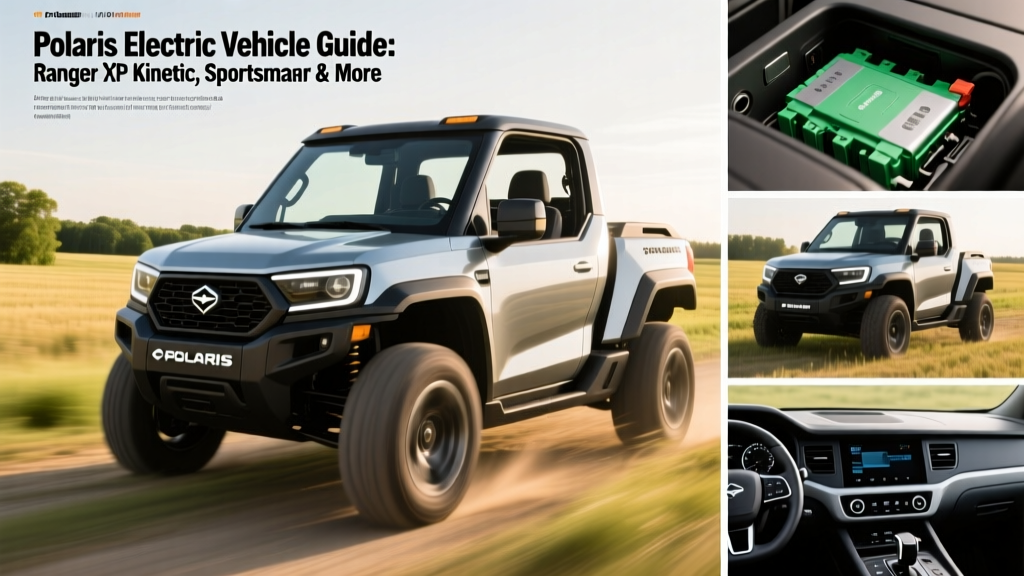
Polaris currently sells one fully electric platform for consumers: the Ranger XP Kinetic, an all-electric side-by-side (UTV) starting around $29,990 MSRP with up to 110 miles of estimated range (Ultimate trim, 29.8 kWh usable battery). It is not a street-legal passenger car — it's an off-road work and recreation vehicle. There is no Polaris electric car, truck, or SUV available for highway use. If you're searching for a Polaris electric vehicle to buy, the Ranger XP Kinetic is the product you'll evaluate, and the decision hinges on your work-site needs, charging access, and whether the instant torque and near-silent operation justify the premium over a gas Ranger.
Polaris has spent years electrifying its off-road lineup through its partnership with Zero Motorcycles (for the electric powertrain expertise) and its own in-house engineering. The Ranger XP Kinetic launched as a 2022 model and has carried forward with iterative updates. For 2026, it remains the only battery-electric utility vehicle in the Polaris stable, though the company has signaled broader electrification ambitions across its Powersports portfolio.
This guide covers what the Ranger XP Kinetic actually delivers in range, power, and charging practicality — and whether it makes financial sense compared to a gasoline Ranger or competing UTVs.
What Polaris Electric Vehicles Can You Actually Buy?
The Polaris electric vehicle lineup is narrow but focused. Here's what's available and what's been discontinued:
| Model | Type | Status (2026) | Est. Range | Starting MSRP |
|---|---|---|---|---|
| Ranger XP Kinetic Premium | Electric UTV | Available | ~55 mi (14.9 kWh) | ~$29,990 |
| Ranger XP Kinetic Ultimate | Electric UTV | Available | ~110 mi (29.8 kWh) | ~$34,990 |
| Ranger XP Kinetic NorthStar | Electric UTV (enclosed cab) | Available | ~110 mi (29.8 kWh) | ~$39,990 |
| Polaris GEM e2/e4/e6 | Neighborhood Electric Vehicle | Discontinued (2022) | ~30-50 mi | N/A (used market) |
| Polaris Slingshot | Three-wheel roadster | Gas only | N/A | ~$23,990+ |
The GEM (Global Electric Motorcars) line was Polaris's low-speed electric vehicle for campus and neighborhood use, but production ended. If you see GEMs for sale, they're used or leftover inventory. The Slingshot remains gas-powered only.
For buyers researching a "Polaris electric vehicle," the Ranger XP Kinetic is the relevant product. Let's break down what it offers.
Ranger XP Kinetic: Range, Battery, and Charging Specs
The Ranger XP Kinetic does not carry a formal EPA range rating the way passenger EVs do, because it's classified as an off-road vehicle. Polaris estimates up to 110 miles on the Ultimate trim's 29.8 kWh battery under ideal conditions (flat terrain, moderate speed, no payload). In real-world work use — towing, hauling, hilly terrain, stop-and-go farm or job-site driving — expect 60–85 miles of practical range on the Ultimate, and roughly 30–45 miles on the Premium's smaller 14.9 kWh pack.
| Specification | Premium Trim | Ultimate / NorthStar Trim |
|---|---|---|
| Battery Capacity (usable) | 14.9 kWh | 29.8 kWh |
| Battery Chemistry | Lithium-ion (NMC) | Lithium-ion (NMC) |
| Estimated Range (ideal) | ~55 miles | ~110 miles |
| Real-World Work Range | ~30–45 miles | ~60–85 miles |
| Motor Output | 110 HP equivalent | 110 HP equivalent |
| Peak Torque | 140 lb-ft | 140 lb-ft |
| Level 1 Charging (120V) | ~10 hours (0–100%) | ~20 hours (0–100%) |
| Level 2 Charging (240V) | ~5 hours (0–100%) | ~10 hours (0–100%) |
| DC Fast Charging | Not supported | Not supported |
| Onboard Charger | ~1.5 kW (L1) / ~3 kW (L2) | ~1.5 kW (L1) / ~3 kW (L2) |
| Towing Capacity | 2,500 lbs | 2,500 lbs |
| Payload Capacity | 1,250 lbs | 1,250 lbs |
| Starting MSRP | ~$29,990 | ~$34,990 / ~$39,990 |
| Warranty (battery) | 3 years, unlimited miles | 3 years, unlimited miles |
Charging Reality for Off-Road EVs
The Ranger XP Kinetic charges via a standard J1772-compatible inlet. On a 120V household outlet (Level 1), the Ultimate's 29.8 kWh battery takes roughly 20 hours from empty to full — essentially one full day. On a 240V Level 2 outlet (like a dryer circuit or dedicated EV charger), that drops to about 10 hours.
This means overnight charging is feasible for most work patterns. If you drive 40–60 miles during the day and plug into a 240V outlet at night, you'll wake up fully charged. But there's no DC fast-charging option — you can't pull up to a public fast charger and top off in 30 minutes. For job-site use where the vehicle stays on-property, this is usually fine. For trail riding far from home, you'll need to plan around the battery.
Key insight: The onboard charger is limited to roughly 3 kW on Level 2. This is much slower than a passenger EV (which typically accepts 7–19 kW on Level 2). The smaller onboard charger keeps weight and cost down but means longer charge times relative to battery size.
Electric UTV vs. Gas UTV: Cost and Performance Comparison
The most common question from buyers: does the Ranger XP Kinetic save money compared to a gas-powered Ranger? The answer depends heavily on your usage pattern.
| Factor | Ranger XP Kinetic Ultimate (Electric) | Ranger XP 1000 (Gas) |
|---|---|---|
| Base MSRP | ~$34,990 | ~$18,500–$22,000 |
| Fuel / Energy Cost per Hour | ~$0.50–$1.50 (electricity at $0.15/kWh) | ~$4.00–$7.00 (gas at ~$3.50/gal, 1–2 gal/hr) |
| Annual Fuel/Energy (500 hrs/yr) | ~$375–$750 | ~$2,000–$3,500 |
| Oil Changes per Year | 0 | 2–4 |
| Air Filter / Spark Plug Replacements | None | Annual |
| Estimated Annual Maintenance | ~$100–$200 | ~$500–$900 |
| Noise Level | Near-silent (conversation-level) | 75–85 dB at idle |
| Instant Torque | Yes (140 lb-ft from 0 RPM) | No (needs RPM build) |
| Range per Fill/Charge | ~60–85 miles (real-world) | ~150–250 miles (10.5-gal tank) |
| Refuel/Recharge Time | 5–20 hours | ~3 minutes |
| Cold-Weather Performance | Range reduced 15–30% | Minimal range impact |
5-Year Cost Breakdown
| Category | Electric (Kinetic Ultimate) | Gas (Ranger XP 1000) |
|---|---|---|
| Purchase Price | $34,990 | $20,000 |
| Fuel/Energy (5 yrs, 500 hrs/yr) | $2,500 | $13,750 |
| Maintenance (5 yrs) | $750 | $3,500 |
| Insurance (5 yrs est.) | $3,000 | $2,500 |
| 5-Year Total | ~$41,240 | ~$39,750 |
| Cost per Operating Hour | ~$16.50 | ~$15.90 |
The electric Ranger costs significantly more upfront but saves $1,500–$2,500 annually on fuel and maintenance at heavy usage levels (500+ hours/year). At lighter usage (100–200 hours/year), the payback period extends well beyond five years, and the gas Ranger wins on total cost. The electric model's value proposition is strongest for high-hour commercial or agricultural users who operate daily and can charge overnight on-site.
Real-World Ownership: What First-Time EV UTV Buyers Need to Know
Charging Infrastructure Requirements
You don't need a public charging network for a Ranger XP Kinetic — this vehicle lives and works on your property. But you do need:
- A dedicated 240V outlet (NEMA 14-50 or hardwired Level 2 charger) near where you park the UTV. A licensed electrician can install this for $500–$2,000 depending on panel proximity and local permitting. A panel upgrade to 200A may add $1,500–$3,000 if your current panel is maxed out.
- 120V as a backup — the included Level 1 cord works on any standard outlet, but expect 20-hour charge times on the Ultimate trim.
- No trail-side fast charging — plan routes within your battery range. There is no DC fast-charging infrastructure for off-road vehicles, and the Kinetic doesn't support it anyway.
Climate and Terrain Considerations
Lithium-ion batteries lose capacity in cold weather. If you operate in sub-freezing temperatures (common in northern states during hunting season or winter ranch work), expect 15–30% range reduction. The Kinetic's battery does not have active thermal management the way a Tesla or Hyundai Ioniq does — it relies on passive cooling. This is adequate for off-road duty cycles but means cold-weather range loss is more pronounced.
On steep terrain or when towing near the 2,500-lb limit, energy consumption spikes. Users in mountainous areas report real-world range closer to 45–55 miles on the Ultimate trim when working hard. Plan accordingly.
Noise as a Feature
One of the Kinetic's most underrated advantages is silence. At idle, it produces essentially zero noise. At speed, tire and suspension noise dominate. This matters enormously for:
- Hunting and wildlife observation — you can approach areas without spooking game at hundreds of yards
- Residential-area work — early morning or late evening operation without noise complaints
- Communication on job sites — you can hold a conversation at 15 mph without shouting
- Stealth for property security — patrol without announcing your presence
Gas UTVs produce 75–85 dB at idle. The Kinetic's silence is a functional advantage that goes beyond comfort.
Federal Tax Credits and Incentives for the Ranger XP Kinetic
Here's where things get complicated. The federal §30D Clean Vehicle Credit (up to $7,500) applies to on-road vehicles that meet specific battery-sourcing, MSRP, and buyer-income requirements per IRS guidelines. The Ranger XP Kinetic, as an off-road vehicle, generally does not qualify for the §30D credit.
- §30D requires the vehicle to be "made by a manufacturer" for use on public roads — off-road UTVs are excluded
- The vehicle must have a VIN registered for on-road use in most states
- MSRP caps ($80,000 vans/SUVs/trucks; $55,000 sedans) are irrelevant since off-road vehicles don't qualify at all
However, there may be alternative incentives:
- IRS §45W Commercial Clean Vehicle Credit — if you purchase the Kinetic for business use (farming, ranching, commercial property management), this credit offers up to $7,500 for vehicles under 14,000 lbs GVWR. Consult a tax professional to confirm eligibility for your specific use case.
- USDA REAP Grants — rural agricultural operations may qualify for equipment electrification grants through the Rural Energy for America Program.
- State and local utility rebates — some electric cooperatives and municipal utilities offer rebates for electric off-road equipment. Check with your local provider.
- Depreciation — business-use UTVs may qualify for Section 179 expensing or bonus depreciation, which can offset the purchase price significantly in year one.
Tax rules change frequently. Always verify current-year eligibility with a qualified tax professional before making a purchase decision based on credits.
Common Misconceptions About Polaris Electric Vehicles
| Myth | Fact |
|---|---|
| "Polaris makes an electric car." | Polaris does not manufacture any street-legal passenger car. The Ranger XP Kinetic is an off-road UTV. The GEM neighborhood vehicle was discontinued in 2022. |
| "The Kinetic has 110 miles of range, so I can ride trails all day." | 110 miles is the ideal-condition estimate. Real-world work use (towing, hills, cargo) yields 60–85 miles. Hard riding on technical terrain may drop that further. |
| "I can fast-charge it on the trail." | The Kinetic does not support DC fast charging. You're limited to Level 1 (120V) and Level 2 (240V) AC charging, which takes hours. |
| "Electric UTVs have less torque than gas." | The opposite is true. The Kinetic delivers 140 lb-ft of torque instantly from 0 RPM. Gas UTVs need to build RPM to reach peak torque. This makes the electric model feel significantly more responsive for towing and climbing. |
| "The battery will need replacing in a few years." | Polaris warranties the battery for 3 years with no mileage limit. Lithium-ion NMC batteries in off-road applications (moderate cycle depth, lower sustained speeds) typically retain 80%+ capacity after 1,000+ charge cycles — equivalent to many years of typical use. Replacement cost is not publicly listed but is a significant expense if needed out of warranty. |
| "It qualifies for the $7,500 EV tax credit." | The §30D credit applies to on-road vehicles. The Kinetic, as an off-road UTV, generally does not qualify. The §45W commercial credit or USDA grants may apply for business use. |
Decision Framework: Should You Buy the Ranger XP Kinetic?
Choose the Ranger XP Kinetic (Electric) If:
- You use a UTV daily or near-daily (400+ hours/year) for farm, ranch, or commercial property work
- You can install a 240V Level 2 outlet at your parking location and charge overnight
- Silent operation is valuable — hunting, wildlife management, residential-area work, or early-morning operations
- You want instant torque for towing and climbing without RPM build-up
- You want to eliminate oil changes, air filters, spark plugs, and fuel-system maintenance
- You qualify for the §45W commercial credit or USDA grants that offset the price premium
- Your typical daily driving is under 60 miles and you return to a home base to charge
Choose a Gas Ranger (or Competing Gas UTV) If:
- You ride long trails or multi-day trips where refueling in 3 minutes matters and range beyond 100 miles is essential
- You operate in extreme cold regularly and can't afford 20–30% range loss
- Your usage is under 200 hours/year — the fuel savings won't justify the $13,000–$15,000 price premium
- You don't have access to 240V charging at your property, or installing it would require a costly panel upgrade
- You need to tow the UTV to remote locations and can't charge on-site
- Upfront budget is a primary constraint
Frequently Asked Questions
Is the Polaris Ranger XP Kinetic street-legal?
In most states, no. The Ranger XP Kinetic is classified as an off-road vehicle (ORV/UTV) and does not come from the factory with the equipment required for on-road registration (DOT windshield, specific lighting, mirrors, etc.). Some states allow limited on-road use of UTVs with aftermarket modifications and local permits, but this varies by jurisdiction. Check your state and county regulations.
How long does the Polaris Kinetic battery last before replacement?
Polaris warranties the battery for 3 years (unlimited miles). Based on NMC lithium-ion degradation data in similar off-road applications, you can expect 80%+ capacity retention after 800–1,200 full charge cycles. For a user charging once daily, that's roughly 2–3+ years of heavy use before noticeable range loss. Many owners report minimal degradation in the first 1–2 years. Battery replacement cost is not published by Polaris but is estimated in the $3,000–$6,000 range based on comparable off-road EV battery packs.
Can I charge the Ranger XP Kinetic from a standard wall outlet?
Yes, using the included Level 1 charging cord on a standard 120V/15A outlet. However, charging the Ultimate's 29.8 kWh battery from empty takes roughly 20 hours. For practical daily use, a 240V Level 2 outlet is strongly recommended — it cuts charge time to about 10 hours, enabling overnight replenishment.
Does Polaris make an electric ATV (not a side-by-side)?
As of 2026, Polaris does not sell a fully electric ATV (single-rider, straddle-seat format). The Ranger XP Kinetic is the only electric model in the current lineup. Polaris's electric ATV concepts and announcements have not reached production. The Sportsman lineup remains gas-powered.
How does the Kinetic compare to other electric UTVs?
Direct competitors are limited. The Can-Outlander Electric (announced, not yet widely available as of 2026) and smaller electric UTVs from brands like Volcon target different segments. The Kinetic remains the most capable full-size electric UTV from a major manufacturer, with 110 HP equivalent, 2,500-lb towing, and a proven platform. Chinese-market electric UTVs exist at lower price points but lack Polaris's dealer network, parts availability, and build quality.
What's the total cost of ownership compared to a gas Ranger over 5 years?
At 500 operating hours per year, the Kinetic Ultimate's 5-year total cost is approximately $41,240 vs. $39,750 for a comparably equipped gas Ranger XP 1000 (see cost table above). The electric model saves significantly on fuel and maintenance but starts ~$15,000 higher. At 300+ hours/year, the break-even point arrives around year 4–5. Below 200 hours/year, the gas model is cheaper overall. Business tax benefits (§45W, Section 179) can shift this equation substantially in the Kinetic's favor.
Sources: Polaris Ranger XP Kinetic official specifications; IRS §30D Clean Vehicle Credit guidelines; USDA REAP Program.