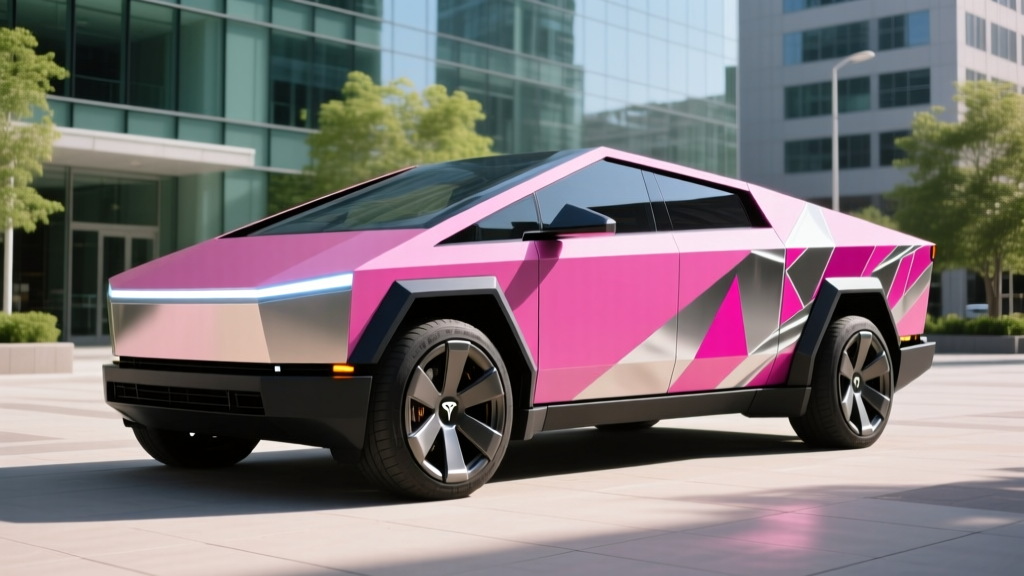
The Tesla Cybertruck rolls off the line in one factory finish: a bare stainless-steel exoskeleton. No paint. No color options. Yet search interest in a pink Tesla Cybertruck continues to climb, driven by social-media builds, celebrity wraps, and buyers who want their $80,000-plus electric truck to stand out in a sea of silver. This guide covers everything you need to know about going pink — from wrap costs and durability to the underlying 2026 Cybertruck specs that actually matter once the vinyl is applied.
Why the Pink Tesla Cybertruck Trend Keeps Growing
Unlike every other truck on the market, the Cybertruck ships without paint. Tesla's cold-rolled stainless-steel body panels are left raw, which saves weight and eliminates a multi-billion-dollar paint shop at Giga Texas. The trade-off is a monochrome lineup and a surface that shows fingerprints, micro-scratches, and water spots aggressively.
A vinyl wrap solves both problems at once. A pink Cybertruck — whether in gloss hot pink, matte rose, satin blush, or metallic magenta — protects the steel from light scratches and transforms the truck's visual identity. Wrap shops across the U.S. report that Cybertruck wraps are among their most-requested jobs, with pink and chrome variants topping the list for owner customization. The angular, flat-panel geometry of the Cybertruck actually makes it one of the easier vehicles to wrap cleanly, since there are fewer compound curves to fight.
2026 Tesla Cybertruck: Core Specs at a Glance
Before choosing a color, you need to know what you're wrapping. Here are the official 2026 model-year specifications for the three Cybertruck trims currently in production:
| Spec | Long Range AWD | All-Wheel Drive | Cyberbeast |
|---|---|---|---|
| EPA Range | ~340 mi | ~340 mi | ~320 mi |
| Battery (usable) | ~123 kWh (est. NMC) | ~123 kWh (est. NMC) | ~123 kWh (est. NMC) |
| Drivetrain | Dual-Motor AWD | Tri-Motor AWD | Tri-Motor AWD |
| Horsepower | ~600 hp | ~845 hp | ~845 hp |
| 0–60 mph | ~3.9 sec | ~3.9 sec | ~2.6 sec |
| Towing Capacity | 11,000 lbs | 11,000 lbs | 11,000 lbs |
| MPGe (combined) | ~67 MPGe | ~67 MPGe | ~64 MPGe |
| Efficiency | ~50 kWh/100 mi | ~50 kWh/100 mi | ~52 kWh/100 mi |
| Base MSRP (2026 est.) | $79,990 | $99,990 | $119,990 |
Source: Tesla Cybertruck specifications and fueleconomy.gov. Final 2026 EPA figures may vary slightly by model-year certification.
Real-World Range: What the EPA Sticker Doesn't Tell You
EPA Estimated Range: 320–340 miles (depending on trim)
Real-World Expectation: Plan for 260–290 miles on sustained highway driving at 70–80 mph. In cold weather (below 32°F), expect an additional 15–25% reduction, dropping effective range to roughly 210–250 miles on winter road trips.
The Cybertruck's angular, brick-like aerodynamic profile (drag coefficient estimated around 0.39–0.42) penalizes highway efficiency far more than a sleeker sedan like the Model S. At 50+ kWh per 100 miles, this is one of the least energy-efficient EVs on the road — you're paying for mass, towing capability, and presence, not efficiency.
For daily commuting under 60 miles round-trip with home charging, range is a non-issue. For road trips, plan charging stops around the 200-mile mark in winter or when towing. The ~123 kWh battery pack (estimated NMC chemistry, chosen for energy density over the cycle-life advantages of LFP) provides a large buffer, but the Cybertruck's consumption rate means you'll burn through electrons faster than almost any other EV in Tesla's lineup.
Charging Speed: DC Fast Charge and Home Level 2
The Cybertruck uses Tesla's NACS connector natively and accesses the full Supercharger network. Here's what to expect at different charging levels:
| Charging Level | Power / Rate | Speed | Notes |
|---|---|---|---|
| Level 1 (120V) | ~1.4 kW | ~3 miles/hour | Emergency/top-up only; a full charge takes 80+ hours |
| Level 2 (240V, 48A) | ~11.5 kW | ~23 miles/hour | Home Wall Connector; ~11–13 hours from 10–100% |
| Level 2 (240V, 80A) | ~19.2 kW | ~38 miles/hour | Requires 100A circuit; ~7 hours from 10–100% |
| DC Fast (V4 Supercharger) | Peak ~350 kW | 10–80% in ~15 min | Peak rate sustained only briefly; curve tapers above 50% SoC |
Charging-curve reality check: The Cybertruck's peak ~350 kW rate is achievable at V4 Supercharger stalls with a preconditioned battery, but sustained average power from 10–80% is closer to 200–250 kW. Expect a typical 10–80% session to take 15–20 minutes at a modern V3/V4 Supercharger. At older V2 stalls (150 kW peak), plan on 35–45 minutes.
For home charging, Tesla's Wall Connector on a 60A circuit (48A continuous) delivers ~11.5 kW — enough to replenish roughly 23 miles of range per hour. Most Cybertruck owners who drive 40–60 miles daily will wake up fully charged every morning without needing maximum amperage. A 100A circuit upgrade for 80A charging is only worth the ~$800–$1,500 electrical upgrade if you regularly drain the battery below 20% and need rapid overnight recovery.
Custom Wrapping Your Cybertruck Pink: Costs, Options, and Durability
Since Tesla doesn't offer a factory pink (or any factory color), a vinyl wrap is the path. Here's what the process involves and what it costs:
- Full-body wrap (premium cast vinyl): $5,000–$8,000 at a reputable shop. Brands like 3M, Avery Dennison, and KPMF offer pink shades from subtle satin rose to vivid hot pink and color-shift magenta.
- Partial wrap or accent: $2,000–$4,000. Common choices include a pink roof-and-hood combo or pink accent stripes over bare steel.
- PPF (paint protection film) with tint: $7,000–$12,000. Clear bra with a pink tint layer — more durable than vinyl, but significantly more expensive.
- Durability: A quality cast-vinyl wrap lasts 5–7 years with proper care. Matte and satin finishes show fewer micro-scratches than gloss. Avoid automatic car washes with abrasive brushes; touchless or hand-wash only.
- Warranty implications: Wrapping does not void Tesla's vehicle warranty. However, if wrap removal damages the stainless steel (rare with professional-grade adhesive), that damage won't be covered.
- Cybertruck-specific considerations: The flat panels are wrap-friendly, but the sharp creases and angular edges require an experienced installer. Ask for portfolio examples of completed Cybertruck wraps before committing.
Pricing, Tax Credits, and Total Cost of Ownership
| Trim | Base MSRP | Federal §30D Credit | Effective Price |
|---|---|---|---|
| Long Range AWD | $79,990 | $0 (exceeds MSRP cap) | $79,990 |
| All-Wheel Drive | $99,990 | $0 (exceeds MSRP cap) | $99,990 |
| Cyberbeast | $119,990 | $0 (exceeds MSRP cap) | $119,990 |
Tax credit reality: Under IRS §30D rules, the new clean vehicle credit offers up to $7,500 — but only if the vehicle's MSRP falls at or below the cap. For trucks, that cap is $80,000. The Cybertruck Long Range AWD starts at ~$79,990, which technically meets the threshold, but any added options, destination fees, or trim upgrades push it over. The AWD and Cyberbeast trims far exceed the cap. Additionally, the credit requires the buyer to meet income limits (AGI ≤ $300,000 joint / $150,000 single), and the battery must meet critical-mineral and component-sourcing requirements outlined by the IRS. Always verify current-year eligibility with a tax professional before counting on this credit.
Total cost with a pink wrap: Add $5,000–$8,000 for a quality full-body wrap on top of the vehicle price. A pink Cybertruck Long Range AWD, realistically, is an $85,000–$88,000 investment before taxes and registration. Insurance for the Cybertruck runs higher than average for EVs — expect $2,500–$4,000 annually depending on your location and driving record, due to the vehicle's repair costs and stainless-steel panel replacement complexity.
Tech, Interior, and Practicality
The Cybertruck's interior is minimal even by Tesla standards. An 18.5-inch front touchscreen handles virtually all vehicle controls, navigation, and entertainment. A 9.4-inch rear touchscreen serves back-seat passengers. Key tech features include:
- Autopilot / FSD (Supervised): Standard Autopilot provides adaptive cruise and lane-keeping. Full Self-Driving (Supervised) is a $8,000 add-on or $99/month subscription that adds automated lane changes, navigation-on-autopilot, and traffic-light recognition. This is SAE Level 2 driver-assist — you must remain engaged with hands on the wheel and eyes on the road at all times. It is not autonomous driving.
- Steer-by-wire: The Cybertruck uses a fully electronic steer-by-wire system with a yoke-style steering wheel (a conventional round wheel is now available as an option). Steering ratio adjusts dynamically with speed.
- 48-volt electrical architecture: A first for a production vehicle at this scale, reducing wiring harness weight and enabling higher-power accessories.
- Vault bed: 6-foot lockable bed with a motorized tonneau cover rated to support 300 lbs. The bed offers ~67 cu ft of volume with the tailgate up.
- Frunk: Front trunk provides additional lockable storage (~7 cu ft estimated).
- Seating: 6-passenger capacity (3 front, 3 rear) with ~41 inches of front legroom and ~38 inches of rear legroom — adequate but not class-leading for a full-size truck.
- Towing and payload: 11,000-lb max towing, ~2,500-lb payload. Note: towing near max capacity will cut effective range by 40–50%.
Notable drawbacks: The stainless-steel body, while dent-resistant, shows smudges relentlessly (solved by wrapping). Visibility is compromised by thick A-pillars and the angular roofline. The rear ride can be harsh when the bed is empty due to the solid rear axle and adaptive air suspension tuning. Panel-gap consistency has improved since early 2024 deliveries but still draws criticism from luxury-truck buyers accustomed to Rivian or Ford build quality.
Who the Pink Cybertruck Suits Best
Choose the pink Cybertruck if:
- You want a head-turning EV truck with genuine towing capability (11,000 lbs) and tri-motor performance
- You have reliable home Level 2 charging and your daily commute is under 80 miles
- You value the Tesla Supercharger network for road-trip convenience
- You're willing to invest $5,000–$8,000 in a professional wrap for both aesthetics and steel protection
Look elsewhere if:
- You need maximum efficiency — the Cybertruck's ~50 kWh/100mi is poor for an EV
- You want a traditional truck interior with physical buttons and proven build quality (consider the Rivian R1T or Ford F-150 Lightning)
- You rely on the $7,500 federal tax credit to justify your purchase — most Cybertruck trims won't qualify
- You regularly tow heavy loads over long distances — range drops dramatically under load
Cybertruck vs. Key Competitors
Here's how the Cybertruck stacks up against other electric trucks in the 2026 market:
- Rivian R1T: More refined interior, quad-motor option (~1,025 hp), ~352-mile max range, starts around $75,000. Better build quality and more conventional truck utility. Less polarizing design — harder to make "pink" stand out since factory colors are available.
- Ford F-150 Lightning: Starting around $55,000, ~320-mile max range, more traditional truck feel, widely available. Lower performance ceiling but better value and easier federal tax credit qualification on lower trims.
- Chevrolet Silverado EV: Up to ~450-mile range (4WT trim), work-truck oriented, GM's Ultium platform. Less performance focus, more fleet/commercial appeal.
Warranty Coverage
Tesla provides the following warranty coverage for the 2026 Cybertruck:
- Basic Vehicle: 4 years / 50,000 miles
- Battery & Drive Unit: 8 years / 120,000 miles (whichever comes first), with a minimum 70% capacity retention threshold over the warranty period
- Stainless-Steel Body: Tesla's warranty covers corrosion perforation but not surface staining, fingerprint etching, or cosmetic oxidation — another reason owners opt for wraps
The battery pack's estimated NMC chemistry will degrade over time. Based on Tesla's historical data across Model S/X/3/Y fleets, expect roughly 10–12% capacity loss over the first 100,000 miles under normal use patterns. The 120,000-mile powertrain warranty is competitive with Rivian's 8-year/175,000-mile battery warranty but trails slightly on mileage coverage.
Frequently Asked Questions
Can I order a pink Tesla Cybertruck directly from Tesla?
No. Tesla sells the Cybertruck exclusively in its bare stainless-steel finish. Any color — including pink — requires an aftermarket vinyl wrap or PPF application. Tesla does not offer factory paint or wrap options for the Cybertruck as of the 2026 model year.
How much does a full pink wrap cost on a Cybertruck?
Expect $5,000–$8,000 for a full-body wrap using premium cast vinyl from brands like 3M or Avery Dennison. The Cybertruck's flat panels are wrap-friendly, but the sharp edges require an experienced installer. Partial wraps or accent treatments start around $2,000.
Does wrapping the Cybertruck void the warranty?
No. A vinyl wrap does not void Tesla's vehicle or battery warranty. However, any damage caused during wrap application or removal (such as adhesive residue on trim or damage to sensors/cameras) would not be covered. Choose a reputable, Cybertruck-experienced installer.
What is the real-world range of the Cybertruck on highway trips?
On sustained highway driving at 70–80 mph, expect 260–290 miles from a full charge, versus the EPA-estimated 320–340 miles. In cold weather (below freezing), range can drop further to 210–250 miles. The Cybertruck's boxy aerodynamics and ~6,600-lb curb weight are the primary efficiency penalties.
Does the Cybertruck qualify for the $7,500 federal EV tax credit?
Most likely not in practice. The IRS §30D credit caps eligible truck MSRP at $80,000. While the Long Range AWD base MSRP of ~$79,990 technically qualifies, any added options or fees push it over the cap. The AWD and Cyberbeast trims far exceed it. Income limits (≤$300,000 AGI joint) and battery-sourcing requirements also apply. Consult a tax professional and check the latest rules at IRS.gov.
How fast does the Cybertruck charge on a road trip?
At a V4 Supercharger with a preconditioned battery, the Cybertruck can peak at ~350 kW and reach 10–80% in approximately 15–20 minutes. At older V3 Superchargers (250 kW peak), expect 20–25 minutes. At V2 stations (150 kW), plan for 35–45 minutes. Charging speed tapers significantly above 80% state of charge.
Is the pink Cybertruck a good daily driver?
For commuting under 80 miles round-trip with home charging, yes — the large battery means you'll rarely need to charge daily. The air suspension provides a comfortable ride, and the steer-by-wire system is responsive at low speeds. However, the Cybertruck's 8-foot-plus width and limited rear visibility make tight parking lots and urban garages challenging. Factor in higher-than-average insurance costs and the wrap maintenance when budgeting for daily ownership.
Final Verdict
A pink Tesla Cybertruck is equal parts practical customization and bold personal statement. The wrap protects the fingerprint-prone stainless steel, adds personality to an already polarizing design, and costs roughly what a high-end paint correction and ceramic coating would on a traditional luxury truck. Underneath the vinyl, the 2026 Cybertruck delivers genuine truck capability — 11,000-lb towing, 845 hp in Cyberbeast trim, and Supercharger access — but it trades efficiency, interior refinement, and tax-credit eligibility to get there. If you've decided the Cybertruck is the right EV truck for your needs, a professional pink wrap is one of the best investments you can make for both protection and presence.