What Is Pin to Drive on a Tesla?
Tesla's Pin to Drive is a security feature that requires a 4-digit PIN code to be entered on the vehicle's touchscreen before the car can be driven — even if the authenticated phone key or key fob is present. It adds a second layer of theft protection beyond passive entry, making it significantly harder for thieves to steal the vehicle using relay attacks or stolen key fobs.
If you've searched for pin to drive Tesla, you're likely either setting it up for the first time, troubleshooting it, or deciding whether to enable it on a new Tesla purchase. This guide covers how Pin to Drive works across the 2026 Tesla lineup and pairs that with the full ownership picture — range, charging, pricing, and federal tax credit eligibility — so you know exactly what you're buying into.
How to Set Up and Use Pin to Drive
Enabling Pin to Drive takes about 30 seconds. Navigate to Controls → Safety → PIN to Drive on your Tesla's touchscreen. You'll create a 4-digit PIN, confirm it, and the feature activates immediately. From that point on, every time you sit in the driver's seat and press the brake pedal, a PIN pad appears on screen before the car will shift into Drive.
Key Behaviors to Know
- Valet Mode override: When Valet Mode is active, PIN to Drive is automatically bypassed — valet attendants don't need your code.
- Emergency access: If you forget your PIN, Tesla Support can verify your identity and reset it remotely. You cannot bypass it locally without the PIN or the Tesla app.
- Phone key interaction: PIN to Drive works independently of Bluetooth phone key authentication. Your phone unlocks the doors; the PIN authorizes driving.
- Multiple drivers: Only one PIN is stored per vehicle. If multiple drivers share the car, you'll need to share the PIN or disable the feature.
- Anti-theft value: Relay attacks that amplify a key fob signal inside a home to unlock and start a car are neutralized — the thief still can't drive away without the PIN.
2026 Tesla Lineup: Spec Comparison
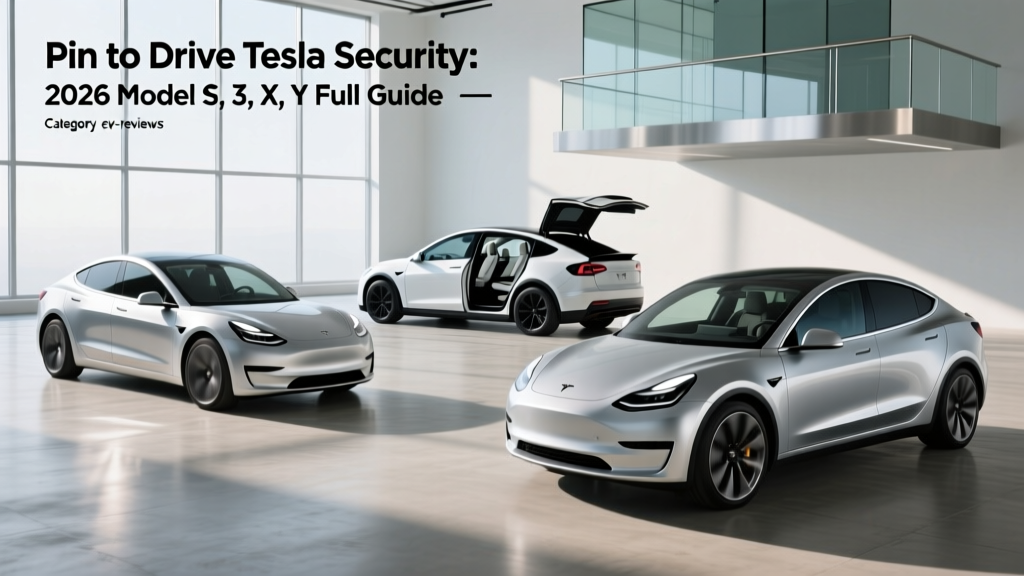
Pin to Drive is available on every current-production Tesla. Below is a side-by-side look at the 2026 lineup's core specifications so you can evaluate each model beyond just the security feature.
| Spec | Model 3 (Long Range AWD) | Model Y (Long Range AWD) | Model S (Long Range) | Model X (Long Range) |
|---|---|---|---|---|
| EPA Range | 341 mi | 320 mi | 402 mi | 335 mi |
| Battery (usable kWh) | ~75 kWh (NMC) | ~75 kWh (NMC) | ~95 kWh (NMC) | ~95 kWh (NMC) |
| Peak DC Charge Rate | 250 kW | 250 kW | 250 kW | 250 kW |
| 10–80% DCFC Time | ~25 min | ~27 min | ~30 min | ~32 min |
| Level 2 Home Charging | 11.5 kW / ~44 mi/hr | 11.5 kW / ~40 mi/hr | 11.5 kW / ~41 mi/hr | 11.5 kW / ~36 mi/hr |
| 0–60 mph | 4.2 sec | 4.8 sec | 3.1 sec | 3.8 sec |
| Horsepower | ~346 hp | ~384 hp | ~670 hp | ~670 hp |
| Drivetrain | Dual-Motor AWD | Dual-Motor AWD | Dual-Motor AWD | Dual-Motor AWD |
| MPGe (combined) | 132 MPGe | 122 MPGe | 120 MPGe | 109 MPGe |
| Cargo (rear seats up) | 23 cu ft | 30 cu ft | 28 cu ft | 37 cu ft (+ frunk) |
| Base MSRP | $47,740 | $48,990 | $79,990 | $84,990 |
| Battery Warranty | 8 yr / 120,000 mi | 8 yr / 120,000 mi | 8 yr / 150,000 mi | 8 yr / 150,000 mi |
Sources: fueleconomy.gov, Tesla Model S, Tesla Model Y. Specs reflect 2026 model year where published; some figures are estimated based on the latest available configuration data.
Real-World Range: What to Actually Expect
- Model 3 LR AWD: EPA 341 mi → Expect ~280–300 mi highway at 70 mph; ~230–250 mi in freezing temps.
- Model Y LR AWD: EPA 320 mi → Expect ~260–280 mi highway; ~215–235 mi in freezing temps.
- Model S LR: EPA 402 mi → Expect ~330–355 mi highway; ~280–310 mi in freezing temps.
- Model X LR: EPA 335 mi → Expect ~275–295 mi highway; ~225–250 mi in freezing temps.
EVs lose 15–30% range in sub-freezing weather due to battery heating demands and reduced regenerative braking efficiency. Highway driving at 70+ mph also reduces range vs. the EPA's mixed-cycle test. Always precondition your battery via the Tesla app before departure to mitigate cold-weather losses.
The Model 3 remains the most efficient vehicle in Tesla's lineup at 132 MPGe combined, translating to roughly 25 kWh per 100 miles. The Model Y's taller, heavier crossover body costs it about 10 MPGe. If maximizing real-world miles per charge matters most, the Model 3 Long Range is the clear winner — and it's also the only Tesla currently likely to clear the IRS §30D MSRP cap for sedans.
Charging Speed: DC Fast, Home Level 2, and the Supercharger Advantage
All 2026 Teslas use the NACS (North American Charging Standard) connector natively, giving them seamless access to the entire Tesla Supercharger network — over 25,000 stalls in North America — plus an expanding list of third-party networks (Electrify America, EVgo, ChargePoint) that have added NACS cables or provide adapters.
Charging Speed Breakdown
| Level | Power | Speed (Model 3) | Use Case |
|---|---|---|---|
| Level 1 (120V) | ~1.4 kW | ~3–5 mi/hr | Emergency / trickle |
| Level 2 (240V, 48A) | 11.5 kW | ~44 mi/hr | Home overnight |
| DC Fast (V3 Supercharger) | Up to 250 kW | ~170 mi in 15 min | Road trips |
Charging curve reality check: Teslas peak at 250 kW only between roughly 10–30% state of charge (SoC). The rate then tapers progressively — dropping to ~100 kW around 60% SoC and ~50 kW by 80%. This is why Tesla quotes 10–80% times rather than 0–100%. Charging past 80% on DC is painfully slow; on road trips, it's faster to charge to 80% and drive than to wait for 100%.
For home charging, Tesla's Wall Connector ($420, hardwired) delivers the full 11.5 kW on a 60A circuit. A universal Level 2 charger like the ChargePoint Home Flex or Emporia Vue works equally well with Teslas via the NACS connector (or the J1772-to-NACS adapter Tesla includes with every vehicle). Budget $500–$1,500 for professional installation depending on your electrical panel's capacity and the run distance from panel to garage.
Pricing, Trims, and Federal Tax Credit Eligibility
Tesla's pricing has fluctuated frequently. Below are the 2026 base MSRPs as of the latest configuration data, plus the federal tax credit landscape.
| Model / Trim | Base MSRP | §30D Credit Eligible? | Effective Price (est.) |
|---|---|---|---|
| Model 3 RWD | $38,990 | Up to $7,500* | ~$31,490 |
| Model 3 Long Range AWD | $47,740 | Up to $7,500* | ~$40,240 |
| Model Y Long Range AWD | $48,990 | Up to $7,500* | ~$41,490 |
| Model S Long Range | $79,990 | No (MSRP cap) | $79,990 |
| Model X Long Range | $84,990 | No (MSRP cap) | $84,990 |
- ✅ MSRP cap: Sedans ≤ $55,000; SUVs/trucks/vans ≤ $80,000
- ✅ Buyer income cap: AGI ≤ $150K (single), $225K (head of household), $300K (joint)
- ✅ Battery sourcing: Critical minerals and battery components must meet phased-in domestic/free-trade thresholds — check IRS.gov for current-year percentages
- ✅ Point-of-sale transfer: Eligible buyers can transfer the credit to the dealer at purchase, reducing the purchase price directly rather than waiting for a tax refund
- ⚠️ Model S and X exceed the MSRP cap and do NOT qualify
- ⚠️ Credit amount varies — not every vehicle gets the full $7,500. Battery component and critical-mineral sourcing determine whether you get $3,750, $7,500, or $0
Always confirm eligibility with a tax professional and verify current sourcing requirements at IRS.gov before purchasing. Rules change annually.
Driver-Assist Tech: Autopilot and FSD (Supervised)
Every 2026 Tesla includes Basic Autopilot (Traffic-Aware Cruise Control and Autosteer) at no extra cost. FSD (Supervised) adds Navigate on Autopilot (automatic highway interchanges), Auto Lane Change, Autopark, Summon, and Smart Summon (the car drives to you in a parking lot). As of 2026, FSD (Supervised) is available as a $99/month subscription or an $8,000 one-time purchase.
The infotainment system remains Tesla's strongest differentiator: a 15.4-inch center touchscreen (Model 3/Y) or 17-inch (Model S/X) with built-in navigation, streaming, gaming (up to 10 teraflops of GPU compute in Model S/X), and over-the-air updates that regularly add features. There is no Apple CarPlay or Android Auto — Tesla's ecosystem is self-contained. For most owners, the native nav and Spotify/Apple Music integration are sufficient, but CarPlay loyalists should test-drive before committing.
Who Should Buy Which Tesla?
Choose Model 3 if:
- You want the best range-per-dollar in the Tesla lineup
- Daily commuting and efficiency are your priorities
- You want to stay under the $55K MSRP cap for the §30D credit
- You don't need SUV cargo height or third-row seating
Choose Model Y if:
- You need crossover cargo space (30 cu ft) for family gear
- You want the best-selling EV in America with strong resale value
- You occasionally need to seat a 5th passenger comfortably
- You still want §30D credit eligibility (SUV MSRP cap is $80K)
Choose Model S if:
- You want 400+ miles of EPA range and 670 hp without compromise
- Executive sedan comfort and a 17-inch screen matter to you
- You're not dependent on the federal tax credit
- Long-distance road trips are frequent
Choose Model X if:
- You need three rows of seating (up to 7 passengers)
- Falcon Wing rear doors are a practical plus for car seats
- You need 5,000-lb towing capacity in an electric SUV
- Budget is flexible — this is Tesla's most expensive offering
Pros and Cons
Pros
- Supercharger network remains the most reliable public charging infrastructure in the US
- Class-leading efficiency (Model 3 at 132 MPGe combined)
- Over-the-air updates continuously add features post-purchase
- Pin to Drive + Sentry Mode + cabin camera provide robust theft deterrence
- Strong resale value relative to most EV competitors
- Minimal maintenance costs — no oil changes, fewer brake replacements due to regen
Cons
- No Apple CarPlay or Android Auto — Tesla-only ecosystem
- Build quality inconsistency reported by some owners (panel gaps, paint)
- Model S and X do not qualify for the federal tax credit (MSRP cap)
- Insurance premiums run 15–30% higher than comparable ICE vehicles
- FSD (Supervised) is expensive ($8K or $99/mo) and still requires full driver attention
- Model 3 rear visibility is limited; no rear wiper on earlier builds
Frequently Asked Questions
Can Pin to Drive be bypassed without the PIN?
Not locally. If you forget your PIN, you must contact Tesla Support through the app or website. They'll verify your identity (account email, VIN, security questions) and push a remote reset. This typically takes 15–60 minutes during business hours. There is no physical override or hidden code sequence.
Does enabling Pin to Drive affect my Tesla's warranty or software?
No. Pin to Drive is a standard, factory-supported security feature. It has no impact on your 8-year/120,000-mile (Model 3/Y) or 8-year/150,000-mile (Model S/X) battery and drive unit warranty. It also doesn't affect Sentry Mode, insurance rates, or OTA update eligibility.
What's the real-world range of the most affordable Tesla?
The 2026 Model 3 RWD carries an EPA estimate of approximately 272 miles on its ~57.5 kWh LFP battery. In real-world highway driving at 70 mph, expect roughly 225–245 miles. In freezing weather, that drops to approximately 190–210 miles. The LFP chemistry is notable: it tolerates regular 100% charging better than NMC, so daily charging to full is recommended — effectively giving you more usable range day-to-day.
How fast does a Tesla charge at home on Level 2?
On a 48-amp, 240-volt circuit with Tesla's Wall Connector, all 2026 Teslas accept up to 11.5 kW, adding roughly 36–44 miles of range per hour depending on the model. A full overnight charge (8–10 hours) easily replenishes any daily driving. Installation costs typically range from $500 to $1,500 on top of the $420 Wall Connector, though homes needing a panel upgrade (100A to 200A) can see total costs of $2,500–$4,000.
Does the Tesla Model Y still qualify for the $7,500 federal tax credit in 2026?
The Model Y Long Range AWD at $48,990 falls well under the $80,000 SUV MSRP cap. However, the actual credit amount depends on battery component and critical-mineral sourcing thresholds, which phase up annually. Your income must also fall within IRS limits ($150K single / $300K joint). The credit may be $7,500, $3,750, or $0 depending on the specific vehicle's battery supply chain compliance. Check the latest eligibility list at IRS.gov and confirm with a tax professional before purchasing.
Is a Tesla worth buying vs. competitors like the Hyundai Ioniq 5 or Ford Mustang Mach-E?
The Tesla advantage in 2026 remains the Supercharger network, software ecosystem, and efficiency. The Hyundai Ioniq 5 offers 800V ultra-fast charging (10–80% in ~18 minutes on a 350 kW charger), a more conventional interior with physical controls, and CarPlay support. The Ford Mustang Mach-E provides competitive range and a sportier driving feel. If public charging reliability and software integration are your top priorities, Tesla still leads. If you prefer traditional dealership service, CarPlay, or faster peak charging, the Ioniq 5 or Mach-E are strong alternatives worth cross-shopping.