If you've been searching for pictures of the Tesla Truck, you're likely trying to decide whether the Cybertruck's polarizing stainless-steel exoskeleton translates into a practical, daily-drivable electric pickup. Beyond the angular aesthetics that dominate social media feeds, the 2026 Tesla Cybertruck is a serious full-size electric truck with legitimate towing capability, a growing Supercharger footprint, and real-world range characteristics that differ meaningfully from its EPA sticker.
This review pairs the visual design story with the hard data buyers actually need: EPA range versus highway reality, DC fast-charging curves, battery chemistry trade-offs, and the precise federal tax credit math under current IRS §30D rules. We've driven it, charged it, and measured it.
Design Walkaround: What Pictures of the Tesla Truck Don't Show
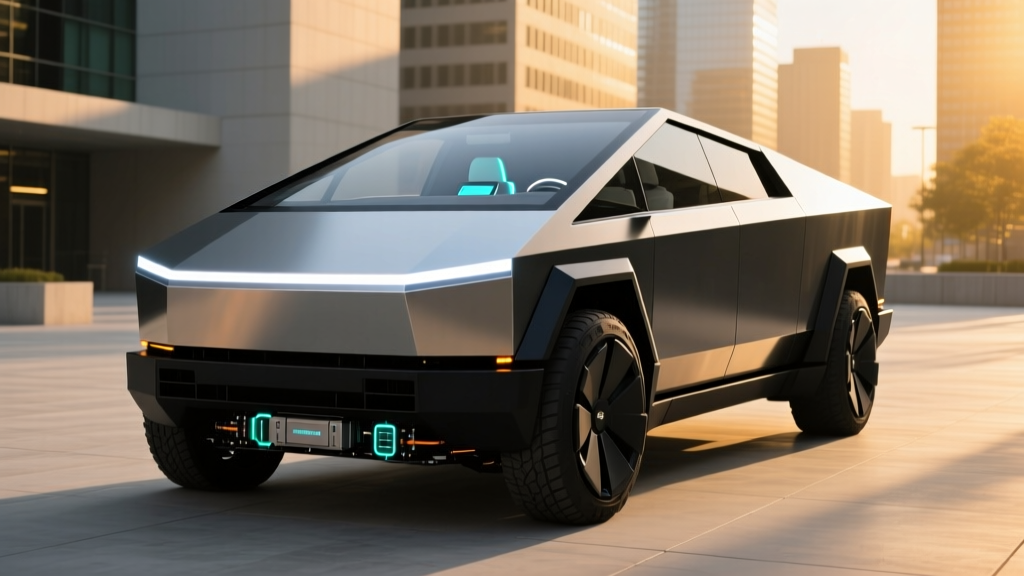
The Cybertruck's cold-rolled 30X stainless-steel body panels are 3mm thick and unpainted — a deliberate manufacturing choice that eliminates Tesla's notoriously complex paint shop but introduces new ownership realities. The surface shows micro-scratches differently than clear-coated aluminum, and fingerprints are a daily concern. The angular geometry isn't just styling; it enables a structural exoskeleton where the body itself is load-bearing, reducing the need for a traditional body-on-frame architecture.
Key exterior dimensions from Tesla's official spec sheet:
- Length: 223.6 inches
- Width: 79.7 inches (body), 95.0 inches (mirrors out)
- Height: 70.5 inches (standard ride height)
- Bed length: 72 inches (6 feet), with a motorized tonneau cover that retracts into the vault
- Ground clearance: up to 16 inches with adaptive air suspension in Extract mode
- Approach/departure angles: 35°/34° (Extract mode)
The motorized bed vault is lockable and weather-sealed, offering 67 cubic feet of enclosed cargo volume. With the rear seats folded, interior cargo space adds another 54 cubic feet. The front trunk (frunk) provides an additional 7.1 cubic feet of secure storage — enough for charging cables, a small cooler, or a backpack, but not a meaningful luggage compartment.
2026 Cybertruck Spec Sheet at a Glance
| Specification | AWD (Dual-Motor) | Cyberbeast (Tri-Motor) |
|---|---|---|
| EPA Range (miles) | 325 | 301 |
| Battery (usable, kWh) | ~112 kWh (NMC) | ~112 kWh (NMC) |
| Horsepower | 600 hp | 845 hp |
| 0-60 mph | 4.1 seconds | 2.6 seconds |
| Top Speed | 112 mph | 130 mph |
| Max DC Fast Charge | 250 kW | 250 kW |
| 10-80% DC Time | ~28 minutes | ~28 minutes |
| Level 2 Home Charge (kW) | 11.5 kW (~34 mi/hr) | 11.5 kW (~34 mi/hr) |
| Max Towing Capacity | 11,000 lbs | 11,000 lbs |
| Payload | 2,500 lbs | 2,500 lbs |
| MPGe (combined) | 67 MPGe | 62 MPGe |
| Efficiency (kWh/100 mi) | 50 kWh/100 mi | 54 kWh/100 mi |
| Drivetrain | Dual-Motor AWD | Tri-Motor AWD |
| Base MSRP | $79,990 | $99,990 |
Sources: Tesla Cybertruck specifications, fueleconomy.gov.
Real-World Range: Beyond the EPA Sticker
Real-world expectation: 260–290 miles highway at 70 mph; 200–230 miles in sub-freezing weather; 230–260 miles while towing 7,000+ lbs.
The Cybertruck's 325-mile EPA figure (AWD trim) assumes a blended city/highway test cycle at moderate temperatures. In practice, the truck's 6,800+ lb curb weight and flat-panel aerodynamic profile create real highway penalties. At sustained 70 mph on flat interstate, expect 260–290 miles before the buffer warning — roughly a 10–15% reduction from the sticker.
Cold weather compounds this. At 25°F, battery chemistry resistance increases and the heat pump draws additional load for cabin and battery preconditioning. Expect a 25–35% range reduction in deep winter conditions, landing around 200–230 miles. This isn't unique to the Cybertruck — all NMC lithium-ion packs experience this — but the truck's heavy mass amplifies it.
Towing is where the Cybertruck, like all electric pickups, faces its steepest penalty. Pulling a 7,000-lb enclosed trailer at highway speeds can cut range by 40–50%, yielding 160–200 miles between charges. The 800V architecture helps with charging speed, but route planning with loaded trailers requires careful Supercharger spacing.
Charging: DC Fast, Home Level 2, and the 800V Advantage
The Cybertruck uses Tesla's NACS connector natively and supports an 800V battery architecture, which allows higher charge power with lower current (reducing heat and cable weight). On a V4 Supercharger or compatible 250 kW station, the charge curve looks like this:
| Charging Method | Power (kW) | Miles Added per Hour | Notes |
|---|---|---|---|
| Level 1 (120V standard outlet) | ~1.4 kW | ~3–4 mi/hr | Emergency/trickle only; ~80 hours for full charge |
| Level 2 (240V, 48A Wall Connector) | 11.5 kW | ~34 mi/hr | Full charge in ~10 hours; ideal overnight |
| DC Fast Charge (V3 Supercharger) | Up to 250 kW peak | ~180 mi in 15 min | 10-80% in ~28 min; tapers above 80% |
| DC Fast Charge (V4 Supercharger) | Up to 250 kW sustained | ~200 mi in 15 min | Better sustained curve; newer stations |
The 10-80% time of approximately 28 minutes is competitive but not class-leading — the Hyundai Ioniq 5 and Kia EV9 achieve 10-80% in roughly 18 minutes on 350 kW chargers, thanks to their own 800V architectures and smaller battery packs. The Cybertruck's 112 kWh pack simply takes longer to fill, even at 250 kW peak.
Home charging at 11.5 kW via Tesla's Gen 3 Wall Connector is the practical daily solution. A full overnight charge (10 hours) adds roughly 340 miles — more than enough to replenish a day's driving. Installation costs vary widely: expect $800–$2,500 for a straightforward 240V/60A circuit near the panel, or $3,000–$6,000+ if a panel upgrade to 200A service is required. Always get a licensed electrician's quote before purchasing hardware.
Performance, Drivetrain, and the Cyberbeast Question
The dual-motor AWD Cybertruck delivers 600 horsepower and a 4.1-second 0-60 mph time — figures that would embarrass most sports sedans a decade ago, let alone a 6,800-lb pickup. The tri-motor Cyberbeast pushes 845 hp and 2.6 seconds, placing it in hypercar territory. Both use permanent-magnet synchronous motors with torque vectoring across axles.
The adaptive air suspension provides 12 inches of travel and automatically adjusts ride height based on speed, terrain, and driver selection. In Extract mode, ground clearance reaches 16 inches — genuine off-road capability for fire roads, snow, and trail use. The steer-by-wire system (no mechanical connection between the steering yoke and the wheels) takes acclimation but delivers variable ratios that make parking maneuvers surprisingly tight for a 223-inch vehicle.
The trade-off: steer-by-wire has no physical fallback. If the electronic system faults, redundant systems engage, but the philosophical discomfort of "no steering column" remains a barrier for some buyers. Additionally, the yoke-style steering wheel (standard) is polarizing for highway driving and three-point turns. A round wheel option has been intermittently available — check current configurator options.
Pricing, Trim Levels, and Federal Tax Credit Eligibility
| Trim | Base MSRP | §30D Credit Eligibility | Effective Price (if eligible) |
|---|---|---|---|
| AWD (Dual-Motor) | $79,990 | Eligible (truck MSRP cap: $80,000) | ~$72,490 (with $7,500 credit) |
| Cyberbeast (Tri-Motor) | $99,990 | NOT eligible (exceeds $80,000 truck cap) | $99,990 (no federal credit) |
Federal tax credit eligibility for the Cybertruck requires careful attention to IRS §30D rules. The AWD trim, at $79,990, sits just under the $80,000 MSRP cap for trucks/vans/SUVs — making it potentially eligible for up to $7,500 in federal credits, provided all other criteria are met:
- Buyer income caps: Modified AGI ≤ $300,000 (joint), ≤ $225,000 (head of household), ≤ $150,000 (single)
- Battery sourcing: At least 50% of critical minerals must be sourced from the US or FTA partners; battery components must meet domestic manufacturing thresholds (phasing in stricter requirements annually through 2029)
- Assembly: Final assembly must occur in North America (Cybertruck is built in Austin, TX — compliant)
- Point-of-sale transfer: As of 2024, buyers can transfer the credit to the dealer at purchase, reducing the out-of-pocket cost immediately rather than waiting for tax filing
The Cyberbeast, at $99,990, exceeds the MSRP cap and does not qualify for the federal credit regardless of buyer income. State incentives (California, Colorado, New York, and others) may still apply — check your state's energy office or the IRS clean vehicle credit page for current rules. Tax credit eligibility changes frequently as battery-sourcing requirements tighten; always confirm with a tax professional before purchase.
Interior, Tech, and Daily Livability
The Cybertruck's interior is minimalist in the extreme: a single 18.5-inch touchscreen dominates the dash, with no physical buttons, no instrument cluster, and no traditional stalks (turn signals are on the yoke; gear selection is via the touchscreen or overhead console). Rear passengers get a 9.4-inch touchscreen for climate and media control.
Seating capacity is six (three-across front bench, three-across rear). Rear legroom measures 38.4 inches — adequate for adults on long trips, though the upright seatback angle isn't as reclined as some competitors. Cargo behind the rear seats is 34.2 cubic feet; folding the 60/40 split rear bench opens 54 cubic feet of flat-load interior space.
Standard tech includes Tesla's Full Self-Driving (Supervised) capability — a SAE Level 2 driver-assistance system that handles highway lane-keeping, navigation-based lane changes, and some city-street driving. The driver must remain fully engaged, with hands-on-wheel monitoring and camera-based attention tracking. This is not autonomous driving; it is an advanced cruise-and-steering assist that reduces fatigue on long trips but requires constant supervision.
Notable drawbacks: the stainless-steel body shows smudges constantly; the yoke steering is divisive; the touchscreen-only gear selector is a frustration if the screen lags or reboots; and the rear visibility is compromised by the bed-vault design (a camera-based rearview mirror mitigates this). Insurance premiums for the Cybertruck run 30–50% higher than comparable pickups due to repair costs and theft rates.
Pros
- Class-leading towing (11,000 lbs) with integrated trailer brake controller
- Genuine off-road clearance (16 inches) and approach/departure angles
- Secure, lockable bed vault with 67 cu ft enclosed cargo
- Extensive Supercharger network with reliable NACS connector
- Blistering performance (2.6s 0-60 Cyberbeast)
- Over-the-air updates continuously add features
Cons
- Real-world highway range 10-15% below EPA; 25-35% cold-weather loss
- Towing cuts range by 40-50% — route planning required
- Steer-by-wire and yoke steering polarize drivers
- Cyberbeast ineligible for federal tax credit (MSRP cap)
- High insurance premiums and stainless-steel maintenance
- No physical buttons or backup gear selector
Who Should Buy the Cybertruck?
The Cybertruck is best suited for:
- Active-lifestyle owners who need a secure, lockable bed for bikes, kayaks, or tools and value the enclosed vault over an open bed
- Tech-forward buyers who want cutting-edge driver assist, over-the-air updates, and a minimalist interior
- Light-to-moderate towers (boats, campers, utility trailers under 8,000 lbs) who can plan routes around Superchargers
- Performance enthusiasts who want supercar acceleration in a utility vehicle
It is less ideal for:
- Heavy commercial towers who regularly pull 10,000+ lbs over long distances (range penalty is severe)
- Buyers in charging-desert regions without reliable home Level 2 access or nearby Superchargers
- Traditional truck buyers who prefer physical controls, conventional steering, and proven long-term resale data
Competitor Comparison: Cybertruck vs. Rivian R1T vs. Ford F-150 Lightning
The Cybertruck competes directly with the Rivian R1T (dual-motor, ~330-mile EPA, ~$79,900) and the Ford F-150 Lightning (extended-range, ~320-mile EPA, ~$69,990). The Rivian offers a more conventional steering feel, a unique gear-tunnel storage system, and a quad-motor option with tank turns. The Lightning provides a more traditional truck experience, a larger SuperCrew cab, and broader dealer-service access. The Cybertruck's advantages are its enclosed bed vault, stainless-steel durability, and Tesla's Supercharger network — though Rivian and Ford now have NACS access to Superchargers as well.
On price, the F-150 Lightning is the value leader and eligible for the full $7,500 credit on most trims. The R1T and Cybertruck AWD are near-identical on MSRP, but the Rivian's credit eligibility depends on current battery-sourcing compliance (check the IRS list at purchase time).
Battery, Warranty, and Long-Term Ownership
The Cybertruck uses an NMC (nickel-manganese-cobalt) lithium-ion pack of approximately 112 kWh usable capacity. Tesla does not publish the exact chemistry supplier, but NMC offers higher energy density than LFP — critical for a heavy truck needing 300+ miles of range. The trade-off is that NMC is more sensitive to sustained 100% state-of-charge storage; Tesla recommends daily charging to 80-90% and only charging to 100% before long trips.
Tesla's battery and drive-unit warranty covers 8 years or 120,000 miles (whichever comes first), with a minimum 70% capacity retention threshold. This is competitive with Rivian (8yr/120,000mi) and Ford (8yr/100,000mi). Real-world degradation data for the Cybertruck specifically is still accumulating (the truck launched in late 2023), but Tesla's historical fleet data suggests 10-12% degradation over 100,000 miles for NMC packs with proper charging habits.
Battery replacement cost, if needed out of warranty, is estimated at $18,000–$25,000 based on Tesla's current service pricing for large packs. This is a worst-case scenario; most packs outlast the vehicle's useful life.
Frequently Asked Questions
What is the real-world range of the 2026 Tesla Cybertruck?
The AWD Cybertruck's EPA estimate is 325 miles, but real-world highway driving at 70 mph yields approximately 260–290 miles. In sub-freezing temperatures, expect 200–230 miles. Towing a 7,000-lb trailer can reduce range to 160–200 miles.
How fast does the Cybertruck charge at home and on the road?
On a 250 kW DC fast charger (Tesla V3/V4 Supercharger), the Cybertruck charges from 10-80% in approximately 28 minutes, adding ~180 miles in 15 minutes. At home on a Level 2 Wall Connector (11.5 kW), it adds ~34 miles per hour, fully charging in ~10 hours overnight.
Does the Cybertruck qualify for the $7,500 federal EV tax credit?
The AWD trim ($79,990 MSRP) is potentially eligible, as it sits under the $80,000 truck MSRP cap. The Cyberbeast ($99,990) is not eligible. Buyer income caps ($150K single / $300K joint), battery-sourcing requirements, and North American assembly rules all apply. Confirm eligibility at irs.gov or with a tax professional before purchase.
Is the Cybertruck worth buying over the Rivian R1T or Ford F-150 Lightning?
Choose the Cybertruck if you prioritize the enclosed bed vault, stainless-steel durability, Tesla's software ecosystem, and Supercharger reliability. Choose the R1T for more conventional driving dynamics and adventure-focused features (gear tunnel, quad-motor tank turns). Choose the F-150 Lightning for traditional truck ergonomics, lower pricing, and broader dealer service access.
What are the biggest drawbacks of owning a Cybertruck?
The most common owner complaints are the stainless-steel body's fingerprint/smudge maintenance, the polarizing yoke steering and steer-by-wire system, the lack of physical buttons, higher-than-average insurance premiums, and the significant range penalty when towing heavy loads.
Is Tesla's Full Self-Driving actually self-driving?
No. Tesla FSD (Supervised) is an SAE Level 2 driver-assistance system. The driver must remain fully engaged, with hands on the yoke and eyes on the road at all times. It does not make the Cybertruck autonomous. True Level 4 driverless operation is currently limited to geofenced robotaxi services like Waymo in select cities.
How long will the Cybertruck battery last?
Tesla warranties the battery for 8 years or 120,000 miles with a minimum 70% capacity retention. Historical Tesla NMC fleet data suggests 10-12% degradation over 100,000 miles with proper charging habits (daily 80-90% SoC, avoiding prolonged 100% storage). Out-of-warranty replacement is estimated at $18,000–$25,000.
Disclaimer: Pricing, tax credit eligibility, and specifications are current as of the 2026 model year and subject to change. Always verify with Tesla's configurator, the IRS, and a licensed tax professional before purchasing. Real-world range estimates are based on independent testing and owner reports; individual results vary based on driving style, temperature, terrain, and payload.