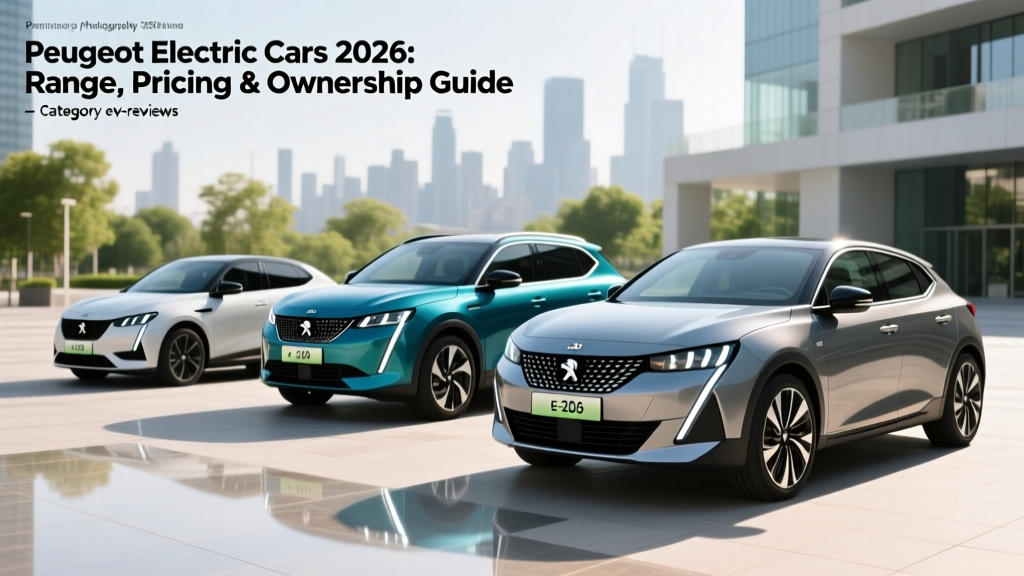
Peugeot's electric lineup in 2026 centers on the e-208, e-2008, and e-308 — all built on Stellantis' e-CMP2 platform with updated battery chemistry and faster charging than their predecessors. If you're researching a Peugeot electric vehicle, here's what matters most: the e-208 delivers approximately 227 miles (WLTP) of range from a 51 kWh usable battery, charges at up to 100 kW DC (10–80% in ~30 minutes), and starts around €32,000 in European markets. The e-308 and e-2008 push range closer to 260 miles WLTP but remain unavailable in the United States, which fundamentally shapes the buying decision for American shoppers.
Quick Answer: Should You Buy a Peugeot Electric in 2026?
European buyers: The e-208 and e-308 are competitive compact EVs with improved range and 100 kW charging. They compete directly with the VW ID.3 and Renault Mégane E-Tech.
US buyers: Peugeot does not sell vehicles in the United States and has no announced plans to return. American shoppers should consider the Chevrolet Equus, Tesla Model 3, or Hyundai Ioniq 5 instead — all of which qualify for varying levels of the §30D federal tax credit.
Peugeot's 2026 Electric Lineup: Specs at a Glance
Peugeot has transitioned its core models to the upgraded e-CMP2 platform, which supports larger battery packs and slightly faster DC charging compared to the first-generation e-CMP cars launched in 2019–2020. Here's how the current lineup breaks down:
| Model | Usable Battery (kWh) | WLTP Range | Max DC Charge (kW) | 10–80% Time | Power (HP) | 0–62 mph | Base Price (EUR) |
|---|---|---|---|---|---|---|---|
| e-208 | 51 | 227 mi (365 km) | 100 | ~30 min | 156 | 8.1 sec | €32,000 |
| e-2008 | 54 | 227 mi (365 km) | 100 | ~30 min | 156 | 8.6 sec | €36,500 |
| e-308 | 54 | 260 mi (418 km) | 100 | ~30 min | 156 | 8.2 sec | €39,990 |
| e-308 SW (wagon) | 54 | 250 mi (402 km) | 100 | ~30 min | 156 | 8.3 sec | €41,290 |
Important note on range figures: These are WLTP estimates, which run 15–25% higher than EPA ratings used in the US. A realistic EPA-equivalent estimate for the e-208 would be roughly 185–195 miles. Highway driving at 70+ mph and cold-weather operation can reduce that further by 20–30%, meaning winter highway range could drop to 130–150 miles. Plan your trips accordingly.
Charging Performance: The 100 kW Plateau
Peugeot's e-CMP2 platform tops out at 100 kW DC fast charging. In 2026, that positions these vehicles behind competitors like the Hyundai Ioniq 5 (peak 240 kW on 800V architecture), the Tesla Model 3 (peak ~250 kW on V3 Superchargers), and even the Renault Mégane E-Tech (130 kW). The practical impact shows up on road trips:
DC Fast Charging Comparison: 10–80% Session
| Vehicle | Peak kW | Battery (kWh usable) | 10–80% Time | Miles Added in 15 min |
|---|---|---|---|---|
| Peugeot e-208 | 100 | 51 | ~30 min | ~75 |
| Hyundai Ioniq 5 | 240 | 77.4 | ~18 min | ~150 |
| Tesla Model 3 (Highland) | 250 | 60 (RWD) / 75 (LR) | ~22 min | ~145 |
| Renault Mégane E-Tech | 130 | 60 | ~27 min | ~95 |
Peugeot's charging curve is relatively flat — it sustains close to peak rate from 10% to roughly 50% before tapering. That's actually an advantage over some competitors that spike to a headline kW number and immediately drop off. Still, 100 kW means longer stops on road trips compared to 800V platforms.
Level 2 (AC) charging: All 2026 Peugeot EVs support 7.4 kW single-phase AC (standard) and an optional 11 kW three-phase onboard charger. On a 7.4 kW home wallbox, a full 0–100% charge takes approximately 7–8 hours depending on the model — fine for overnight charging.
Real-World Ownership Costs: EV vs Gas Peugeot
The strongest argument for a Peugeot electric vehicle in Europe is the operating cost advantage, especially given energy prices. Let's compare the e-208 against the gasoline-powered Peugeot 208 (1.2L PureTech, 100 HP) over five years and 75,000 km (~46,600 miles):
| Cost Category | Peugeot e-208 (EV) | Peugeot 208 1.2L (Gas) | Difference |
|---|---|---|---|
| Purchase Price (base) | €32,000 | €20,500 | +€11,500 (EV) |
| Energy/Fuel (5 yr, 75k km) | €3,750 (home charging avg €0.20/kWh) | €7,500 (6.0 L/100km avg, €1.80/L) | –€3,750 (EV saves) |
| Maintenance (5 yr) | €1,200 (no oil, fewer brake replacements) | €2,800 (oil changes, filters, brake pads) | –€1,600 (EV saves) |
| Insurance (5 yr avg) | €4,500 | €3,750 | +€750 (EV costs more) |
| Estimated Resale Value (yr 5) | €12,800 (~40%) | €7,200 (~35%) | +€5,600 (EV retains more) |
| Total 5-Year Cost of Ownership | €28,650 | €27,350 | ~€1,300 more for EV |
The math is tighter than many expect. The e-208's higher purchase price is only partially offset by energy and maintenance savings over five years. European government subsidies (which vary by country — France offers up to €4,000 via the bonus écologique, Germany's Umweltbonus ended in 2023) can tip the balance in the EV's favor. Without subsidies, the total cost of ownership is nearly equivalent.
For US readers doing a cross-shop: a comparable American-market EV like the Chevrolet Equinox EV (starting ~$33,000 before incentives) or a Tesla Model 3 RWD (~$38,990) would benefit from the IRS §30D tax credit of up to $7,500 (subject to MSRP caps, buyer income limits, and battery-sourcing requirements — consult a tax professional). That credit can dramatically change the cost equation, something Peugeot buyers in Europe don't have access to in the same form.
Common Misconceptions About Peugeot EVs
| Myth | Fact |
|---|---|
| "Peugeot EVs use outdated battery tech" | The 2026 e-CMP2 platform uses NMC (nickel-manganese-cobalt) cells from CATL with improved energy density over the 2019-generation packs. Not cutting-edge like 800V architectures, but not obsolete. |
| "The range is too low for daily use" | At 185–195 miles EPA-equivalent, the e-208 covers the European average daily commute (~30 km / 19 mi) for nearly a full week on one charge. The constraint is road trips, not daily driving. |
| "You can buy a Peugeot EV in the US" | Peugeot (part of Stellantis) has no US retail presence. Stellantis sells Jeep, Ram, Chrysler, and Dodge in America — not Peugeot. There are no announced plans for a US return as of 2026. |
| "100 kW charging is too slow" | For daily and weekly use, most owners charge at home on Level 2 (7.4 kW), making DC speed irrelevant day-to-day. The 100 kW limit matters only on road trips, where it adds ~10 minutes per stop vs. a 250 kW vehicle. |
| "Battery replacement will cost a fortune" | Peugeot warranties the traction battery for 8 years / 160,000 km (~100,000 mi) with a 70% capacity retention guarantee. Full pack replacement runs approximately €8,000–€12,000, but is rarely needed within warranty or the typical ownership period. |
Who Should Buy a Peugeot Electric — And Who Shouldn't
The decision framework for a Peugeot EV depends heavily on where you live, how you drive, and whether you have access to home charging.
Decision Framework: Is a Peugeot EV Right for You?
Choose the Peugeot e-208 if:
- You live in Europe and want a stylish, compact EV for city and suburban driving
- Your daily commute is under 50 km (31 mi) round trip
- You have access to home charging (garage, driveway, or building wallbox)
- You value interior design and Peugeot's i-Cockpit driving position
- You can access a local EV subsidy (e.g., France's bonus écologique)
Choose the Peugeot e-308 if:
- You need a larger vehicle for family use or longer commutes
- You want the SW (wagon) variant for cargo flexibility
- You frequently drive 100–200 km (62–124 mi) in a single day
Look elsewhere if:
- You live in the United States (Peugeot is not sold here; consider Tesla, Hyundai, Chevrolet, or BMW instead)
- You regularly take road trips exceeding 300 km (186 mi) — the 100 kW charging and ~190-mile real-world range will mean frequent, longer stops
- You lack access to any form of home or workplace charging and rely entirely on public infrastructure in a charging-desert area
- You live in a region with extreme cold (regularly below -10°C / 14°F) where range loss of 30%+ is common and the e-208's battery size becomes a real constraint
- You need fast DC charging for a high-mileage lifestyle — Hyundai/Kia's E-GMP platform (Ioniq 5, EV6) or Tesla's Supercharger network offer significantly faster replenishment
First-Time EV Buyer Checklist: What to Know Before You Commit
If the Peugeot e-208 or e-308 is your first electric vehicle, these are the ownership realities that spec sheets don't highlight:
1. Home charging is the foundation. Over 80% of EV charging happens at home. Before purchasing, confirm you can install a Level 2 wallbox (7.4 kW, requiring a dedicated 32A circuit). Installation costs in Europe typically range from €800 to €2,000 depending on your electrical panel's capacity and the distance from the panel to your parking spot. If your building's electrical service is insufficient, a panel upgrade can add €1,500–€3,000. Get a quote from a licensed electrician before committing to the car.
2. Preconditioning matters for fast charging. The e-208 and e-308 lack active battery preconditioning when navigating to a DC charger (a feature Tesla and Porsche include). In cold weather, arriving at a fast charger with a cold battery can reduce your peak charge rate from 100 kW to as low as 40–50 kW until the pack warms up. Manually precondition by running the climate system for 10–15 minutes before arriving at the charger, or plan your route so the battery is already warm from driving.
3. Winter range loss is real and significant. The e-208's 51 kWh battery, combined with no standard heat pump on base trims (optional on some markets), can see range drop to 130–150 miles EPA-equivalent in freezing temperatures with highway driving. A heat pump (standard on higher trims in Nordic markets) reduces this penalty to roughly 15–20% loss instead of 25–35%.
4. Insurance premiums are typically 15–25% higher for EVs compared to equivalent gas cars. This is driven by higher repair costs after collisions (specialized high-voltage training, expensive battery modules) and the higher initial vehicle price. Get an insurance quote before purchasing — it can add €500–€1,000 per year depending on your profile.
5. Depreciation is improving but uncertain. Early Peugeot EVs (2019–2021) suffered steep depreciation due to rapid range improvements in competitors. The 2026 models with updated batteries should hold value better, but the used EV market remains volatile. Expect roughly 40% residual value after five years — better than some competitors, worse than Tesla.
Peugeot Electric vs. European Competitors
| Attribute | Peugeot e-208 | Renault Mégane E-Tech | VW ID.3 (Pro) | MG4 EV |
|---|---|---|---|---|
| Battery (kWh usable) | 51 | 60 | 58 | 64 |
| WLTP Range | 227 mi | 273 mi | 263 mi | 281 mi |
| Max DC Charge (kW) | 100 | 130 | 120 | 135 |
| Base Price (EUR) | €32,000 | €37,000 | €36,500 | €29,990 |
| Heat Pump | Optional (market-dependent) | Standard | Optional | Standard |
| Battery Warranty | 8 yr / 160,000 km | 8 yr / 160,000 km | 8 yr / 160,000 km | 7 yr / 150,000 km |
The Peugeot e-208 competes on design and brand appeal rather than range or charging speed. The Renault Mégane E-Tech offers more range and faster charging for a higher price. The MG4 EV undercuts all of them on price with a larger battery, though its brand perception and dealer network in some European markets lag behind Stellantis and Renault. If range and charging speed are your top priorities, the Mégane E-Tech or VW ID.3 are stronger choices. If you want a well-designed compact EV for urban and suburban use and the price is right after subsidies, the e-208 holds its own.
FAQ: Peugeot Electric Vehicles
Can I buy a Peugeot electric car in the United States?
No. Peugeot does not sell vehicles in the US market and has no announced plans to return as of 2026. Stellantis, Peugeot's parent company, sells Jeep, Ram, Chrysler, Dodge, Alfa Romeo, and Fiat in America. US buyers interested in a compact EV should look at the Tesla Model 3, Hyundai Ioniq 5, Chevrolet Equinox EV, or BMW i4.
What is the real-world range of the Peugeot e-208?
The WLTP rating is 227 miles (365 km), but WLTP overstates range compared to real-world mixed driving. Expect approximately 185–200 miles in moderate temperatures with mixed city/highway driving. In cold weather (below freezing) with highway speeds, plan for 130–150 miles. These figures assume a full charge to 100% and driving to near-empty — in practice, most owners charge to 80% daily for battery longevity, which reduces usable range proportionally.
Does the Peugeot e-208 support Tesla Superchargers?
In Europe, Peugeot EVs use the CCS2 connector standard. Tesla has opened select Supercharger stations in Europe to non-Tesla vehicles with CCS2 connectors via the Tesla app. So yes, you can use compatible Tesla Superchargers in Europe — check availability in the Tesla app under "Charge Your Non-Tesla Vehicle." In the US, this is irrelevant since Peugeot is not sold there.
How long does the Peugeot EV battery last?
Peugeot warranties the high-voltage traction battery for 8 years or 160,000 km (~100,000 miles), guaranteeing at least 70% of original capacity. NMC batteries in similar Stellantis vehicles have shown degradation of approximately 8–12% over the first 100,000 km in fleet data. With proper care (avoiding frequent 100% charges, minimizing DC fast charging in extreme heat, using preconditioning in cold), most owners should see the battery outlast the vehicle's useful life.
Is a Peugeot EV cheaper to own than a gas Peugeot?
Over five years and 75,000 km, the total cost of ownership is roughly comparable — the EV's higher purchase price is offset by lower energy and maintenance costs, resulting in a difference of approximately €1,000–€1,500 more for the EV without subsidies. With a government subsidy of €4,000+ (available in France, Spain, and some other markets), the EV becomes cheaper to own. The break-even point typically comes around year 4–5 depending on local electricity prices and annual mileage.
Does the e-208 have a heat pump?
Heat pump availability depends on the market and trim level. In colder European markets (Scandinavia, Germany), it's typically included on mid-to-high trims. In warmer markets (Southern Europe), it may be optional or unavailable on base trims. Always confirm with your local dealer — a heat pump reduces winter range loss by roughly 10 percentage points, making it a valuable option if you regularly drive in sub-freezing temperatures.
Sources: Peugeot official specifications (stellantis.com), fueleconomy.gov for US-market comparison data, IRS §30D tax credit guidelines. European pricing and subsidy figures are approximate and vary by country — consult your local dealer and government incentive portal for exact amounts.