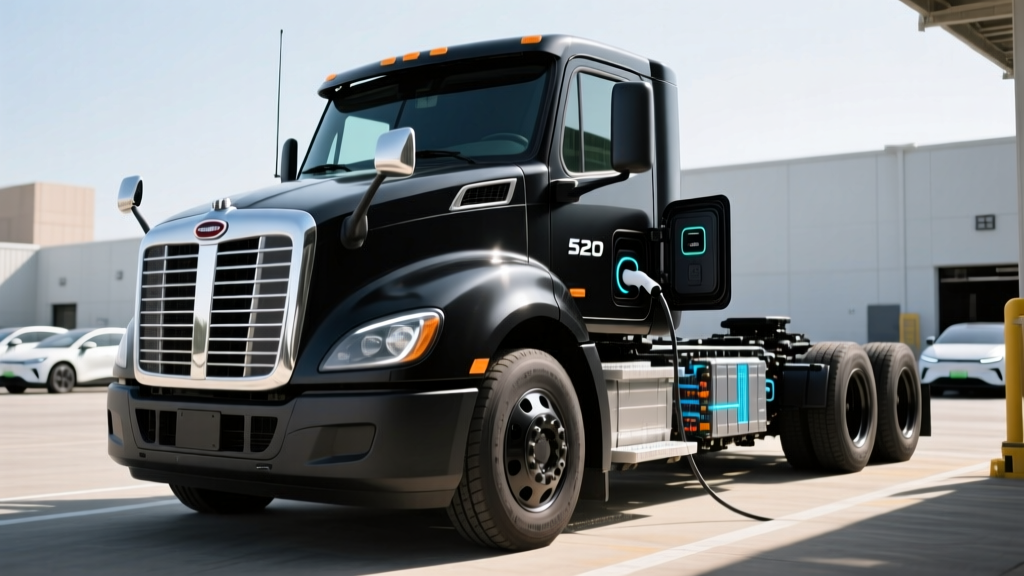
Bottom line: The Peterbilt 520EV is a Class 8 battery-electric refuse truck built for short-haul, high-stop collection routes. With a 170 kWh NMC battery pack delivering an estimated 150–200 miles of real-world range and 150 kW DC fast charging, it covers a typical single-shift refuse cycle on one charge. Fleet operators save roughly $18,000–$25,000 annually per truck in fuel and maintenance versus a diesel 520, but face $350,000+ upfront costs and depot charging infrastructure requirements. It is best suited to municipal and private waste fleets with predictable sub-150-mile daily routes and overnight depot charging access.
What the Peterbilt 520EV Actually Is
The Peterbilt 520EV is the battery-electric variant of Peterbilt's long-running 520 low-cab-forward (LCF) chassis, purpose-built for refuse collection, recycling, and municipal vocational work. Unlike highway-focused electric semis, the 520EV operates in stop-start, low-speed environments where regenerative braking recovers significant energy and diesel idling costs add up fast.
For 2026, the 520EV continues on the platform introduced in the early 2020s with incremental battery and thermal management updates. Peterbilt, a division of PACCAR, positions the 520EV against the Mack LR Electric, Autocar E-ACTT, and Crane Carrier Electrified chassis in the Class 8 BEV refuse segment.
This is not a consumer vehicle. MSRP pricing is negotiated through fleet sales channels and varies by configuration, battery option, and body integrator. Expect base chassis pricing in the $350,000–$420,000 range before body equipment (loader, hopper), which can add $80,000–$150,000 depending on spec.
Range, Battery, and Efficiency Specs
Heavy-duty vocational trucks do not carry EPA Monroney stickers the way light-duty vehicles do. Range figures come from manufacturer estimates and fleet operational data rather than fueleconomy.gov testing. Peterbilt rates the 520EV's battery pack at 170 kWh (usable), using NMC (nickel manganese cobalt) chemistry chosen for energy density in a chassis-constrained package.
| Specification | Peterbilt 520EV (2026) |
|---|---|
| Battery Capacity (usable) | 170 kWh, NMC |
| Manufacturer Estimated Range | Up to 200 mi (empty/light load) |
| Real-World Refuse Route Range | 120–170 mi (loaded, stop-start) |
| Electric Motor Output | ~350 kW (469 hp) peak |
| Peak Torque | ~3,600 lb-ft at wheels |
| GVWR | Up to 72,000 lbs (with pusher axle) |
| DC Fast Charge Rate (peak) | 150 kW (CCS1) |
| 10–80% DC Charge Time | ~65–75 minutes |
| Level 2 AC Charging | 19.2 kW (SAE J1772/CCS AC) |
| AC Full Charge Time | ~9–10 hours |
| Battery Warranty | 5 years / 300,000 mi (typical PACCAR HV) |
Real-world range reality: Peterbilt's "up to 200 miles" figure assumes favorable conditions — moderate temperatures, flat terrain, partial load. On a fully loaded residential refuse route with 800+ stops, PTO (power take-off) running the hydraulic loader, and hot or cold ambient temperatures, expect 120–150 miles before needing to return to depot. Cold weather (below 30°F) can reduce range by 20–30% due to battery thermal management loads and reduced regenerative braking efficiency. Most refuse routes run 60–100 miles per shift, which keeps the 520EV within comfortable margin.
Charging Infrastructure: What Depots Need
Charging a Class 8 truck is fundamentally different from plugging in a consumer EV. The 520EV uses a CCS1 connector and supports up to 150 kW DC fast charging — adequate for mid-shift top-ups but primarily designed for overnight depot charging at Level 2 AC speeds.
| Charging Level | Power | Miles Added/Hour | Use Case |
|---|---|---|---|
| Level 2 AC (Depot) | 19.2 kW | ~15–20 mi/hr | Overnight return-to-base |
| DC Fast (Mid-shift) | 150 kW peak | ~90–110 mi/hr (to 80%) | Split-shift top-up |
Depot charging installation costs are a major ownership variable. Each DC fast charger capable of 150 kW output costs $60,000–$120,000 for equipment alone. Electrical infrastructure upgrades — switchgear, transformers, conduit, utility service upgrades — frequently add $50,000–$200,000+ per site depending on existing capacity. For a fleet of ten 520EV trucks, total depot charging infrastructure can reach $1.5M–$3M before utility rebates.
Utility demand charges are another cost consumer EV owners never face. Charging ten trucks simultaneously at even 19.2 kW each pulls ~192 kW of continuous load, which can trigger significant demand charges on commercial electricity bills. Smart charging software that staggers charge sessions is practically mandatory.
Fleet operators should coordinate early with their local utility. Many utilities in California, New York, and other states with ZEV mandates offer make-ready infrastructure programs that cover 50–100% of electrical upgrade costs for commercial EV depot sites.
Total Cost of Ownership: 520EV vs Diesel 520
The purchase price gap between electric and diesel refuse trucks is enormous, but operating cost savings close it over time. Below is a 7-year TCO comparison based on typical municipal refuse fleet data — 80 miles/day, 250 operating days/year, diesel at $4.20/gallon, and commercial electricity at $0.18/kWh (national average for commercial accounts in 2026).
| Cost Category | Peterbilt 520EV | Peterbilt 520 Diesel |
|---|---|---|
| Purchase Price (chassis + body) | $450,000–$550,000 | $280,000–$340,000 |
| Federal/State Incentives | –$40,000 to –$165,000* | $0 |
| Annual Fuel/Energy (20,000 mi/yr) | $9,500–$12,000 | $24,000–$28,000 |
| Annual Maintenance | $4,000–$6,000 | $12,000–$16,000 |
| 7-Year Fuel Total | $66,500–$84,000 | $168,000–$196,000 |
| 7-Year Maintenance Total | $28,000–$42,000 | $84,000–$112,000 |
| Estimated 7-Year TCO (net of incentives) | $400,000–$530,000 | $532,000–$648,000 |
*Incentive note: The federal IRC §45W Commercial Clean Vehicle Credit provides up to $40,000 for qualifying Class 8 BEVs (30% of incremental cost over ICE equivalent, capped at $40,000 for vehicles over 14,000 lbs GVWR). Additional state incentives — particularly California's HVIP (Hybrid and Zero-Emission Truck and Bus Voucher Incentive Project) and similar programs in New York, New Jersey, and Oregon — can stack $50,000–$125,000 on top. Incentive availability and amounts vary by jurisdiction and change annually. Consult official program sources and a tax professional.
The breakeven point typically arrives around year 4–5 for high-utilization fleets (20,000+ miles/year). Below 10,000 miles/year, the diesel truck likely retains a TCO advantage through year 7 due to the massive upfront price gap.
EV vs Diesel: Head-to-Head Comparison
| Factor | 520EV (Electric) | 520 (Diesel) |
|---|---|---|
| Energy Cost per Mile | $0.48–$0.60 | $1.20–$1.40 |
| Drivetrain Maintenance | Minimal (no oil, filters, DEF, DPF) | Regular (oil, fuel filters, DEF, emissions) |
| Brake Wear | Reduced 40–60% (regen) | Standard replacement cycle |
| Range per Shift | 120–170 mi (loaded) | 350–500+ mi |
| Refueling/Recharge Time | 9–10 hr AC / 65–75 min DC (10–80%) | 10–15 min (diesel fill) |
| Noise at Collection Point | Near-silent (motor + hydraulics only) | 85+ dB diesel idle |
| Tailpipe Emissions | Zero | NOx, PM, CO₂ |
| Cold-Weather Impact | 20–30% range loss below 30°F | Minimal (block heater, gelled fuel mgmt) |
| Route Flexibility | Depot-tethered; limited mid-shift recharge | Any diesel station; reroute freely |
The 520EV's biggest operational advantage beyond cost is noise reduction. Residential refuse collection before 7 AM generates noise complaints; the electric drivetrain virtually eliminates drivetrain noise, leaving only the hydraulic loader and backup beeper as sound sources. Several municipalities have reported the ability to shift collection windows earlier, improving route efficiency.
Common Misconceptions About Electric Refuse Trucks
| Myth | Fact |
|---|---|
| "Electric trucks can't handle a full day of refuse collection." | Most single-shift residential routes run 60–100 miles. The 520EV's 120–170 loaded range covers this with margin. Double-shift or transfer-station routes may require mid-shift DC fast charging or route restructuring. |
| "Battery replacement will bankrupt the fleet." | NMC packs in vocational service are warrantied for 5 years / 300,000 miles. Replacement cost is estimated at $40,000–$70,000 (battery module, not full chassis teardown). Degradation in stop-start refuse service is slower than highway cycling due to shallow depth-of-discharge patterns. |
| "You can charge it from any public station." | Most public DC fast chargers are designed for light-duty vehicles. Physical clearance, cable length, and connector orientation often don't accommodate Class 8 chassis. Fleet depot charging is the standard model. |
| "Federal tax credits cover the full price difference." | The §45W credit caps at $40,000 for heavy trucks. State programs bridge more of the gap, but total incentives rarely exceed 30–40% of the EV premium. The remaining gap is closed through operational savings over years. |
Decision Framework: Is the 520EV Right for Your Fleet?
Choose the Peterbilt 520EV if:
- Your daily routes are under 120 miles loaded with predictable return-to-depot patterns
- You operate in a state or municipality with ZEV fleet mandates (CARB states, cities with clean-fleet ordinances)
- You have depot space and utility capacity for overnight Level 2 charging infrastructure
- You can access state incentive programs (HVIP, NYTVIP, etc.) that bridge $80,000+ of the cost gap
- Noise ordinances restrict early-morning collection in residential zones
- Your fleet runs 250+ days/year, maximizing operational savings to offset the purchase premium
Stick with the diesel 520 (or wait) if:
- Routes regularly exceed 150 miles or include highway transfer-station runs
- You lack depot charging infrastructure and your utility cannot support the load upgrade within your timeline
- You operate fewer than 150 days/year — the annual savings won't close the purchase gap
- Your service area is in a region with no state incentive programs and limited utility make-ready support
- You need mid-shift flexibility to reroute trucks across wide service areas without charger access
First-Time Electric Fleet Buyer Essentials
Transitioning from an all-diesel fleet to even a partial BEV deployment requires planning that goes well beyond vehicle selection:
Utility engagement starts 18–24 months before truck delivery. Transformer upgrades, new service drops, and switchgear installations for a multi-truck depot can take over a year. Start this conversation immediately.
Charge management software is not optional. Simultaneously plugging in ten trucks at 19.2 kW each creates a 192 kW continuous load. Smart charging platforms (e.g., Amply, Zeem, or OEM-integrated solutions) stagger sessions, manage demand charges, and ensure all trucks reach target SoC by departure time.
Driver and technician training changes are significant. High-voltage safety protocols (the 520EV operates at 600V+ nominal), regenerative braking behavior, and pre-trip inspection differences (no oil, coolant level checks replaced by battery thermal system checks) require formal training. Peterbilt and PACCAR offer fleet training programs.
Plan for battery end-of-life at procurement. While the battery should outlast the truck's first 7–10 year service cycle, second-life applications and recycling logistics are evolving. Include battery disposition in your procurement RFP.
Frequently Asked Questions
How long does the Peterbilt 520EV battery last?
PACCAR warranties the high-voltage battery for 5 years or 300,000 miles, whichever comes first, with a capacity retention threshold typically set at 70% of original capacity. In refuse service with shallow cycling and frequent regenerative braking, real-world degradation data from early-adopter fleets suggests 80–85% SoH (state of health) at the 5-year mark. The pack should remain serviceable through the truck's typical 10–12 year vocational lifespan, though with gradually reduced range.
What incentives are available for the 520EV?
The federal IRC §45W Commercial Clean Vehicle Credit provides up to $40,000 for qualifying Class 8 BEVs. State-level programs can add substantially more: California's HVIP has historically offered $60,000–$120,000+ per Class 8 refuse BEV, and similar voucher programs exist in New York (NYTVIP), New Jersey, and other CARB-influenced states. Eligibility rules, funding availability, and program structures change annually — consult IRS guidance and your state air quality board for current figures.
Can the 520EV operate in extreme cold?
Yes, but with range penalties. Below 30°F, expect 20–30% range reduction due to battery thermal conditioning energy draw and reduced regenerative braking efficiency. The 520EV includes a battery thermal management system that preconditioning while plugged in at the depot can mitigate significantly. Fleets in northern climates should spec routes conservatively — a 100-mile winter route is the practical maximum rather than the 140-mile summer capability.
What does depot charging infrastructure cost for a fleet of 520EVs?
For a 5-truck deployment with Level 2 AC depot charging (19.2 kW per truck), budget $150,000–$400,000 for equipment, electrical infrastructure, permits, and utility make-ready work. Adding one or two 150 kW DC fast chargers for mid-shift top-ups adds $120,000–$250,000. Utility make-ready incentive programs can offset 50–100% of electrical upgrade costs in qualifying jurisdictions. Engage your utility early for a site-specific assessment.
How does the 520EV compare to the Mack LR Electric?
The Mack LR Electric is the 520EV's most direct competitor. The LR Electric offers a similar ~150–200 mile range with a comparable NMC battery pack (around 160–170 kWh depending on configuration) and charges at similar DC rates. Differences come down to dealer network, body integrator compatibility, fleet management software ecosystem, and regional incentive qualification. Both are viable; the decision often comes down to which OEM your fleet's existing service relationship and body supplier support.