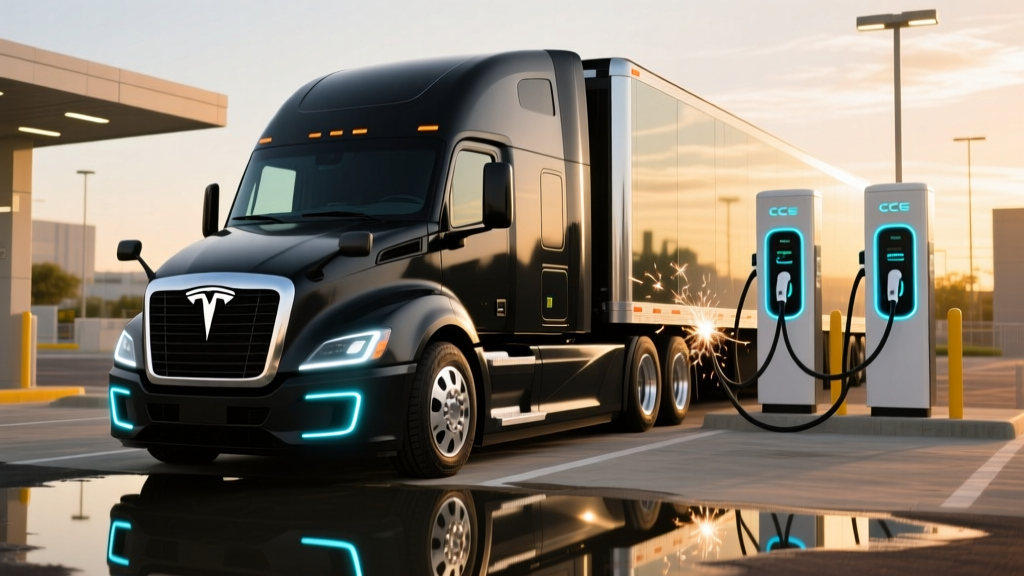
When PepsiCo's Frito-Lay division took delivery of its first Tesla Semi trucks in late 2022, it marked the highest-profile bet any major consumer-goods company had made on Class 8 electric trucking. By early 2026, Pepsi operates one of the largest Tesla Semi fleets in the world — over 100 units running regional routes out of Sacramento, Modesto, and other California distribution hubs. The "Pepsi Tesla Semi" has become shorthand for the promise and the friction of electrifying heavy freight. Here's what the data, the route logs, and the physics actually tell us.
Pepsi Tesla Semi: Core Specifications at a Glance
| Spec | Value |
|---|---|
| EPA-estimated range | 500 miles (loaded, 500-mile variant) |
| Battery capacity (est.) | ~900 kWh usable, NMC chemistry |
| Drivetrain | Tri-motor AWD (1 steer + 2 drive axles) |
| Horsepower / torque | ~1,000+ hp combined; >1,200 lb-ft peak |
| 0-60 mph (loaded) | ~20 seconds (80,000 lb GCW) |
| 0-60 mph (unloaded) | ~5 seconds (bobtail) |
| GCWR | 82,000 lb (California); 80,000 lb federal |
| Efficiency | <2 kWh/mile (Tesla claim, flat route) |
| Max DC fast charge | ~1.2 MW via MCS (Megacharger) |
| 10-80% charge time | ~30 minutes (at 1 MW+ sustained) |
| Base MSRP (500-mi) | $250,000 (estimated, fleet pricing) |
| Base MSRP (300-mi) | $180,000 (estimated) |
| Warranty | Not publicly disclosed; fleet contracts vary |
Two important context notes: Tesla has never published an official, third-party-verified battery capacity figure for the Semi. The ~900 kWh estimate is derived from the 500-mile range claim at <2 kWh/mile and is consistent with teardown analyses and industry modeling. Pricing is based on Tesla's originally announced MSRPs; actual fleet transaction prices, especially for a marquee customer like Pepsi, are negotiated and not public.
Real-World Range: What 500 EPA Miles Actually Means on a Route
Real-world expectation: 350–430 miles on mixed highway/regional routes with HVAC and elevation. Pepsi's own published data from early Sacramento-modesto runs showed ~400-450 mile round trips completed on a single charge with 5-10% SoC remaining — but those are relatively flat, climate-controlled California corridors.
Class 8 range is brutally sensitive to three variables that passenger EV drivers rarely think about:
- Payload weight. A fully cubed-out snack trailer at 42,000 lb of cargo draws significantly more energy than a half-load of lightweight product. Pepsi's Frito-Lay routes often run bulky-but-light loads (chips, puffs), which is actually favorable for range versus dense beverages.
- Grade and terrain. The 2% sustained grades on I-5 through the Grapevine or Tejon Pass can push consumption past 3 kWh/mile. Regenerative braking on the tri-motor setup recovers meaningful energy on descents, but net range on mountainous routes drops 15-25%.
- Ambient temperature and HVAC. Battery thermal management plus cab heating in a Midwest winter can trim 20-30% off the sticker range. Pepsi's California-heavy deployment sidesteps the worst of this, which is no accident.
For fleet planners: treat 500 EPA miles as a 375-425 mile operational planning radius on typical regional routes, with a hard 300-mile ceiling for cold-weather, high-altitude, or fully-loaded mountain corridors.
Charging the Pepsi Tesla Semi: Megachargers, MCS, and the 1.2 MW Reality
This is where the Pepsi Tesla Semi story gets genuinely interesting — and genuinely hard. Charging a ~900 kWh battery is not a scaled-up Model 3 problem. It's an infrastructure category of its own.
| Charging level | Connector | Peak power | Miles added per hour | Notes |
|---|---|---|---|---|
| Megacharger (Tesla proprietary MCS-class) | Proprietary / MCS | ~1.2 MW (1,200 kW) | ~500–600 mi/hr equivalent | 10-80% in ~30 min; depot-installed |
| Third-party MCS (CharIN standard) | MCS (Megawatt Charging System) | Up to 1.2 MW | ~500–600 mi/hr equivalent | Public MCS stations still sparse in 2026 |
| CCS2 / CCS1 high-power DC (adapter) | CCS (with adapter) | ~350–500 kW | ~175–250 mi/hr | Limited by connector thermal limits |
| Level 2 AC (depot overnight) | J1772 / Type 2 AC | ~40–80 kW | ~20–40 mi/hr | 10-12 hr overnight top-up |
The Megacharger is the unlock. Pepsi has co-invested with Tesla in depot-based Megacharger installations at its Modesto and Sacramento facilities. At a sustained ~1 MW, the Semi can recover roughly 70% of its battery in 30 minutes — enough to turn a driver's federally-mandated 30-minute meal break into a near-full recharge. The charge curve, like all large NMC packs, tapers meaningfully above 80% SoC; the final 20% can take as long as the first 80%.
Off-depot charging is the constraint. Public MCS infrastructure in 2026 is growing (WattEV, TeraWatt, and utility-backed corridor projects in California), but a Pepsi Semi running outside its home depot network cannot reliably find 1 MW+ charging en route. This is why Pepsi's Semi deployment is overwhelmingly hub-and-spoke: out-and-back routes from a Megacharger-equipped DC, not long-haul point-to-point.
Power requirement reality check: A 10-stall Megacharger depot pulling 12 MW simultaneously requires a utility-scale interconnection — typically a dedicated medium-voltage feed, on-site switchgear, and often a multi-month utility upgrade process. Pepsi's California depots have been able to leverage state incentive programs (including CARB's Hybrid and Zero-Emission Truck and Bus Voucher Incentive Project, or HVIP) to offset some of this infrastructure cost.
Performance and Drivetrain: Tri-Motor, 1,000+ Horsepower, and Merge-Lane Confidence
The Tesla Semi uses a tri-motor configuration — one motor on the steer axle (front) and two on the rear drive axles. Combined output exceeds 1,000 horsepower, which sounds absurd for a truck until you remember it's hauling 80,000 pounds up a 6% grade.
Key performance figures:
- 0-60 mph loaded (80,000 lb GCW): ~20 seconds. For context, a modern diesel Class 8 typically takes 45-60+ seconds for the same run.
- 0-60 mph unloaded (bobtail): ~5 seconds — sports-sedan territory, and a genuine safety benefit for highway on-ramps.
- Grade performance: Tesla claims the Semi can sustain 65 mph up a 5% grade — a scenario where many diesels drop into the 40s. This isn't a vanity stat; it directly reduces the "truck in the left lane doing 38 mph" problem that plagues freight corridors.
- Regen braking: The tri-motor regen is aggressive enough that Tesla touts dramatically reduced mechanical brake wear — a real maintenance cost saving for fleet operators.
The Semi's low center of gravity (battery pack under the cab and between the rails) gives it a notably planted feel versus a diesel with a high-mounted engine and fuel tanks. Rollover risk, a real concern in Class 8, is reduced.
Economics: MSRP, Fleet Pricing, and the Federal Tax Credit Question
| Item | Amount / Status |
|---|---|
| 300-mile variant MSRP (announced) | $180,000 |
| 500-mile variant MSRP (announced) | $250,000 |
| Pepsi / fleet transaction price | Not publicly disclosed |
| IRA §45W Commercial Clean Vehicle Credit | Up to $40,000 for vehicles >14,000 lb GVWR (subject to battery sourcing + MSRP caps per IRS §45W rules) |
| California HVIP voucher | Up to $240,000+ per Class 8 zero-emission truck (funding-dependent) |
| Estimated diesel-equivalent TCO parity | ~3-5 years on high-utilization regional routes |
Critical tax-credit distinction: The Tesla Semi is a commercial vehicle. It does not qualify for the consumer §30D Clean Vehicle Credit (the one with the $7,500 cap, income limits, and MSRP caps of $55,000/$80,000). Instead, fleets and owner-operators look at §45W, the Commercial Clean Vehicle Credit, which provides up to $40,000 for qualifying heavy-duty vehicles — but with its own battery-component and critical-mineral sourcing requirements that have tightened significantly under the Inflation Reduction Act. Pepsi, as a large corporate fleet, structures these credits differently than an owner-operator would; consult a tax professional and review current IRS §45W guidance for eligibility.
The bigger economic story is state-level incentives. California's HVIP vouchers, combined with CARB's advancing Clean Truck Rule and the state's mandate for drayage and short-haul fleets to electrify, have made the Semi's effective acquisition cost dramatically lower for California-deployed units like Pepsi's. Outside California and a handful of incentive-rich states (New York, New Jersey, Oregon), the economics are considerably tougher without similar voucher support.
Operating cost delta: At $0.15–$0.25/kWh industrial electricity rates (typical for depot charging in California), the Semi's energy cost is roughly $0.30–$0.50/mile. A comparable diesel at $4.50/gallon and 6.5 mpg runs ~$0.69/mile in fuel alone — before accounting for diesel's higher maintenance burden (DEF, DPF, oil, transmission service). On a 100,000-mile/year regional route, the energy savings alone can approach $30,000–$40,000 annually per truck.
Technology, Cab, and Driver Experience
The Semi's cab is where Tesla's passenger-car DNA shows most clearly — and where it diverges most sharply from a Freightliner eCascadia or Volvo VNR Electric.
- Center-mounted driver seat with dual 15-inch touchscreens flanking the steering column — one for vehicle/telemetry, one for navigation/media. No analog gauges.
- Tesla's fleet telematics platform provides real-time SoC, route energy prediction, driver behavior scoring, and remote preconditioning — all integrated, no third-party dongle required.
- Enhanced Autopilot (Level 2 SAE) is standard, including adaptive cruise, lane-keep, and automatic emergency braking. This is not self-driving — the driver must remain fully engaged and is legally responsible for the vehicle at all times. See the NHTSA's guidance on ADS for context on automation levels.
- Jackknife prevention: Tesla's stability control system actively modulates individual motors to prevent trailer swing — a meaningful safety upgrade over conventional ESC.
- No sleeper cab (as of 2026): The Semi is a day-cab configuration. This is a hard constraint that limits it to regional and short-haul applications; long-haul team-driving with a sleeper is not currently an option.
Who the Pepsi Tesla Semi Model Suits — and Who It Doesn't
The Pepsi deployment is instructive because it reveals the specific use case where the Semi excels:
- Ideal: Regional hub-and-spoke routes, 200-400 miles round-trip, depot-based overnight + opportunity charging on driver breaks, high annual mileage (to amortize the capex), California or incentive-rich states, bulk/lightweight freight (snacks, consumer goods, e-commerce).
- Poor fit: Long-haul OTR (>500-mile one-way runs without reliable en-route MCS), heavy/dense freight at max GCW in mountainous terrain, fleets without depot ownership or utility-upgrade capacity, operations in states without HVIP-class vouchers.
Pepsi's success with the Semi is partly a function of route selection — they deployed the trucks on routes engineered to play to the Semi's strengths. A fleet buying Semis for unrestricted long-haul use in 2026 will have a very different experience.
Competitive Set: Tesla Semi vs. Freightliner eCascadia vs. Volvo VNR Electric
The Pepsi Tesla Semi doesn't operate in a vacuum. Its two primary production competitors in the Class 8 battery-electric space:
- Freightliner eCascadia: ~230-mile range, ~470 kWh battery, ~400 hp, CCS charging at ~180 kW peak. Lower upfront cost (~$300,000+ list, heavily voucher-dependent), far broader dealer/service network, sleeper-cab option. The volume leader in Class 8 EV, but range and performance are a tier below the Semi.
- Volvo VNR Electric: ~275-mile range (6-battery pack), ~565 kWh, ~455 hp, CCS at ~250 kW. Strong build quality, excellent dealer support, good for regional/drayage. Again, range and performance trail the Semi substantially.
The Semi's range and performance advantage is real — but so is its infrastructure dependency and Tesla's limited Class 8 service footprint compared to Daimler Truck or Volvo Group. Pepsi's choice reflects a willingness to invest in dedicated infrastructure in exchange for a capability gap no competitor currently matches.
Pros, Cons, and the Bottom Line
Pros
- Class-leading 500-mile EPA range enables routes no other production BEV Class 8 can touch
- 1.2 MW Megacharger capability: 10-80% in ~30 min when infrastructure exists
- Tri-motor performance eliminates the "slow truck on the grade" problem
- Integrated telematics and fleet software — no third-party integration tax
- Dramatically lower per-mile energy cost vs. diesel on high-utilization routes
- Regen braking cuts mechanical brake maintenance significantly
Cons
- ~900 kWh battery = massive upfront cost and depot power-interconnection burden
- Public MCS infrastructure in 2026 is still sparse; off-depot operation is risky
- No sleeper cab — regional/day-cab only
- Tesla's Class 8 service and parts network is thin vs. Daimler/Volvo
- Fleet pricing opaque; MSRP is an "announced" number, not a consumer sticker
- Heavy curb weight reduces legal payload vs. diesel in some jurisdictions
Bottom line: The Pepsi Tesla Semi is less a consumer product review and more a proof-of-concept at scale. Pepsi has demonstrated that, on the right routes with the right depot infrastructure and the right incentives, a 500-mile BEV Class 8 can run real commercial freight profitably. For other fleets, the question is whether your routes, your depot, and your state incentives look like Pepsi's. If they do, the Semi is the most capable production electric semi-truck available. If they don't, the eCascadia or VNR Electric — with their broader service networks and lower infrastructure demands — may be the more pragmatic 2026 play.
Pepsi Tesla Semi FAQ
What is the real-world range of the Pepsi Tesla Semi?
EPA-estimated at 500 miles (500-mile variant, loaded). Real-world fleet operations on flat California regional routes show 400-450 miles achievable with modest SoC remaining. Expect 350-400 miles in mixed terrain and 300-350 miles in cold, mountainous, or fully-loaded conditions.
How fast does the Tesla Semi charge at a Megacharger vs. at the depot overnight?
At a Tesla Megacharger (~1.2 MW), 10-80% in roughly 30 minutes. Overnight Level 2 depot charging at 40-80 kW takes 10-12 hours for a full cycle — suitable for daily top-up but not a mid-day turnaround.
Does the Tesla Semi qualify for the $7,500 federal EV tax credit?
No. The $7,500 credit is the consumer §30D credit with passenger-vehicle MSRP and income caps. The Semi is a commercial vehicle and may qualify for the §45W Commercial Clean Vehicle Credit of up to $40,000, subject to battery sourcing and other IRS requirements. Consult a tax professional and current IRS guidance.
Is the Pepsi Tesla Semi worth it vs. a Freightliner eCascadia or Volvo VNR Electric?
For high-mileage regional routes where 500-mile range and 30-minute fast charging unlock operational advantages — and where depot Megacharger investment is feasible — the Semi's capability lead is substantial. For fleets needing sleeper cabs, broad dealer service, or operation outside incentive-rich states, the eCascadia and VNR Electric are more pragmatic 2026 options.
How many Tesla Semis does Pepsi actually operate?
As of early 2026, PepsiCo (primarily through Frito-Lay and Pepsi Beverages) operates well over 100 Tesla Semis, concentrated in California. Exact fleet counts fluctuate as deliveries continue; Pepsi has publicly committed to scaling its zero-emission fleet significantly through 2030.
Can a Tesla Semi do long-haul, cross-country routes today?
Not practically. The absence of a sleeper cab, the sparsity of public 1 MW+ MCS charging outside select California corridors, and the route-planning overhead of a ~900 kWh battery make the Semi a regional/day-cab truck in 2026. Long-haul BEV Class 8 remains an emerging, not a current, capability.