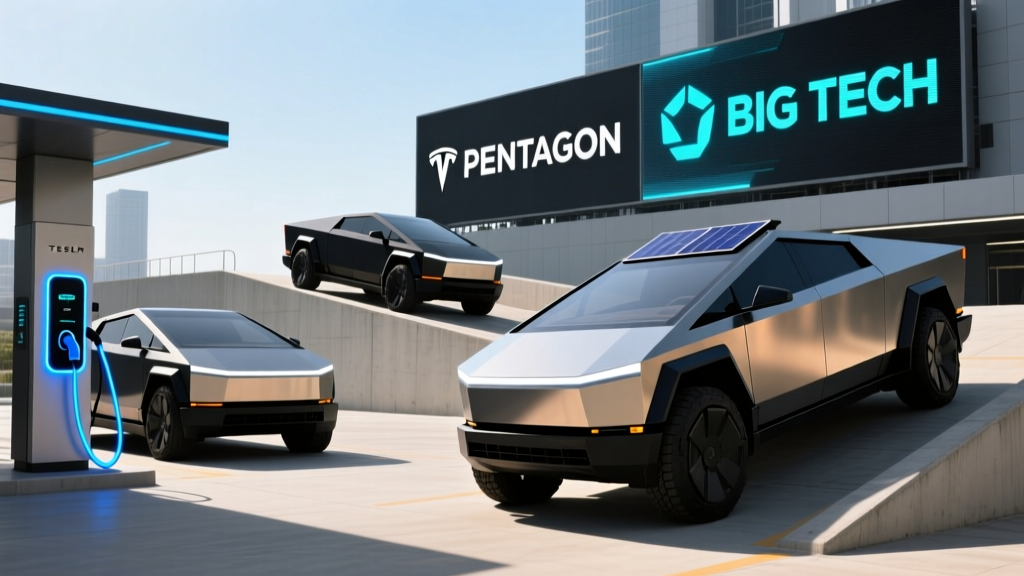
The Tesla Cybertruck has become an unlikely fixture in two very different motor pools: defense-contractor campuses around the Pentagon and the employee parking structures of Big Tech headquarters from Mountain View to Seattle. The Pentagon, Big Tech, and Tesla Cybertrucks might seem like a strange Venn diagram, but the convergence makes sense once you look at the 2026 model's specs, fleet economics, and the stainless-steel exoskeleton's utility profile. This review breaks down the Cybertruck as a fleet and consumer vehicle with exact numbers on range, charging, pricing, and tax-credit eligibility.
Why the Pentagon and Big Tech Are Both Buying Cybertrucks
Defense contractors (think General Dynamics, BAE Systems, Leidos) operating near the Pentagon and at proving grounds have begun adding Cybertrucks to light-duty fleet roles: site-to-site personnel transport, light cargo runs, and security patrol vehicles on secured campuses. The appeal is the 48-volt electrical architecture (which supports high-draw auxiliary equipment), the stainless-steel body's resistance to minor impacts, and the ability to run fleet tax incentives under IRS §30D and §45W.
Big Tech fleets — Google, Meta, Apple shuttle-adjacent logistics — are drawn by a different calculus: employee-perk optics, sustainability reporting (Scope 1 electrification), and the Cybertruck's 11,000-pound towing rating for campus facilities work. Neither group buys the Cybertruck as a tactical vehicle; they buy it as an electrified light truck that happens to look like nothing else in the lot.
Spec Table: 2026 Tesla Cybertruck at a Glance
| Specification | AWD (Dual-Motor) | Cyberbeast (Tri-Motor) |
|---|---|---|
| EPA Range | 340 miles | 320 miles |
| Battery (usable) | ~123 kWh, NMC | ~123 kWh, NMC |
| Horsepower | 600 hp | 845 hp |
| 0-60 mph | 3.9 seconds | 2.6 seconds |
| Drivetrain | Dual-motor AWD | Tri-motor AWD |
| Peak DC Fast Charge | 250 kW | 250 kW |
| 10-80% DCFC Time | ~25 minutes | ~25 minutes |
| Level 2 Home Charge | 11.5 kW (~37 mi/hr) | 11.5 kW (~37 mi/hr) |
| Towing Capacity | 11,000 lbs | 11,000 lbs |
| Payload | 2,500 lbs | 2,500 lbs |
| Base MSRP (2026) | $79,990 | $99,990 |
Real-World Range: What the EPA Sticker Doesn't Tell You
EPA Estimate: 340 miles (AWD) / 320 miles (Cyberbeast)
Real-World Expectation: Expect 270-295 miles at sustained 75 mph highway speeds in moderate temperatures. In cold weather (below 30°F), plan for 220-260 miles due to cabin heating load, battery preconditioning draw, and increased rolling resistance. City driving with regen braking recovers closer to the EPA figure, around 310-330 miles.
The Cybertruck's angular stainless-steel body has a drag coefficient around 0.34 — worse than the Model Y's 0.23 but competitive with the Rivian R1T. Highway efficiency suffers accordingly. On fueleconomy.gov, the AWD variant posts roughly 2.0 kWh/mile (50 MPGe combined), meaning highway-heavy commutes will push consumption to 2.3-2.5 kWh/mile. Fleet managers running Pentagon-area routes with 65-mph belts will see better numbers than 80-mph interstate hauls.
Charging: 250 kW Peak with a Steep Taper
The Cybertruck uses the NACS (Tesla) connector natively and charges on the Supercharger network at a peak of 250 kW. However, that peak is short-lived. The charge curve holds roughly 230-250 kW only from approximately 10-30% State of Charge, then tapers to ~150 kW by 50% and drops below 100 kW past 70%. The practical 10-80% time is about 25 minutes if you precondition the battery by routing to a Supercharger via navigation.
| Charging Method | Power | Miles Added per Hour | Notes |
|---|---|---|---|
| Level 1 (120V) | 1.4 kW | ~3 mi/hr | Emergency/trickle only |
| Level 2 (240V, 48A) | 11.5 kW | ~37 mi/hr | Full overnight charge (~9 hrs 10-80%) |
| DC Fast (Supercharger V3/V4) | 250 kW peak | ~750+ mi/hr (at peak) | 10-80% in ~25 min; tapers sharply above 70% |
For Big Tech campuses installing depot charging, the Cybertruck accepts 11.5 kW on Level 2, which is adequate for overnight fleet turnaround but requires 48A dedicated circuits per stall. Fleet electricians should plan for 60A breakers per vehicle and verify panel capacity — a 10-vehicle Cybertruck depot could demand 600A of new 240V service.
Performance, Cargo, and the Stainless-Steel Reality
The Cyberbeast's 2.6-second 0-60 time is supercar territory in a 6,800-pound truck, and the AWD's 3.9 seconds is quicker than nearly every gas truck on the market. Dual- and tri-motor torque vectoring provides genuine off-road capability in low-traction scenarios, though ground clearance (9.1 inches standard, up to 17.4 inches with adaptive air suspension) limits serious rock-crawling versus a Rivian R1T or Ford F-150 Lightning with skid plates.
Cargo dimensions matter for fleet work:
- Bed: 6 ft × 4 ft (72 cu ft enclosed with powered tonneau)
- Vault (frunk): ~7 cu ft lockable front trunk
- Rear-seat legroom: 41.4 inches
- Front headroom: 40.7 inches
The powered retractable tonneau is standard and can support 300 pounds distributed — useful for standing loads or gear racks. The stainless-steel "Ultra-Hard" 30X body panels resist dents and minor abrasions, which is why Pentagon-adjacent security teams appreciate them for patrol duty. The trade-off: body repair after a significant collision requires Tesla-certified shops with specialized welding equipment, and wait times for panels have stretched to 6-10 weeks in some markets.
Pricing, Tax Credits, and Fleet Economics
| Trim | Base MSRP | Federal Credit (§30D) | Effective Price |
|---|---|---|---|
| AWD (Dual-Motor) | $79,990 | Up to $7,500* | ~$72,490 |
| Cyberbeast (Tri-Motor) | $99,990 | Up to $7,500* | ~$92,490 |
*Federal §30D credit eligibility requires: buyer AGI below $150K single / $300K joint; vehicle MSRP under $80,000 for trucks (the AWD qualifies, the Cyberbeast does not); battery sourcing and critical-mineral thresholds met per IRS guidance. Point-of-sale transfer is available at participating dealers. Fleet purchases under §45W (commercial clean vehicle credit) follow different rules — consult a tax professional.
Big Tech companies purchasing Cybertrucks as fleet vehicles typically use §45W rather than §30D, since the vehicles are titled to the corporation. Pentagon contractors operating under GSA schedules may face additional procurement rules. In both cases, the Cybertruck's effective cost drops further when state incentives (California's CVRP, for example) and MACRS depreciation are applied.
Warranty, Tech, and Driver-Assist Limitations
Tesla covers the Cybertruck with:
- Basic Vehicle: 4 years / 50,000 miles
- Battery & Drive Units: 8 years / 150,000 miles (minimum 70% capacity retention)
- Rear Torque-Arm Recall: Addressed on all 2024-2025 builds; 2026 models ship with the revised part
The 18.5-inch center touchscreen runs Tesla's current software stack, including navigation-based trip planning with Supercharger routing. Autopilot (basic lane-keep and traffic-aware cruise) is standard. Full Self-Driving (Supervised) remains a SAE Level 2 driver-assist system — the driver must remain engaged, eyes on the road, hands available. It is not autonomous driving and should not be confused with Level 4 services like Waymo.
FSD (Supervised) Limitations: Requires continuous driver supervision. Performance degrades in construction zones, unmapped roads, heavy rain, and faded lane markings. Fleet policies at many Big Tech companies and defense contractors prohibit FSD use during work hours due to liability and safety protocols.
Pros, Cons, and Who Should Buy
Pros
- 340-mile EPA range (AWD) is top-tier for electric trucks
- 250 kW DC fast charging with NACS native
- 11,000-lb towing with integrated trailer brake controller
- Stainless body resists dents — ideal for fleet/patrol use
- 48V architecture supports high-draw auxiliary equipment
- Supercharger network access (most reliable public DC network in the US)
Cons
- Cyberbeast exceeds $80K MSRP cap — no §30D credit
- Highway efficiency drops sharply above 70 mph (~2.3 kWh/mi)
- Cold-weather range loss of 20-30% without preconditioning
- Stainless panel repair requires specialized shops, long lead times
- Rear visibility is poor; relies heavily on camera/digital mirror
- Steep charge-curve taper past 70% SoC frustrates road-trip charging
Best for: Fleet operators (corporate campuses, defense-adjacent contractors, facilities management) who need a durable electric truck with high towing capacity and can depot-charge overnight. Also suits individual buyers who tow boats or trailers on weekends and have home Level 2 charging.
Not ideal for: Apartment dwellers without charging access, budget-conscious buyers (the Rivian R1S and Ford F-150 Lightning XLT start far lower), or anyone who needs a third row for family hauling.
FAQ: Pentagon, Big Tech & Tesla Cybertrucks
What is the real-world range of the 2026 Cybertruck?
EPA rates the AWD at 340 miles and the Cyberbeast at 320 miles. In real-world highway driving at 75 mph, expect 270-295 miles. In sub-30°F cold, plan for 220-260 miles unless you precondition the battery while plugged in.
How fast does the Cybertruck charge at home and on DC fast chargers?
At home on a 240V Level 2 charger (48A), it adds about 37 miles per hour, filling 10-80% in roughly 9 hours. On a 250 kW Supercharger, 10-80% takes about 25 minutes, but the charge rate tapers significantly above 70%.
How much does the Cybertruck cost after federal tax credits?
The AWD at $79,990 qualifies for up to $7,500 under §30D (if buyer income and battery-sourcing rules are met), bringing the effective price to ~$72,490. The Cyberbeast at $99,990 exceeds the $80,000 MSRP cap for trucks and does not qualify for §30D.
Does the Cybertruck qualify for the federal EV tax credit?
The AWD trim does, subject to IRS §30D rules: buyer AGI under $150K (single) or $300K (joint), vehicle MSRP under $80K for trucks, and battery critical-mineral/sourcing thresholds. The Cyberbeast does not qualify due to its $99,990 MSRP. Fleet buyers may use §45W instead. Always verify current rules at irs.gov.
Is the Cybertruck worth buying vs. the Rivian R1T or Ford F-150 Lightning?
It depends on use case. The Cybertruck offers more range (340 vs. R1T's ~328) and faster Supercharger network access, but the R1T has better off-road clearance and a more conventional repair network. The F-150 Lightning is cheaper and more practical for traditional truck buyers but has shorter range and slower DC charging. For fleet buyers who value stainless durability and 48V architecture, the Cybertruck has no direct rival.
Why are Pentagon contractors and Big Tech buying Cybertrucks?
Defense contractors value the stainless body's durability for security patrol, the 48V system for auxiliary equipment, and fleet tax incentives. Big Tech companies use them for sustainability reporting, campus logistics, and employee-perk optics. Neither group uses them as tactical or autonomous vehicles — they're electrified light trucks for specific fleet roles.