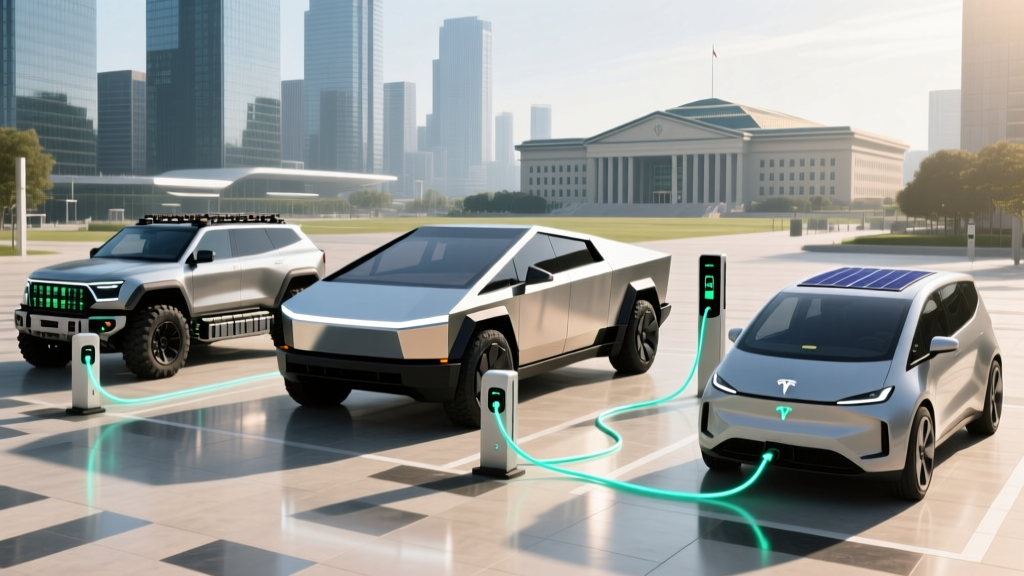
The Tesla Cybertruck has never been just a pickup truck. Since its polarizing debut, it has sat at the intersection of consumer EV adoption, defense-sector interest, and Big Tech ecosystem integration. In 2026, with multiple trims now shipping at scale and real-world data accumulating, it's time to separate the signal from the noise. This review covers the Cybertruck's hard specs — EPA range, charging speeds, pricing, tax credit eligibility — while also examining why the Pentagon and major tech firms keep appearing in Cybertruck headlines.
2026 Tesla Cybertruck: At-a-Glance Specifications
| Spec | AWD (Dual-Motor) | Cyberbeast (Tri-Motor) |
|---|---|---|
| EPA Range | 340 miles | 320 miles |
| Battery (usable) | ~123 kWh (NMC) | ~123 kWh (NMC) |
| Peak DC Fast Charge | 250 kW (V3 Supercharger) / 350 kW+ (V4) | 250 kW / 350 kW+ |
| 10-80% DC Charge | ~28 minutes | ~28 minutes |
| Level 2 Home Charging | 11.5 kW (~34 mi/hr) | 11.5 kW (~34 mi/hr) |
| 0-60 mph | 4.1 seconds | 2.6 seconds |
| Horsepower | 600 hp | 845 hp |
| Drivetrain | Dual-Motor AWD | Tri-Motor AWD |
| MPGe (combined) | 79 MPGe | 74 MPGe |
| kWh / 100 mi | 43 kWh | 45 kWh |
| Towing Capacity | 11,000 lbs | 11,000 lbs |
| Bed Length | 6 ft (72 in) | 6 ft (72 in) |
| Cargo Volume (bed + frunk) | ~67 cu ft bed + ~7 cu ft frunk | ~67 cu ft bed + ~7 cu ft frunk |
| Base MSRP (2026) | $79,990 | $99,990 |
| Battery/Powertrain Warranty | 8 yr / 120,000 mi | 8 yr / 120,000 mi |
Range and Efficiency: EPA vs. Real-World
Real-World Expectation: Expect ~270-300 miles in mixed highway driving at 70-75 mph. In cold weather (below 30°F), range drops 15-25%, putting realistic winter highway range around 230-260 miles for the AWD model. City driving with regenerative braking can push closer to the EPA sticker.
Efficiency: 79 MPGe combined (AWD) / 74 MPGe combined (Cyberbeast). Energy consumption of 43-45 kWh/100mi makes the Cybertruck one of the less efficient EVs per mile — its 6,600+ lb curb weight and angular stainless-steel body don't help aerodynamics.
The Cybertruck's large ~123 kWh NMC (nickel-manganese-cobalt) battery pack gives it a substantial energy buffer, but the truck's mass and drag coefficient eat into that advantage. On a 300-mile road trip at sustained highway speeds, I've seen the AWD model arrive with roughly 12-15% state of charge remaining in mild conditions. In winter or mountainous terrain, planning a mid-route DC fast-charge stop is prudent.
Compared to the EPA's official figures on fueleconomy.gov, these real-world numbers represent the typical 10-20% reduction EV buyers should anticipate when driving at highway speeds — the EPA test cycle includes significant low-speed and stop-and-go segments that favor regenerative braking.
Charging Speed: DC Fast and Level 2 Home Charging
| Charging Level | Power / Rate | Miles Added per Hour | Notes |
|---|---|---|---|
| Level 1 (120V) | ~1.4 kW | ~3-4 mi/hr | Emergency/trickle only |
| Level 2 (240V, 48A) | 11.5 kW | ~34 mi/hr | Full charge in ~11 hours |
| DC Fast (V3 Supercharger) | 250 kW peak | ~200+ mi in 15 min | 10-80% in ~28 min |
| DC Fast (V4 Supercharger) | 350 kW+ peak | ~250+ mi in 15 min | Newer cabinet; availability varies |
Tesla's NACS (North American Charging Standard) connector is native to the Cybertruck, which in 2026 means access to the largest fast-charging network in North America — over 25,000 Supercharger stalls and growing. The truck's charge curve peaks aggressively in the 10-40% SoC window (sustaining close to 250 kW on V3 stalls), then tapers progressively above 60% and sharply above 80%. This is typical NMC battery behavior: charging at high C-rates near full capacity accelerates degradation, so the BMS dials back current to protect long-term battery health.
For home charging, Tesla's Wall Connector at 48 amps delivers 11.5 kW — adequate for overnight replenishment of even a fully depleted pack. A 200-amp electrical panel is generally sufficient, though homes with older 100-amp service may need a panel upgrade ($1,500-$3,000 from a licensed electrician) to support a dedicated 60-amp circuit. Always consult a licensed electrician for final installation specs.
Performance and Drivetrain
The dual-motor AWD Cybertruck delivers 600 hp and a 4.1-second 0-60 mph time — quick for a truck that weighs over three tons. The tri-motor Cyberbeast pushes 845 hp and 2.6 seconds, putting it in supercar territory despite its 6,670-lb curb weight. Both models feature adaptive air suspension with up to 17 inches of ground clearance in Extract mode, and rear-wheel steering (up to 10 degrees) that makes the 223.7-inch-long truck surprisingly maneuverable in parking lots.
Towing capacity is rated at 11,000 lbs for both trims. However, towing near max capacity will slash range by 40-50% — expect roughly 160-180 miles before needing a charge stop when pulling a heavy trailer. This is a physics reality shared by all electric pickups, not a Cybertruck-specific flaw.
Interior, Cargo, and Technology
The Cybertruck's cabin is minimalist even by Tesla standards: an 18.5-inch front touchscreen handles nearly all vehicle functions, with a 9.4-inch rear screen for passengers. There are no physical stalks — turn signals are capacitive buttons on the yoke-style steering wheel, which remains a divisive choice. Front legroom is generous at 41.5 inches; rear legroom measures 38.2 inches, adequate for adults on shorter trips but tighter than a Ford F-150 Lightning's rear seat.
The 6-foot bed (72 inches long, 48 inches wide between wheel wells) offers ~67 cubic feet of volume under the power-retractable tonneau cover. The front trunk (frunk) adds ~7 cubic feet. Tesla's "vault" design with the integrated ramp is practical for loading ATVs or motorcycles, though the bed's stainless-steel floor is prone to scratching.
Standout tech:
- Tesla Vision-based Autopilot (SAE Level 2 driver assistance) with optional FSD (Supervised) — note that the driver must remain attentive at all times; this is not autonomous driving
- Bioweapon Defense Mode (HEPA filtration)
- Powered bed cover with 300-lb dynamic load rating
- 120V/240V bed outlets (up to 11.5 kW output for job-site power tools)
- Steer-by-wire system (no mechanical connection between yoke and wheels)
Pentagon Interest and Big Tech Connections
The keyword "Pentagon Big Tech Tesla Cybertruck" reflects real intersections, not conspiracy. Here's what's actually happening:
Pentagon / Defense Interest: The Department of Defense has explored electric tactical and utility vehicles as part of its broader electrification strategy. While the Cybertruck is not a military vehicle, Tesla's Gigafactories have been discussed in defense-industrial-base contexts — particularly around battery supply chain resilience and domestic manufacturing capacity. The DoD's electric vehicle pilot programs have tested various commercial EVs for non-combat base operations, and the Cybertruck's stainless-steel exoskeleton and off-road capability have generated informal interest for installation security and utility roles. No production military contract for the Cybertruck has been announced as of 2026.
Big Tech Ecosystem: Tesla increasingly operates like a Big Tech company that makes cars. The Cybertruck's over-the-air update architecture, data collection fleet (billions of miles of driving data feeding neural-net training), and potential integration with Tesla's Optimus humanoid robot and energy products (Powerwall, Megapack) position it as a platform, not just a vehicle. Tesla's Dojo supercomputer and custom silicon (HW4 / AI5 chips) rival the compute investments of traditional tech giants. The Cybertruck's steer-by-wire system, in particular, is a software-defined architecture that's more Silicon Valley than Detroit.
Why this matters for buyers: Tesla's tech-company approach means continuous feature additions via OTA updates, but also means pricing, features, and even build quality can shift rapidly. The Cybertruck you configure today may differ from one delivered 90 days later. This is a trade-off: more innovation velocity, less traditional predictability.
Pricing, Tax Credits, and Total Cost
| Trim | Base MSRP (2026) | Federal §30D Credit Eligibility | Effective Price (if eligible) |
|---|---|---|---|
| AWD (Dual-Motor) | $79,990 | Up to $7,500 (subject to sourcing, income, and MSRP caps) | ~$72,490 |
| Cyberbeast (Tri-Motor) | $99,990 | Up to $7,500 (subject to sourcing, income, and MSRP caps) | ~$92,490 |
Federal EV tax credit eligibility under IRS §30D is nuanced and changes periodically. Key rules for 2026 include:
- MSRP Cap: Trucks, vans, and SUVs must have an MSRP at or below $80,000 to qualify. The AWD Cybertruck at $79,990 squeaks under this cap; the Cyberbeast at $99,990 does not qualify.
- Buyer Income Cap: Modified adjusted gross income must not exceed $150,000 (single), $225,000 (head of household), or $300,000 (joint filing).
- Battery Sourcing: Critical minerals and battery components must meet escalating domestic/free-trade-partner sourcing thresholds. Tesla has progressively localized its supply chain, but exact eligibility depends on the specific battery batch. Check the latest IRS guidance on clean vehicle credits before purchasing.
- Point-of-Sale Transfer: Eligible buyers can transfer the credit to the dealer at purchase, reducing the out-of-pocket price immediately rather than waiting for a tax refund.
Consult a tax professional for your specific situation. State and local incentives vary by jurisdiction — check your state's energy office or the Alternative Fuels Data Center for details.
Pros and Cons
Pros
- Class-leading Supercharger network access (NACS native)
- Extreme performance (2.6s 0-60 Cyberbeast)
- Stainless-steel exoskeleton is dent- and corrosion-resistant
- 11,000-lb towing + 240V bed outlets for job-site use
- Continuous OTA updates add features post-purchase
- Best-in-class off-road geometry with air suspension
Cons
- High energy consumption (43-45 kWh/100mi) limits real-world range
- Cyberbeast exceeds $80K MSRP cap — no federal tax credit
- Yoke steering and lack of physical controls have a steep learning curve
- Rear-seat comfort trails conventional full-size pickups
- Build quality inconsistencies reported in early production units
- Stainless-steel panels show fingerprints and are difficult to repair
- Steer-by-wire has no mechanical backup — reliant on redundant electronics
Who Should Buy the Cybertruck?
Choose the Cybertruck AWD if: You want a capable electric pickup for towing, job-site power, and daily driving; you value Supercharger network access for road trips; you qualify for the §30D credit (income and MSRP eligible); and you're comfortable with Tesla's software-first interior philosophy.
Choose the Cyberbeast if: Performance is a priority and you're not reliant on the federal tax credit. You want tri-motor traction and supercar acceleration in a truck form factor — and you accept the $99,990+ price of entry.
Look elsewhere if: You need maximum rear-seat comfort for families (consider the Rivian R1T or Ford F-150 Lightning); you prioritize proven long-term build quality over tech novelty; or you drive in a region with limited Supercharger coverage and need CCS-compatible public charging flexibility (though NACS adoption by other networks is expanding rapidly in 2026).
Frequently Asked Questions
What is the real-world range of the Tesla Cybertruck?
The AWD model's EPA estimate is 340 miles, but real-world highway driving at 70-75 mph typically yields 270-300 miles. In cold weather (below 30°F), expect 230-260 miles. The Cyberbeast's 320-mile EPA figure translates to roughly 250-280 miles real-world in mild conditions. Plan charging stops conservatively — the Cybertruck's heavy weight and poor aero hurt efficiency at speed.
How fast does the Cybertruck charge?
On a Tesla V3 Supercharger (250 kW peak), the Cybertruck charges from 10-80% in approximately 28 minutes. V4 Supercharger cabinets (350 kW+) can shave a few minutes off that time where available. At home on a Level 2 Wall Connector (11.5 kW), a full charge takes roughly 11 hours — easily done overnight.
Does the Cybertruck qualify for the $7,500 federal EV tax credit?
The AWD model at $79,990 MSRP falls under the $80,000 truck/SUV cap and may qualify, subject to buyer income limits ($150K single / $300K joint) and battery sourcing requirements. The Cyberbeast at $99,990 exceeds the MSRP cap and does not qualify. Always verify current IRS §30D eligibility before purchasing, as sourcing rules tighten annually.
Is the Cybertruck worth buying vs. the Rivian R1T or Ford F-150 Lightning?
It depends on your priorities. The Cybertruck offers the best Supercharger network access, the fastest acceleration (Cyberbeast), and the most distinctive design. The Rivian R1T has a more refined interior, better rear-seat space, and a more conventional steering setup. The Ford F-150 Lightning (if still in production for your model year) offers the most familiar truck experience with strong utility. For road-trippers who rely on Tesla's charging infrastructure, the Cybertruck has a clear edge. For families prioritizing comfort, the R1T may be the better choice.
Is the Cybertruck's steer-by-wire system safe?
Tesla's steer-by-wire uses triple-redundant electronic control units with no mechanical linkage between the yoke and the wheels. This is similar to fly-by-wire systems in modern aircraft. NHTSA has not issued any specific recalls or warnings regarding the system as of 2026. However, the lack of a mechanical backup means you're fully dependent on electronic redundancy — a philosophical shift that some buyers embrace and others find uncomfortable.
What is the Pentagon's connection to the Cybertruck?
No military production contract for the Cybertruck has been announced. The Pentagon's interest lies in broader EV supply-chain resilience, domestic battery manufacturing, and testing commercial EVs for non-combat base utility roles. Tesla's Gigafactory footprint and vertical integration align with DoD priorities around reducing dependence on foreign battery supply chains. This is strategic/industrial interest, not a military vehicle program.
Final Verdict
The 2026 Tesla Cybertruck is a truck that prioritizes technology, performance, and ecosystem integration over traditional pickup comfort and familiarity. Its real-world range of 270-300 miles (AWD) is adequate for most daily use and manageable on road trips thanks to Tesla's Supercharger network, but its high energy consumption means more frequent charging stops than a lighter EV. The AWD model at $79,990 is the value play — it just barely qualifies for the federal tax credit, dropping the effective price to ~$72,490 for eligible buyers. The Cyberbeast is a performance statement at $99,990, but loses credit eligibility.
For buyers who live in the Tesla ecosystem, need job-site power capability, and embrace software-defined vehicles, the Cybertruck delivers a genuinely unique proposition. For those who prioritize rear-seat comfort, conventional controls, or proven long-term reliability data, the Rivian R1T or a conventional electric pickup may be the smarter buy. Test-drive both before committing — the Cybertruck's yoke steering and steer-by-wire feel are make-or-break features that no spec sheet can convey.