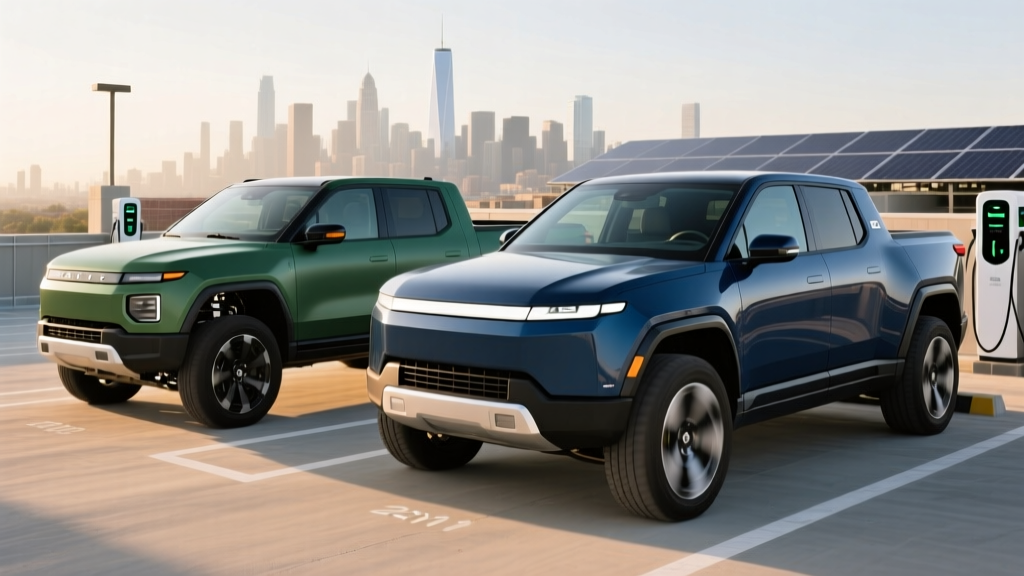
Buying a Rivian is not like buying a Toyota. The R1T pickup and R1S SUV are software-defined, adventure-oriented EVs built by a startup that iterates hardware and firmware continuously. For owners of Rivian vehicles in 2026, the experience is a blend of class-leading capability, over-the-air evolution, and the growing pains of a young automaker. This review synthesizes real-world ownership data, EPA figures, and 2026 model-year specs to answer the questions buyers actually ask before signing a $75,000+ purchase order.
2026 Rivian Lineup: Quick Spec Snapshot
| Spec | R1T (Pickup) | R1S (SUV) |
|---|---|---|
| EPA Range (Standard / Max) | 270 mi / 420 mi | 270 mi / 410 mi |
| Battery (usable, chemistry) | 95 kWh / NMC (Std); 141 kWh / NMC (Max) | 95 kWh / NMC (Std); 141 kWh / NMC (Max) |
| Drivetrain | Dual-Motor AWD (Tri- & Quad-Motor avail.) | Dual-Motor AWD (Tri- & Quad-Motor avail.) |
| Horsepower (Dual / Tri / Quad) | 533 / 665 / 1,025 hp | 533 / 665 / 1,025 hp |
| 0-60 mph (Dual-Motor) | 4.5 sec | 4.6 sec |
| Max DC Fast Charge | 220 kW (peak) | 220 kW (peak) |
| 10-80% DCFC Time | ~30 min (Std pack) | ~30 min (Std pack) |
| Level 2 Home Charge | 11.5 kW / ~25 mi/hr | 11.5 kW / ~25 mi/hr |
| Efficiency (MPGe) | 73 MPGe combined | 73 MPGe combined |
| Towing Capacity | 11,000 lbs | 7,700 lbs |
| Cargo (bed / behind 3rd row) | 54 cu ft bed + 11 cu ft frunk | 105 cu ft max (seats folded) |
| Base MSRP (2026) | $69,900 | $75,900 |
| Battery/Powertrain Warranty | 8 yr / 175,000 mi | 8 yr / 175,000 mi |
Real-World Range vs. EPA Sticker: What Owners Actually See
Rivian's NMC (nickel manganese cobalt) battery chemistry prioritizes energy density over cycle longevity compared to LFP. The 141 kWh Max Pack adds roughly 600 lbs and $10,000 to the build, but it's the only configuration that makes cross-country travel stress-free on the current Electrify America and Rivian Adventure Network infrastructure. Standard Pack owners plan charging stops every 2-2.5 hours of interstate driving.
Charging Speed and Infrastructure: The Rivian Adventure Network Advantage
Rivian's 2026 models accept up to 220 kW at DC fast chargers, but sustained rates tell the real story. On a 350 kW Electrify America station, the Standard Pack peaks near 200 kW for roughly 10 minutes before tapering, averaging ~140 kW across a 10-80% session. The Max Pack, with its larger thermal mass, sustains higher rates longer but takes 45-50 minutes for 10-80% due to sheer capacity.
| Charging Level | Power (kW) | Miles Added per Hour | Typical Use Case |
|---|---|---|---|
| Level 1 (120V household) | 1.4 kW | ~3 mi/hr | Emergency / trickle only |
| Level 2 (240V home Wall Connector) | 11.5 kW | ~25 mi/hr | Daily overnight charging |
| DC Fast Charge (Std Pack) | 220 kW peak | ~200 mi in 30 min (10-80%) | Road trips |
| DC Fast Charge (Max Pack) | 220 kW peak | ~270 mi in 45 min (10-80%) | Road trips |
Home charging is where most owners of Rivian vehicles spend 90% of their charging time. Rivian's Wall Connector ($500) delivers 11.5 kW on a 60-amp circuit, fully replenishing the Standard Pack in ~9 hours. Installation costs typically range from $800-$2,500 depending on panel capacity and conduit runs — budget for a possible $1,500-$3,000 panel upgrade if your home still has a 100-amp service. According to fueleconomy.gov, home charging at $0.15/kWh costs roughly $14 for a full Standard Pack, equating to ~$0.05/mile — a fraction of gasoline at current prices.
Performance, Towing, and Off-Road Capability
The Dual-Motor AWD powertrain delivers 533 hp and a 4.5-second 0-60 mph time in the R1T — quick for a 7,000-lb truck. The Tri-Motor ($10,000 upgrade) bumps output to 665 hp, while the Quad-Motor (available in Adventure and Ascend trims) produces 1,025 hp and a sub-3.0-second sprint. Most owners opt for the Dual-Motor, which provides ample passing power and better efficiency.
Towing is where Rivian's engineering shows its limits and strengths simultaneously. The R1T's 11,000-lb rating exceeds the Ford F-150 Lightning's 10,000-lb max, but towing at capacity cuts range by 40-50%. Owners of Rivian trucks report 130-160 miles of effective range when towing 8,000+ lbs at highway speeds. The integrated trailer brake controller and digital hitch view are excellent, but no EV pickup currently makes long-distance heavy towing practical without meticulous charge planning.
Off-road, the R1T and R1S are legitimately capable. The air suspension provides up to 14.9 inches of ground clearance, and the quad-motor torque-vectoring system (Tri- and Quad-Motor only) delivers precise wheel-level traction control. The hydraulic roll control system eliminates the need for traditional sway bars, improving articulation. This is not a mall-crawler — owners regularly take these vehicles on moderate-to-difficult trails with confidence.
Pricing, Trims, and Federal Tax Credit Eligibility
2026 Rivian pricing has stabilized after several years of restructuring. The base Dual-Motor Standard Pack R1T starts at $69,900; the R1S at $75,900. The Adventure trim (mid-level) adds $5,000-$7,000; the Ascend (luxury) adds $10,000-$12,000. Max Pack adds $10,000; Tri-Motor adds $10,000; Quad-Motor adds $18,000. A well-equipped R1T Adventure Dual-Motor Max Pack lands around $96,000 before incentives.
| Requirement | R1T Eligibility | R1S Eligibility |
|---|---|---|
| MSRP Cap (trucks: $80K; SUVs/vans: $80K) | ✅ Base/Dual-Motor Std qualifies | ⚠️ Base qualifies; most trims exceed $80K |
| Buyer Income Cap (AGI: $150K single / $300K joint) | Varies by buyer | Varies by buyer |
| Battery Component Sourcing (N. America assembly) | ✅ Normal, IL assembly | ✅ Normal, IL assembly |
| Critical Minerals Sourcing | ⚠️ Partial credit ($3,750) likely | ⚠️ Partial credit ($3,750) likely |
| Point-of-Sale Transfer | ✅ Available at delivery | ✅ Available at delivery |
Source: IRS §30D guidelines. Eligibility depends on specific build configuration, buyer AGI, and current-year battery sourcing certifications. Consult a tax professional before purchase. Many Rivian configurations qualify for $3,750 (half-credit) due to critical mineral sourcing requirements; full $7,500 eligibility varies by model year and battery supplier.
Tech, Software, and Driver Assistance: Rivian OS and Highway Assist
Rivian's in-house software stack (Rivian OS, currently v2026.x) is a standout. The 15.6-inch center display is responsive, the navigation integrates the Rivian Adventure Network and third-party chargers with battery preconditioning, and the gear tunnel (R1T-exclusive) is accessible via the touchscreen or phone app. Over-the-air updates arrive monthly, adding features like camp mode improvements, new trail maps, and efficiency optimizations.
Highway Assist is Rivian's Level 2 driver-assistance system (SAE Level 2 — driver must remain engaged with hands on wheel and eyes on road). It combines adaptive cruise control and lane-centering on divided highways. It's competent but not class-leading: the system occasionally hunts in construction zones and requires more steering-wheel torque input than GM's Super Cruise or Ford's BlueCruise. It does not offer hands-free driving or automatic lane changes without driver confirmation. Owners of Rivian vehicles generally use it for long highway stretches but remain fully attentive.
Ownership Costs, Reliability, and Warranty
Rivian's 8-year/175,000-mile battery and powertrain warranty exceeds the industry-standard 8-year/100,000-mile coverage, reflecting confidence in its NMC cell suppliers (Samsung SDI and LG Energy Solution). The bumper-to-bumper warranty is 5 years/60,000 miles. Battery degradation data from early 2022-2023 owners shows ~5-7% capacity loss at 50,000 miles — within expectations for NMC chemistry with active thermal management.
Reliability has been a mixed bag. Early-build R1T and R1S vehicles (2022-2023) experienced panel-gap inconsistencies, 12V battery drain issues, and occasional drive-unit replacements. 2025-2026 builds show marked improvement, but owners of Rivian vehicles still report more service-center visits than Tesla or Hyundai/Kona owners. Rivian's mobile service fleet handles ~60% of repairs at the owner's home, but major issues (battery pack, drive unit) require a service center, and wait times in some regions stretch to 2-3 weeks.
Insurance costs are elevated: expect $2,500-$4,000 annually depending on location and driving record, reflecting the vehicle's repair costs and performance. Depreciation has been steep for early models (30-40% in year one) but is stabilizing as the brand matures and the used market absorbs supply.
Who Should Buy a Rivian — and Who Should Look Elsewhere
- You need genuine off-road capability and 11,000-lb towing in an EV
- You value software-driven features and OTA updates
- You have home Level 2 charging and mostly drive <200 miles/day
- You want a distinctive, non-Tesla design with adventure branding
- You need 300+ miles of reliable highway range without the $10K Max Pack upcharge
- You want the lowest possible cost of ownership (Hyundai Ioniq 5, Tesla Model Y are cheaper)
- You live far from a Rivian service center
- You need three-row seating with adult-sized third row (R1S third row is child-sized; consider Kia EV9)
Pros and Cons: The Owner Verdict
- Best-in-class off-road and towing capability for an EV
- Rivian Adventure Network expanding (400+ chargers by end of 2026)
- Excellent software, frequent OTA updates
- 8yr/175K battery warranty exceeds competitors
- Unique features: gear tunnel, camp kitchen, air suspension
- Standard Pack range (270 mi EPA) requires frequent road-trip stops
- Service center availability limited in rural areas
- Highway Assist lags Super Cruise/BlueCruise in refinement
- Max Pack and Tri/Quad-Motor push price past $100K
- Insurance and depreciation costs above segment average
FAQ: Answers for Prospective Owners of Rivian Vehicles
What is the real-world range of a 2026 Rivian R1T?
The Dual-Motor Standard Pack delivers ~230-250 highway miles, ~180-210 miles towing, and ~190 miles in cold weather. The Max Pack delivers ~340-360 highway miles. Always plan conservatively; the EPA sticker (270/420 mi) assumes mixed driving at moderate speeds.
How fast does the Rivian charge at home and on road trips?
Home Level 2 (11.5 kW) adds ~25 miles per hour, fully charging the Standard Pack overnight. DC fast charging peaks at 220 kW, delivering 10-80% in ~30 minutes (Standard) or ~45 minutes (Max Pack), though sustained rates average lower due to charge-curve taper above 80%.
Does the 2026 Rivian qualify for the $7,500 federal tax credit?
Base Dual-Motor Standard configurations qualify for at least $3,750 under IRS §30D, subject to buyer income caps ($300K joint / $150K single) and MSRP limits ($80K). Full $7,500 eligibility depends on critical mineral sourcing certifications, which vary by build month. Many buyers receive the $3,750 half-credit as a point-of-sale reduction.
Is Rivian more reliable than Tesla?
Early Rivian builds (2022-2023) had more reported issues than contemporary Teslas, primarily fit/finish and 12V system problems. 2025-2026 builds show improvement, but Tesla's mature service network and simpler powertrain still give it an edge in uptime. Rivian's mobile service mitigates this for minor issues.
Can I tow a trailer long-distance with the R1T?
Yes, but plan carefully. At 8,000+ lbs, expect 130-160 miles of range. The 11,000-lb rating is for short, low-speed moves. Long-distance towing requires Max Pack and meticulous charge planning along the Rivian Adventure Network and Electrify America corridors.
How does the R1S compare to the Kia EV9 or Tesla Model X?
The R1S is more off-road capable and adventure-focused but has a cramped third row. The EV9 offers more passenger space at a lower price (~$55K-$73K) but lacks off-road chops. The Model X provides more range and Supercharger access but is aging and costs significantly more (~$80K-$100K). Choose R1S for trails and towing; EV9 for family hauling; Model X for range and network.
Ownership data aggregated from Rivian owner forums, EPA fueleconomy.gov listings, and manufacturer specifications. Tax credit rules subject to change; verify current-year eligibility at IRS.gov before purchase.