The Short Answer on the Outlander Electric
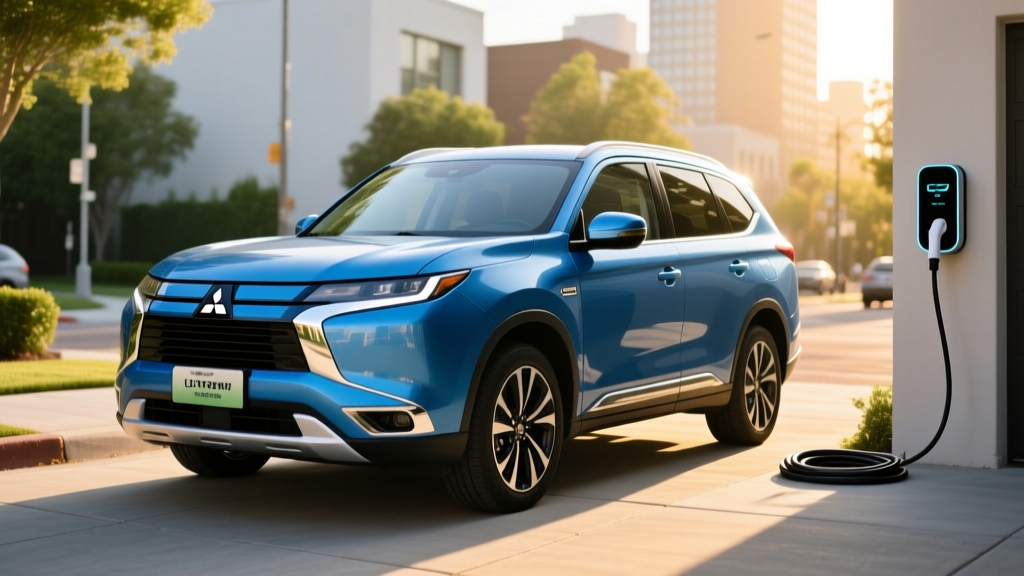
There is no fully electric (BEV) Mitsubishi Outlander for the 2026 model year. What exists is the Mitsubishi Outlander PHEV — a plug-in hybrid SUV that pairs a 20.0 kWh battery with a 2.4-liter gasoline engine. It delivers 38 miles of EPA-rated electric-only range, 64 MPGe in electric mode, and 26 MPG combined once the battery is depleted. Starting at $41,840 (including destination), it qualifies for the full $7,500 federal tax credit under current IRS §30D rules, effectively bringing the base price to roughly $34,340 for eligible buyers. If you're searching for an "Outlander electric," this PHEV is the electrified model Mitsubishi offers — and for many households, it's the most practical bridge between gas and full EV ownership.
2026 Outlander PHEV: Core Specs at a Glance
| Specification | Value |
|---|---|
| Powertrain | 2.4L 4-cyl + twin electric motors (S-AWC AWD) |
| Combined System Output | 248 hp / 353 lb-ft torque |
| Battery Capacity | 20.0 kWh (lithium-ion, NMC chemistry) |
| EPA Electric-Only Range | 38 miles |
| EPA MPGe (Electric Mode) | 64 MPGe |
| EPA MPG (Gas-Only / Charge-Sustaining) | 26 MPG combined (25 city / 27 hwy) |
| Total Driving Range (Gas + Electric) | ~420 miles |
| Max DC Fast Charge Rate | ~22 kW (CHAdeMO connector) |
| Level 2 Charge Time (0–100%) | ~6.5 hours at 3.3 kW |
| DC Fast Charge (0–80%) | ~38 minutes |
| 0–60 mph | ~7.4 seconds |
| Cargo Volume (Behind 2nd Row) | 33.5 cu ft |
| Seating | 7 passengers (standard 3rd row) |
| Towing Capacity | 1,500 lbs |
| Battery Warranty | 10 years / 100,000 miles |
| Powertrain Warranty | 10 years / 100,000 miles |
| Base MSRP (ES trim, incl. destination) | $41,840 |
| Top Trim MSRP (GT-Prestige) | $52,840 |
A few numbers deserve immediate context. The 38-mile electric range is the EPA sticker figure; in real-world driving, expect 30–35 miles if you're doing mostly highway miles at 70+ mph or driving in temperatures below 40°F. Mitsubishi's 20 kWh battery has a usable capacity closer to 17.5 kWh, as the system reserves a buffer to protect long-term battery health. The 6.5-hour Level 2 charge time assumes a dedicated 240V circuit at 16 amps — more on home charging costs below.
Outlander PHEV vs. Gas SUV: The Real Cost Comparison
The most common question from shoppers considering the Outlander PHEV is whether the premium over a gas-only compact SUV pays off. Let's compare it against a well-equipped 2026 Honda CR-V AWD (gas) and a fully electric rival, the Hyundai Ioniq 5 AWD, over a 5-year ownership horizon at 15,000 miles per year.
| Cost Factor (5 Years / 75k Miles) | Outlander PHEV (ES) | Honda CR-V AWD (Gas) | Hyundai Ioniq 5 AWD (BEV) |
|---|---|---|---|
| MSRP (before incentives) | $41,840 | $36,200 | $50,250 |
| Federal Tax Credit (§30D) | −$7,500 | $0 | −$7,500* |
| Effective Purchase Price | $34,340 | $36,200 | $42,750 |
| Fuel/Energy Cost (5 yr) | $4,800 | $9,750 | $3,600 |
| Maintenance (5 yr) | $2,800 | $3,500 | $1,500 |
| Insurance (5 yr avg.) | $8,200 | $7,100 | $8,900 |
| Estimated Depreciation | $14,500 | $12,800 | $18,200 |
| 5-Year Total Cost of Ownership | $64,640 | $69,350 | $74,950 |
*Ioniq 5 §30D eligibility depends on battery sourcing and buyer income — verify current-year rules at IRS.gov. Fuel costs assume 70% electric / 30% gas driving for the PHEV, $3.50/gal for gas, and $0.14/kWh for home charging. Actual costs vary by region and utility rates.
The Outlander PHEV wins the 5-year TCO contest primarily because of the $7,500 federal credit collapsing the purchase price below the gas CR-V, combined with substantially lower fuel costs when daily driving stays within that 38-mile electric envelope. The key variable is your commute: if your round trip is under 35 miles and you charge nightly at home, you'll burn very little gasoline. If you regularly drive 60+ miles daily without charging opportunities, the PHEV operates mostly as a 26-MPG hybrid, and the cost advantage narrows.
Charging the Outlander PHEV: Home Setup and Costs
The Outlander PHEV charges through a J1772 connector for Level 1 and Level 2 AC charging, and uses a CHAdeMO connector for DC fast charging. This is important: CHAdeMO is a legacy standard. While Electrify America and some regional networks still maintain CHAdeMO connectors, the North American industry has standardized on NACS (Tesla) and CCS. If DC fast charging on road trips matters to you, the CHAdeMO limitation is a genuine drawback compared to CCS/NACS-equipped PHEVs like the Toyota RAV4 Prime (which also lacks DC fast charging, but for different packaging reasons).
| Charging Level | Power (kW) | Time to Full | Cost per Full Charge | Where |
|---|---|---|---|---|
| Level 1 (120V household outlet) | ~1.4 kW | ~15 hours | $2.45 (at $0.14/kWh) | Any standard outlet |
| Level 2 (240V, 16A dedicated circuit) | 3.3 kW | ~6.5 hours | $2.45 | Home wall charger / public L2 |
| DC Fast Charge (CHAdeMO) | ~22 kW peak | ~38 min (0–80%) | $4.50–$6.00 (public rates) | Select public stations |
For most PHEV owners, Level 1 charging is actually sufficient. The 20 kWh battery is small enough that plugging into a standard 120V outlet overnight (10–12 hours) will fully replenish it by morning. This means many buyers can skip the $800–$2,000 Level 2 home installation entirely — a significant ownership advantage over full BEVs with 75+ kWh batteries.
That said, if you want faster turnaround between drives or plan to use the Outlander PHEV's battery more aggressively throughout the day, a Level 2 installation makes sense. Budget $500–$800 for a quality 16A EVSE (charge cable unit) and $400–$1,200 for electrician labor, depending on whether your electrical panel is near the garage or requires a conduit run. A panel upgrade (from 100A to 200A service) adds $1,500–$3,000 but is only needed in older homes.
Who Should Buy the Outlander PHEV — and Who Shouldn't
Not every SUV shopper is well-served by a plug-in hybrid. The Outlander PHEV excels in specific ownership scenarios and falls short in others. Here's a practical decision framework:
Choose the Outlander PHEV If:
- Your daily round-trip commute is under 35 miles and you can charge at home overnight.
- You need 3-row seating for 7 passengers — very few PHEVs or EVs in this price range offer this.
- You take 2–4 road trips per year of 200+ miles and don't want to plan around DC fast-charging infrastructure.
- You want to reduce gasoline consumption meaningfully without committing to a full BEV.
- You qualify for the $7,500 federal tax credit (income caps: $150K single / $300K joint; MSRP cap: $80K for SUVs).
Look Elsewhere If:
- Your daily commute exceeds 50+ miles one-way — you'll spend most miles on gasoline at 26 MPG, negating the PHEV advantage. Consider a full BEV like the Ioniq 5 or a more efficient hybrid like the Toyota Highlander Hybrid (35 MPG).
- You cannot charge at home (apartment, street parking, no garage access). Without regular plug-in charging, you're paying a premium for a battery you never use. A conventional HEV makes more economic sense.
- You need towing over 1,500 lbs. The Outlander PHEV's 1,500-lb rating is below competitors like the Toyota RAV4 Prime (1,500 lbs but with far more electric range) or the gas-only Honda Passport (5,000 lbs).
- DC fast charging on road trips is critical. The CHAdeMO connector limits your public charging options significantly compared to NACS/CCS vehicles.
Common Misconceptions About the Outlander PHEV
| Myth | Fact |
|---|---|
| "It's a fully electric SUV." | The Outlander PHEV is a plug-in hybrid, not a battery-electric vehicle. It has a gasoline engine and requires fuel for trips beyond its 38-mile electric range. Mitsubishi does not currently sell a fully electric Outlander. |
| "The battery will need expensive replacement soon." | Mitsubishi covers the PHEV battery for 10 years / 100,000 miles against defects and capacity loss below a specified threshold. PHEV batteries are smaller and undergo shallower charge cycles than BEV batteries, which generally translates to slower degradation. Replacement cost, if ever needed out of warranty, is estimated at $4,000–$6,000 — far less than a full BEV battery pack. |
| "I need to install a $2,000 home charger." | The 20 kWh battery charges fully overnight on a standard 120V outlet (Level 1). Many PHEV owners never install a Level 2 charger. Level 2 is a convenience upgrade, not a requirement. |
| "The $7,500 tax credit applies to everyone." | The §30D credit has income caps ($150K single filers, $225K head of household, $300K joint), an $80,000 MSRP cap for SUVs, and battery sourcing requirements that may change yearly. The credit can now be transferred to the dealer at point of sale as a purchase price reduction. Always verify current eligibility at IRS.gov or with a tax professional before purchasing. |
| "It gets 64 MPG all the time." | 64 MPGe applies only when driving on electricity from a full charge. Once the battery depletes, the Outlander PHEV operates as a conventional hybrid rated at 26 MPG combined. Your blended fuel economy depends entirely on how often you charge and how far you drive between charges. |
Living With the Outlander PHEV: Real Ownership Considerations
After the purchase decision, daily life with a PHEV introduces habits that differ from both gas cars and full EVs. Here's what first-time PHEV buyers should anticipate:
Daily charging discipline matters. The economic case for the Outlander PHEV rests on using its electric range every day. Plug in when you get home — it takes 10 seconds, like charging a phone. If you forget or skip charging for weeks, you're driving a 26-MPG hybrid that cost you an extra $5,640 (after the tax credit) over a gas-only competitor. The PHEV rewards consistent habits.
Cold weather affects electric range, not total range. At 20°F, expect electric-only range to drop to roughly 25–28 miles. The gasoline engine will engage sooner to provide cabin heat and maintain battery temperature. However, your total range (gas + electric) remains roughly 400+ miles because the gas tank is unaffected. This is the core PHEV advantage: cold weather is an inconvenience, not a crisis.
Regenerative braking is adjustable. The Outlander PHEV offers paddle-shift regen adjustment, letting you increase regenerative braking intensity for one-pedal-style driving around town. It won't bring the vehicle to a complete stop (as some full EVs do), but it significantly reduces brake wear in stop-and-go traffic. Expect brake pad life of 60,000–80,000+ miles thanks to regen offloading.
The third row is real but tight. The 2026 Outlander PHEV's third row fits children or smaller adults for short trips. Cargo space behind the third row is limited (roughly 11.7 cu ft), but with the third row folded, you get 33.5 cu ft — competitive for the segment. The battery pack is mounted under the floor and does not intrude into cargo or passenger space, which is a packaging win.
Insurance runs 10–15% higher than a comparable gas-only Outlander, based on national averages for PHEVs. This reflects higher repair costs for electrified powertrains and elevated parts pricing. Get a quote before purchasing — the premium varies significantly by insurer and state.
How It Stacks Up Against Rivals
| Spec | Mitsubishi Outlander PHEV | Toyota RAV4 Prime | Hyundai Tucson PHEV |
|---|---|---|---|
| Electric Range (EPA) | 38 mi | 42 mi | 33 mi |
| MPGe (Electric) | 64 MPGe | 94 MPGe | 80 MPGe |
| MPG (Gas Only) | 26 combined | 38 combined | 35 combined |
| Horsepower | 248 hp | 302 hp | 261 hp |
| Battery Capacity | 20.0 kWh | 18.1 kWh | 13.8 kWh |
| 0–60 mph | ~7.4 sec | ~5.7 sec | ~7.1 sec |
| Seating | 7 (3 rows) | 5 (2 rows) | 5 (2 rows) |
| DC Fast Charging | CHAdeMO (~22 kW) | None | None |
| Base MSRP | $41,840 | $44,515 | $38,725 |
| Federal Tax Credit | $7,500 | $7,500 | $7,500 |
| Battery Warranty | 10 yr / 100k mi | 10 yr / 150k mi | 10 yr / 100k mi |
The Outlander PHEV's standout advantage is 7-passenger seating — neither the RAV4 Prime nor Tucson PHEV offers a third row. If you need three rows and want plug-in hybrid efficiency, the Outlander is essentially the only option under $55,000. However, the RAV4 Prime delivers far superior gas-only fuel economy (38 vs. 26 MPG), more power, and longer electric range — it's the better PHEV for 5-passenger households. The Tucson PHEV undercuts on price but offers less electric range.
For fuel economy data, see the EPA's ratings at fueleconomy.gov.
Frequently Asked Questions
Is there a fully electric Mitsubishi Outlander?
No. As of the 2026 model year, Mitsubishi does not offer a battery-electric (BEV) Outlander. The only electrified variant is the Outlander PHEV (plug-in hybrid). Mitsubishi has announced future EV plans but no fully electric Outlander is currently on sale or available for order.
Can I drive the Outlander PHEV on electricity alone without ever using gas?
Yes, for trips under 38 miles (EPA) or roughly 30–35 miles in real-world conditions, the Outlander PHEV runs purely on electricity. However, the gasoline engine will start periodically for system maintenance (engine lubrication, emissions system readiness) even if you primarily drive electric. Mitsubishi's system manages this automatically. You should still keep fuel in the tank and change it periodically to prevent stale gasoline issues.
How much does it cost to charge the Outlander PHEV at home?
A full charge of the 20 kWh battery (roughly 17.5 kWh usable) costs approximately $2.45 at the national average residential rate of $0.14/kWh. That's about 7¢ per electric mile. Compare this to gasoline at $3.50/gal and 26 MPG, which works out to about 13.5¢ per mile. Electric driving in the Outlander PHEV costs roughly half what gasoline driving costs per mile.
Do I qualify for the $7,500 federal tax credit?
Eligibility for the §30D New Clean Vehicle Credit depends on three factors: your adjusted gross income (must not exceed $150K single / $225K head of household / $300K joint), the vehicle MSRP (must be under $80,000 for SUVs — all Outlander PHEV trims qualify), and battery component and critical mineral sourcing requirements set by the IRS. As of 2026, the Outlander PHEV qualifies for the full $7,500 credit. The credit can be applied as a point-of-sale reduction through a registered dealer. Verify current rules at IRS.gov before purchasing, as sourcing requirements update annually.
What happens when the battery runs out of warranty?
The Outlander PHEV battery is covered for 10 years or 100,000 miles. If the battery degrades below a specified capacity threshold (typically around 60–70% of original capacity) during the warranty period, Mitsubishi will repair or replace it. Out of warranty, a PHEV battery replacement is estimated at $4,000–$6,000 — significantly less than a full BEV battery. Given the smaller battery size and shallower cycling, most PHEV batteries outlast their warranty periods with minimal degradation.
How does the Outlander PHEV handle in snow and ice?
Very well. The Outlander PHEV comes standard with Mitsubishi's S-AWC (Super All-Wheel Control) system, which uses the twin rear electric motors to provide torque vectoring across all four wheels. Combined with the vehicle's weight (roughly 4,700 lbs) and available winter tires, it performs confidently in snow. The electric motors provide instant torque from a standstill, which aids traction on slippery surfaces.