What Is the Orange EV OBD Connector and Why Does It Matter?
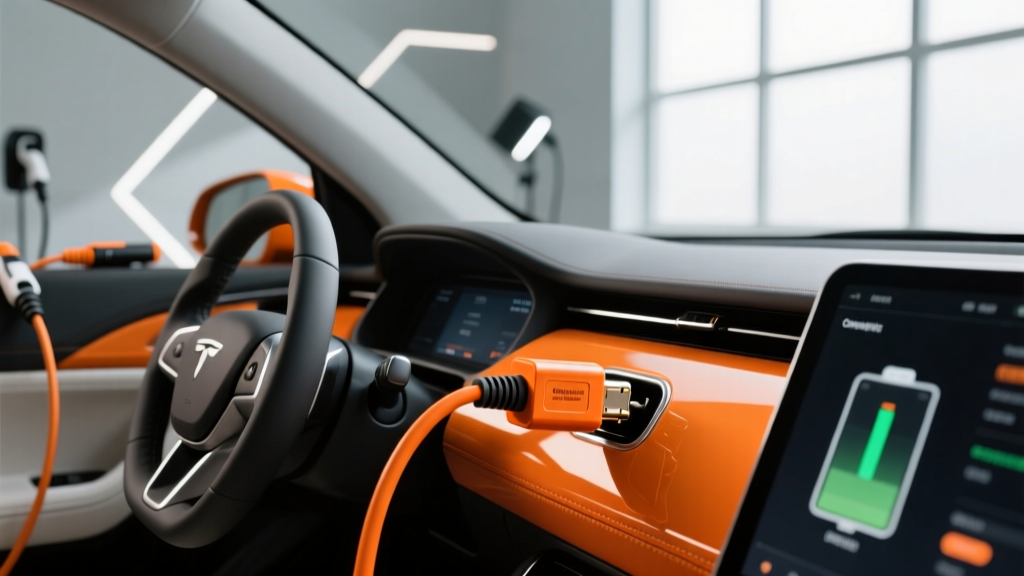
Short answer: The "orange EV OBD connector" typically refers to either (1) the orange-colored high-voltage (HV) cabling and connectors found under the hood and beneath EV floor pans — a universal SAE/ISO color code warning of lethal voltage — or (2) the OBD-II diagnostic port on an electric vehicle, which some aftermarket scan tools and adapters feature in orange housings. In EVs, these are two entirely different systems. The orange HV connectors carry 400V–800V+ DC between the battery pack, inverter, and motor and must never be disconnected by owners. The OBD-II port, by contrast, is a low-voltage 12V data port (standardized since 1996) that lets you read battery state of health (SoH), cell voltages, thermal data, and fault codes using an EV-compatible scan tool or Bluetooth dongle.
If you searched for "orange EV OBD connector" because you spotted bright orange cabling near your EV's under-hood area or beneath the chassis, that is the high-voltage wiring harness — mandated by SAE J1766 and ISO 6469 to be colored orange for safety. It has nothing to do with the OBD-II diagnostic port, which is usually located under the dashboard near the driver's left knee and looks identical to the port on a gas car.
If you are looking to read diagnostic data from your EV — battery degradation, individual cell voltages, coolant temperatures, charge-session logs — you need an OBD-II reader that supports EV-specific PIDs (Parameter IDs). Standard gas-car OBD readers will return very little useful data from a BEV because EVs lack the emissions-related sensors (O2, MAF, catalytic converter temp) that conventional OBD-II was designed to monitor.
How OBD-II Works on Electric Vehicles
Every street-legal EV sold in the US still includes a standard 16-pin OBD-II port. However, the data available through that port differs significantly from a gas vehicle:
- Battery State of Health (SoH): Percentage of original capacity remaining — critical for used-EV purchases
- Individual cell group voltages: Identifies weak or imbalanced cells within the pack
- Battery inlet/outlet coolant temperature: Reveals thermal management system health
- DC fast-charge session logs: Number of sessions, peak kW achieved, taper behavior
- Isolation resistance: Safety metric for HV system integrity
- 12V auxiliary battery voltage: The #1 cause of "dead EV" stranded events
The challenge is that most EV-specific PIDs are manufacturer-proprietary. Tesla, Hyundai/Kia (E-GMP platform), GM (Ultium), Ford, and BMW each expose different data through different CAN bus addresses. A generic OBD reader pulling standard Mode 01 PIDs will show almost nothing on a Tesla Model Y — but an EV-aware tool like OBDLink SX/MX+ paired with apps such as EVNotify, LeafSpy (Nissan Leaf), ABRP OBD, or Scan My Tesla can surface rich telemetry.
Orange High-Voltage Connectors: Safety and Identification
The orange cables and connectors on an EV are not diagnostic ports — they are the high-voltage DC power bus. Here is what you need to know:
| Parameter | Typical 400V EV | 800V Architecture (e.g., Hyundai Ioniq 5, Kia EV6, Porsche Taycan) |
|---|---|---|
| Nominal pack voltage | 350–400V DC | 690–800V DC |
| Peak current | Up to ~400A | Up to ~500A+ |
| Connector color | Orange (SAE J1766) | Orange (SAE J1766) |
| Interlock loop | HVIL (High Voltage Interlock Loop) | HVIL |
| Owner-serviceable? | No | No |
The HVIL (High Voltage Interlock Loop) is a low-voltage safety circuit threaded through every orange connector. If any HV connector is partially unplugged, the HVIL breaks and the vehicle's contactors open within milliseconds, isolating the battery pack. This is why you should never attempt to disconnect, probe, or modify any orange cable — even with the vehicle "off." Capacitors in the inverter can retain lethal charge for minutes after shutdown.
OBD Diagnostic Tools for EVs: What to Buy and What They Cost
| Tool / Setup | Approximate Cost | EV Compatibility | Key Data Available |
|---|---|---|---|
| Generic ELM327 Bluetooth dongle | $10–$25 | Limited — mostly 12V battery and basic fault codes | Minimal on BEVs |
| OBDLink MX+ (Bluetooth) | $120–$140 | Broad — works with most EV-specific apps | Cell voltages, SoH, temps, charge logs |
| OBDLink SX (USB, laptop) | $50–$70 | Broad with FORScan, LeafSpy, etc. | Same as MX+ but wired |
| Carista OBD2 adapter | $70–$90 + subscription | Good for Toyota/bZ4X, some Hyundai | Customization + basic diagnostics |
| Pro-level: Autel MaxiSYS EV kit | $2,500–$5,000+ | Full OEM-level EV diagnostics | Battery balancing, HV isolation tests, module-level data |
| Tesla-specific: Scan My Tesla app + OBDLink | $15 app + adapter cost | Tesla Model S/3/X/Y (with CAN bus access) | Detailed pack telemetry, supercharger logs |
For most EV owners, an OBDLink MX+ ($120–$140) paired with an EV-specific app is the sweet spot. This setup lets you monitor battery SoH before and after road trips, log degradation over time, and check whether your 12V auxiliary battery is dying before it strands you.
EV vs. Gas Car: Diagnostic and Maintenance Cost Comparison
One of the biggest ownership advantages of EVs is the dramatic reduction in routine maintenance. Here is how diagnostic and maintenance costs compare over a 5-year/75,000-mile ownership period:
| Cost Category | BEV (e.g., Tesla Model Y, Hyundai Ioniq 5) | Gas Car (e.g., Toyota RAV4 AWD) |
|---|---|---|
| Routine maintenance (oil, filters, plugs) | $0 | $1,200–$1,800 |
| Brake pad replacement | $0–$200 (regen braking extends life) | $400–$800 |
| Coolant flush | $150–$250 (battery thermal loop, ~5yr interval) | $100–$200 |
| OBD diagnostic scan (out of warranty) | $100–$150 dealer, or $0 with own tool | $100–$150 dealer |
| Transmission fluid | $0 (single-speed reduction gear, sealed) | $150–$300 |
| Cabin air filter | $30–$60 (DIY) | $30–$60 |
| 5-Year Maintenance Total | $300–$700 | $2,000–$3,300 |
Data from fueleconomy.gov and the Department of Energy consistently show EVs costing roughly $0.061/mile to maintain versus $0.101/mile for ICE vehicles — a savings of approximately $1,500–$2,600 over 5 years.
Real-World EV Ownership Considerations for 2026
Before plugging in an OBD reader and diving into battery telemetry, step back and evaluate whether an EV fits your actual life. The biggest ownership friction points in 2026 remain:
Home Charging Access
Roughly 25–30% of US households lack access to dedicated home charging (apartments, street parking, older electrical panels). If you cannot install a Level 2 (240V) home charger, an EV may still work — but you will rely on public DC fast charging and workplace charging, which costs 2–4× more per kWh and adds 20–40 minutes per session. A Level 2 home install typically costs $500–$2,200 depending on panel capacity and run distance. Homes with 100A panels may need a $1,500–$3,000 panel upgrade to 200A.
Climate and Range Reality
EPA range estimates assume moderate temperatures and mixed driving. In real-world conditions:
- Highway driving at 75 mph: Expect 10–15% below EPA range
- Cold weather (below 32°F / 0°C): Expect 20–35% range loss without a heat pump; 15–25% with one
- Mountain driving: Consumption spikes on ascents; regen recovers some on descents
Insurance Costs
EV insurance premiums average 15–25% higher than equivalent gas cars due to higher repair costs (especially battery pack replacement after collision). Shop quotes from EV-friendly insurers before purchasing.
Common Misconceptions About EV OBD Ports and Orange Connectors
| Myth | Fact |
|---|---|
| "The orange port under the hood is where I plug in a scan tool" | Orange = high-voltage power. The OBD-II port is under the dashboard and is standard black/gray. |
| "Any OBD reader works on any EV" | Generic readers pull minimal data. EV-specific PIDs require compatible hardware and apps. |
| "I can reset battery degradation through OBD" | SoH is a physical measurement of cell capacity. No software reset restores degraded chemistry. |
| "OBD data can void my battery warranty" | Reading data is passive. Only active commands (clearing crash data, modifying firmware) could raise warranty issues. |
| "Orange cables only carry power when the car is on" | The battery pack maintains voltage at all times. Contactors isolate the pack when off, but the pack itself is always live. |
Decision Framework: Should You Buy an OBD Tool for Your EV?
If you are buying a used EV: → Yes. An OBD tool reading SoH is the single most important pre-purchase check. A pack at 85% SoH has lost 15% of its original capacity — factor that into range expectations and price negotiation.
If you own a new EV under warranty: → Optional. Your dealer handles diagnostics. But an OBDLink MX+ lets you track degradation yourself and catch 12V battery failure early (the #1 EV roadside-assistance call).
If you are an EV enthusiast or hypermiler: → Yes. Real-time cell voltage monitoring, thermal data, and charge-curve logging help you optimize charging habits and extend pack life.
If you spotted an orange connector and are worried: → Do not touch it. That is the HV power bus. If you see damage, exposed wires, or a burning smell, call your dealer's service department immediately and do not drive the vehicle.
Federal Tax Credit and EV Purchase Context (2026)
If you are buying a new EV in 2026, the IRS §30D Clean Vehicle Credit remains in effect but with strict eligibility rules:
- Maximum credit: $7,500 for new EVs; $4,000 for used EVs (subject to separate rules)
- MSRP caps: $80,000 for SUVs/pickups/vans; $55,000 for sedans
- Buyer income caps: $150,000 single / $225,000 head of household / $300,000 joint (AGI)
- Battery sourcing: Increasing percentages of critical minerals and battery components must be sourced from the US or FTA partners — many popular models only qualify for $3,750 (half credit) or $0 depending on the month
- Point-of-sale transfer: You can transfer the credit to the dealer at purchase to reduce the sale price immediately
Always verify current eligibility on the IRS website and with your tax professional — sourcing requirements tighten annually and model eligibility can change mid-year.
Frequently Asked Questions
Can I damage my EV by plugging in an OBD reader?
No. Reading data through the OBD-II port is passive — you are only listening to the CAN bus, not sending commands. You cannot damage the battery, inverter, or BMS with a read-only scan tool. Risks only arise from active commands (firmware modifications, clearing crash data) which consumer tools generally cannot perform.
Why are EV high-voltage cables colored orange?
SAE J1766 and ISO 6469 mandate orange coloring for all high-voltage (above 60V DC) wiring and connectors in electric vehicles. This is a universal safety standard so that first responders, tow operators, and technicians can instantly identify lethal-voltage components. Never cut, puncture, or disconnect an orange cable.
Will a standard OBD code reader show EV battery health?
Almost never. Standard OBD readers query emissions-related PIDs (Mode 01) that do not exist on BEVs. You need an EV-compatible app — such as LeafSpy (Nissan), Scan My Tesla, or a Hyundai/Kia-specific tool — paired with a quality adapter like the OBDLink MX+ to access battery SoH, cell voltages, and thermal data.
How often should I check my EV's battery SoH via OBD?
For most owners, checking SoH every 6 months or every 10,000 miles is sufficient. More frequent checks won't change anything — degradation is gradual. The most important check is a pre-purchase inspection on any used EV.
What should I do if I see a fault code related to the HV system?
If your EV throws an HV-related DTC (diagnostic trouble code) — typically in the P0Axx range — do not attempt to clear it and ignore it. HV isolation faults, contactor welds, or coolant leak codes can indicate serious safety issues. Have the vehicle inspected by a certified EV technician. Under the federal battery warranty mandate, major HV components are covered for at least 8 years / 100,000 miles.