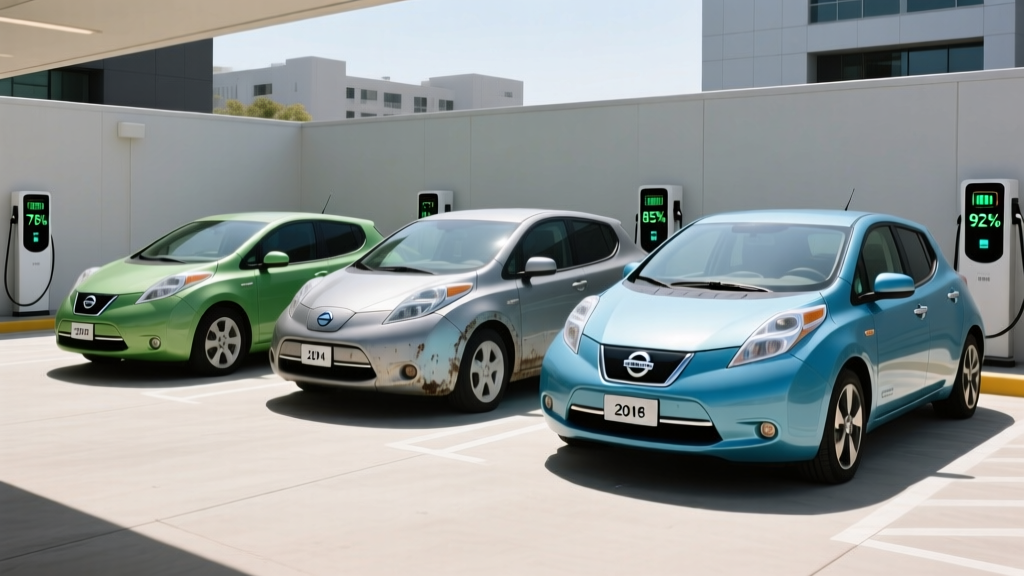
The Nissan Leaf holds a unique place in electric-vehicle history. Launched for the 2011 model year, it was the first mass-market, purpose-built battery-electric vehicle sold in the United States. More than a decade later, used examples of the earliest Leafs are flooding the sub-$10,000 market, tempting budget-conscious commuters and first-time EV buyers. But the oldest Nissan Leaf models — those from 2011 through 2017 — carry specific battery degradation risks, outdated charging standards, and range figures that demand honest scrutiny before you hand over any cash.
This guide dissects what you actually get when buying an early-generation Nissan Leaf in 2026: real-world range after years of battery wear, the CHAdeMO charging reality, ownership economics, and whether the federal used-EV tax credit can make the math work. We'll also benchmark the first-generation Leaf against the 2026 Nissan Leaf SV Plus (the final model year before Nissan transitions to its next-gen EV lineup) so you can weigh used bargains against new-vehicle incentives.
First-Generation Nissan Leaf (2011–2017): Core Specifications
Before evaluating any used Leaf, you need the baseline numbers. The first generation spanned two battery sizes and a mid-cycle power bump. Here's what Nissan built:
| Spec | 2011–2012 (24 kWh) | 2013–2015 (24 kWh) | 2016–2017 (30 kWh) |
|---|---|---|---|
| Battery Capacity (usable) | ~21 kWh | ~21 kWh | ~28 kWh |
| Battery Chemistry | NMC (lithium manganese) | NMC (lithium manganese) | NMC (lithium manganese) |
| EPA Range (new) | 73 miles | 75–84 miles | 107 miles |
| Motor Output | 80 kW (107 hp) | 80 kW (107 hp) | 80 kW (107 hp) |
| 0–60 mph | ~9.9 sec | ~9.9 sec | ~9.5 sec |
| Drivetrain | FWD | FWD | FWD |
| DC Fast Charge Port | CHAdeMO (optional) | CHAdeMO (optional/standard) | CHAdeMO (standard) |
| Max DC Charge Rate | ~44 kW | ~44 kW | ~44 kW |
| Level 2 Charge Rate | 3.3 kW (6.6 kW opt.) | 6.6 kW | 6.6 kW |
| MPGe (combined, new) | 99 MPGe | 114 MPGe | 112 MPGe |
| Cargo Volume | 24.0 cu ft | 24.0 cu ft | 24.0 cu ft |
| Battery Warranty (original) | 8 yr / 100,000 mi | 8 yr / 100,000 mi | 8 yr / 100,000 mi |
A few things jump out. First, kWh is energy capacity (how much the battery holds), while kW is power (how fast the motor draws or the charger delivers). The 24 kWh pack in early Leafs only offered about 21 kWh of usable capacity due to buffer limits — and that was when new. Second, the CHAdeMO DC fast-charging connector was optional on 2011–2012 models; many early Leafs were sold without it, limiting them to Level 1 (120V) or Level 2 (240V) charging only.
Real-World Range: What the Oldest Nissan Leaf Actually Delivers in 2026
EPA Sticker (new, 2011–2012): 73 miles
Expected real-world range in 2026 (10–15-year-old pack): 40–60 miles depending on State of Health
Highway driving (70 mph): subtract ~15–20% → as low as 35–50 miles
Cold weather (below 40°F): subtract another 20–30% → potentially 25–40 miles
The EPA range sticker on a 2011 Leaf read 73 miles when the car was new. That number assumed a fully healthy 24 kWh (21 kWh usable) NMC battery at 100% State of Charge. In 2026, a 12-to-15-year-old Leaf battery has experienced significant degradation.
Nissan's NMC chemistry in these early packs is particularly susceptible to capacity loss from two factors: heat exposure (the Leaf uses passive air cooling rather than active liquid thermal management) and repeated DC fast charging. Data aggregated from Leaf owner communities and tools like LeafSpy shows typical State of Health (SoH) readings of 65–80% for 2011–2013 models in 2026. That translates to roughly 14–17 kWh of usable capacity remaining.
For the 2016–2017 models with the 30 kWh pack, degradation curves are somewhat better — these packs typically read 75–85% SoH at this age — but the passive cooling limitation remains. Real-world range for a 30 kWh Leaf in 2026 typically lands between 65–85 miles in mixed driving, dropping to 50–65 miles on the highway and potentially 40–55 miles in freezing temperatures.
The absence of a heat pump in the first-generation Leaf means cabin heating draws directly from the traction battery via a resistive PTC heater, which is extremely energy-intensive. If you live in a cold climate, this is a deal-limiting factor for winter commuting.
Charging the Oldest Nissan Leaf: CHAdeMO Realities and Home Setup
Charging infrastructure has shifted dramatically since the Leaf debuted. The industry has largely standardized on CCS and, increasingly, NACS (Tesla's North American Charging Standard). CHAdeMO — the Japanese DC fast-charging protocol the Leaf uses — is being phased out at most public networks in North America.
| Charging Level | Power (kW) | Connector | Miles of Range per Hour | Full Charge Time (0–100%) |
|---|---|---|---|---|
| Level 1 (120V household) | 1.2–1.4 kW | J1772 | ~4–5 mi/hr | 18–22 hours (24 kWh) |
| Level 2 (240V home/public) | 3.3 kW (2011–12 base) / 6.6 kW (2013+) | J1772 | ~12 mi/hr (3.3 kW) / ~24 mi/hr (6.6 kW) | 4–5 hours (6.6 kW, 24 kWh) |
| DC Fast Charge | ~44 kW peak | CHAdeMO | N/A (session-based) | ~30 min (0–80%, 24 kWh pack) |
A critical detail: the ~44 kW DC fast-charge rate is a peak, not sustained. The Leaf's charge curve tapers significantly above 60–70% State of Charge to protect the passively cooled battery. A 10–80% session on a 50 kW CHAdeMO station typically takes 30–40 minutes for a 24 kWh pack, but finding a working CHAdeMO connector in 2026 is increasingly difficult. Electrify America has discontinued CHAdeMO at new stations, and many existing units are being decommissioned or left unmaintained.
For home charging, a Level 2 station delivering 6.6 kW (32 amps at 240V) is the practical standard for 2013-and-later Leafs. Installation costs for a home Level 2 circuit typically range from $500 to $2,000 depending on panel capacity and run distance — budget for a licensed electrician to assess your 200-amp panel before purchase. The 2011–2012 base models with the 3.3 kW onboard charger are painfully slow on Level 2, taking nearly twice as long to charge.
Battery Degradation, Warranty Status, and Replacement Costs
This is the single most important factor when evaluating the oldest Nissan Leaf. Nissan's original lithium-ion battery warranty covered 8 years or 100,000 miles against capacity loss below 70% (as indicated by the dashboard capacity bars). For a 2011 Leaf, that warranty expired in 2019. For a 2017 model, it expired in 2025. No first-generation Leaf carries active factory battery warranty in 2026.
Battery replacement options exist but are costly:
- Nissan OEM replacement (24 kWh): $6,500–$8,500 including labor, though availability of new OEM packs is dwindling
- Refurbished/remanufactured packs: $3,500–$5,500 from third-party EV battery shops
- Used packs from salvage Leafs: $1,500–$3,000, but carry unknown SoH and zero warranty
The passive air-cooling design means these batteries degrade faster than liquid-cooled competitors. If you're in Arizona, Texas, or any hot climate, expect the low end of SoH ranges. LeafSpy Pro (an OBD-II dongle and app) is essential for reading actual battery health before purchase — never rely solely on the dashboard capacity bars, which are a coarse approximation.
Performance, Interior, and Daily Usability
The first-generation Leaf was designed as an urban commuter, and it still fulfills that role adequately. The 80 kW (107 hp) electric motor delivers instant torque, making 0–30 mph acceleration feel peppier than the 9.9-second 0–60 time suggests. Regenerative braking is moderate — the Leaf offers a "B" mode for increased regen, but it does not enable true one-pedal driving to a full stop like modern EVs.
Interior space remains a practical strong point:
- Passenger volume: 94.0 cu ft (seats 5)
- Rear legroom: 33.3 inches
- Cargo (rear seats up): 24.0 cu ft
- Cargo (rear seats folded): ~30.0 cu ft
The infotainment in 2011–2015 models is a 5-inch or 7-inch touchscreen with basic navigation (on higher trims) and Bluetooth. Apple CarPlay and Android Auto were not available until the 2016 model year and only on certain trims. Driver-assistance features are limited to a rearview camera (standard from 2013) and available blind-spot monitoring on later SL trims. There is no adaptive cruise control, lane-keeping assist, or automatic emergency braking — these are SAE Level 0 features (no driving automation).
- Passive battery cooling accelerates degradation in hot climates
- CHAdeMO DC charging is being phased out across North America
- No active thermal management means poor fast-charge consistency
- Resistive cabin heater devastates winter range
- Early models (2011–2012) may lack DC fast-charge capability entirely
- No modern ADAS features (no AEB, no lane-keep)
Pricing, Used Market Values, and Tax Credit Eligibility
Used first-generation Leaf prices in 2026 reflect their age and battery uncertainty:
| Model Year | Typical Mileage | Price Range (Private Party) | Price Range (Dealer) |
|---|---|---|---|
| 2011–2012 | 80,000–130,000 mi | $3,500–$5,500 | $4,500–$7,000 |
| 2013–2015 | 60,000–110,000 mi | $5,000–$8,000 | $6,500–$9,500 |
| 2016–2017 (30 kWh) | 50,000–90,000 mi | $7,000–$11,000 | $8,500–$13,000 |
For comparison, the 2026 Nissan Leaf SV Plus — the final model year of the Leaf nameplate — starts at approximately $29,230 MSRP (before destination) with a 60 kWh battery, 214-mile EPA range, and 150 kW CCS DC fast charging. After the §30D federal tax credit (up to $7,500, subject to MSRP caps under $55,000 for cars, buyer income limits of $150,000 single / $300,000 joint, and battery critical-mineral sourcing requirements), a new Leaf SV Plus can land near $21,730.
Used EV buyers may qualify for the §25E Previously Owned Clean Vehicle Credit, which provides up to $4,000 (or 30% of the sale price, whichever is lower) for used EVs purchased from a dealer for $25,000 or less. Income caps apply: $75,000 single / $150,000 joint. Most first-generation Leafs fall under the $25,000 threshold, making this credit accessible — but the vehicle must be purchased through a licensed dealer (not private party) and the dealer must report the sale to the IRS. Consult a tax professional to confirm eligibility for your specific situation.
Oldest Nissan Leaf vs. Key Competitors: Is It Worth Buying?
The used sub-$10,000 EV market in 2026 includes several alternatives. Here's how the oldest Leaf stacks up against its most common cross-shops:
| Attribute | 2013–2015 Nissan Leaf (24 kWh) | 2013–2016 Fiat 500e | 2017–2018 Chevy Bolt EV (used, higher price) |
|---|---|---|---|
| EPA Range (new) | 75–84 mi | 87 mi | 238 mi |
| Expected 2026 Range | 45–65 mi | 55–70 mi | 180–210 mi |
| Battery Cooling | Passive air | Passive air | Active liquid |
| DC Fast Charge | CHAdeMO (~44 kW) | None (Level 2 only) | CCS (~55 kW) |
| Used Price Range | $5,000–$8,000 | $5,500–$8,500 | $11,000–$15,000 |
| Cargo Space | 24.0 cu ft | 9.5 cu ft | 56.6 cu ft |
Choose the 2011–2017 Leaf if:
- Your daily round-trip commute is under 30 miles
- You have reliable home Level 2 charging
- You live in a moderate climate (not extreme heat or cold)
- You want the most affordable entry into EV ownership
- You value cargo space over range (24 cu ft beats the Fiat 500e badly)
- Your commute exceeds 40 miles round-trip
- You need DC fast charging for road trips (CHAdeMO is disappearing)
- You live in a hot climate where battery degradation will accelerate
- You need winter range reliability (no heat pump, resistive heating)
- You want modern safety features (AEB, lane-keep, blind-spot intervention)
Pros and Cons Summary
- Extremely low purchase price ($3,500–$11,000)
- Proven, simple drivetrain with low maintenance costs
- Spacious hatchback cargo area (24 cu ft)
- Eligible for up to $4,000 used-EV tax credit (§25E)
- Smooth, quiet electric commute for short distances
- Extensive owner community and aftermarket support (LeafSpy)
- Severely degraded battery range (40–65 mi typical)
- CHAdeMO DC charging is being abandoned by networks
- Passive battery cooling accelerates degradation
- No heat pump — winter range collapses
- Outdated infotainment, no CarPlay/Android Auto (pre-2016)
- No modern driver-assist safety features
- All factory battery warranties have expired
Frequently Asked Questions
What is the real-world range of the oldest Nissan Leaf in 2026?
Expect 40–60 miles from a 2011–2015 Leaf with its original 24 kWh battery at 65–80% State of Health. The 2016–2017 models with the 30 kWh pack deliver 65–85 miles. Highway speeds and cold weather reduce these figures by 20–40%.
How fast does the oldest Nissan Leaf charge?
On a Level 2 home charger at 6.6 kW (2013+ models), a depleted 24 kWh pack reaches full in about 4–5 hours. DC fast charging on CHAdeMO peaks at ~44 kW, delivering a 10–80% charge in roughly 30 minutes — but CHAdeMO stations are increasingly scarce.
Does the oldest Nissan Leaf qualify for any federal tax credit?
Not the new-vehicle §30D credit. However, if purchased from a licensed dealer for $25,000 or less, it may qualify for the §25E used-EV credit of up to $4,000 (30% of sale price, whichever is less). Income caps of $75,000 (single) / $150,000 (joint) apply. Verify current rules at IRS.gov and consult a tax professional.
Is the oldest Nissan Leaf worth buying vs. competitors?
It depends entirely on your commute and climate. For a sub-30-mile daily commute in a moderate climate with home charging, it's the cheapest way into EV ownership. For anything beyond that, the 2017+ Chevy Bolt EV (even at $11,000–$15,000 used) is a far better investment due to its liquid-cooled 60 kWh battery, CCS charging, and 200+ mile range.
How do I check battery health before buying a used Leaf?
Purchase a LeafSpy Pro OBD-II dongle (~$20 for the app, ~$30 for the dongle) and plug it into the car's OBD-II port. It reads actual State of Health percentage, individual cell voltages, and charge cycle data. Do not rely on the dashboard capacity bars alone — they update infrequently and are imprecise. Any seller who refuses a LeafSpy reading should be treated as a red flag.
What happens if the battery fails completely?
Out-of-warranty replacement runs $3,500–$8,500 depending on whether you source a refurbished or OEM pack. At that cost, a battery replacement often exceeds the vehicle's value, making it a total-economic-loss scenario. Budget for this risk or prioritize a Leaf with a verified high-SoH battery.
Sources: fueleconomy.gov (EPA range and efficiency data), IRS §25E Used Clean Vehicle Credit, NHTSA safety records. Battery degradation data aggregated from Leaf owner community reporting via LeafSpy Pro.