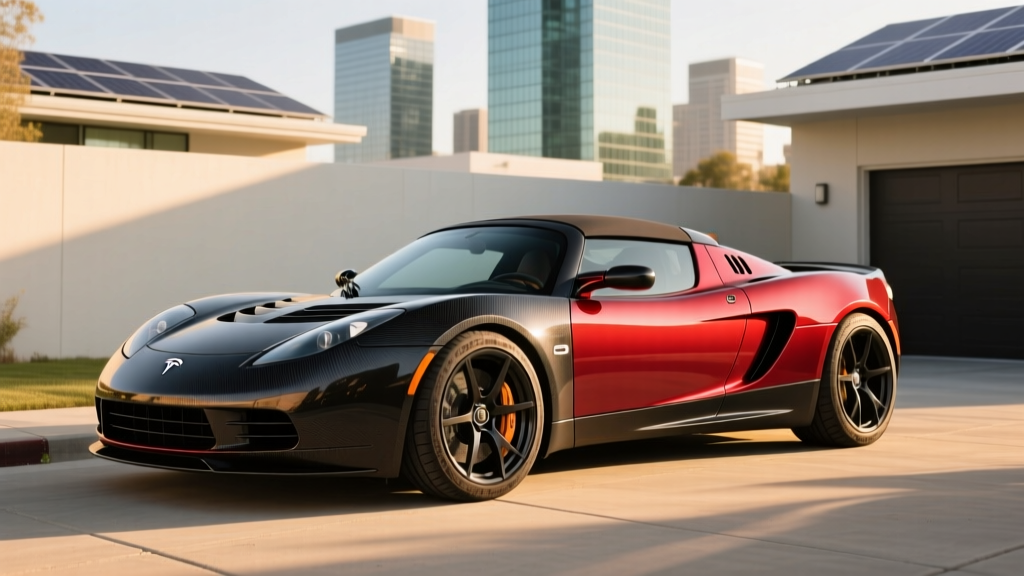
Before the Model S reshaped the luxury sedan market and the Model 3 brought EVs to the masses, there was the car that started it all: the original Tesla Roadster. Produced from 2008 to 2012, this Lotus Elise-based sports car proved that a battery-electric vehicle could deliver supercar-rivaling performance with zero tailpipe emissions. Today, the old Tesla Roadster occupies a unique space — part collector's curiosity, part EV history lesson, and part surprisingly usable weekend driver for those who know what they're signing up for.
This review examines the original Roadster from a 2026 ownership perspective: what its 53 kWh battery pack actually delivers after more than a decade of use, how charging works in a NACS-dominated world, what battery replacements cost, and whether buying one today is a passion purchase or a practical gamble.
Old Tesla Roadster: Quick Specs at a Glance
| Specification | Roadster 1.5 (2008) | Roadster 2.0 / 2.5 (2010–2012) |
|---|---|---|
| EPA Range (original) | 220 miles | 244 miles (Ideal); ~220 mi EPA-adjusted |
| Battery Capacity | 53 kWh (usable ~48 kWh) | 53 kWh (usable ~48 kWh) |
| Battery Chemistry | NMC (Lithium-Ion, 6,831 cells) | NMC (Lithium-Ion, 6,831 cells) |
| Motor Output | 248 hp / 288 lb-ft | 288 hp / 295 lb-ft |
| 0–60 mph | 3.9 seconds | 3.7 seconds |
| Top Speed | 125 mph (electronically limited) | 125 mph |
| Drivetrain | RWD, single-speed gearbox | RWD, single-speed gearbox |
| Efficiency | ~135 MPGe / 25 kWh/100 mi | ~135 MPGe / 25 kWh/100 mi |
| Curb Weight | 2,690 lbs | 2,723 lbs |
| Cargo Volume | ~3.5 cu ft (rear trunk) | ~3.5 cu ft |
| Original Base MSRP | $109,000 | $109,000–$129,000 |
| 2026 Used Market Range | $50,000–$150,000+ (condition-dependent) | |
| Battery Warranty (original) | 5 years / 50,000 miles (expired) | |
Real-World Range: What to Expect in 2026
EPA (original sticker): 220–244 miles
Real-world 2026 expectation: 120–180 miles (highly dependent on battery health and conditions)
Highway (70 mph, moderate temps): ~140–160 miles with a healthy pack
Cold weather (below 40°F): ~90–120 miles — expect 25–40% range loss
The old Tesla Roadster's 53 kWh NMC battery was cutting-edge in 2008, but NMC chemistry degrades with time, heat, and charge cycles. After 14–18 years on the road, most original packs have lost 25–45% of their original capacity. Tesla's original 5-year/50,000-mile battery warranty expired long ago for every Roadster on the road.
Real-world range in 2026 is a function of one critical variable: has the battery been replaced? Roadsters with original packs typically deliver 120–160 miles in mixed driving. Cars that received Tesla's official Energy Storage System (ESS) replacement — a service Tesla offered for approximately $29,000–$35,000 — may see range closer to 180–200 miles, depending on the replacement pack's age and condition.
The Roadster's thermal management system was rudimentary compared to modern liquid-cooled packs. Early models relied on air cooling with a glycol loop, making them susceptible to heat-related degradation in hot climates. If you're evaluating a used Roadster, request a battery health report from Tesla or a qualified EV specialist — the State of Health (SoH) percentage is the single most important data point.
Charging: Navigating a Modern Network with Legacy Hardware
Charging the old Tesla Roadster in 2026 requires understanding its legacy connectors and modest charge rates. This car predates the Tesla Supercharger network, CCS, and the NACS standard that now dominates North American charging.
| Charging Level | Power / Rate | Time / Notes |
|---|---|---|
| Level 1 (120V household) | ~1.4 kW | ~35+ hours for full charge; ~5 mi/hr |
| Level 2 (240V, Roadster HPC) | ~16.8 kW (70A) | ~3.5 hours 10–80%; ~48 mi/hr |
| Level 2 (240V, standard J1772 w/ adapter) | ~6.6–7.2 kW (30A) | ~6–7 hours 10–80%; ~22 mi/hr |
| DC Fast Charging | NOT SUPPORTED | The Roadster has no DC fast-charge capability |
This is the most important charging fact for prospective buyers: the old Tesla Roadster cannot DC fast charge. There is no CCS port, no Supercharger compatibility, and no CHAdeMO adapter. Tesla's proprietary High Power Connector (HPC) was the fastest option, delivering up to 16.8 kW on a dedicated 70-amp circuit — impressive for 2008, but it means this car is strictly a home-and-destination charging vehicle.
Tesla also provided a Roadster-specific J1772 adapter, allowing use of public Level 2 stations at reduced speed (typically 6.6–7.2 kW). In 2026, with the broader public charging infrastructure standardized around NACS and CCS, finding compatible public chargers requires planning. Most Level 2 destination chargers (hotels, restaurants) with J1772 connectors will work with the adapter.
For home charging, the Roadster's High Power Wall Connector (HPWC) requires a dedicated 100-amp circuit to deliver the full 16.8 kW — an electrical service upgrade that many homes cannot support without panel work. Most owners in 2026 charge on a standard 240V/30A circuit using the J1772 adapter, accepting overnight charge times of 6–8 hours.
Performance & Driving: Still Thrilling After All These Years
The old Tesla Roadster's performance credentials have aged remarkably well. The 288-hp (2.0/2.5 models) electric motor delivers instant torque to the rear wheels through a single-speed gearbox — no shifting, no lag, just relentless acceleration from standstill.
The 3.7-second 0–60 mph time (2.5 Sport models) remains competitive with modern sports cars. More importantly, the driving experience is uniquely visceral: the Roadster weighs just 2,723 pounds — roughly 1,000 pounds lighter than a current Model 3 — and the Lotus-tuned suspension communicates every imperfection in the road. Steering is unassisted and heavy at low speeds but communicative at pace.
The single-speed transmission in later 2.0 and 2.5 models replaced the troubled two-speed unit in the earliest 1.5 cars, which was a source of reliability problems. The later Sport variant added a more powerful rear motor and revised power electronics for sharper throttle response.
Driver assistance: The Roadster has none. No Autopilot, no lane-keeping, no adaptive cruise control, no automatic emergency braking. This is a pure analog driving experience with modern electric powertrain technology. ABS and traction control are the only electronic safety nets.
Interior, Tech, and Daily Livability
The Roadster's cabin is a Lotus Elise interior with minor Tesla modifications — which is a polite way of saying it's spartan. The center stack features a small touchscreen display that controls climate, audio, and vehicle settings. Bluetooth audio streaming was added in later models but the infotainment is primitive by 2026 standards: no navigation, no app integration, no over-the-air updates.
Practical limitations are significant:
- Cargo space: ~3.5 cubic feet in the rear trunk — enough for a weekend bag, nothing more
- Seating: Two seats only, with fixed-back sport buckets that are snug but not adjustable for height
- Entry/exit: Extremely low door sills and a targa top that must be manually removed and stored
- Visibility: Rear visibility is poor; the car has no backup camera
- Noise: Minimal insulation — road and wind noise are prominent above 60 mph
The removable targa roof panel is a highlight, offering an open-air experience that amplifies the electric motor's whine into something almost exotic. HVAC performance is adequate but the resistive heater draws significantly from the battery pack in cold weather — another range consideration.
Pricing, Tax Credits, and Total Cost of Ownership
The old Tesla Roadster is a used collector vehicle, and its market has diverged sharply based on condition, mileage, model variant, and — most critically — battery health.
| Cost Factor | Estimated Range |
|---|---|
| Used purchase price (2026 market) | $50,000–$150,000+ |
| Federal §30D new-EV tax credit | NOT ELIGIBLE (discontinued model) |
| Federal used-EV credit (§25E) | Up to $4,000 (30% of sale price, max $4,000; income caps apply: $75K single / $150K joint; vehicle must be <$25,000 sale price — Roadster does NOT qualify) |
| Battery replacement (if needed) | $29,000–$40,000 (limited availability) |
| Annual insurance | $2,500–$5,000 (collector/specialty policies may be lower) |
| Annual maintenance | $500–$1,500 (coolant service, brake fluid, 12V battery, tires) |
| Home Level 2 charging (electricity) | ~$400–$700/year at 12¢/kWh, 8,000 mi/yr |
Federal tax credit reality check: The old Tesla Roadster does not qualify for the §30D new clean vehicle credit (production ended in 2012). It also fails the §25E used-EV credit because the vehicle's sale price far exceeds the $25,000 cap for used-EV credit eligibility. Buyers should not expect any federal tax incentive for this purchase. State-level collector-vehicle or EV incentives vary by jurisdiction — consult your state's DMV or energy office.
The elephant in the room is battery replacement. Tesla's official Roadster battery replacement program has been inconsistently available, and parts supply is limited. Some owners have turned to independent EV shops for custom battery solutions, but this is expensive and may affect vehicle registration or insurance. Budget for a potential $30,000–$40,000 battery replacement within your ownership timeline if the current pack shows significant degradation.
Who Should Buy an Old Tesla Roadster in 2026?
- You want a piece of EV history — the car that launched Tesla and the modern EV movement
- You prioritize lightweight, analog driving dynamics over tech features
- You have home Level 2 charging and a realistic daily range need under 120 miles
- You understand this is a collector/specialty vehicle, not a daily commuter
- You can budget for a potential battery replacement
- You need DC fast charging for road trips
- You want modern safety features (AEB, backup camera, lane-keep)
- You need more than two seats or meaningful cargo space
- You live in a cold climate and need reliable year-round range
- You're looking for a cost-effective daily driver
The old Tesla Roadster is best understood as a collector's sports car that happens to be electric, not as an EV evaluated on the same criteria as a 2026 Model Y or Ioniq 5. Its value proposition is historical significance, Lotus-bred driving dynamics, and the novelty of a 2,700-pound EV sports car — a formula Tesla itself has not replicated since (the upcoming Roadster 2 remains unreleased as of 2026).
Pros and Cons
- Instant 288-hp torque in a 2,723-lb chassis — still thrilling
- Historical significance: the car that started the EV revolution
- Lotus Elise suspension tuning — exceptional handling
- Removable targa roof for open-air driving
- Appreciating collector value for well-maintained examples
- Low running costs if battery is healthy
- No DC fast charging — road trips require overnight stops
- Severe battery degradation risk; $30K+ replacement cost
- No modern driver assists or safety technology
- Cramped interior, minimal cargo, difficult entry/exit
- No federal tax credit eligibility (new or used)
- Limited Tesla service/parts support for this generation
Frequently Asked Questions
What is the real-world range of the old Tesla Roadster in 2026?
With an original, un-replaced battery, expect 120–160 miles in mixed driving and potentially as low as 90–120 miles in cold weather (below 40°F). Roadsters with a Tesla-replaced ESS pack may achieve 180–200 miles. Battery State of Health (SoH) is the determining factor — always verify before purchasing.
How fast does the old Tesla Roadster charge?
The Roadster has no DC fast-charge capability. On its proprietary High Power Connector (HPC) at 16.8 kW, a 10–80% charge takes approximately 3.5 hours. On a standard 240V/30A Level 2 station using the included J1772 adapter, expect 6–7 hours for a 10–80% session. Level 1 (120V) charging adds roughly 5 miles per hour.
Does the old Tesla Roadster qualify for any federal EV tax credit?
No. The §30D new clean vehicle credit applies only to new vehicles, and Roadster production ended in 2012. The §25E used clean vehicle credit requires the sale price to be under $25,000 — well below current Roadster market values of $50,000–$150,000+. Per IRS guidelines, no federal credit is available for this purchase.
Is the old Tesla Roadster worth buying vs. modern EVs?
Not as a daily driver or practical EV. A 2026 Tesla Model 3 Performance offers 346 miles of range, DC fast charging at 250 kW, full Autopilot capability, modern safety tech, and a ~$55,000 MSRP — all while being a four-door sedan. The old Roadster's value is as a collector's item and driving experience. Compare it to a Porsche Boxster or Lotus Elise, not to a Model Y. If you want a fun, fast EV with modern practicality, the EPA's fueleconomy.gov database lists dozens of current options with superior range, charging, and safety.
What are the biggest risks of buying an old Tesla Roadster?
The primary risk is battery degradation and replacement cost. The NMC pack was designed for a 5–7 year service life; most are now 14–18 years old. Secondary risks include limited parts availability (Tesla has deprioritized Roadster service), the proprietary HPC charging connector (adapters are needed for public Level 2), and the absence of any modern safety technology. A pre-purchase inspection by a Tesla-certified technician or EV specialist is essential.
Can I use Tesla Superchargers with the old Tesla Roadster?
No. The original Roadster uses Tesla's legacy HPC connector, which is physically and electrically incompatible with the Supercharger network (which uses the NACS connector and a different communication protocol). There is no adapter available. Supercharger access is limited to Model S/3/X/Y and later Tesla vehicles.
How does the old Roadster compare to the upcoming Tesla Roadster 2?
Tesla's second-generation Roadster (announced in 2017) remains unreleased as of 2026, with no confirmed production date. Preliminary claims include 620 miles of range, sub-1-second 0–60, and AWD with three motors. Until it ships, the old Roadster remains the only two-seat Tesla sports car ever produced. The two vehicles share a nameplate but are fundamentally different in architecture, capability, and market positioning.