The OG Tesla Roadster: America's First Highway-Capable Lithium-Ion EV
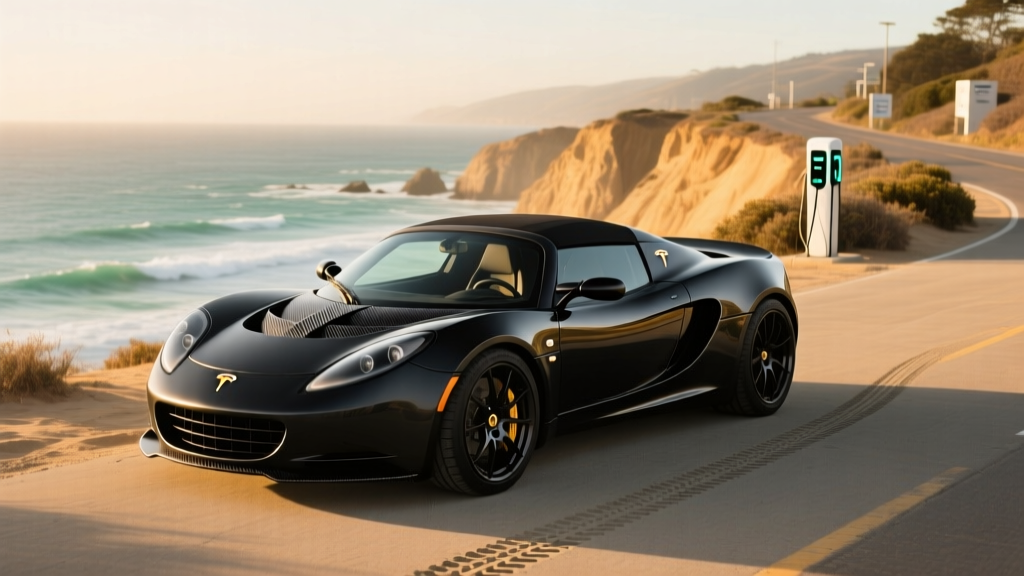
Before the Model S redefined the luxury sedan, before the Model 3 made EVs mainstream, and before the Cybertruck polarized the internet, there was the original Tesla Roadster. Produced between 2008 and 2012, the OG Tesla Roadster was the first production automobile to use lithium-ion battery cells and the first to achieve over 200 miles of range on a single charge. Built on a modified Lotus Elise chassis in the UK, it proved that electric propulsion could deliver supercar-rivaling performance — not just compliance-car commuting.
This is not a review of a car you can order today. Tesla ceased Roadster production in 2012 after building approximately 2,450 units. But for collectors, EV historians, and buyers exploring the secondary market, the OG Tesla Roadster remains a fascinating artifact — and a surprisingly usable classic. Here's the full technical breakdown of what made it tick, what it costs now, and whether one belongs in your garage.
Range, Battery, and Real-World Efficiency
The OG Tesla Roadster's defining achievement was its energy storage system. Tesla packed 6,831 commodity-format lithium-ion cells (the same type used in laptops) into a module that replaced the Lotus Elise's mid-mounted engine, creating a battery pack that was revolutionary for its time.
| Specification | Value |
|---|---|
| Battery Capacity (Total) | 53 kWh |
| Battery Capacity (Usable) | ~48 kWh |
| Battery Chemistry | NMC (Lithium Cobalt Oxide / NCA blend, laptop-format 18650 cells) |
| EPA Estimated Range (Sport 2.5) | 244 miles |
| EPA Estimated Range (Base 1.5/2.0) | 220–231 miles |
| Energy Consumption | ~280 Wh/mile (EPA combined) |
| Efficiency (MPGe equivalent) | 120 MPGe combined (estimated) |
| Battery Cooling | Active liquid thermal management |
Real-World Range Reality
The EPA sticker of 244 miles applied to the Roadster 2.5 Sport under ideal conditions. In real-world driving, owners consistently reported 180–210 miles at highway speeds of 70–75 mph. Cold-weather range loss was significant — expect 140–160 miles in sub-40°F conditions due to the early-generation thermal management system and the energy cost of cabin heating (which drew directly from the traction battery). City driving with aggressive regenerative braking could push range closer to the EPA figure, but this was fundamentally a performance car that invited hard acceleration, which naturally reduced range.
It's critical to note that any OG Tesla Roadster on the secondary market today has a battery that is 13–18 years old. Tesla offered a battery replacement program (the "ESS 3.0" upgrade, bringing capacity back to near-new levels), but availability is now extremely limited. Expect 60–80% state of health (SoH) on an original pack, translating to roughly 130–190 miles of usable range depending on the car's history and climate exposure. Tesla's fueleconomy.gov listing provides the original EPA test data for reference.
Charging: Slow by Modern Standards
If there's one area where the OG Tesla Roadster shows its age most dramatically, it's charging. This car predates the Supercharger network, CCS, and even the CHAdeMO standard in its current form. Charging infrastructure has evolved enormously since 2012, and the Roadster's capabilities reflect the technology of its era.
| Charging Level | Power | Time / Rate | Notes |
|---|---|---|---|
| Level 1 (120V household) | ~1.4 kW | ~34 hours (0–100%) | Emergency/trickle only; impractical for daily use |
| Level 2 (240V, Roadster HPC) | Up to 16.8 kW (70A) | ~3.5 hours (0–100%) | Required Tesla's proprietary High Power Wall Connector; rare today |
| Level 2 (240V, standard J1772 w/ adapter) | Up to 6.6 kW (28A) | ~8 hours (0–100%) | Using the Roadster's J1772 adapter; most realistic home option |
| DC Fast Charging | N/A | N/A | The OG Roadster has NO DC fast-charge capability |
The absence of DC fast charging is the single biggest practical limitation for modern ownership. You cannot pull up to a Tesla Supercharger, Electrify America station, or any other DC network and plug in. The Roadster was designed before public fast-charging infrastructure existed. All charging is AC-only, through the car's onboard charger.
Tesla's proprietary High Power Connector (HPC) delivered up to 70 amps / 16.8 kW — remarkably fast for Level 2 in 2008 — but these wall units are now essentially orphaned hardware. Most current owners rely on a J1772 adapter (included with the car) connected to a standard 240V/30A outlet, yielding roughly 6.6 kW and about 19–22 miles of range per hour of charging. For a collector car that's driven on weekends, this is manageable: plug in Friday night, wake up to a full battery Saturday morning.
Charging curve note: Because there's no DC fast charging, the taper curve issue that plagues modern EVs above 80% SoC doesn't apply here in the same way. However, the onboard BMS does slow charging rate as the pack approaches full to protect the aging cells — expect the final 10% to add roughly 45 minutes on Level 2.
Performance: The Numbers That Changed the Industry
The OG Tesla Roadster didn't just prove EVs could work — it proved they could embarrass internal-combustion sports cars. The electric motor's instant torque delivery, combined with a curb weight of roughly 2,723 lbs, produced acceleration that rivaled a Porsche 911 Turbo of the same era.
| Performance Metric | Roadster 2.5 | Roadster 2.5 Sport |
|---|---|---|
| Motor Type | 3-phase, 4-pole AC induction | 3-phase, 4-pole AC induction |
| Horsepower | 288 hp | 288 hp |
| Torque | 295 lb-ft | 317 lb-ft |
| Drivetrain | Rear-wheel drive (single-speed) | Rear-wheel drive (single-speed) |
| 0–60 mph | 3.9 seconds | 3.7 seconds |
| Top Speed | 125 mph (electronically limited) | 125 mph (electronically limited) |
| Transmission | Single-speed fixed gear (1-speed) | Single-speed fixed gear (1-speed) |
| Curb Weight | ~2,723 lbs | ~2,723 lbs |
Early Roadsters (2008–2009, version 1.5) originally shipped with a two-speed gearbox, which proved unreliable and was quickly replaced by the single-speed reduction gear that became standard. The Sport variant, introduced in 2010, added a more powerful inverter and hand-wound motor for the slight torque and acceleration bump.
The driving experience is raw, analog, and engaging. There is no power steering (the Elise chassis carries over), minimal sound insulation, and a targa-top roof that stows in the trunk. Regenerative braking is aggressive and largely enables one-pedal driving once you acclimate. The low center of gravity from the floor-mounted battery pack gives the car exceptional cornering composure. This is not a refined grand tourer — it's a track-day toy with an electric heart.
Interior, Cargo, and Daily Practicality
The Roadster's cabin is essentially a Lotus Elise interior with Tesla's instrument cluster and a small touchscreen grafted in. Expect the following:
- Seating: 2 passengers only; fixed-back sport seats with limited adjustability
- Headroom: ~37.5 inches (with targa top installed)
- Legroom: ~42.0 inches
- Cargo volume: ~2.5 cubic feet (rear trunk area behind the motor/battery)
- Frunk: None — the front trunk area of the Elise is occupied by HVAC and electronics
- Infotainment: 7-inch touchscreen with basic media playback, Bluetooth audio, and vehicle settings; no navigation, no over-the-air updates, no app integration
- Driver assists: None — no Autopilot, no lane-keeping, no adaptive cruise. This is a pre-ADAS vehicle.
- Climate: Electric HVAC with resistive cabin heater (significant range draw in cold weather)
Practicality is essentially zero. The trunk holds a soft bag at best. There's no rear seat, no child-seat anchors, and ingress/egress requires genuine athleticism thanks to the high door sills inherited from the Elise. As a weekend toy, this is fine. As a daily driver, it's severely compromised.
Pricing, Collector Value, and Tax Credit Eligibility
The OG Tesla Roadster's original MSRP was $109,000 for the base model and approximately $128,500 for the Roadster 2.5 Sport when production ended in 2012. Today, the car exists entirely in the collector/secondary market, and values have appreciated considerably.
| Pricing Factor | Details |
|---|---|
| Original MSRP (2008–2012) | $109,000 – $128,500 |
| Current Collector Market Value (2026) | $150,000 – $250,000+ (varies by mileage, condition, battery SoH, and provenance) |
| Low-Mileage / Pristine Examples | $250,000 – $350,000+ at auction |
| Federal §30D New EV Tax Credit | NOT ELIGIBLE — vehicle is no longer in production |
| Used EV Tax Credit (§25E) | NOT ELIGIBLE — credit caps vehicle sale price at $25,000; Roadster values far exceed this |
| State/Local Incentives | Varies by jurisdiction; unlikely to apply to collector purchases. Check AFDC state incentive database. |
The IRS §30D clean vehicle credit applies only to new vehicles purchased from a manufacturer. Since Tesla ceased Roadster production in 2012, no tax credit applies. The used EV credit (§25E) has a hard $25,000 sale-price cap that excludes any Roadster on the market. Buyers should budget the full purchase price plus insurance (collector-car policies from Hagerty or similar typically run $1,500–$3,500/year depending on agreed value).
Notable: Roadster #0001, owned by Elon Musk, sold at auction for nearly $1 million in 2024. More typical examples with 20,000–50,000 miles and verified battery health trade in the $150,000–$220,000 range through specialist auction platforms like Bring a Trailer and RM Sotheby's.
Warranty, Reliability, and Ownership Costs
The original warranty package is long expired for every Roadster on the road. Here's what Tesla originally provided and what ownership looks like today:
- Original Battery Warranty: 5 years / 125,000 miles (70% capacity retention threshold)
- Original Powertrain Warranty: 5 years / 125,000 miles
- Original Bumper-to-Bumper: 3 years / 36,000 miles
- Current Warranty Status (2026): All factory warranties expired; aftermarket collector-car warranties available from third parties at significant cost
Reliability concerns center on three areas: battery degradation (the NCA/cobalt chemistry is less cycle-stable than modern LFP or NMC811 packs, and cells are now 13–18 years old), PEM (Power Electronics Module) failure (a known failure point that can cost $5,000–$8,000 to repair), and coolant system leaks (the liquid cooling loop can develop pinhole leaks that threaten the battery pack — a worst-case scenario requiring a full pack replacement at $30,000–$40,000 if parts can even be sourced).
The Roadster owner community is tight-knit and resourceful. Independent EV shops and Tesla-enthusiast networks have kept these cars running, but parts availability is a genuine and growing concern. Tesla no longer manufactures Roadster-specific components, and the Lotus Elise parts that carry over are themselves becoming scarce as that platform ages.
Who Should Consider the OG Tesla Roadster?
Buy the OG Tesla Roadster If:
- You want a historically significant EV with genuine provenance — the car that launched the electric revolution
- You're a collector seeking appreciating automotive assets with cultural significance
- You enjoy raw, analog driving dynamics and don't need creature comforts
- You have access to a climate-controlled garage and Level 2 charging
- You're mechanically sympathetic and willing to invest in preventive maintenance
Look Elsewhere If:
- You need a daily driver with practical range, fast charging, or cargo space
- You want modern driver-assistance features or infotainment
- You're budget-conscious — total cost of ownership is high and unpredictable
- You plan road trips — the lack of DC fast charging makes intercity travel impractical
- You want warranty protection or dealer service support
The OG Tesla Roadster competes not with modern EVs but with other collector sports cars: the Lotus Elise/Exige (its platform donor), the Porsche Boxster/Cayman of the same era, and increasingly, the next-generation Tesla Roadster 2.0 (announced but not yet in production as of 2026 — treat all specs as preliminary). It occupies a unique niche as the first true electric sports car, with historical importance that transcends its spec sheet.
Pros and Cons
Pros
- Historic significance as the first highway-capable lithium-ion EV
- Exhilarating performance: 3.7s 0–60, instant torque, low center of gravity
- Appreciating collector value with strong auction demand
- Lightweight (2,723 lbs) with go-kart-like handling from the Lotus chassis
- Active liquid battery thermal management was ahead of its time
- Tight-knit owner community and enthusiast support network
Cons
- No DC fast charging — AC only, 3.5+ hours minimum on best Level 2
- Severely aged battery packs with uncertain remaining life and costly replacement
- Zero modern driver-assist or safety technology (pre-ADAS era)
- Minimal cargo space (2.5 cu ft) and difficult ingress/egress
- No factory warranty, limited parts availability, and orphaned charging hardware
- Cold-weather range drops to 140–160 miles on a healthy pack; far less on a degraded one
- No federal or state EV tax credits apply to purchase
Frequently Asked Questions
What is the real-world range of the OG Tesla Roadster?
On a healthy battery, expect 180–210 miles at highway speeds and 200–230 miles in city driving. On a typical 15-year-old pack with 70% SoH, realistic range drops to 130–170 miles. Cold weather (below 40°F) can reduce this further to 100–140 miles due to resistive cabin heating and reduced cell performance.
How fast does the OG Tesla Roadster charge?
The Roadster has no DC fast-charging capability. On its proprietary High Power Connector (16.8 kW, rare), a full charge takes about 3.5 hours. On a standard 240V/30A Level 2 outlet with the J1772 adapter (~6.6 kW), expect roughly 8 hours from empty. On a 120V household outlet, a full charge takes over 34 hours.
How much does the OG Tesla Roadster cost in 2026?
As a collector vehicle, prices range from approximately $150,000 to $250,000+ depending on condition, mileage, battery health, and provenance. Low-mileage, documented examples have exceeded $300,000 at auction. The original MSRP was $109,000–$128,500.
Does the OG Tesla Roadster qualify for the federal EV tax credit?
No. The IRS §30D new clean vehicle credit applies only to new vehicles from active production. The §25E used EV credit caps the vehicle sale price at $25,000, far below any Roadster's market value. No federal tax credit is available. Check your state's incentive programs via the AFDC database, though collector purchases rarely qualify.
Is the OG Tesla Roadster worth buying vs. a modern EV sports car?
They serve entirely different purposes. The OG Roadster is a collector piece with historical significance — you buy it for provenance and appreciation potential, not daily usability. Modern EVs like the Porsche Taycan, Tesla Model S Plaid, or Lucid Air Sapphire offer vastly superior range, charging, technology, and comfort. If you want a daily-drivable electric sports car, look to current production. If you want a piece of EV history, the Roadster is unmatched.
Can I charge the OG Tesla Roadster at a Supercharger?
No. The Roadster predates the Supercharger network and uses a proprietary AC charging connector. No adapter exists to connect it to Superchargers (DC) or CCS/CHAdeMO public DC stations. Charging is limited to AC sources: home Level 2 outlets, the rare Tesla HPC, or J1772 public Level 2 stations with the included adapter.
What is the battery replacement cost for the OG Tesla Roadster?
A full battery pack replacement, if parts can be sourced through Tesla's service network or independent specialists, is estimated at $30,000–$40,000+. Tesla's original ESS 3.0 replacement program is no longer actively offered. Some owners have pursued custom cell-level rebuilds through independent EV shops, though this requires significant expertise and carries risk.