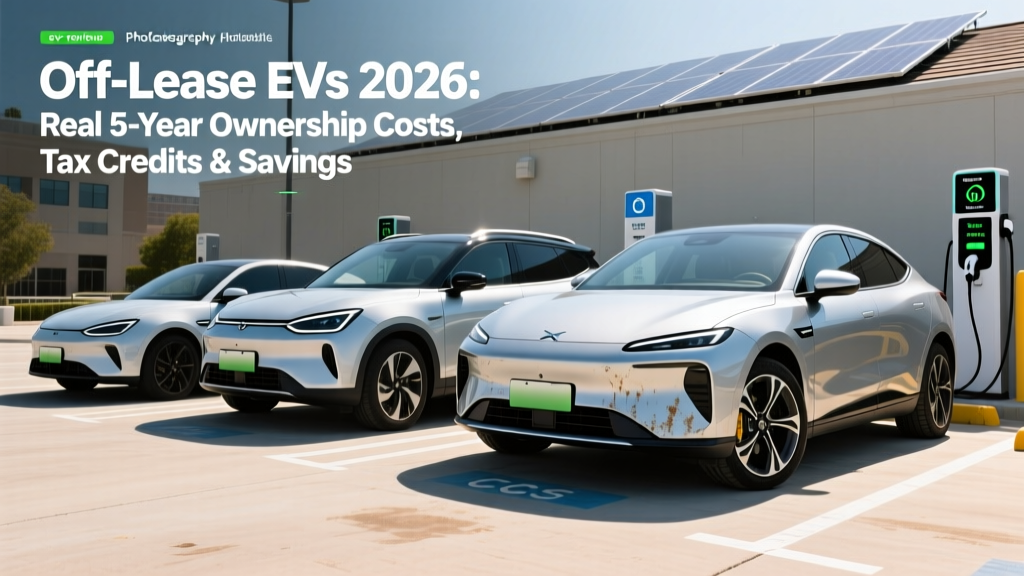
The wave of three-year EV leases signed in 2022 and 2023 is crashing into the used market right now. For budget-conscious buyers, off-lease EVs in 2026 represent one of the most compelling entry points into electric ownership: late-model vehicles with low mileage, remaining factory warranty, and price tags 30-45% below their original MSRP. But the total cost picture extends far beyond the sticker price. Between shifting federal tax credit rules, higher-than-average insurance premiums, and evolving battery health considerations, buying a used EV requires a different calculus than buying a used gas car.
This guide breaks down the exact numbers — from the IRS §25E used-EV credit to per-mile fuel and maintenance costs — so you can evaluate whether an off-lease Tesla Model Y, Hyundai Ioniq 5, Ford Mustang Mach-E, or Chevrolet Equinox EV actually saves you money over five years of ownership.
What Does It Really Cost to Own an Off-Lease EV for 5 Years?
The headline appeal of an off-lease EV is the purchase price. A 2023 Hyundai Ioniq 5 SEL that stickered at $48,650 new is landing on used lots in early 2026 between $26,000 and $31,000 depending on mileage and condition. A 2023 Tesla Model Y Long Range, originally $52,990, is transacting in the $28,000-$34,000 range. Apply the federal used-EV credit (details below), and the effective cost drops further.
But total cost of ownership (TCO) includes five line items beyond purchase price: energy (charging), insurance, maintenance, depreciation, and any financing costs. Here's a realistic 5-year breakdown for a typical off-lease EV purchased at $28,000 in 2026, driven 12,000 miles per year:
| Category | Annual Cost | 5-Year Total | Notes |
|---|---|---|---|
| Purchase price (after credit) | — | $24,000 | $28,000 purchase − $4,000 §25E credit |
| Home charging (Level 2) | $540 | $2,700 | 60,000 mi ÷ 3.5 mi/kWh × $0.16/kWh avg |
| Public DC fast charging | $240 | $1,200 | ~20% of charging at $0.35/kWh avg |
| Insurance | $2,100 | $10,500 | Varies widely; EVs typically 15-25% more than gas equivalent |
| Maintenance & repairs | $350 | $1,750 | Tires, cabin filter, wipers, brake fluid; no oil changes |
| Depreciation (resale value loss) | — | $8,000 | Estimated $24,000 → $16,000 over 5 years |
| Total 5-Year Cost | $48,150 |
For comparison, a 2023 gas-powered compact SUV purchased used at $24,000 with 30 MPG combined, driven the same 60,000 miles, would cost roughly $43,000-$47,000 over five years depending on gas prices and maintenance. The EV's edge comes from dramatically lower energy and maintenance costs, but that edge narrows when insurance premiums and steeper depreciation are factored in.
The Federal Used-EV Tax Credit (§25E): What You Can Actually Claim in 2026
The Inflation Reduction Act created the §25E Previously-Owned Clean Vehicle Credit — distinct from the §30D new-vehicle credit — offering up to $4,000 or 30% of the sale price (whichever is less) for qualifying used EVs and PHEVs. This is the credit most off-lease EV buyers will pursue.
- Maximum credit: $4,000 or 30% of sale price, whichever is lower
- Vehicle sale price cap: $25,000 or less (the actual transaction price, not MSRP)
- Vehicle age: Must be at least 2 model years old (2024 or earlier models qualify in 2026)
- Buyer income limits (MAGI): $75,000 single / $112,500 head of household / $150,000 joint filers
- Dealer requirement: Vehicle must be purchased from a licensed dealer (private-party sales excluded)
- Transfer option: Credit can be transferred to the dealer as a point-of-sale discount (effective Jan 2024 onward)
- Claim frequency: Once per taxpayer every 3 years
- First use: The vehicle's first use must begin with you (cannot claim if you were a prior owner)
Source: IRS §25E Used Clean Vehicle Credit. Rules are subject to legislative change; consult a tax professional for your specific situation.
The $25,000 sale price cap is the most restrictive constraint. Many off-lease 2023 EVs — particularly higher-trim Tesla Model Ys, Ford F-150 Lightnings, and Cadillac Lyriqs — transact above $25,000 even in 2026, disqualifying them from the federal credit. However, a well-shopped 2023 Chevrolet Bolt EUV, Nissan Ariya S, base Hyundai Ioniq 5 SE, or standard-range Ford Mustang Mach-E Select can often be found at or below the $25,000 threshold, especially with higher mileage or minor cosmetic wear.
Critical nuance: Unlike the §30D new-vehicle credit, the §25E used credit does not have battery-sourcing or critical-mineral requirements. The tradeoff is the lower maximum ($4,000 vs. $7,500) and the strict $25,000 price cap.
State, Local, and Utility Incentives: The Hidden Discounts
State, local, and utility incentives vary enormously by jurisdiction and change frequently. The figures below are illustrative examples — always verify current programs through your state energy office, utility provider, or the AFDC Alternative Fuels Data Center.
Beyond the federal credit, many buyers can stack additional incentives:
- California (CVRP): Up to $7,000 for income-qualified buyers purchasing used EVs through the Clean Cars 4 All program, though funding availability fluctuates
- Colorado: State tax credit of up to $3,500 for used EVs under $50,000 (as of current legislation)
- Utility rebates: Many utilities offer $300-$1,500 rebates for home Level 2 charger installation (e.g., PG&E, ConEdison, Xcel Energy programs) plus discounted time-of-use electricity rates
- HOV lane access: States like California, Colorado, and Virginia offer single-occupant HOV lane access for EVs — a significant time and quality-of-life benefit that doesn't show up in dollar figures
- Property/sales tax exemptions: Several states exempt EVs from ad valorem taxes or reduce registration fees
When stacking a $4,000 federal credit with a state incentive and a utility charger rebate, the effective discount on a $25,000 off-lease EV can reach $7,000-$9,000 — bringing the real acquisition cost into the $16,000-$21,000 range for qualifying buyers.
Charging vs. Gasoline: The Per-Mile Math That Matters
The single largest ongoing savings for EV owners comes at the energy pump. But the actual number depends heavily on how and where you charge.
| Scenario | Energy Cost | Efficiency | Cost Per Mile |
|---|---|---|---|
| Home Level 2 (national avg electricity) | $0.16/kWh | 3.5 mi/kWh (286 Wh/mi) | $0.046 |
| Home Level 2 (California/NE rates) | $0.28/kWh | 3.5 mi/kWh | $0.080 |
| Home with time-of-use (off-peak) | $0.09/kWh | 3.5 mi/kWh | $0.026 |
| Public DC fast charging (avg) | $0.35/kWh | 3.2 mi/kWh (highway) | $0.109 |
| Tesla Supercharger (member pricing) | $0.28/kWh | 3.2 mi/kWh | $0.088 |
| Gas SUV (30 MPG combined) | $3.40/gallon | 30 MPG | $0.113 |
| Gas sedan (35 MPG combined) | $3.40/gallon | 35 MPG | $0.097 |
For a driver covering 12,000 miles per year with 80% home charging and 20% public DC charging, the blended annual energy cost is roughly $600-$800. A comparable gas SUV at 30 MPG would spend $1,360 at $3.40/gallon. That's a $560-$760 annual fuel savings, or $2,800-$3,800 over five years.
The savings expand dramatically with off-peak home charging (some utilities offer rates under $0.10/kWh overnight) and shrink if you rely entirely on public DC fast charging at $0.35-$0.50/kWh. If you cannot charge at home, the EV energy cost advantage narrows significantly — in some markets, exclusive DC fast charging approaches or exceeds gasoline cost per mile.
Efficiency matters too. A Hyundai Ioniq 5 (EPA-rated ~3.0-3.5 mi/kWh depending on trim and wheel size) will cost 15-20% less to charge than a Ford F-150 Lightning (roughly 2.0-2.3 mi/kWh) on the same electricity rate. Check the EPA's fueleconomy.gov for exact kWh/100mi ratings on specific models.
Maintenance Savings: Fewer Parts, Fewer Visits, Real Dollars Saved
EVs eliminate the maintenance items that generate the bulk of gas-car service bills. No engine oil, no oil filters, no spark plugs, no timing belts, no exhaust systems, no transmission fluid changes (most EVs use single-speed reductions gears sealed for life).
| Maintenance Item | Gas Vehicle | EV |
|---|---|---|
| Oil changes (2-3×/year) | $150-$250 | $0 |
| Engine air filter | $30-$50 | $0 |
| Spark plugs (every 30-60k mi) | $200-$400 amortized | $0 |
| Transmission fluid | $100-$200 (at interval) | $0 |
| Brake pads/rotors | $300-$600 every 30-50k mi | $0-$200 (regen braking extends life 2-3×) |
| Tire rotation & replacement | $400-$800 | $500-$1,000 (EVs are heavier; tires wear faster) |
| Cabin air filter | $30-$60 | $30-$60 |
| Washer fluid, wipers, misc. | $50-$100 | $50-$100 |
| Estimated annual total | $900-$1,500 | $300-$500 |
The net maintenance savings is roughly $500-$900 per year, or $2,500-$4,500 over five years. The primary EV maintenance cost is tires — EVs are 10-20% heavier than equivalent gas vehicles and deliver instant torque, both of which accelerate tire wear. Budget for a tire replacement every 30,000-40,000 miles rather than the 50,000-60,000 miles typical for gas cars.
One often-overlooked maintenance advantage on off-lease EVs: many are still under the original factory warranty. A 2023 model with a 5-year/60,000-mile bumper-to-bumper warranty will carry coverage through 2028. The federally mandated battery warranty (8 years/100,000 miles minimum, per EPA/CARB rules) means the traction battery is protected through 2031 on a 2023 model — a significant peace-of-mind factor on a used EV purchase.
The Insurance Reality: Expect to Pay More
This is where the EV ownership story gets less rosy. Insurance premiums for EVs are typically 15-25% higher than for comparable gas vehicles, and in some cases the gap is wider.
The reasons are structural and unlikely to change soon:
- Higher repair costs: EV battery packs and power electronics are expensive to replace after collision damage. Even minor accidents that compromise the battery enclosure can trigger a total battery replacement ($10,000-$20,000+)
- Specialized labor: Fewer body shops are certified for high-voltage EV repair, limiting competition and raising labor rates
- Higher vehicle values: Even used, EVs often carry higher actual cash values than gas equivalents, increasing comprehensive/collision premiums
- Parts availability: EV-specific parts (battery modules, inverter assemblies, heat pump units) have longer lead times and fewer aftermarket alternatives
Based on 2026 national averages, expect annual EV insurance premiums of $1,800-$2,600 for a used mid-size EV, compared to $1,400-$2,000 for a gas equivalent. That's an additional $400-$600 per year, or $2,000-$3,000 over five years, which partially offsets the fuel and maintenance savings.
Practical tip: Shop insurance quotes before purchasing. Insurers vary enormously in how they price EVs — some (like Geico and Progressive) have become more competitive as EV volumes grow, while others still price them at a significant premium. Bundling home and auto, maintaining a clean record, and choosing higher deductibles can narrow the gap.
Depreciation and Resale Value: What to Expect in 2026 and Beyond
EV depreciation has been volatile. In 2023-2024, aggressive Tesla price cuts on new vehicles triggered a cascading drop in used EV values across all brands. A 2022 Model Y that was worth $55,000 used in mid-2022 had fallen to $28,000-$32,000 by early 2025.
By 2026, the market has stabilized somewhat, but EVs still depreciate faster on average than comparable gas vehicles. Key factors:
- Battery degradation uncertainty: Buyers discount used EVs for perceived battery risk, even though data shows most modern NMC and LFP batteries retain 85-92% capacity after 100,000 miles
- Rapid technology obsolescence: Newer EVs charge faster (350 kW vs. 150-250 kW on 2022-2023 models), have longer range, and offer updated ADAS features, making 3-year-old models feel dated
- Price competition from new EVs: As new EV prices drop (several 2026 models start under $35,000), used EVs must price aggressively to attract buyers
- Leasing dominance: Over 50% of new EVs were leased in 2023-2024, creating a steady supply of off-lease inventory that keeps used prices soft
For a buyer, this depreciation trend is a feature, not a bug. You're purchasing a vehicle that has already absorbed its steepest depreciation hit. A $28,000 off-lease EV that depreciates 30% over the next five years costs you $8,400 in resale value loss — far less than the $18,000-$22,000 the original lessee absorbed in the first three years.
Models that hold value best include the Porsche Taycan (enthusiast demand), Toyota bZ4X (brand loyalty), and well-equipped Tesla Model Ys (Supercharger network access and software updates). Models that depreciate fastest tend to be first-year nameplates from brands with less EV track record.
Putting It All Together: Does an Off-Lease EV Save You Money?
For a qualifying buyer purchasing a $25,000 off-lease EV with home charging access:
- Fuel savings: +$2,800 to +$3,800
- Maintenance savings: +$2,500 to +$4,500
- Federal used-EV credit: +$4,000
- State/utility incentives: +$500 to +$3,000 (varies)
- Insurance premium increase: −$2,000 to −$3,000
- Net 5-year savings vs. gas equivalent: +$7,800 to +$12,300
Savings are maximized with off-peak home charging, a qualifying state incentive, and competitive insurance quotes. Savings shrink or disappear if you rely exclusively on public DC fast charging in a high-electricity-rate market and cannot qualify for incentives.
Smart Shopping Tips for Off-Lease EVs in 2026
If you're ready to shop, these steps maximize value and minimize risk:
- Check battery State of Health (SoH): Request a battery health report from the dealer or use an OBD-II dongle with apps like EV Health or LeafSpy (for Nissan). Look for ≥90% capacity retention at 30,000-40,000 miles
- Verify warranty transfer: The 8-year/100,000-mile battery warranty follows the vehicle, not the owner. Confirm remaining coverage with the manufacturer
- Confirm credit eligibility before buying: The $25,000 sale price cap for §25E means negotiating the price down to or below the threshold before taxes and fees (which don't count toward the cap). Get the dealer to confirm the final sale price on the purchase agreement
- Test the charging port and cable: Ensure the charge port door opens properly, the CCS or NACS connector seats firmly, and the included Level 1/mobile charger works
- Check for open recalls and software updates: EVs receive OTA updates, but some require dealer visits. Verify all recalls (check at nhtsa.gov/recalls) are completed
- Get pre-qualified for insurance: Run quotes from at least three insurers before finalizing your purchase to avoid premium surprises
Frequently Asked Questions
How much does it really cost to own an off-lease EV over 5 years?
Based on a $28,000 purchase price (after a $4,000 federal credit), 12,000 miles/year, and mostly home charging, expect approximately $48,000-$52,000 in total 5-year costs including purchase, energy, insurance, maintenance, and depreciation. This is competitive with — and often lower than — a comparable used gas SUV when all costs are tallied.
Do I qualify for the federal used-EV tax credit?
You qualify for the §25E credit (up to $4,000) if your modified adjusted gross income is under $75,000 (single) or $150,000 (joint), the vehicle's sale price is $25,000 or less, the vehicle is at least 2 model years old, and you buy from a licensed dealer. You can claim it once every 3 years. The credit can be applied as a point-of-sale discount at purchase. Always verify current rules at irs.gov as legislation may change.
How much do I save on fuel and maintenance compared to a gas car?
Typical savings are $560-$760/year on fuel and $500-$900/year on maintenance, totaling roughly $5,300-$8,300 over five years. Savings are highest with off-peak home charging and lowest if you rely entirely on expensive public DC fast charging.
Are EVs more expensive to insure?
Yes, typically 15-25% more than an equivalent gas vehicle due to higher repair costs, specialized labor requirements, and expensive battery components. Expect to pay an additional $400-$600 per year. Shop multiple insurers — rates vary significantly between companies for EV coverage.
How well do off-lease EVs hold their value?
EVs have depreciated faster than gas vehicles in recent years, driven by rapid technology advances, new-vehicle price cuts, and battery degradation concerns. Expect 25-35% depreciation over 5 years of ownership on a used EV. However, because you're buying after the initial steep depreciation, your absolute dollar loss is smaller than the original owner's.
Should I worry about battery degradation on a 3-year-old off-lease EV?
Modern EV batteries (both NMC and LFP chemistries) typically retain 90-95% capacity after 3 years and 30,000-45,000 miles of normal use. Significant degradation (below 80%) within the first 3 years is rare and would be covered under the 8-year/100,000-mile federal battery warranty. Request a State of Health report before purchasing and prioritize vehicles with documented charging history.
What's the best off-lease EV to buy in 2026?
For value and efficiency: 2023 Hyundai Ioniq 5 or Kia EV6 (250 kW charging, ~300 mi EPA range, strong reliability). For lowest total cost: 2023 Chevrolet Bolt EUV (excellent efficiency, affordable parts, GM's Ultium warranty). For practicality and charging infrastructure: 2023 Tesla Model Y Long Range (NACS/Supercharger access, ~310 mi EPA range, strong OTA update track record). Always verify the specific vehicle's battery SoH and service history.