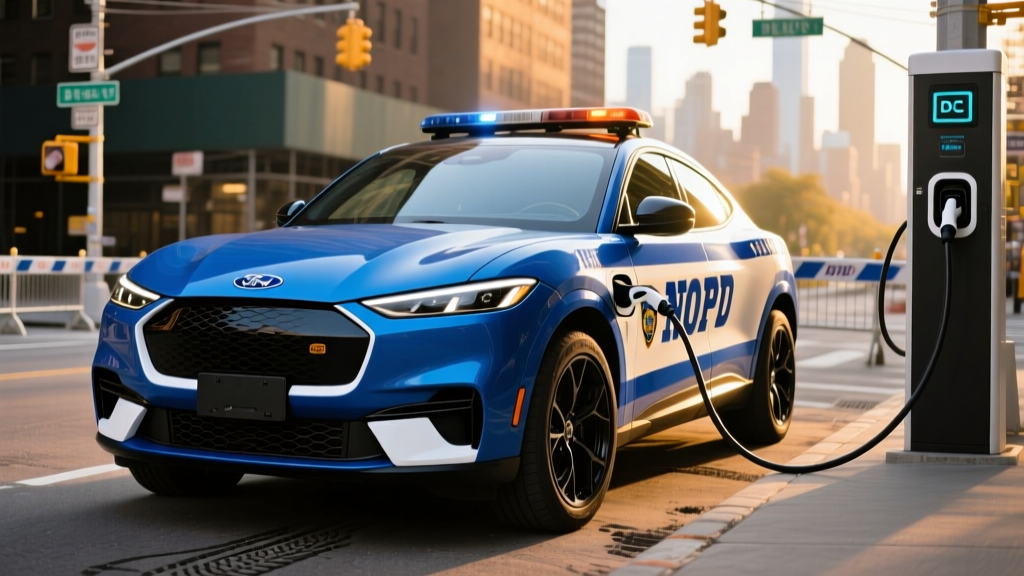
When the New York Police Department began adding the Ford Mustang Mach-E to its fleet, it became one of the most visible law-enforcement EV deployments in the country. The "NYPD Mach-E" isn't a special police-only variant — it's the retail Mustang Mach-E adapted for patrol and administrative use. That distinction matters for buyers: if a Mach-E can handle stop-and-go city patrols, idle-heavy shifts, and Northeast winters, it can likely handle your daily commute. This review breaks down the 2025–2026 Mustang Mach-E specs that matter most to real buyers, using the NYPD deployment as a lens into real-world durability.
Quick Verdict: Why the Mach-E Ended Up in NYPD Livery
Ford's Mustang Mach-E was a logical choice for NYPD fleet procurement. It's built in North America (Cuautitlán, Mexico — which affects tax-credit sourcing rules), offers available all-wheel drive for snow and rain, has a spacious cabin for partition and equipment mounting, and delivers competitive range for urban patrol routes. The Mach-E also benefits from Ford's established fleet-sales infrastructure and dealer network across the five boroughs. For civilian buyers, the Mach-E remains a compelling midsize electric crossover that balances efficiency, technology, and practicality — though it faces stiff competition from the Hyundai Ioniq 5, Tesla Model Y, and Kia EV6.
Range, Battery, and Efficiency: The Numbers That Matter
| Specification | Select (Std Range) | Premium (Ext Range RWD) | GT (Ext Range AWD) |
|---|---|---|---|
| EPA Range | 250 miles | 320 miles | 290 miles |
| Battery Capacity (usable) | 70 kWh (LFP) | 91 kWh (NMC) | 91 kWh (NMC) |
| Drivetrain | RWD | RWD | Dual-Motor AWD |
| Horsepower | 266 hp | 290 hp | 480 hp (GT) |
| 0-60 mph | 6.3 sec | 6.1 sec | 3.5 sec (GT) |
| MPGe (combined) | 105 MPGe | 101 MPGe | 84 MPGe |
| Efficiency (kWh/100 mi) | 32 kWh | 33 kWh | 40 kWh |
The Standard Range model uses a lithium iron phosphate (LFP) battery, which trades energy density for longevity and thermal stability. LFP cells tolerate daily 100% charging better than NMC and show slower degradation over time — a major plus for fleet operators who charge nightly. The Extended Range models use nickel-manganese-cobalt (NMC) chemistry for higher energy density, which is better for maximizing range but benefits from charging to 80–90% for daily use.
Charging Speed: DC Fast, Level 2, and Fleet Depot Reality
| Charging Level | Power / Rate | Time / Miles Added |
|---|---|---|
| Level 1 (120V household) | ~1.4 kW | ~3–4 miles per hour |
| Level 2 (240V home/fleet) | 10.5 kW (48A) | ~32 miles per hour; full charge in ~9–10 hrs |
| DC Fast Charge (peak) | 150 kW (Std Range) / 150 kW (Ext Range) | 10–80% in ~45 min (Std) / ~45 min (Ext) |
The Mach-E's DC fast-charging speed is its most debated spec. At a peak of 150 kW, it falls behind the Hyundai Ioniq 5 (which peaks at 240 kW on 800V architecture) and the Tesla Model Y (up to 250 kW at V3 Superchargers). The Mach-E's 10–80% charge time of approximately 45 minutes is adequate for depot-based fleet charging but less ideal for road-trippers relying on highway fast chargers.
For home charging, the Mach-E's onboard charger accepts up to 10.5 kW on a 48-amp Level 2 circuit. That's competitive and will fully replenish the Extended Range battery overnight. Fleet installations for NYPD typically use networked Level 2 chargers (ChargePoint or EVgo commercial units) at precinct parking facilities, with vehicles plugged in at shift end.
Charge curve note: Like most EVs, the Mach-E's charge rate tapers significantly above 80% state of charge. If you're road-tripping, plan to charge from 10–80% and move on rather than waiting for a full top-off, which can add 20+ minutes for the last 20%.
Interior, Cargo, and Patrol-Fit Practicality
The Mach-E's cabin is where fleet conversions shine — and where civilian buyers benefit from thoughtful packaging.
- Cargo volume: 29.7 cu ft behind rear seats; 59.7 cu ft with rear seats folded
- Front trunk (frunk): 4.7 cu ft — useful for charging cables or small equipment
- Rear legroom: 38.1 inches
- Front headroom: 40.4 inches (panoramic glass roof reduces this slightly vs. solid roof)
NYPD upfitters typically install a prisoner transport partition, lightbar wiring harness, and equipment trays in the cargo area. The flat load floor and wide hatch opening make the Mach-E more upfit-friendly than sedan alternatives. For civilian buyers, the cargo space is competitive with the Model Y (30.2 cu ft rear) and larger than the Ioniq 5 (27.2 cu ft), though the Tesla offers more total volume with seats folded (76.2 cu ft).
Technology, Driver Assists, and Standout Features
The Mach-E comes standard with Ford's Co-Pilot360 suite, which includes:
- Adaptive cruise control with stop-and-go
- Lane-keeping system with lane-centering
- Automatic emergency braking with pedestrian detection
- Blind-spot monitoring with rear cross-traffic alert
- Evasive steering assist
Ford's available BlueCruise (hands-free driving on pre-mapped divided highways) is a strong competitor to GM's Super Cruise. As of 2025–2026, BlueCruise covers over 130,000 miles of compatible highways in the US and Canada. It works well but requires a subscription after the initial trial period (typically $75/month or $800/year after the first year).
The infotainment system runs on a large 15.5-inch vertical touchscreen with SYNC 4A, wireless Apple CarPlay and Android Auto, and over-the-air (OTA) update capability. The Mach-E was one of Ford's first vehicles built around OTA updates, meaning software improvements (including battery management and driver-assist refinements) can be pushed remotely — a feature fleet managers value for reducing service-visit downtime.
Notable drawback: The Mach-E relies heavily on the touchscreen for climate controls, with no physical knobs for temperature or fan speed. This is a frequent complaint among owners and can be distracting while driving.
Pricing, Trims, and Federal Tax Credit Eligibility
| Trim | Base MSRP (2025) | Est. After §30D Credit* |
|---|---|---|
| Select (Std Range RWD) | $39,995 | ~$32,495 |
| Premium (Ext Range RWD) | $48,995 | ~$41,495 |
| Premium (Ext Range AWD) | $51,995 | ~$44,495 |
| GT (Ext Range AWD) | $59,995 | ~$52,495 |
| Rally (Ext Range AWD) | $61,995 | ~$54,495 |
*Credit eligibility depends on buyer income, battery sourcing, and MSRP caps. See checklist below.
- MSRP cap: SUVs/crossovers must be under $80,000 — the Mach-E qualifies across all trims
- Buyer income cap (AGI): $150,000 single / $225,000 head of household / $300,000 joint
- Battery sourcing: Must meet critical-mineral and battery-component requirements per IRS §30D rules — the Mach-E's Mexico assembly and supply-chain sourcing have caused credit eligibility to fluctuate; always verify current eligibility on the IRS qualified vehicle list before purchase
- Point-of-sale transfer: As of 2024+, buyers can transfer the credit to the dealer at purchase, reducing the upfront price rather than waiting for a tax refund
- Leasing loophole: Commercial-lease entities may pass through the §45W commercial credit, sometimes allowing lessees to benefit even when purchase credit is unavailable — consult a tax professional
NYPD fleet purchases are made through municipal procurement channels and are not subject to consumer tax-credit rules. For civilian buyers, however, the Mach-E's credit eligibility can shift based on Ford's battery supply chain — always confirm the specific VIN's eligibility at fueleconomy.gov before signing.
Warranty and Long-Term Ownership
Ford backs the Mach-E with:
- Battery warranty: 8 years / 100,000 miles (retains at least 70% capacity)
- Powertrain warranty: 5 years / 60,000 miles
- Bumper-to-bumper: 3 years / 36,000 miles
The 70% capacity-retention threshold is industry-standard but less generous than Hyundai/Kia's approach (which guarantees 70% for 10 years/100,000 miles). For fleet operators like NYPD, vehicles are typically cycled out of service within 3–5 years and 60,000–80,000 miles, so warranty coverage is sufficient. Civilian owners planning to keep the Mach-E beyond 100,000 miles should budget for potential battery degradation below the warranty threshold — replacement costs for the 91 kWh pack are estimated at $15,000–$20,000 out of warranty.
Mach-E vs. the Competition: What Should You Actually Buy?
| Spec | Ford Mach-E (Ext RWD) | Tesla Model Y (LR) | Hyundai Ioniq 5 (LR RWD) |
|---|---|---|---|
| EPA Range | 320 mi | 320 mi | 303 mi |
| Battery | 91 kWh NMC | ~75 kWh NMC | 77.4 kWh NMC |
| DC Fast Charge (peak) | 150 kW | 250 kW | 240 kW (800V) |
| 10–80% DC Time | ~45 min | ~27 min | ~18 min |
| 0–60 mph | 6.1 sec | 5.0 sec | 7.3 sec |
| Cargo (rear / folded) | 29.7 / 59.7 cu ft | 30.2 / 76.2 cu ft | 27.2 / 59.3 cu ft |
| Base MSRP | $48,995 | $44,990 | $46,650 |
Choose the Model Y if: Maximum cargo space, fastest DC charging on the Supercharger network, and lowest starting price are your priorities — and you're comfortable with Tesla's service model.
Choose the Ioniq 5 if: Fastest possible DC charging (18 min 10–80%) and retro-modern styling matter most, and you want the longest warranty coverage at 10 years/100,000 miles.
Pros and Cons
Pros
- Comfortable ride quality, quiet cabin at highway speeds
- Spacious interior with practical hatchback cargo area
- BlueCruise hands-free driving on 130,000+ miles of highway
- LFP option on Standard Range for daily 100% charging without degradation worry
- OTA updates keep software current without dealer visits
- Strong fleet/dealer support network
Cons
- 150 kW peak DC charging is slow vs. 800V competitors
- Touchscreen-only climate controls are distracting
- Tax-credit eligibility fluctuates based on battery sourcing
- GT and Rally trims push price near $60K+
- Real-world winter range drops 15–25% in cold climates
- No frunk drain plug (limits wet-use practicality)
Who Is the Mach-E Best For?
The Mach-E fits daily commuters and small families who want a refined, quiet electric crossover with good range and don't frequently road-trip more than 250 miles between stops. Its LFP Standard Range variant is particularly well-suited for urban commuters who charge nightly at home and want long-term battery health. The AWD variants handle Northeast and Midwest winters competently.
It's less ideal for frequent road-trippers who prioritize fast DC charging (the Ioniq 5 or Model Y charge significantly faster) or towing-oriented buyers (the Mach-E is rated for only 1,500 lbs with the factory hitch, far below the F-150 Lightning or Rivian R1S).
FAQ
What is the real-world range of the Mustang Mach-E?
The EPA rates the Extended Range RWD at 320 miles. In real-world highway driving at 70 mph, expect 260–280 miles. In cold weather below 30°F, range drops to roughly 200–230 miles on the highway. City driving with regenerative braking can match or slightly exceed the EPA figure.
How fast does the Mach-E charge at home and on DC fast chargers?
At home on a 48-amp Level 2 charger (10.5 kW), the Mach-E adds about 32 miles of range per hour and fully charges overnight. On DC fast chargers, it peaks at 150 kW, achieving a 10–80% charge in approximately 45 minutes — slower than the Ioniq 5 or Model Y.
Does the Mustang Mach-E qualify for the $7,500 federal tax credit?
Eligibility depends on your income (AGI caps of $150K single / $300K joint), the vehicle's MSRP (under $80K — all trims qualify), and current battery-sourcing compliance per IRS §30D. Because the Mach-E is assembled in Mexico and battery sourcing rules change, always verify eligibility at fueleconomy.gov for the specific VIN before purchase.
Is the Mach-E worth buying vs. the Tesla Model Y or Hyundai Ioniq 5?
The Mach-E wins on ride comfort, cabin quietness, and BlueCruise. The Model Y wins on cargo space, Supercharger access, and price. The Ioniq 5 wins on DC charging speed and warranty length. Your priority among these factors should drive the decision.
What are the biggest drawbacks of the Mach-E?
The 150 kW DC charging speed is the most significant limitation for road-trippers. The touchscreen-only climate controls frustrate many owners. Tax-credit eligibility can be inconsistent. And cold-weather range loss is noticeable in northern climates.
How does the NYPD use the Mach-E?
NYPD deploys the Mach-E primarily for patrol and administrative duties in urban environments. Fleet units are charged at precinct Level 2 stations between shifts. The Mach-E's AWD availability, hatchback practicality, and low operating costs (no oil changes, reduced brake wear from regen) make it well-suited to municipal fleet duty cycles.