The Short Answer
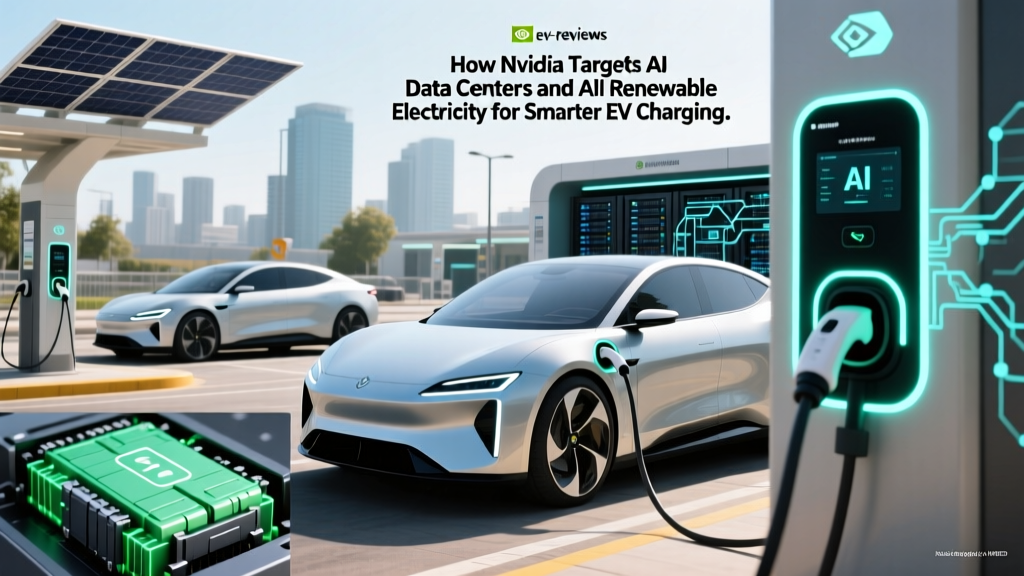
Nvidia's push into AI data centers powered entirely by renewable electricity intersects directly with EV ownership: utilities and charging networks are deploying AI-driven load management to cut peak-charging costs by 15–30%, while Nvidia's GPU-accelerated grid software helps integrate solar and wind power that ultimately charges your car. For buyers, this means smarter time-of-use rates, faster route-based preconditioning via AI navigation, and improving public-charger uptime — but the benefits are uneven across regions today.
Why Nvidia's AI and Renewable Push Matters to EV Owners
When Nvidia targets AI data centers and all renewable electricity, the headline is usually about cloud computing or hyperscale GPU clusters. But the infrastructure behind that strategy — advanced grid orchestration, predictive energy dispatch, and real-time load balancing — is the same technology reshaping how EVs charge. Nvidia's Omniverse and AI Enterprise platforms are being adopted by utilities to model grid behavior at sub-second resolution, allowing them to accommodate thousands of EVs plugging in simultaneously without triggering brownouts or expensive peaker-plant dispatches.
For a 2026 EV buyer, the practical upshot is that your home charger and your local DC fast-charging station are increasingly managed by AI systems that decide when electrons flow, not just how fast. That scheduling intelligence directly affects your electricity bill and your charging speed.
Real Costs: EV Charging vs Gas in the AI-Optimized Grid
Let's put concrete numbers on the table. The national average residential electricity rate sits near $0.17/kWh in early 2026 (EIA data), while gasoline averages roughly $3.40/gallon. Here's how a mid-size EV and a comparable gas sedan compare over 15,000 annual miles:
| Metric | EV (e.g., Tesla Model 3 RWD) | Gas (e.g., Toyota Camry LE) |
|---|---|---|
| Energy efficiency | 26 kWh/100 mi (132 MPGe) | |
| Energy efficiency | — | 32 MPG combined |
| Annual energy use | 3,900 kWh | 469 gallons |
| Cost (home L2, $0.17/kWh avg) | $663 | — |
| Cost (gas at $3.40/gal) | — | $1,595 |
| AI-optimized TOU rate savings | –$100 to –$200/yr | N/A |
| Net annual fuel cost | ~$460–$560 | ~$1,595 |
The "AI-optimized TOU" row reflects utilities using GPU-accelerated forecasting (Nvidia-powered or otherwise) to offer tighter off-peak windows with rates as low as $0.06–$0.09/kWh. If you can schedule charging between 11 PM and 5 AM, your annual cost drops substantially. If you rely on public DC fast chargers at $0.35–$0.48/kWh, your EV fuel cost climbs to roughly $1,365–$1,872/year — erasing much of the savings advantage.
EV vs Gas vs Hybrid: A Data-Driven Comparison
The Nvidia-renewable-grid story changes the calculus slightly for each powertrain type. Here's a side-by-side using current 2026 models:
| Attribute | BEV: Hyundai Ioniq 6 SEL | PHEV: Toyota RAV4 Prime XSE | Gas: Honda Accord EX-L |
|---|---|---|---|
| EPA range / MPG | 361 mi (EV) | 42 mi EV + 38 MPG gas | 33 MPG combined |
| Battery / fuel tank | 77.4 kWh (NMC) | 18.1 kWh (NMC) + 14.5 gal | 14.8 gal |
| DC fast charge (10–80%) | ~18 min @ peak 235 kW | No DCFC (L2 only, ~2.5 hr) | ~3 min refuel |
| MSRP (before incentives) | $42,600 | $44,990 | $33,890 |
| Federal tax credit (§30D) | Up to $7,500 (income/sourcing rules apply) | Up to $7,500 | $0 |
| Annual fuel cost (15k mi) | ~$660 (home L2 avg) | ~$520 EV + $830 gas (mixed) | ~$1,540 |
| 5-yr maintenance est. | ~$1,800 | ~$2,800 | ~$3,500 |
| Grid/AI optimization benefit | High (full load flexibility) | Moderate (smaller battery) | None |
The BEV benefits most from AI-managed renewable grids because its large battery can absorb cheap overnight wind power or midday solar surplus. A PHEV benefits modestly. A gas car is entirely outside that ecosystem.
What First-Time EV Buyers Should Know in 2026
If you're entering the EV market for the first time, here are the ownership realities that no amount of AI grid optimization can eliminate:
Home Charging Access Is the Single Biggest Variable
Approximately 30% of US households lack dedicated off-street parking, making Level 2 home charging difficult or impossible. Without home charging, you'll rely on public infrastructure where costs are 2–3× higher and availability varies wildly by region. A Level 2 home installation typically runs $800–$2,200 (charger + electrician + permit), but can exceed $4,000 if your panel needs a 200-amp upgrade.
Cold Weather Still Cuts Range 20–35%
No AI model changes battery chemistry physics. In sub-freezing temperatures, expect an EPA-rated 361-mile Ioniq 6 to deliver roughly 235–290 real-world miles, depending on cabin heat usage and whether the vehicle's heat pump (standard on Hyundai, Tesla, and most 2026 models) is active. Preconditioning while plugged in mitigates this loss significantly.
The §30D Tax Credit Is Not Guaranteed
Under current IRS §30D rules, the up-to-$7,500 credit requires:
- Buyer AGI under $150K (single) / $300K (joint)
- Vehicle MSRP under $55K (sedans) or $80K (SUVs/trucks)
- Battery critical-mineral and component sourcing thresholds (tightening annually)
- Point-of-sale transfer is available, reducing your dealer price directly
Always verify eligibility on the IRS site and with a tax professional before committing.
Common Misconceptions About AI, Renewables, and EV Charging
| Myth | Fact |
|---|---|
| "AI data centers will drain the grid and leave no power for EVs." | Nvidia's own efficiency roadmap targets 25× inference performance per watt across GPU generations. Meanwhile, data centers are contracting dedicated renewable PPAs (power purchase agreements), adding new solar/wind capacity rather than competing for existing supply. |
| "Renewable electricity means my EV charges for free from the sun." | Solar and wind have near-zero marginal generation cost, but transmission, distribution, and utility overhead still apply. Expect $0.06–$0.17/kWh even on 100% renewable plans. |
| "AI-managed charging means I can't charge when I want." | Most smart-charging programs are opt-in and allow override. You set a departure time; the AI finds the cheapest window. You can always force immediate charging. |
| "All public chargers are unreliable." | Network uptime varies: Tesla Superchargers average ~98% uptime; Electrify America and EVgo report 90–95% in 2026 (J.D. Power EV Experience Index). AI-driven predictive maintenance is improving non-Tesla network reliability. |
Your Decision Framework: Which Powertrain Fits Your Situation?
If / Then EV Buying Guide
- If you have a garage or driveway with 240V access, drive under 60 miles/day, and live in a region with time-of-use rates → Then a BEV like the Tesla Model 3 ($38,990 base, 341 mi EPA) or Chevy Equinox EV ($33,600 base, 319 mi EPA) offers the lowest total cost of ownership. Pair with a smart Level 2 charger ($500–$700) and enroll in your utility's AI-managed off-peak program.
- If you lack home charging but have reliable public DCFC within 5 miles → Then a BEV with fast-charge capability (peak ≥150 kW, 10–80% under 25 min) is workable but budget $1,200–$1,800/yr for public charging.
- If you regularly drive 300+ miles in rural areas or tow frequently → Then a PHEV (RAV4 Prime, Wrangler 4xe) or an EREV gives you electric daily commuting with gas- powered range security. The AI-renewable grid benefit is smaller but real for the electric portion.
- If you live in an apartment without charging and drive long distances → Then a conventional hybrid (Toyota Camry Hybrid, 51 MPG combined, $29,995) remains the pragmatic choice until public charging access improves in your area.
5-Year Total Cost of Ownership: EV vs Gas Reality Check
Let's run the full numbers for a 2026 Tesla Model 3 Long Range ($47,740 MSRP, ~$40,240 after $7,500 §30D credit if eligible) versus a 2026 Toyota Camry SE ($30,490 MSRP), over 5 years and 75,000 miles:
| Cost Category | Tesla Model 3 LR (BEV) | Toyota Camry SE (Gas) |
|---|---|---|
| Purchase (after credit) | $40,240 | $30,490 |
| Fuel / electricity | $3,100 (home L2 avg) | $7,700 |
| Maintenance | $1,800 | $3,500 |
| Insurance (avg) | $9,500 | $6,800 |
| Depreciation (est. 5-yr) | $18,000 | $12,500 |
| 5-Year Total | $72,640 | $60,990 |
| Cost per mile | $0.97 | $0.81 |
The EV still costs more over five years in this comparison, primarily due to higher insurance premiums and steeper depreciation. The fuel savings are real (~$4,600 over 5 years) but don't fully close the gap. Buyers who prioritize lower running costs over total cost, who qualify for the full credit, or who keep vehicles 8+ years see the math flip in the EV's favor.
Frequently Asked Questions
Does Nvidia actually build EV chargers?
No. Nvidia provides the AI computing infrastructure (GPUs, Omniverse digital twins, AI Enterprise software) that utilities, charging networks, and grid operators use to optimize energy flow. Think of Nvidia as the "brains behind the grid" rather than a hardware charging company.
Will AI-optimized charging work with any EV?
Most 2026 EVs support scheduled charging via their infotainment system or companion app, and any smart Level 2 charger (ChargePoint, Wallbox, Emporia) can manage charging windows independently of the car. The AI optimization happens at the charger or utility level, so compatibility is broad.
How much can I realistically save with time-of-use rates and smart charging?
Typical savings are $100–$250/year compared to unmanaged charging on a flat rate, depending on your utility's TOU spread. In markets like California (PG&E, SCE) with aggressive off-peak rates, savings can reach $300+ annually.
Are AI data centers competing with my EV for renewable energy?
In the short term, yes — both increase electricity demand. But Nvidia's hyperscale customers (Microsoft, Google, Amazon) are contracting new-build renewable capacity via PPAs, meaning their demand is driving solar and wind construction that expands total clean energy supply rather than cannibalizing existing generation.
Should I wait for the grid to get smarter before buying an EV?
No. AI-managed charging is already operational at major utilities in 2026 and will only improve. The EVs you buy today are compatible with tomorrow's smarter grid. Waiting means missing years of fuel savings and current §30D credit availability, which is subject to legislative change.
The convergence of Nvidia's AI infrastructure push and the renewable-energy buildout is real and accelerating — but for today's EV buyer, the fundamentals haven't changed: secure home charging, understand your local electricity rates, verify your tax-credit eligibility, and choose the powertrain that matches your actual driving patterns, not the marketing narrative.