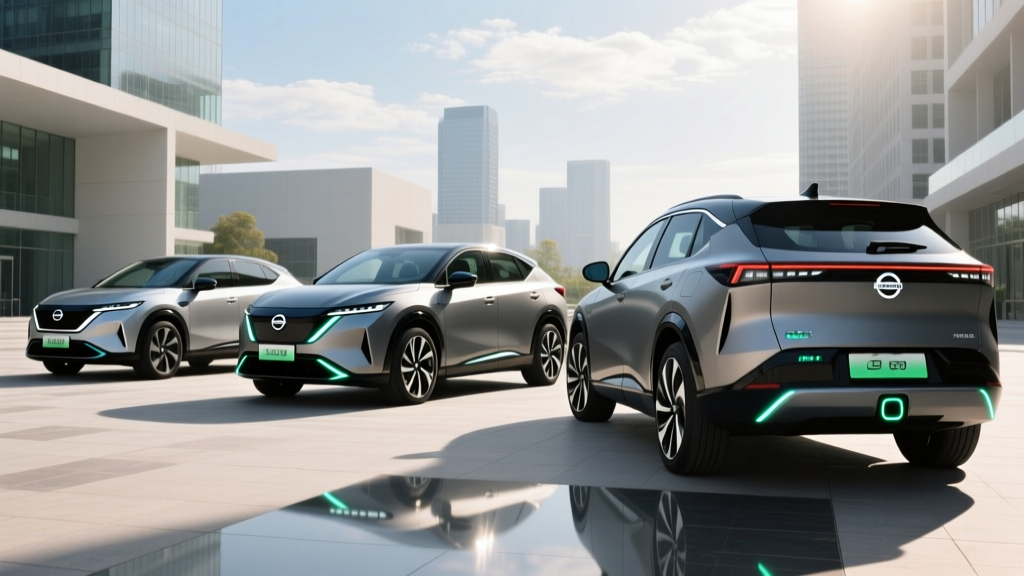
Bottom line: The 2026 Nissan Ariya is currently Nissan's only fully electric SUV available in the U.S. With an EPA-estimated 304 miles of range (Venture+ trim), 130 kW DC fast charging, and a starting MSRP of $39,770, it's a practical midsize crossover for buyers who want a mainstream-brand EV without Tesla's ecosystem. However, its charging speed trails rivals like the Hyundai Ioniq 5 (240 kW peak) and Kia EV6 (239 kW), meaning road-trip stops take noticeably longer. If you need a Nissan SUV EV today, the Ariya is your answer — but go in with eyes open about its charging-curve limitations and federal tax credit eligibility.
What Nissan SUV EV Models Can You Actually Buy?
Nissan's electric SUV lineup in 2026 is a one-model show. The Nissan Ariya — introduced for the 2023 model year and refreshed incrementally since — remains the brand's sole battery-electric SUV in the North American market. Nissan has announced future EV plans globally, but no additional Nissan SUV EV models are currently on sale or available for order in the U.S. as of early 2026.
The Ariya slots into the competitive midsize electric crossover segment, facing off against the Hyundai Ioniq 5, Kia EV6, Ford Mustang Mach-E, Volkswagen ID.4, and Tesla Model Y. It rides on the Renault-Nissan-Mitsubishi CMF-EV platform and offers both front-wheel-drive and e-4ORCE all-wheel-drive configurations.
2026 Nissan Ariya: Range, Battery, and Charging Specs
| Specification | Venture+ (FWD) | Empower+ (FWD) | Evolve+ e-4ORCE (AWD) | Platinum+ e-4ORCE (AWD) |
|---|---|---|---|---|
| EPA Range | 304 mi | 289 mi | 272 mi | 267 mi |
| Battery (usable) | 91 kWh | 91 kWh | 91 kWh | 91 kWh |
| Chemistry | NMC (lithium-ion) | NMC | NMC | NMC |
| Motor | Single FWD | Single FWD | Dual AWD (e-4ORCE) | Dual AWD (e-4ORCE) |
| Horsepower | 238 hp | 238 hp | 389 hp | 389 hp |
| 0-60 mph | ~7.5 sec | ~7.5 sec | ~4.8 sec | ~4.8 sec |
| Peak DC Charge Rate | 130 kW | 130 kW | 130 kW | 130 kW |
| 10-80% DCFC Time | ~35 min | ~35 min | ~35 min | ~35 min |
| Level 2 (240V) Rate | 7.2 kW | 7.2 kW | 7.2 kW | 7.2 kW |
| Connector | CCS1 (NACS adapter avail.) | CCS1 | CCS1 | CCS1 |
| Efficiency (MPGe) | 109/94/101 | 105/91/98 | 99/86/93 | 97/84/91 |
| Starting MSRP | $39,770 | $44,170 | $47,570 | $51,670 |
| Battery Warranty | 8 years / 100,000 miles (capacity retention to ~66%) | |||
Source: fueleconomy.gov and Nissan USA specifications.
Real-world range reality: The 304-mile EPA figure on the Venture+ is achievable in moderate temperatures with mixed city/highway driving. Expect roughly 250–275 miles on sustained highway trips at 70+ mph, and potentially 210–240 miles in sub-freezing winter conditions. NMC chemistry in the Ariya's 91 kWh pack performs adequately in cold weather, but like all liquid-cooled EV batteries, it loses efficiency below 32°F. Preconditioning the battery before DC fast charging is essential to hit peak charge rates.
Charging the Ariya: Home, Public, and the 130 kW Limitation
The Ariya's 130 kW peak DC fast charging rate is the single most consequential spec to understand before buying. Here's what that means in practice:
| Charging Level | Power | Miles Added Per Hour | Typical Use Case |
|---|---|---|---|
| Level 1 (120V) | ~1.4 kW | ~4–5 mi/hr | Emergency/top-up only |
| Level 2 (240V, 32A) | 7.2 kW | ~25–28 mi/hr | Home overnight, workplace |
| DC Fast Charge | 130 kW peak | N/A (session-based) | Road trips |
At home on a Level 2 charger, the Ariya adds roughly 25–28 miles of range per hour. A full 10% to 100% charge takes about 13 hours — perfectly manageable for overnight charging if you plug in when you get home. A typical daily commute of 40 miles requires roughly 1.5 hours of Level 2 replenishment.
On road trips, the 130 kW peak rate means a 10–80% session takes approximately 35 minutes under ideal conditions. For comparison, the Hyundai Ioniq 5 peaks at 240 kW and completes the same session in roughly 18 minutes. The Ariya's charge curve also tapers significantly above 80% state of charge — charging from 80% to 100% can add another 25+ minutes, so plan to charge only to 80% on road trips unless you need every mile.
Nissan equips the Ariya with a CCS1 connector. A NACS (Tesla Supercharger) adapter is available, giving Ariya owners access to Tesla's Supercharger network — a significant practical advantage for road-trip charging infrastructure coverage. Nissan has confirmed future Ariya model years will transition to a native NACS port.
Nissan Ariya vs. Gas SUV vs. Hybrid: Cost and Efficiency Comparison
How does the Ariya stack up against a comparable gas-powered Nissan Rogue or a hybrid alternative? Here's a five-year ownership cost snapshot:
| Cost Category | 2026 Nissan Ariya Venture+ | 2026 Nissan Rogue SV (Gas) | 2026 Toyota RAV4 Hybrid |
|---|---|---|---|
| Base MSRP | $39,770 | $31,250 | $33,425 |
| Est. Federal Tax Credit (§30D) | Up to $7,500* | $0 | $0 |
| Effective Purchase Price | ~$32,270* | $31,250 | $33,425 |
| Fuel/Energy (5 yrs, 15k mi/yr) | ~$4,100 | ~$9,800 | ~$6,400 |
| Maintenance (5 yrs) | ~$1,800 | ~$4,200 | ~$3,600 |
| Insurance (5 yrs avg.) | ~$10,500 | ~$8,200 | ~$8,800 |
| Est. 5-Year Depreciation | ~$16,500 | ~$14,000 | ~$13,500 |
| Total 5-Year Cost | ~$65,170 | ~$67,450 | ~$65,725 |
*Federal §30D tax credit eligibility depends on MSRP caps (SUVs: $80,000), buyer income limits ($150k single / $300k joint), and battery critical-mineral/component sourcing requirements. Verify current-year rules at IRS.gov. Point-of-sale transfer is available at participating dealers.
The Ariya's higher insurance premiums and steeper depreciation partially offset its fuel and maintenance savings. However, if you qualify for the full §30D credit and charge primarily at home on off-peak electricity rates ($0.12–$0.15/kWh), the total cost of ownership becomes competitive with — or lower than — a gas Rogue over five years.
Real-World Ownership: What First-Time EV Buyers Need to Know
Before committing to a Nissan SUV EV, honestly assess these practical factors:
Home Charging Access
The Ariya ownership experience is dramatically better with home Level 2 charging. A 240V / 32A home charger installation typically costs $800–$2,500 (equipment plus licensed electrician), depending on your electrical panel's capacity and the distance from panel to garage. If your home has a 200-amp panel with available breaker slots, expect the lower end. Homes with older 100-amp panels may need a $2,000–$4,000 panel upgrade before adding an EV circuit.
Without home charging, you'll rely on public Level 2 and DC fast charging. At current public charging rates ($0.35–$0.55/kWh for DCFC), your "fuel" cost approaches or exceeds that of a gas car — eliminating one of the Ariya's primary economic advantages.
Climate Considerations
If you live in a region with sustained sub-freezing winters (Upper Midwest, Northeast, Mountain West), budget for 20–30% range reduction in cold months. The Ariya's heat pump (standard on most trims) helps preserve cabin efficiency, but battery chemistry inherently loses capacity in cold temperatures. A 304-mile EPA range becomes roughly 210–240 real-world miles at 15°F with highway driving and cabin heat.
Driving Patterns
The Ariya excels as a daily commuter and suburban family hauler. For frequent road-trippers covering 300+ miles regularly, the 130 kW charge rate means longer stops than competing EVs. If your typical trip exceeds the Ariya's real-world range and passes through areas with sparse DCFC infrastructure, a PHEV like the Toyota RAV4 Prime may be more practical.
Common Misconceptions About the Nissan Ariya
| Myth | Fact |
|---|---|
| "The Ariya qualifies for the full $7,500 tax credit for everyone." | §30D credit eligibility requires meeting buyer income caps ($150k single / $300k joint for 2026), MSRP under $80,000 (Ariya qualifies), and battery critical-mineral and component sourcing thresholds. The credit amount can be $3,750 or $7,500 depending on sourcing compliance. Check current IRS guidance. |
| "The battery will need expensive replacement in a few years." | Nissan warrants the Ariya's battery for 8 years/100,000 miles against degradation below ~66% capacity. Real-world NMC degradation data from similar platforms suggests 10–15% capacity loss over 150,000 miles with normal use. A full replacement, if ever needed, currently costs $12,000–$18,000 — but most owners will never need one. |
| "I can use Tesla Superchargers directly." | The Ariya ships with a CCS1 port. You need Nissan's NACS adapter to access Tesla Superchargers. The adapter is available through Nissan dealers and costs approximately $200–$300. |
| "The Ariya is self-driving with ProPILOT Assist." | ProPILOT Assist 2.0 is a SAE Level 2 driver-assistance system. It handles adaptive cruise control and lane centering on compatible highways, but you must remain attentive with hands available. It is not autonomous driving. |
| "130 kW charging is fast enough for any road trip." | 130 kW is moderate by 2026 standards. You'll spend roughly 35 minutes per 10–80% session — nearly double the time of 240+ kW competitors. Plan accordingly on trips over 250 miles. |
Decision Framework: Should You Buy the 2026 Nissan Ariya?
Choose the Nissan Ariya if:
- You want a mainstream-brand electric SUV with a conventional crossover design (no polarizing styling)
- You have reliable home Level 2 charging access
- Your daily commute is under 80 miles round-trip
- You qualify for the §30D federal tax credit, bringing effective price near $32,000–$35,000
- You value a quiet, comfortable ride over sporty driving dynamics
- You want access to Tesla Superchargers via adapter for road-trip flexibility
Look at alternatives if:
- Road-trip charging speed is a priority → Hyundai Ioniq 5 or Kia EV6 (240 kW peak, ~18 min 10–80%)
- You need maximum range → Tesla Model Y Long Range (~330 mi EPA) or Hyundai Ioniq 5 (~310 mi)
- You lack home charging and drive long distances → Consider a PHEV like the Toyota RAV4 Prime (42 mi electric-only, then hybrid)
- You need three rows of seating → The Ariya is two-row only; look at the Kia EV9 or VW ID.4 (optional third row)
- Budget is under $35,000 before incentives → The Ariya's MSRP starts at $39,770; consider used EV market or wait for lower-priced Nissan EV models
Frequently Asked Questions
Is the Nissan Ariya the only Nissan SUV EV available?
Yes, as of 2026, the Ariya is Nissan's only fully electric SUV sold in the United States. The Nissan Leaf is a hatchback (not an SUV) and has been discontinued after the 2025 model year. Nissan has announced broader EV plans globally, but no additional Nissan SUV EV models are on sale in the U.S. market.
How much does it cost to charge the Ariya at home?
At the U.S. average residential electricity rate of ~$0.16/kWh (varies significantly by state and utility), charging the Ariya's 91 kWh battery from 10% to 100% costs approximately $13–$15. That translates to roughly $0.04–$0.05 per mile — compared to $0.12–$0.14 per mile for a gas SUV getting 28 MPG at $3.50/gallon. Over 15,000 annual miles, home charging saves approximately $1,100–$1,400 versus gasoline.
Does the Ariya's battery degrade quickly?
NMC lithium-ion batteries in liquid-cooled packs like the Ariya's typically lose 10–15% capacity over 150,000 miles of normal use. Nissan's battery warranty covers 8 years/100,000 miles with a capacity retention floor of approximately 66%. To maximize longevity, avoid routinely charging to 100% or letting the battery sit at 0% for extended periods. Daily charging to 80% is ideal for battery health.
Can the Ariya tow?
The Ariya's towing capacity is limited. Front-wheel-drive trims are not rated for towing. The e-4ORCE AWD trims have a maximum towing capacity of 1,500 pounds when properly equipped — enough for a small utility trailer but not a camper or boat. If towing is a priority, the Ford Mustang Mach-E (up to 3,500 lbs with the California Route 1 package) or Rivian R1S are better options.
What is ProPILOT Assist 2.0, and is it self-driving?
ProPILOT Assist 2.0 is Nissan's advanced driver-assistance system, classified as SAE Level 2. It provides hands-off driving on pre-mapped divided highways under specific conditions, combining adaptive cruise control and lane-centering. However, the driver must remain alert and ready to take over at any time. Eye-monitoring cameras ensure driver engagement. This is not Level 4 autonomous driving — it's a supervised assistance system. NHTSA provides detailed guidance on automation levels and safety expectations.
How does the Ariya compare to the Tesla Model Y?
The Model Y Long Range offers more EPA range (~330 mi vs. 304 mi), faster DC charging (~250 kW peak vs. 130 kW), and access to the native Supercharger network. The Ariya counters with a more traditional crossover interior design, standard ProPILOT Assist 2.0 (Tesla's Autopilot is standard but FSD costs extra), and a lower starting MSRP on base trims. Both are strong midsize EV SUVs — the Model Y wins on efficiency and charging infrastructure, while the Ariya appeals to buyers who prefer mainstream dealership service and conventional design.