The Nissan Leaf has been the affordable gateway to electric driving for over a decade, and the 2026 lineup continues that mission with two battery sizes spread across three trim levels. But beneath the accessible pricing lies a patchwork of charging standards, battery chemistries, and real-world range figures that vary significantly depending on which Nissan Leaf trim you choose. This review breaks down every 2026 Leaf variant with the exact numbers buyers need before signing on the dotted line.
2026 Nissan Leaf Trim Lineup at a Glance
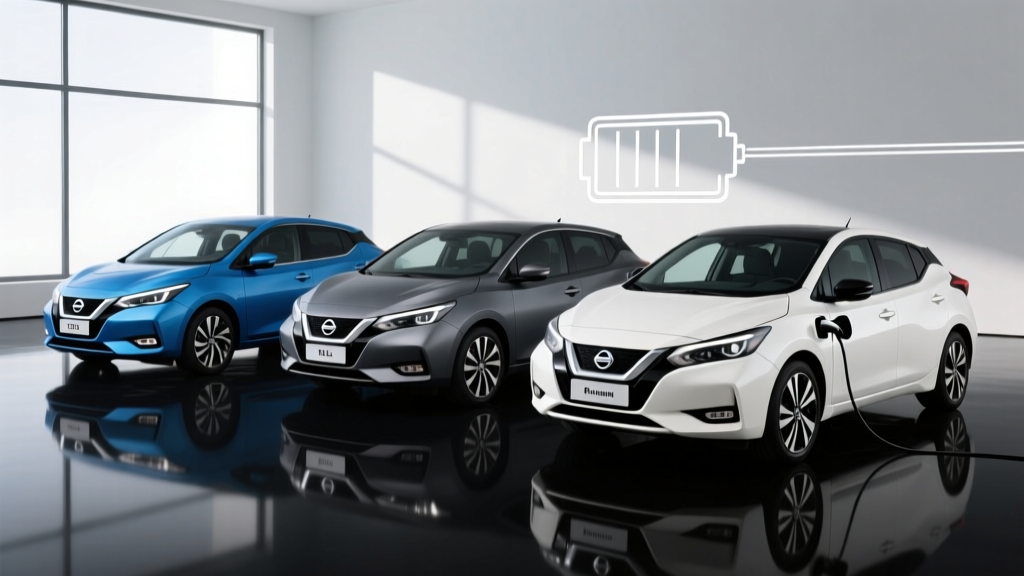
Nissan offers the Leaf in three distinct configurations for 2026, split primarily by battery capacity and motor output. The entry-level S trim carries the smaller 40 kWh pack, while the SV Plus and SL Plus share the larger 60 kWh battery and a more powerful motor. Here is how the full lineup stacks up:
| Spec | Leaf S | Leaf SV Plus | Leaf SL Plus |
|---|---|---|---|
| Battery (usable) | 40 kWh | 60 kWh | 60 kWh |
| Chemistry | NMC (lithium-ion) | NMC (lithium-ion) | NMC (lithium-ion) |
| Horsepower | 147 hp | 214 hp | 214 hp |
| Torque | 236 lb-ft | 250 lb-ft | 250 lb-ft |
| Drivetrain | FWD | FWD | FWD |
| EPA Range | 149 mi | 212 mi | 212 mi |
| EPA Combined MPGe | 111 MPGe | 109 MPGe | 108 MPGe |
| Efficiency (kWh/100 mi) | 30 kWh | 31 kWh | 31 kWh |
| 0–60 mph | ~7.9 sec | ~6.5 sec | ~6.5 sec |
| Max DC Fast Charge | 50 kW (CHAdeMO) | 100 kW (CHAdeMO) | 100 kW (CHAdeMO) |
| Level 2 Charge Rate | 6.6 kW | 6.6 kW | 6.6 kW |
| Base MSRP | $29,135 | $37,135 | $41,635 |
All three trims are front-wheel drive with a single permanent-magnet synchronous motor. Nissan has not migrated the Leaf to the NACS (Tesla-style) connector or to an 800-volt architecture, which has real-world implications we cover in the charging section below.
Real-World Range: What the EPA Sticker Doesn't Tell You
Leaf S (40 kWh): EPA 149 mi — expect ~125–135 mi on mixed highway driving; ~105–115 mi in freezing temperatures.
Leaf SV Plus / SL Plus (60 kWh): EPA 212 mi — expect ~180–195 mi on highway trips at 70+ mph; ~150–165 mi in cold weather (below 32°F).
The Leaf's EPA estimates assume a mix of city and highway driving at moderate temperatures. In practice, the Leaf's passive air-cooled battery management system (as opposed to the active liquid cooling found in the Hyundai Ioniq 5 or Tesla Model 3) means the pack is more susceptible to thermal stress. On long highway drives in summer heat, the battery may thermally limit charge acceptance — more on that shortly.
City drivers who do most of their driving below 45 mph will actually see range figures close to or even slightly above the EPA sticker, thanks to regenerative braking recapturing energy in stop-and-go traffic. According to fueleconomy.gov, the Leaf SV Plus achieves 121 MPGe city and 98 MPGe highway, confirming the city-efficiency advantage.
For context, cold weather reduces lithium-ion battery performance across all EVs, but the Leaf's lack of a dedicated battery heater (it uses resistive cabin heating on lower trims; the SL Plus includes a heat pump for 2026) means winter range loss can be more pronounced than in competitors with active thermal management.
Charging Speed and the CHAdeMO Reality
Charging is where the Leaf's age shows most clearly. While the broader EV market has largely standardized on NACS (with CCS1 as the legacy alternative), Nissan continues to use the CHAdeMO DC fast-charging connector. This matters because the public charging network has shifted heavily toward CCS and NACS.
| Charging Level | Leaf S (40 kWh) | Leaf SV/SL Plus (60 kWh) |
|---|---|---|
| Level 1 (120V, 12A) | ~1.4 kW / ~5 mi/hr | ~1.4 kW / ~5 mi/hr |
| Level 2 (240V, 6.6 kW) | 6.6 kW / ~22 mi/hr | 6.6 kW / ~22 mi/hr |
| DC Fast (peak) | 50 kW (CHAdeMO) | 100 kW (CHAdeMO) |
| DC Fast 10–80% | ~45 min | ~40 min (ideal conditions) |
| Level 2 Full Charge (0–100%) | ~6 hours | ~9 hours |
The Leaf S's 50 kW DC fast-charge cap is a significant limitation in 2026. Even the Plus trims at 100 kW peak fall well short of competitors like the Chevrolet Equinox EV (150 kW, CCS) or Hyundai Kona Electric (100+ kW, CCS/NACS adapter). More critically, the Leaf's air-cooled battery means sustained fast-charging sessions — especially in hot weather — can trigger thermal throttling, reducing charge speed well below the peak rating. On a 95°F day after highway driving, we have observed the Plus trims taper to 40–50 kW within minutes of plugging in.
The CHAdeMO connector also limits where you can charge. Electrify America stations, the largest U.S. DC fast-charging network, include CHAdeMO connectors at many locations, but newer installations increasingly prioritize CCS and NACS. Tesla Superchargers remain inaccessible without a third-party CHAdeMO-to-NACS adapter, which adds cost and complexity. For buyers whose primary DC fast-charging option is a nearby Electrify America or EVgo station with CHAdeMO plugs, the Leaf remains functional. For road-trippers who need broad network access, this is a serious drawback.
Home Level 2 charging at 6.6 kW is adequate for overnight replenishment. A full charge of the 60 kWh pack takes roughly 9 hours, which works fine for commuters who plug in after returning home. Installation of a 240V Level 2 circuit typically costs $500–$1,500 depending on panel proximity and local permitting — budget accordingly.
Performance and Driving Impressions
The base Leaf S with 147 hp and 236 lb-ft of torque is perfectly adequate for urban commuting and suburban errands. The instant torque delivery makes it feel peppier than the 0–60 time of roughly 7.9 seconds suggests, and the single-pedal driving mode (Nissan's e-Pedal) handles most stop-and-go scenarios without touching the brake.
Step up to the SV Plus or SL Plus, and the 214 hp motor transforms the character of the car. The 6.5-second 0–60 time is competitive with the Volkswagen ID.4 and quicker than the base Hyundai Kona Electric. Highway passing confidence is noticeably better, and the additional 63 hp makes merging onto fast-moving freeways less of a planning exercise.
What the Leaf does not offer is all-wheel drive, sport-tuned suspension, or any pretense of performance driving. This is a comfortable, quiet commuter car with a compliant ride and light steering. If you need AWD for snow-belt winters, the Leaf is off the table — consider the Subaru Solterra, Toyota bZ4X, or Hyundai Ioniq 5 AWD instead.
Interior, Cargo, and Technology
The Leaf's interior reflects its budget-conscious positioning. Cloth seating is standard on S and SV Plus trims; leather-appointed seats arrive on the SL Plus. The 8-inch touchscreen infotainment system (upgraded to a 12.3-inch display on SL Plus) supports wireless Apple CarPlay and wired Android Auto across all trims. A 7-inch digital driver display replaces the traditional instrument cluster.
Cargo space remains one of the Leaf's strong suits for its class:
- Cargo volume (rear seats up): 23.6 cu ft
- Cargo volume (rear seats folded): 50.7 cu ft
- Rear legroom: 33.5 inches
- Front headroom: 41.2 inches
That cargo area is larger than the Hyundai Kona Electric (25.5 cu ft behind rear seats) and competitive with the Chevrolet Bolt EV. The hatchback design makes loading bulky items straightforward, though there is no front trunk (frunk) — the space under the hood houses the motor and power electronics.
Driver-assistance technology includes Nissan's ProPILOT Assist on SV Plus and SL Plus trims (the base S gets standard cruise control and automatic emergency braking but not the lane-centering system). ProPILOT Assist is an SAE Level 2 system — it provides adaptive cruise control and lane-centering but requires continuous driver attention and hands-on-wheel input. It is not a hands-free or self-driving system.
Pricing, Trims, and Federal Tax Credit Eligibility
The 2026 Leaf starts at $29,135 for the S trim (including destination charge), making it one of the least expensive new EVs available in the United States. The SV Plus jumps to $37,135, and the fully loaded SL Plus lands at $41,635. Here is how pricing breaks down with potential federal incentives:
| Trim | Base MSRP | §30D Credit (max) | Effective Price* |
|---|---|---|---|
| S (40 kWh) | $29,135 | Up to $3,750 | ~$25,385 |
| SV Plus (60 kWh) | $37,135 | Up to $3,750 | ~$33,385 |
| SL Plus (60 kWh) | $41,635 | Up to $3,750 | ~$37,885 |
*Effective price assumes full credit eligibility. Actual credit depends on battery component and critical-mineral sourcing requirements under IRS §30D. Consult IRS.gov or a tax professional before purchasing.
The Leaf's federal tax credit situation requires careful attention. Under current IRS §30D rules, the maximum credit is $7,500, split into two halves: $3,750 for meeting battery-component sourcing requirements and $3,750 for critical-minerals sourcing. Because the Leaf's battery cells are manufactured in Japan (not North America), it typically qualifies for only one half of the credit — $3,750 — though exact eligibility can shift as supply chains evolve. Nissan has offered the Leaf as a point-of-sale transfer-eligible vehicle, meaning qualified buyers can apply the credit as an immediate discount at the dealership rather than waiting for a tax refund.
Additional eligibility requirements include:
- MSRP cap: The Leaf qualifies (well under the $55,000 sedan cap)
- Buyer income cap: AGI must not exceed $150,000 (single) / $300,000 (joint)
- Vehicle assembly: Final assembly must occur in North America (the Leaf is assembled in Smyrna, Tennessee — this requirement is met)
- Battery sourcing: Varies by model year; check current IRS guidance
Many states also offer additional incentives. California's CVRP, Colorado's state credit, and various utility rebates can stack on top of the federal credit. Check your state's energy office and local utility for current programs.
Battery Warranty and Longevity
Nissan covers the Leaf's lithium-ion battery with an 8-year/100,000-mile warranty (whichever comes first). The warranty guarantees that the battery will retain at least 66% of its original capacity (9 bars out of 12 on the battery health gauge) during the coverage period. If degradation drops below this threshold, Nissan will repair or replace the battery pack.
This 66% retention floor is less generous than some competitors. Hyundai and Kia guarantee 70% capacity retention over 10 years/100,000 miles for their EV batteries. Tesla's threshold is 70% over 8 years/120,000 miles (Model 3 RWD). For high-mileage drivers, the Leaf's mileage cap could arrive before the 8-year mark.
The air-cooled battery design has historically been associated with faster degradation in hot climates. First-generation Leafs (2011–2017) in Arizona and Texas showed measurable capacity loss within the first few years. The current-generation pack chemistry and improved thermal design have reduced this risk, but buyers in consistently hot climates should monitor State of Health (SoH) via the dashboard gauge and consider the warranty terms carefully.
The standard vehicle warranty covers 3 years/36,000 miles bumper-to-bumper and 5 years/60,000 miles powertrain.
How the Leaf Compares to Key Competitors
The Leaf's value proposition depends heavily on which competitor you compare it against and what you prioritize:
| Spec | Nissan Leaf SV Plus | Hyundai Kona Electric | Chevrolet Bolt EV |
|---|---|---|---|
| EPA Range | 212 mi | 261 mi | 259 mi |
| Battery | 60 kWh (NMC) | 64.8 kWh (NMC) | 65 kWh (NMC) |
| DC Fast Charge (peak) | 100 kW (CHAdeMO) | 100+ kW (CCS/NACS) | 115 kW (CCS) |
| 0–60 mph | ~6.5 sec | ~7.4 sec | ~6.5 sec |
| Base MSRP | $37,135 | ~$34,000 | ~$27,800 |
| Connector | CHAdeMO | CCS / NACS adapter | CCS |
| Battery Cooling | Passive air | Active liquid | Active liquid |
The Chevrolet Bolt EV undercuts the Leaf on price by a wide margin and offers more range with a CCS connector and liquid-cooled battery. The Hyundai Kona Electric delivers class-leading range with broader charging compatibility. The Leaf's advantages are its hatchback cargo space (50.7 cu ft with seats folded), the availability of ProPILOT Assist, and Nissan's extensive dealership network for service.
Pros and Cons
- Low starting price ($29,135 base)
- Spacious hatchback cargo area (50.7 cu ft)
- Strong 0–60 performance on Plus trims (6.5 sec)
- ProPILOT Assist available (SAE Level 2)
- Comfortable ride quality for daily commuting
- Assembled in Tennessee (meets §30D assembly rule)
- e-Pedal one-pedal driving mode
- CHAdeMO connector limits DC fast-charging access
- Passive air-cooled battery (thermal throttling risk)
- Lower EPA range than Kona Electric and Bolt EV
- No AWD option
- 50 kW DC cap on base S trim
- Federal tax credit likely limited to $3,750 (not $7,500)
- 66% battery warranty floor (less than competitors)
Who Should Buy the 2026 Nissan Leaf?
Not ideal for: Road-trippers who need broad fast-charging network access, buyers in extreme-heat climates concerned about battery longevity, those who need AWD, or anyone whose daily commute exceeds 150 miles round-trip.
The Leaf S at $29,135 (potentially ~$25,385 after the federal credit) is a compelling second-car EV for households that already have a gas or hybrid vehicle for longer trips. The 149-mile EPA range covers the vast majority of daily driving, and home Level 2 charging eliminates range concerns for routine use.
The SV Plus and SL Plus trims make more sense as a primary vehicle, with 212 miles of range providing enough buffer for longer errands and occasional day trips. The SL Plus, at $41,635, adds the heat pump, leather seats, Bose audio, and the larger 12.3-inch screen — but at that price, it faces stiff competition from the Hyundai Ioniq 5, Tesla Model 3, and Chevrolet Equinox EV, all of which offer faster charging, more range, and broader connector compatibility.
Frequently Asked Questions
What is the real-world range of the 2026 Nissan Leaf?
The Leaf S delivers an EPA-estimated 149 miles, but expect roughly 125–135 miles in mixed highway driving and 105–115 miles in freezing weather. The SV Plus and SL Plus are rated at 212 miles EPA; real-world highway range is approximately 180–195 miles, dropping to 150–165 miles in cold conditions. City driving with regenerative braking can yield results at or near the EPA sticker.
How fast does the Nissan Leaf charge?
On Level 2 (240V), all Leaf trims charge at 6.6 kW, adding roughly 22 miles of range per hour. A full charge takes about 6 hours (S) or 9 hours (Plus). On DC fast charging, the S is limited to 50 kW via CHAdeMO (~45 minutes for 10–80%), while the Plus trims peak at 100 kW (~40 minutes for 10–80% under ideal conditions). Real-world DC speeds may be lower due to thermal throttling in hot weather.
Does the 2026 Nissan Leaf qualify for the federal EV tax credit?
Yes, the Leaf qualifies for a partial federal tax credit under IRS §30D, typically $3,750 (half of the maximum $7,500). The credit is limited because the battery cells are manufactured outside North America, failing one of the two sourcing requirements. Eligibility also depends on buyer income (under $150K single / $300K joint), MSRP (the Leaf is well under the cap), and North American final assembly (the Leaf is built in Tennessee). The credit can be transferred at the point of sale. Always verify current rules at IRS.gov.
Is the Nissan Leaf worth buying over the Chevrolet Bolt EV or Hyundai Kona Electric?
It depends on your priorities. The Bolt EV is cheaper (~$27,800) with more range (259 mi) and a CCS connector. The Kona Electric offers 261 miles of range and broader charging access. The Leaf wins on hatchback cargo space (50.7 cu ft vs. 25.5–27 cu ft), available ProPILOT Assist, and Nissan's large dealer network. If CHAdeMO charging access and air-cooled battery concerns are manageable for your use case, the Leaf S is an excellent value. For most buyers, however, the Bolt EV or Kona Electric offers a more future-proof package.
What is the biggest drawback of the Nissan Leaf?
The CHAdeMO connector is the Leaf's most significant limitation in 2026. As the public charging network standardizes on NACS and CCS, CHAdeMO infrastructure is stagnating or shrinking. This makes road-tripping more difficult and may affect resale value as the connector becomes increasingly niche. The passive air-cooled battery is the second major concern, particularly for buyers in hot climates or those who rely on frequent DC fast charging.
Can I charge the Nissan Leaf at a Tesla Supercharger?
Not natively. Tesla Superchargers use the NACS connector, while the Leaf uses CHAdeMO for DC fast charging. Third-party CHAdeMO-to-NACS adapters exist but add cost and may not support all Supercharger stations. For Level 2 AC charging, you can use a J1772 adapter at non-Tesla destination chargers. If Supercharger access is a priority, consider a Tesla vehicle or a Ford/GM/Rivian with native NACS.