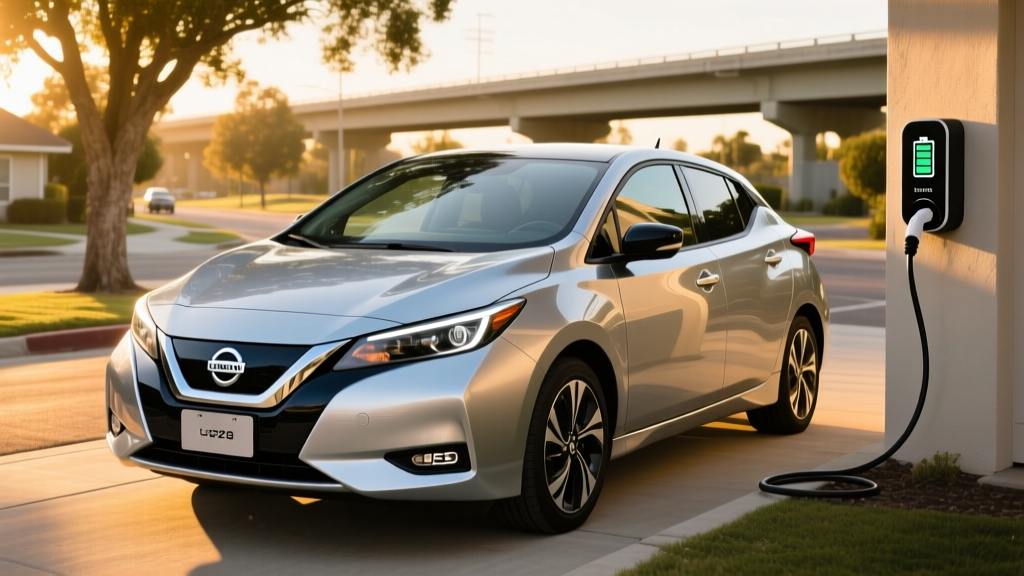
The Nissan Leaf holds a unique place in EV history. Launched in the U.S. for the 2011 model year, it became the world's best-selling plug-in electric vehicle for nearly a decade and introduced millions of drivers to battery-electric motoring. But as the Leaf enters its final years of production — Nissan confirmed the model will be discontinued after the 2025 model year in the U.S. — the question that dominates owner forums and buyer searches is practical and financial: what is the real lifespan of a Nissan Leaf, and does its aging platform still make sense for cost-conscious EV shoppers in 2026?
This review dissects the Leaf's battery longevity data, real-world range, charging architecture, ownership economics, and how it stacks up against modern competitors for buyers considering a remaining new-inventory 2025 Leaf or a certified pre-owned example.
Nissan Leaf Battery Chemistry and Degradation: The Core of Lifespan
The single most important factor determining any EV's lifespan is its battery pack. The Nissan Leaf uses NMC (nickel manganese cobalt) lithium-ion cells manufactured by AESC (Automotive Energy Supply Corporation, a Nissan joint venture). Unlike newer EVs from Tesla and Ford that have adopted LFP (lithium iron phosphate) chemistry for standard-range models — which offers superior cycle life and thermal stability — the Leaf's NMC chemistry prioritizes energy density over longevity.
There are two battery configurations available in the final-generation Leaf:
| Specification | Leaf S (Standard Range) | Leaf SV Plus (Extended Range) |
|---|---|---|
| Usable Battery Capacity | 40 kWh | 60 kWh |
| Chemistry | NMC (AESC) | NMC (AESC) |
| Thermal Management | Passive (air-cooled) | Passive (air-cooled) |
| EPA Range | 149 miles | 212 miles |
| Motor Output | 147 hp / 236 lb-ft | 214 hp / 250 lb-ft |
The Air-Cooled Battery Problem
The Leaf's most significant engineering limitation — and the primary reason its battery lifespan trails competitors — is its passive air-cooling system. Every modern EV at or above the Leaf's price point (Chevrolet Bolt, Hyundai Kona Electric, Kia Niro EV) uses active liquid thermal management to keep cells within an optimal temperature window (roughly 60–95°F / 15–35°C).
The Leaf relies on ambient airflow. This means:
- Hot climates accelerate degradation: Sustained cell temperatures above 100°F (38°C) — common in Arizona, Texas, and Southern California summers — cause faster capacity loss. Studies from fleet data aggregator Recurrent Auto show Leafs in hot climates losing 10–15% more capacity over five years compared to identical vehicles in temperate Pacific Northwest climates.
- Repeated DC fast charging causes heat stress: Without liquid cooling, consecutive fast-charge sessions allow cell temperatures to climb, triggering thermal throttling (Nissan calls this "Rapidgate") that slows charge speed and, over time, hastens degradation.
- Cold-weather range loss is severe: Without a battery heater, the Leaf's range drops 25–40% in sub-freezing temperatures, partly due to increased internal resistance and partly because cabin heating draws directly from the traction battery.
What the Degradation Data Actually Shows
Based on aggregated fleet data from sources including Recurrent Auto, PlugShare owner surveys, and Nissan dealer diagnostic reports, here is the typical capacity retention curve for the 40 kWh and 60 kWh Leaf packs:
| Vehicle Age | 40 kWh Pack (Avg. SoH) | 60 kWh Pack (Avg. SoH) | Effective Range (60 kWh, EPA base 212 mi) |
|---|---|---|---|
| New | 100% | 100% | 212 mi |
| Year 2 | 95–97% | 95–97% | ~202 mi |
| Year 4 | 89–93% | 90–94% | ~193 mi |
| Year 6 | 83–88% | 85–90% | ~182 mi |
| Year 8 | 77–84% | 80–87% | ~174 mi |
| Year 10 | 72–80% | 76–83% | ~165 mi |
For context, a Tesla Model 3 with liquid-cooled NMC/NCA cells and active thermal management typically retains 88–92% capacity at year 8, per data published by the company and verified by third-party fleet analysis. The gap is meaningful: at year 10, a Leaf SV Plus owner might have ~165 miles of degraded range while a comparable Model 3 Long Range owner still has roughly 285+ miles from its original 334-mile EPA rating.
EPA-rated range for the 2025 Leaf SV Plus is 212 miles (40 kWh Leaf S: 149 miles). In real-world driving, expect:
- City/suburban commuting (moderate temps): 195–210 miles — the Leaf excels here thanks to strong regenerative braking and low average speeds.
- Highway driving (70+ mph, 75°F): 170–185 miles — higher aero drag and sustained speed reduce efficiency.
- Cold weather (below 32°F, mixed driving): 125–155 miles — the passive thermal system and resistive cabin heater are significant penalties.
- Hot weather (above 95°F, AC running): 180–195 miles — less severe than cold but still noticeable.
Source: fueleconomy.gov and owner-reported data.
Charging Speed: The Leaf's Persistent Bottleneck
Charging capability is where the Leaf's age shows most clearly. While competitors have moved to 150–250 kW DC fast-charging architectures, the Leaf remains limited by the CHAdeMO connector standard and modest charge acceptance rates.
| Charging Level | Leaf S (40 kWh) | Leaf SV Plus (60 kWh) | Connector |
|---|---|---|---|
| Level 1 (120V, 12A) | ~1.4 kW / ~5 mi/hr | ~1.4 kW / ~4 mi/hr | J1772 |
| Level 2 (240V, 32A) | ~6.6 kW / ~23 mi/hr | ~6.6 kW / ~20 mi/hr | J1772 |
| DC Fast Charge (Peak) | ~50 kW | ~100 kW (peak, brief) | CHAdeMO |
| DC Fast 10–80% Time | ~40–50 min (50 kW) | ~45–60 min (sustained ~55–70 kW avg) | CHAdeMO |
Critical nuance on DC fast charging: The 60 kWh Leaf SV Plus advertises "up to 100 kW" peak capability, but this figure is misleading for real-world trip planning. Because the pack is air-cooled, the vehicle typically sustains only 55–70 kW on average during a 10–80% session, and subsequent charges in the same day drop further as cell temperatures rise (the Rapidgate effect). On a warm day after highway driving, your second DC fast charge of the trip may peak at just 30–40 kW.
For home Level 2 charging, the Leaf's 6.6 kW onboard charger is adequate for overnight replenishment. A full 0–100% charge takes roughly 9 hours on the 60 kWh pack and 6 hours on the 40 kWh pack — fine for daily commuting but slower than the 11–19 kW Level 2 capability found on newer rivals like the Hyundai Ioniq 5 and Ford Mustang Mach-E.
The CHAdeMO Connector Problem
The Nissan Leaf is the last mainstream EV sold in the U.S. using the CHAdeMO DC fast-charging standard. The broader industry has consolidated around CCS (Combined Charging System) and, increasingly, Tesla's NACS (North American Charging Standard). Electrify America, the largest U.S. public fast-charging network, maintains CHAdeMO connectors at most stations but has signaled future focus on CCS and NACS. Tesla Superchargers do not support CHAdeMO at all.
For Leaf owners, this means public fast-charging options are adequate today but may narrow over the vehicle's remaining lifespan. Plan trips around Electrify America, EVgo, and regional networks with active CHAdeMO infrastructure.
Performance, Efficiency, and Daily Usability
| Metric | Leaf S | Leaf SV Plus |
|---|---|---|
| 0–60 mph | ~7.9 seconds | ~6.5 seconds |
| Horsepower | 147 hp | 214 hp |
| Drivetrain | FWD (single motor) | FWD (single motor) |
| EPA Efficiency | 111 MPGe (30 kWh/100mi) | 104 MPGe (32 kWh/100mi) |
| Cargo Volume (rear seats up) | 23.6 cu ft | 23.6 cu ft |
| Cargo Volume (rear seats folded) | 30.0 cu ft | 30.0 cu ft |
| Rear Legroom | 33.5 in | 33.5 in |
| Curb Weight | ~3,490 lbs | ~3,780 lbs |
| Towing Capacity | Not rated | Not rated |
The Leaf SV Plus's 214 hp and 6.5-second 0–60 time are adequate for highway merging and passing, though they trail the Chevrolet Bolt EUV (~6.3 sec, 200 hp) and Hyundai Kona Electric (~7.2 sec but with 201 hp and more modern packaging). The front-wheel-drive layout delivers confident traction in rain but limits the Leaf in snow compared to AWD alternatives.
Efficiency is a relative bright spot. The 40 kWh Leaf achieves 111 MPGe combined (30 kWh/100 miles), making it one of the more efficient compact EVs available. The heavier 60 kWh SV Plus drops slightly to 104 MPGe (32 kWh/100 miles). At the U.S. average electricity rate of ~$0.17/kWh, fueling a Leaf SV Plus costs roughly $5.44 per 100 miles — about one-third the cost of fueling a 30 MPG gasoline compact at $3.50/gallon.
Pricing, Trims, and Federal Tax Credit Eligibility
As the Leaf enters its final model year, pricing remains aggressive, especially when incentives are factored in. Here is the 2025 MSRP structure (carried into remaining 2026 dealer inventory):
| Trim | MSRP (incl. destination) | Federal §30D Credit Eligibility | Est. Effective Price (if eligible) |
|---|---|---|---|
| Leaf S (40 kWh) | ~$29,135 | Up to $3,750 (partial — battery sourcing) | ~$25,385 |
| Leaf SV Plus (60 kWh) | ~$37,285 | Up to $3,750 (partial — battery sourcing) | ~$33,535 |
Important tax credit caveats: Under current IRS §30D rules, the Leaf qualifies for a partial credit of $3,750 — not the full $7,500. The reduction is because the Leaf's battery cells and critical minerals do not fully meet the domestic-sourcing thresholds that took effect in 2024 and tighten annually. Buyer income caps apply ($150,000 single / $225,000 head of household / $300,000 joint AGI). The Leaf's MSRP falls well under the $55,000 passenger-car cap, so price is not a barrier. As of 2026, the point-of-sale transfer option allows dealers to apply the credit as a down-payment reduction at purchase — confirm eligibility with your tax professional and dealer.
Additionally, many states offer supplemental rebates. California's CVRP program, Colorado's state credit, and various utility-company incentives can stack on top of the federal credit — check your state-specific programs via the DOE's Alternative Fuels Data Center.
Tech, Safety, and Driver Assistance
The Leaf's technology suite reflects its 2018-generation architecture with incremental updates. Standard and available features include:
- Infotainment: 8-inch touchscreen with wireless Apple CarPlay and wired Android Auto, 6-speaker audio, available Bose premium system (SV Plus).
- Nissan ProPILOT Assist: SAE Level 2 driver assistance combining adaptive cruise control and lane-centering steering. Competent for highway use but lacks the hands-free capability of GM's Super Cruise or Ford's BlueCruise.
- Nissan Safety Shield 360: Automatic emergency braking with pedestrian detection, blind-spot warning, rear cross-traffic alert, lane departure warning, and rear automatic braking — all standard.
- e-Pedal: Nissan's one-pedal driving mode that uses aggressive regenerative braking to bring the car to a complete stop without touching the brake pedal. A standout usability feature for city commuting.
Notable drawbacks include the absence of a heat pump (cabin heating relies on a resistive element that significantly reduces cold-weather range), no vehicle-to-load (V2L) capability, no frunk (front trunk), and a rear cargo area that, at 23.6 cu ft, trails the Chevrolet Bolt EUV (27.0 cu ft) and Hyundai Kona Electric (25.8 cu ft).
Warranty Coverage and Battery Replacement Costs
Nissan provides the following warranty coverage for the Leaf:
- Limited Vehicle Warranty: 3 years / 36,000 miles
- Powertrain Warranty: 5 years / 60,000 miles
- Lithium-Ion Battery Capacity Warranty: 8 years / 100,000 miles — guarantees the battery will retain at least 9 bars of capacity (approximately 66–70% of original capacity) on the Leaf's 12-bar battery health gauge. If it drops below 9 bars within the warranty period, Nissan will repair or replace the pack.
Out-of-warranty battery replacement is a key consideration for long-term ownership. As of 2025–2026, a replacement 40 kWh Leaf battery pack costs approximately $6,500–$8,500 (parts and labor), while a 60 kWh pack runs $9,000–$12,000. Third-party refurbishers and used packs from salvaged Leafs offer lower-cost alternatives ($3,500–$6,000), though availability varies.
For context, the Leaf's battery replacement cost is moderate compared to larger-pack EVs (a Tesla Model S pack replacement can exceed $15,000–$20,000), but it's a meaningful expense for a vehicle with a sub-$30,000 starting price.
Leaf vs. Modern Competitors: Is It Still Worth Buying?
The Leaf competes in a segment that has evolved dramatically since its 2018 redesign. Here is how it compares to key alternatives on the metrics that matter most:
| Spec | Nissan Leaf SV Plus | Hyundai Kona Electric | Chevrolet Bolt EUV |
|---|---|---|---|
| EPA Range | 212 mi | 261 mi | 247 mi |
| Battery Capacity | 60 kWh (NMC) | 65.4 kWh (NMC) | 65 kWh (NMC) |
| Thermal Management | Passive (air) | Active (liquid) | Active (liquid) |
| DC Fast Charge Peak | ~100 kW (brief) | ~100 kW (sustained) | ~55 kW |
| DC Fast Connector | CHAdeMO | CCS / NACS adapter | CCS |
| Level 2 Onboard Charger | 6.6 kW | 10.9 kW | 11.5 kW |
| Heat Pump | No | Yes | No |
| 0–60 mph | ~6.5 sec | ~7.2 sec | ~6.3 sec |
| Base MSRP | ~$37,285 | ~$34,075 | ~$28,800 (discontinued, remaining inventory) |
| Projected 8-Yr Battery SoH | ~80–87% | ~88–93% | ~86–91% |
Pros
- Low starting price, especially after partial tax credit
- Strong city efficiency and one-pedal e-Pedal driving
- Comprehensive standard safety suite (Safety Shield 360)
- Proven, well-understood platform with wide dealer service network
- Comfortable ride quality and quiet cabin at city speeds
Cons
- Passive air-cooled battery degrades faster, especially in hot climates
- CHAdeMO connector limits long-term public charging access
- No heat pump — significant cold-weather range penalty
- DC fast charging is slow and throttles with repeated use (Rapidgate)
- Discontinued after 2025 — long-term parts and support uncertainty
- Smaller cargo area and no frunk compared to newer competitors
Who Should Buy the Nissan Leaf in 2026?
Choose the Nissan Leaf If:
- You need an affordable commuter EV for city and suburban driving under 80 miles round-trip daily.
- You live in a temperate climate (Pacific Northwest, coastal California, mid-Atlantic) where the passive battery cooling is less of a liability.
- You have reliable home Level 2 charging and rarely need public DC fast charging.
- You're buying a second vehicle for errands and commuting, not a primary road-trip car.
- You can secure remaining 2025 new inventory or a low-mileage CPO example at a steep discount.
Look Elsewhere If:
- You live in a hot climate (Arizona, Texas, Deep South) where battery degradation will be accelerated.
- You need road-trip capability with fast DC charging and broad network compatibility (NACS/CCS).
- You want a vehicle with a heat pump for efficient cold-weather operation.
- You plan to keep the vehicle 8+ years and want maximum battery longevity.
- You need AWD, towing capability, or substantial cargo space for family use.
For buyers who prioritize long-term battery lifespan and modern charging infrastructure, the Hyundai Kona Electric, Chevrolet Bolt EUV (remaining inventory), or a used Tesla Model 3 represent stronger value propositions. But for budget-conscious urban commuters with home charging and mild climates, the Leaf's low entry price and proven reliability in its specific use case remain compelling.
Frequently Asked Questions
How long will a Nissan Leaf battery last before needing replacement?
Based on fleet degradation data, a Nissan Leaf battery in a temperate climate typically retains 76–83% of its original capacity at 10 years. Most owners find the battery remains functional for daily commuting well beyond 100,000 miles, though range gradually decreases. The 8-year/100,000-mile battery warranty (covering drops below ~70% capacity) provides a safety net. Replacement, when needed, costs $6,500–$12,000 depending on pack size.
Does the Nissan Leaf qualify for the full $7,500 federal tax credit?
No. Under current IRS §30D rules, the Leaf qualifies for a partial credit of $3,750 because its battery does not fully meet the critical-minerals and battery-component sourcing requirements that phase in through 2026. Buyer income limits ($150K single / $300K joint) and the $55,000 MSRP cap for passenger cars also apply. The credit can be transferred to the dealer at point of sale. Consult a tax professional and verify current-year rules at irs.gov.
Is the Nissan Leaf still being sold in 2026?
Nissan discontinued the Leaf in the U.S. market after the 2025 model year. However, remaining 2025 new-inventory units are still available at many dealerships in early 2026, and the used/CPO market is well-stocked given the Leaf's 14-year production run. Nissan's EV future in the U.S. centers on the Ariya crossover and upcoming next-generation models.
How does the Leaf's range compare in cold weather?
The Leaf lacks a battery heater and heat pump, making it one of the most cold-weather-sensitive EVs on the market. In temperatures below 32°F, expect 25–40% range loss depending on driving conditions and cabin heating use. A 212-mile SV Plus may deliver only 125–155 real-world miles in freezing weather. Preconditioning while plugged in helps somewhat but does not eliminate the penalty.
Can I use Tesla Superchargers with a Nissan Leaf?
No. Tesla Superchargers use the NACS connector, and there is no commercially available adapter that converts CHAdeMO to NACS for DC fast charging. Leaf owners must rely on Electrify America, EVgo, and other networks that maintain CHAdeMO connectors. As the industry shifts to NACS and CCS, CHAdeMO infrastructure may become less common over the vehicle's remaining lifespan.
Is it worth buying a used Nissan Leaf?
A used Leaf can be excellent value for the right buyer — specifically, a city commuter with home charging in a temperate climate. Key checks when buying used: (1) Request a battery health report showing the 12-bar gauge reading or State of Health percentage from a Nissan dealer diagnostic tool. (2) Verify remaining battery warranty coverage (8 years from original in-service date). (3) Prioritize 2018+ models (second generation) with the larger battery options. A well-maintained 2019–2023 Leaf SV Plus with 85%+ SoH can provide 170+ miles of real-world range at a fraction of the cost of a new EV.