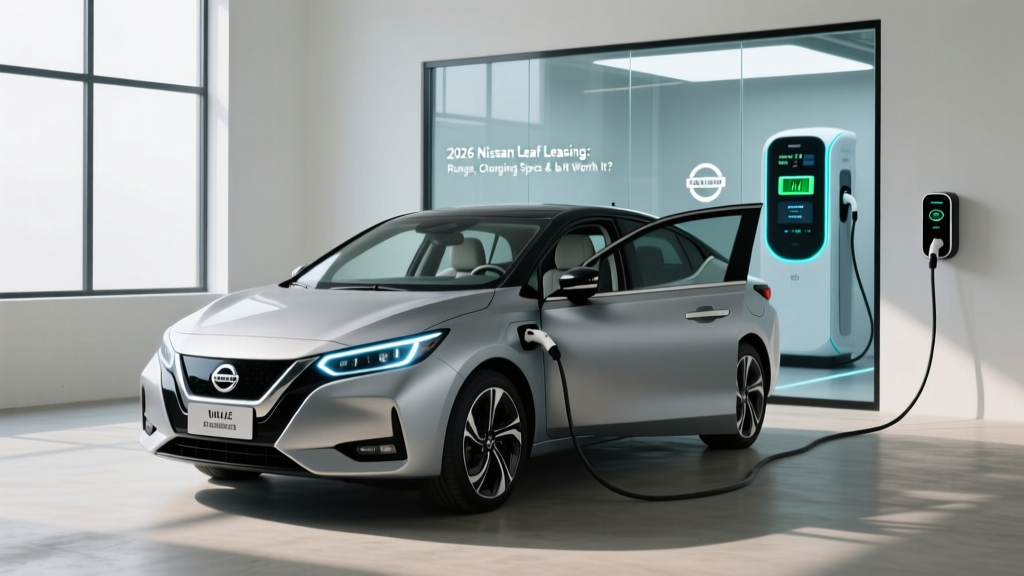
The Nissan Leaf has been the budget EV benchmark since 2011, but in 2026 the landscape around it has shifted dramatically. With rivals like the Chevrolet Bolt EV, Hyundai Kona Electric, and Volvo EX30 offering longer range and faster charging, prospective buyers are asking a pointed question: is Nissan Leaf leasing still a smart financial move, or are you better off buying a more modern platform outright?
This review dissects the 2026 Nissan Leaf's real-world range, charging behavior, pricing, and tax-credit eligibility to help you decide whether a lease makes sense — and which trim to target if it does.
2026 Nissan Leaf: Quick Verdict on Leasing
Leasing a Nissan Leaf in 2026 can be the most financially rational way to drive one, primarily because the Leaf's CHAdeMO charging standard and air-cooled battery architecture place it at a disadvantage for long-term ownership and road-trip usability. A lease shields you from the steeper depreciation curve that CHAdeMO-equipped EVs face as the industry consolidates around NACS and CCS connectors.
For a city commuter with reliable home Level 2 charging, the Leaf SV Plus delivers a genuinely practical 212–226 miles of EPA range and a comfortable, spacious cabin — all at a monthly lease payment that undercuts most competitors. But if you need frequent DC fast charging or drive in extreme climates, you should weigh the Leaf's thermal limitations carefully before signing.
Range, Battery, and Real-World Efficiency
The 2026 Leaf continues with two battery configurations across its trim lineup:
| Trim | Battery (usable) | Chemistry | EPA Range | MPGe (combined) | kWh/100 mi |
|---|---|---|---|---|---|
| S (40 kWh) | ~39 kWh | NMC (lithium-ion) | 149 mi | 111 MPGe | 30 |
| SV Plus (60 kWh) | ~59 kWh | NMC (lithium-ion) | 212–226 mi | 104–109 MPGe | 31–33 |
EPA Sticker: 149 mi (S) / 212–226 mi (SV Plus)
Highway (70 mph, moderate temps): Expect ~125 mi (S) and ~185–200 mi (SV Plus). The Leaf's boxy shape and lack of an active thermal management system hurt highway and extreme-weather efficiency.
Cold Weather (below 32°F): Plan for 20–30% range loss. The SV Plus could drop to ~150–170 mi in freezing conditions, and the S trim may fall below 110 mi. Nissan's resistance heater (no heat pump) is a significant winter efficiency penalty compared to rivals with heat-pump HVAC systems.
According to fueleconomy.gov, the SV Plus achieves its best efficiency in city driving where regenerative braking recaptures energy. Highway driving erodes the advantage, and unlike liquid-cooled competitors, the Leaf's passive air-cooling system can allow battery temperatures to climb during sustained high-speed runs or repeated DC fast-charge sessions — a factor that impacts both efficiency and long-term battery health.
Charging Speed: DC Fast, Level 2, and the CHAdeMO Question
Charging is the Leaf's most debated characteristic in 2026. Here are the exact numbers:
| Level | Power (kW) | Connector | Charge Time / Rate |
|---|---|---|---|
| Level 1 (120V household) | ~1.4 kW | J1772 / CHAdeMO adapter | ~2–3 mi/hr |
| Level 2 (240V home/public) | 6.6 kW (onboard charger) | J1772 | ~22 mi/hr (S); ~25 mi/hr (SV Plus). Full charge: ~7–9 hrs |
| DC Fast Charge | Up to 100 kW (SV Plus) / 50 kW (S) | CHAdeMO | 10–80% in ~45 min (SV Plus); ~40 min (S, to 80%) |
The CHAdeMO challenge: Nissan remains one of the last automakers using the CHAdeMO DC fast-charging standard. While Electrify America, EVgo, and some ChargePoint stations still maintain CHAdeMO connectors, the overwhelming infrastructure momentum in North America is behind NACS (Tesla's standard, now adopted by Ford, GM, Rivian, Hyundai, and others) and CCS. In practice, this means fewer available fast-charger stalls and a higher chance of encountering a broken or occupied CHAdeMO plug on road trips.
Charge-curve reality: The SV Plus peaks near 100 kW only at a low state of charge (roughly 10–25% SoC) and tapers significantly above 60%. Sustained average power during a 10–80% session is closer to 55–65 kW. Additionally, the air-cooled battery can heat-soak during consecutive fast charges — often called "Rapidgate" in Leaf communities — causing the car to throttle charging speeds to protect the cells. On a multi-stop road trip, your second and third DC charges of the day will be noticeably slower than the first.
Performance, Drivetrain, and Driving Impressions
| Spec | S (40 kWh) | SV Plus (60 kWh) |
|---|---|---|
| Horsepower | 147 hp | 214 hp |
| Torque | 236 lb-ft | 250 lb-ft |
| Drivetrain | FWD (single motor) | FWD (single motor) |
| 0–60 mph | ~7.9 sec | ~6.5 sec |
The SV Plus's 214 hp and instant electric torque make it genuinely quick off the line — adequate for confident highway merging and passing. The S trim's 147 hp is sufficient for city commuting but feels strained at highway speeds when fully loaded. Both trims are front-wheel drive only; there is no AWD option, which is a limitation for snow-belt buyers compared to competitors like the Subaru Solterra or Toyota bZ4X.
Ride quality is a Leaf strength. The suspension is tuned for comfort, cabin noise is well-managed, and the low center of gravity from the floor-mounted battery keeps body roll reasonable. Nissan's e-Pedal mode provides aggressive regenerative braking that enables one-pedal driving in most city conditions, though it doesn't bring the car to a complete hold at very low speeds without touching the brake pedal.
Interior, Cargo, and Technology
The Leaf's cabin is practical and spacious for its class, even if the materials and infotainment feel a generation behind newer EVs.
- Front legroom: 42.1 inches
- Rear legroom: 33.5 inches
- Cargo volume (rear seats up): 23.6 cu ft
- Cargo volume (rear seats folded): 30.0 cu ft
- No front trunk (frunk): The power electronics occupy the space under the hood
Infotainment: An 8-inch touchscreen with wireless Apple CarPlay and wired Android Auto is standard on the SV Plus (the S gets a smaller display). The interface is functional but dated — no wireless Android Auto, and the resolution trails competitors. A 6-speaker audio system is standard; Bose premium audio is available on upper trims.
Driver Assistance (ADAS): Nissan's ProPILOT Assist is standard on the SV Plus and includes adaptive cruise control with stop-and-go, lane centering, and lane-keeping assist. This is an SAE Level 2 system — it requires the driver to keep hands on the wheel and eyes on the road at all times. It is not autonomous driving. ProPILOT is competent for highway cruising but doesn't match the lane-centering precision of GM's Super Cruise or Ford's BlueCruise on mapped roads.
Nissan ProPILOT Assist is an SAE Level 2 driver-assistance system. It does not make the Leaf a self-driving vehicle. The driver must remain fully engaged, monitor the road, and be prepared to take over instantly. Hands-off-wheel detection will issue warnings and eventually bring the vehicle to a stop if the driver does not respond.
Notable drawbacks: No frunk, no vehicle-to-load (V2L) capability, no heat pump, rear drum brakes (which are fine for an EV's regen-heavy usage but feel spec-down on paper), and the CHAdeMO connector's shrinking network.
Pricing, Trims, and Nissan Leaf Leasing Economics
| Trim | Base MSRP | As-Tested (typical) | Federal §30D Credit Eligible? |
|---|---|---|---|
| S (40 kWh) | ~$28,140 | $29,000–$30,500 | Check current-year sourcing rules* |
| SV Plus (60 kWh) | ~$36,190 | $37,500–$40,000 | Check current-year sourcing rules* |
*Under IRS §30D, the federal EV tax credit of up to $7,500 is subject to battery-component and critical-minerals sourcing requirements, buyer adjusted gross income caps ($150K single / $300K joint), and an MSRP cap of $55,000 for sedans/hatchbacks. The Leaf clears the MSRP cap easily, but battery-sourcing compliance changes frequently. Additionally, the credit can now be transferred to the dealer as a point-of-sale discount. Always verify current eligibility at IRS.gov or with a tax professional before committing.
Why leasing changes the equation: When you lease an EV, the §30D credit technically goes to the lessor (the financing company), not to you. However, most manufacturers and their captive finance arms pass the credit's value through as a "lease cash" incentive, effectively reducing your monthly payment. This can make leasing a Leaf significantly cheaper than buying, especially if you're uncertain about long-term battery health on an air-cooled pack. A 36-month lease on the SV Plus often lands in the $250–$350/month range (depending on region, incentives, and money-down), which is highly competitive for an EV with over 200 miles of range.
Total lease-cost framing: Over 36 months at ~$300/month with $2,500 due at signing, you're looking at roughly $13,300 for three years of driving. Compare that to buying at ~$36,000 and absorbing 40–50% depreciation over the same period (which could mean $14,000–$18,000 in value loss for a CHAdeMO-equipped EV). Leasing transfers the resale-value risk to Nissan — a meaningful advantage given the Leaf's connector and battery-cooling concerns.
Warranty, Battery Longevity, and Degradation
Nissan provides the following warranty coverage for the 2026 Leaf:
- Limited vehicle warranty: 3 years / 36,000 miles
- Powertrain warranty: 5 years / 60,000 miles
- Lithium-ion battery capacity warranty: 8 years / 100,000 miles (guarantees the battery will retain at least 66% of original capacity — i.e., no more than 9 bars of degradation on the 12-bar gauge)
The 66% capacity-retention threshold is notably less generous than competitors. Hyundai and Kia warrant their EV batteries at 70% retention for 10 years/100,000 miles, and Tesla warrants at 70% for 8 years/100,000–120,000 miles depending on model.
The Leaf's passive air-cooling system remains a long-term concern. Data from fleet operators and owner communities consistently show that Leafs in hot climates (Arizona, Texas, Southern California) experience measurably faster capacity loss than liquid-cooled competitors. If you live in a moderate climate and primarily use Level 2 home charging, degradation should be manageable within the warranty period. But if you rely heavily on DC fast charging or live where summer temperatures regularly exceed 95°F, this is a real consideration — and another reason leasing (where you hand the car back before major degradation sets in) can be appealing.
Leaf vs. Key Competitors: Is It Worth Leasing?
Here's how the Leaf SV Plus stacks up against the most relevant 2026 alternatives at similar price points:
| Spec | Nissan Leaf SV Plus | Chevy Bolt EV 2LT | Hyundai Kona Electric SEL |
|---|---|---|---|
| EPA Range | 212–226 mi | 259 mi | 261 mi |
| Battery | ~59 kWh (NMC, air-cooled) | ~65 kWh (NMC, liquid-cooled) | ~64.8 kWh (NMC, liquid-cooled) |
| DC Fast Charge | 100 kW (CHAdeMO) | 115 kW (CCS/NACS) | 100+ kW (CCS/NACS) |
| 10–80% DC Time | ~45 min | ~30 min | ~43 min |
| 0–60 mph | ~6.5 sec | ~6.5 sec | ~7.4 sec |
| Starting MSRP | ~$36,190 | ~$28,000 | ~$34,000 |
| Heat Pump | No | Yes | Yes |
The Bolt EV offers substantially more range and faster charging at a lower price, though its rear seat and cargo area are tighter. The Kona Electric matches or exceeds the Leaf on range with liquid cooling and a more modern charging connector. The Leaf's advantages are its roomier rear seat, proven reliability record for the drivetrain, and the strong lease incentives Nissan typically offers.
- Comfortable ride and spacious cabin for the class
- Aggressive lease incentives often make monthly payments very competitive
- ProPILOT Assist is standard on SV Plus (not paywalled)
- Strong regenerative braking via e-Pedal
- Low MSRP clears the §30D sedan cap easily
- CHAdeMO connector limits DC fast-charging options as networks shift to NACS/CCS
- Air-cooled battery risks faster degradation and charge throttling ("Rapidgate")
- No heat pump — significant winter range loss
- No frunk, no V2L, no AWD option
- Battery warranty threshold (66%) is weaker than most rivals
- You commute under 60 miles round-trip and charge at home nightly
- You want the lowest monthly EV payment available and don't road-trip often
- You live in a moderate climate where battery heat-soak is less of a concern
- You want to avoid long-term resale-value risk on a CHAdeMO vehicle
- You need reliable DC fast charging for frequent highway travel
- You live in a hot climate and plan to keep the vehicle 5+ years (buy, not lease)
- You need AWD or a heat pump for winter driving
- You want a modern NACS/CCS connector for maximum charging-station compatibility
Frequently Asked Questions
What is the real-world range of the 2026 Nissan Leaf?
The Leaf S delivers an EPA-estimated 149 miles, but expect roughly 120–130 miles on the highway and potentially under 110 miles in freezing weather. The SV Plus is rated at 212–226 miles EPA; real-world highway driving yields about 185–200 miles in moderate temps, dropping to 150–170 miles in cold conditions. The lack of a heat pump is a meaningful winter penalty.
How fast does the Nissan Leaf charge at home and on DC fast chargers?
On a 240V Level 2 home charger, the Leaf charges at 6.6 kW, adding roughly 22–25 miles of range per hour — a full charge takes 7–9 hours. On DC fast chargers, the SV Plus peaks at 100 kW (CHAdeMO), reaching 10–80% in approximately 45 minutes, though the charge curve tapers heavily above 60% and consecutive sessions may be throttled due to battery heat buildup.
How much does the Nissan Leaf cost after tax credits?
The Leaf S starts around $28,140 and the SV Plus around $36,190. If the vehicle qualifies for the full §30D credit of $7,500 (subject to battery-sourcing rules, income caps, and point-of-sale transfer availability), effective prices can drop to roughly $20,640 (S) and $28,690 (SV Plus). However, battery-sourcing compliance changes periodically — verify at fueleconomy.gov's tax credit tracker before purchasing or leasing.
Does the Nissan Leaf qualify for the federal EV tax credit?
The Leaf's MSRP is well under the $55,000 sedan cap, and most buyers will fall within the income limits ($150K single / $300K joint AGI). However, the battery-component and critical-minerals sourcing requirements under §30D are complex and subject to change. Some Leafs may qualify for the full $7,500, a partial $3,750, or no credit depending on the current sourcing determination. When leasing, the credit goes to the lessor but is typically passed through as a lease incentive. Always confirm with the dealer and consult IRS guidance.
Is it better to buy or lease the Nissan Leaf?
For most buyers in 2026, leasing is the stronger play. The CHAdeMO connector's declining infrastructure support and the air-cooled battery's degradation risk in hot climates make long-term ownership less predictable. Leasing passes resale-value risk to Nissan and typically includes the tax credit's value as a lease incentive, resulting in lower monthly payments and no battery-health anxiety at trade-in time.
Is the Nissan Leaf worth it compared to the Chevy Bolt or Kona Electric?
If your priority is the lowest possible lease payment and you're a city commuter with home charging, the Leaf SV Plus is competitive. But the Bolt EV offers 259 miles of range at a lower MSRP with a more future-proof charging connector, and the Kona Electric adds liquid cooling and a heat pump. The Leaf wins on rear-seat space and ride comfort but trails on charging infrastructure compatibility and battery thermal management.