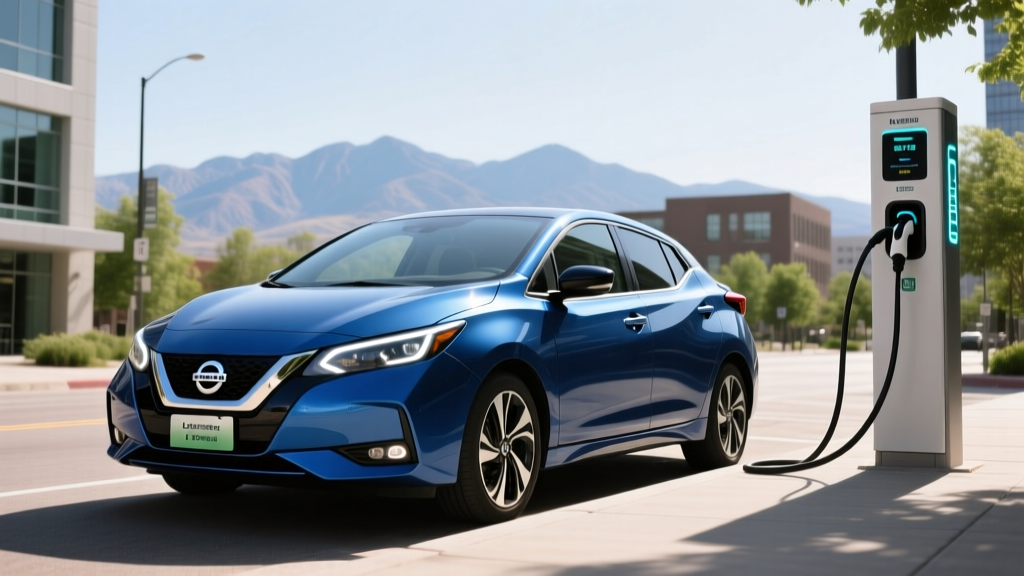
Is the 2026 Nissan Leaf Still Worth Leasing in Colorado?
The Nissan Leaf pioneered mass-market electric vehicles over a decade ago, and the 2026 model continues as one of the most affordable new EVs you can lease. For Colorado drivers navigating high-altitude commutes along the Front Range, cold Rocky Mountain winters, and a growing but uneven public charging network, the Leaf presents a specific value proposition: low monthly payments, reliable daily-range coverage, and straightforward ownership — with notable trade-offs in charging speed and highway capability.
This review breaks down the 2026 Leaf's real-world range in Colorado conditions, charging infrastructure compatibility, lease economics, and federal tax credit eligibility so you can decide whether it fits your driving profile.
2026 Nissan Leaf Specifications at a Glance
| Spec | Leaf S (40 kWh) | Leaf SV Plus (60 kWh) |
|---|---|---|
| EPA Range | 149 miles | 212 miles |
| Battery Capacity (usable) | ~39 kWh | ~58 kWh |
| Battery Chemistry | NMC (Lithium-ion) | NMC (Lithium-ion) |
| Motor Output | 147 hp / 236 lb-ft | 214 hp / 250 lb-ft |
| Drivetrain | FWD (single motor) | FWD (single motor) |
| 0–60 mph | ~7.9 seconds | ~6.5 seconds |
| MPGe (combined) | 111 MPGe | 104 MPGe |
| kWh/100 mi | 30 kWh | 32 kWh |
| Max DC Fast Charge | 50 kW (CHAdeMO) | 100 kW (CHAdeMO) |
| Level 2 Charge Rate | 6.6 kW (~22 mi/hr) | 6.6 kW (~22 mi/hr) |
| Cargo Volume | 23.6 cu ft (rear seats up) / 50.0 cu ft (folded) | 23.6 cu ft / 50.0 cu ft |
| Base MSRP | $28,140 | $36,190 |
Real-World Range: What Colorado Drivers Actually Get
Leaf S (40 kWh): EPA 149 mi → Expect 110–130 mi on highway trips at 70+ mph; 90–110 mi in Colorado winter (below 30°F) with cabin heat.
Leaf SV Plus (60 kWh): EPA 212 mi → Expect 170–190 mi highway; 145–165 mi in winter conditions.
Colorado's altitude actually helps EV efficiency slightly — thinner air reduces aerodynamic drag — but the state's cold winters and frequent mountain grades work against it. The Leaf lacks a heat pump (it uses resistive PTC heating), which draws significantly more battery energy in sub-freezing temperatures. On I-70 westbound toward the Eisenhower Tunnel, expect range to drop further due to sustained 7,000–11,000 ft elevation climbs. Regenerative braking recovers some energy on descents, but net range on mountain passes will fall well below the EPA sticker.
For Front Range commuters driving Boulder-to-Denver or Colorado Springs-to-DTC round trips under 80 miles, the SV Plus handles daily duties comfortably year-round. The 40 kWh S trim is better suited to shorter urban loops under 50 miles with a reliable home-charging routine.
Charging Speed and Colorado Network Compatibility
The Leaf's charging situation is its most significant limitation in 2026. Nissan retains the CHAdeMO DC fast-charging connector while the broader US market has standardized on NACS (Tesla Supercharger) and CCS1. This matters for Colorado drivers:
| Charging Level | Leaf S (40 kWh) | Leaf SV Plus (60 kWh) |
|---|---|---|
| Level 1 (120V, 1.4 kW) | ~4 mi/hr | Full charge ~28 hrs | ~4 mi/hr | Full charge ~42 hrs |
| Level 2 (240V, 6.6 kW) | ~22 mi/hr | Full charge ~7 hrs | ~22 mi/hr | Full charge ~10 hrs |
| DC Fast (CHAdeMO) | 50 kW peak | 10–80% ~45 min | 100 kW peak | 10–80% ~40 min |
The 100 kW peak on the SV Plus sounds adequate, but CHAdeMO stations are increasingly rare. Electrify America, EVgo, and ChargePoint have largely pivoted to CCS and NACS connectors on new installations. According to the Alternative Fuels Data Center, Colorado has roughly 40–50 public CHAdeMO connectors statewide as of early 2026 — compared to hundreds of CCS and NACS ports. If you rely on public fast charging for road trips or apartment living, this is a serious constraint.
At home on a Level 2 charger, the Leaf charges overnight without issue. A standard 6.6 kW home station replenishes the SV Plus from 20% to full in about 8 hours — perfectly adequate for daily commuters who plug in each evening.
Lease Pricing, Tax Credits, and Colorado Incentives
Leasing the Leaf in Colorado involves understanding how the federal §30D tax credit interacts with lease structures, plus available state incentives.
Federal Tax Credit Eligibility (§30D)
The 2026 Nissan Leaf qualifies for up to $3,750 of the federal EV tax credit under current IRS rules — not the full $7,500. The reduced amount reflects battery component and critical mineral sourcing requirements under the Inflation Reduction Act. Key eligibility rules:
- MSRP cap: The Leaf (starting under $29,000) is well below the $55,000 sedan cap ✓
- Income cap: AGI must not exceed $150,000 (single), $225,000 (head of household), or $300,000 (joint) ✓
- Battery sourcing: Partial credit ($3,750) due to critical-mineral and component requirements not fully met
- Point-of-sale transfer: You can transfer the credit to the dealer at purchase to reduce the transaction price — this applies to purchases, and lease structures handle credits differently (see below)
Lease Structure and the "Pass-Through" Credit
When you lease a Leaf, the leasing company (Nissan Motor Acceptance Corporation) technically owns the vehicle and claims any applicable tax credit. Many automakers pass this savings through as a lease cash incentive that reduces your monthly payment or capitalized cost. For 2026, Nissan has historically applied the available federal credit as lease cash on the Leaf, but confirm the exact pass-through amount with your dealer before signing — it is not guaranteed by law.
Colorado State Incentives
Colorado offers an Innovative Motor Vehicle Tax Credit for qualifying EVs. As of 2026, the state credit is up to $5,000 for new EV purchases (with income-based tiers and MSRP caps under $80,000). For leases, the credit may apply differently — consult the Colorado Energy Office or a tax professional for current-year rules. Some Colorado utilities (Xcel Energy, Holy Cross Energy) also offer rebates for home Level 2 charger installation, typically $500–$1,000.
Estimated Lease Cost Breakdown
| Item | Leaf S (40 kWh) | Leaf SV Plus (60 kWh) |
|---|---|---|
| MSRP | $28,140 | $36,190 |
| Federal Lease Cash (est.) | -$3,750 | -$3,750 |
| CO State Credit (est., if passed through) | Up to -$5,000 | Up to -$5,000 |
| Effective Cap Cost (est.) | ~$19,390 | ~$27,440 |
| Est. Monthly Payment (36-mo, $0 down) | ~$199–$249 | ~$299–$359 |
Note: Lease terms vary by dealer, credit tier, money factor, and residual value. Always negotiate the capitalized cost, not just the monthly payment. Verify all incentive pass-throughs in writing.
Driving Experience, Tech, and Daily Livability
The Leaf drives like a comfortable, compliant compact hatchback — not a performance EV. The SV Plus's 214 hp provides confident highway merging and passing, while the S trim's 147 hp is adequate for city driving but feels leisurely on I-25 on-ramps. The single-speed reduction gear delivers smooth, linear acceleration with no shift interruptions.
ProPILOT Assist (standard on SV Plus, available on S) provides SAE Level 2 adaptive cruise control with lane centering. It handles stop-and-go traffic on US-36 competently but requires continuous driver supervision — hands must remain on the wheel. This is not autonomous driving; it is a driver-assist system.
The 8-inch touchscreen infotainment system supports wireless Apple CarPlay and Android Auto. It's functional but dated compared to the large-format displays in the Hyundai Ioniq 5 or Tesla Model 3. Nissan includes a 120/240V portable charging cable with every Leaf, which is useful for Level 1 trickle charging at work or on visits to family without a dedicated home station.
Cargo space (23.6 cu ft behind the rear seats) is generous for a hatchback and swallows a week's groceries or two large suitcases. Rear legroom (33.5 inches) is adequate for adults on short trips but tight for tall passengers on longer drives.
Battery Warranty, Longevity, and Degradation
Nissan covers the Leaf's lithium-ion battery with an 8-year/100,000-mile warranty against capacity loss below 9 bars (out of 12) on the dashboard capacity gauge — roughly equivalent to 65–70% state of health. The powertrain carries a 5-year/60,000-mile warranty.
The Leaf's NMC battery chemistry offers higher energy density than LFP (lithium iron phosphate) alternatives, enabling the 212-mile range in a compact package. However, NMC cells degrade somewhat faster under repeated DC fast charging and extreme heat. In Colorado's moderate climate, degradation should be manageable — expect 85–90% capacity retention after 5 years of typical use with mostly Level 2 home charging. The Leaf's passively cooled battery (no liquid thermal management) is a known limitation; repeated fast charging in summer or sustained mountain driving can elevate cell temperatures and accelerate wear over time.
This is also why leasing makes strategic sense for the Leaf: you transfer long-term degradation risk to Nissan and can upgrade to a newer platform after 36 months.
Pros, Cons, and Who Should Lease the Leaf in Colorado
Pros
- Among the lowest lease payments of any new EV in 2026
- 212-mile EPA range (SV Plus) covers most Front Range commutes
- Generous hatchback cargo space (50 cu ft seats folded)
- Simple, proven powertrain with low maintenance costs
- Qualifies for federal + Colorado state EV credits
- Portable 120/240V charging cable included
Cons
- CHAdeMO connector — shrinking public fast-charge network
- Peak 100 kW DC charging is slow vs. 200+ kW rivals
- No liquid battery thermal management
- No heat pump — significant winter range loss in CO
- Dated infotainment and interior materials
- FWD only — no AWD option for Colorado snow/ice
Best For
Lease the Leaf if: You're a Front Range commuter with reliable home Level 2 charging, your daily round trip is under 80 miles, you want the lowest possible new-EV monthly payment, and you plan to upgrade in 3 years rather than hold long-term.
Look elsewhere if: You take frequent I-70 mountain trips, need AWD for unplowed roads, rely on public DC fast charging, or plan to keep the vehicle 7+ years.
How the Leaf Compares to Key Rivals
| Spec | Nissan Leaf SV Plus | Hyundai Kona Electric | Chevrolet Equinox EV | Tesla Model 3 RWD |
|---|---|---|---|---|
| EPA Range | 212 mi | 261 mi | 319 mi | 272 mi |
| Battery (usable) | ~58 kWh | ~61 kWh | ~85 kWh | ~57 kWh |
| DC Fast Peak | 100 kW (CHAdeMO) | 100 kW (CCS/NACS) | 150 kW (CCS/NACS) | 170 kW (NACS) |
| 10–80% DC | ~40 min | ~43 min | ~30 min | ~25 min |
| Heat Pump | No | Yes | Yes | Yes |
| AWD Option | No | No | Yes | Yes (LR AWD) |
| Base MSRP | $36,190 | $32,975 | $33,600 | $38,990 |
| Federal Credit (est.) | $3,750 | $7,500 | $7,500 | $7,500 |
The Hyundai Kona Electric and Chevrolet Equinox EV deliver more range, modern connectors (CCS/NACS), heat pumps for better winter efficiency, and potentially the full $7,500 federal credit — all at comparable or lower MSRPs. The Leaf's advantage remains aggressive lease pricing driven by Nissan's incentive stacking and strong residual-value guarantees on lease cash. If the dealer passes through both federal and state credits, the Leaf SV Plus can undercut rivals by $50–$100/month.
Frequently Asked Questions
What is the real-world range of the 2026 Nissan Leaf in Colorado?
The SV Plus (60 kWh) achieves an EPA-rated 212 miles. In Colorado's real-world conditions — highway speeds, mountain grades, and winter cold — expect 145–190 miles depending on season and route. The S trim (40 kWh) delivers 149 EPA miles, realistically 90–130 miles.
How fast does the Leaf charge at home and on the road?
On a 6.6 kW Level 2 home charger, the SV Plus adds roughly 22 miles of range per hour, fully charging overnight in about 10 hours. On DC fast charging (CHAdeMO), the SV Plus peaks at 100 kW, reaching 10–80% in approximately 40 minutes. However, CHAdeMO stations are increasingly scarce in Colorado.
Does the 2026 Nissan Leaf qualify for the federal EV tax credit?
Yes, but only partially. Under current IRS §30D rules, the Leaf qualifies for up to $3,750 due to battery sourcing requirements not being fully met. Buyer income caps apply ($150K single / $300K joint). When leasing, the credit goes to the leasing company — confirm it's passed through as lease cash before signing.
Is it worth leasing the Leaf vs. the Hyundai Kona Electric or Chevy Equinox EV?
If your priority is the lowest possible monthly payment and you have home charging, the Leaf's aggressive lease incentives can make it the cheapest new EV to drive in Colorado. If you need more range, AWD, faster public charging (CCS/NACS), or better cold-weather efficiency (heat pump), the Kona Electric or Equinox EV are stronger overall vehicles — though monthly payments may be higher depending on dealer incentives.
Can I charge the Leaf at Tesla Superchargers in Colorado?
Not directly. The Leaf uses CHAdeMO for DC fast charging and J1772 for Level 2. Tesla Superchargers use the NACS connector. No adapter currently allows CHAdeMO-to-NACS DC fast charging. You can use a J1772-to-NACS adapter for Level 2 destination charging at some Tesla locations, but not for fast charging on road trips.
Should I be concerned about the Leaf's air-cooled battery in Colorado?
Colorado's dry, moderate climate is actually kinder to the Leaf's passively cooled battery than hot, humid states. The main concern is repeated DC fast charging sessions generating heat without active cooling — if you fast-charge daily, degradation may accelerate. For owners who primarily use Level 2 home charging, battery longevity should be acceptable over a 3-year lease term.