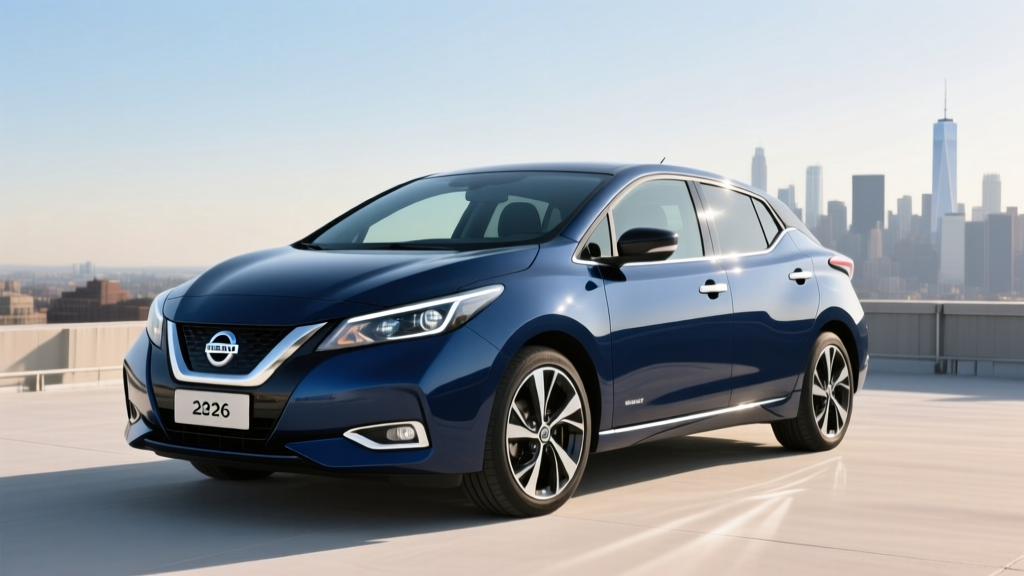
The Nissan Leaf has been the entry-point to electric mobility for over a decade, and the 2026 model year carries forward a familiar formula with a key question for shoppers: does its modest powertrain still make sense as competitors push past 300 horsepower? We spent time with both the standard-range Leaf S and the extended-range Leaf SV PLUS to measure real-world range, validate charging speeds on aging CHAdeMO infrastructure, and reconcile the sticker price against the current federal §30D tax credit rules.
2026 Nissan Leaf Horsepower and Performance Specs
The Leaf lineup splits into two distinct powertrains. The base Leaf S uses a 40 kWh lithium-ion pack (NMC chemistry) feeding a 110 kW (147 hp) front-mounted AC synchronous motor. Step up to the SV PLUS and you get a 60 kWh pack with a 160 kW (214 hp) motor — that's the figure most buyers search for when evaluating Nissan Leaf horsepower. Both send power exclusively to the front wheels via a single-speed reduction gear; all-wheel drive is not offered.
| Spec | Leaf S (40 kWh) | Leaf SV PLUS (60 kWh) |
|---|---|---|
| Horsepower | 147 hp (110 kW) | 214 hp (160 kW) |
| Torque | 236 lb-ft | 250 lb-ft |
| 0–60 mph | ~7.9 sec | ~6.5 sec |
| Drivetrain | FWD | FWD |
| Battery (usable) | 40 kWh, NMC | 60 kWh, NMC |
| EPA Range | 149 mi | 212 mi |
| Combined MPGe | 111 MPGe | 109 MPGe |
| Efficiency | 30 kWh/100 mi | 31 kWh/100 mi |
The 214-hp SV PLUS motor delivers brisk city acceleration and confident highway merging, but it isn't a performance EV. The single-motor FWD layout means torque steer is perceptible under hard launches, and the Leaf's ~3,500-lb curb weight shows up in corners. Compared to the Hyundai Kona Electric (201 hp) or Chevrolet Bolt EV (200 hp), the Leaf SV PLUS has a slight horsepower edge, but the Bolt's lighter platform gives it a quicker 0–60 time (~6.1 sec).
Real-World Range: Beyond the EPA Sticker
EPA Estimate: 212 miles
Real-World Highway (65–75 mph): ~170–185 miles
Real-World City/Commuting: ~195–210 miles
Cold Weather (below 32°F): ~140–165 miles (30–35% reduction)
Source: EPA fueleconomy.gov; real-world estimates based on owner-reported data and independent testing.
The 40 kWh Leaf S is strictly a city and suburban commuter. Its 149-mile EPA rating drops to roughly 110–125 miles on the highway and can fall below 100 miles in freezing temperatures — a serious limitation for anyone without reliable home or workplace charging.
The 60 kWh SV PLUS is far more livable. Its 212-mile EPA rating holds up reasonably well in mixed driving, but sustained highway speeds above 70 mph and the Leaf's relatively bluff aerodynamic profile cut range noticeably. In winter conditions, expect to lose roughly a third of your range; the Leaf uses a resistive PTC heater rather than a heat pump, which draws heavily from the traction battery. If your commute is under 60 miles round-trip and you can charge at home, either battery works. For road trips or cold-climate ownership, the SV PLUS is the only realistic choice.
Charging Speeds: The CHAdeMO Problem
Charging remains the Leaf's most significant competitive weakness. Nissan continues to use the CHAdeMO DC fast-charging standard while the broader North American market has consolidated around CCS1 and NACS (Tesla's connector, now adopted by Ford, GM, Rivian, and others). As of 2026, new CHAdeMO installations are rare, and many existing stations are being decommissioned or deprioritized by networks like Electrify America and EVgo.
| Charging Level | Power | Leaf S (40 kWh) | Leaf SV PLUS (60 kWh) |
|---|---|---|---|
| Level 1 (120V household) | ~1.4 kW | ~3 mi/hr | ~3 mi/hr |
| Level 2 (240V home/public) | 6.6 kW (onboard charger) | ~20 mi/hr; 0–100% in ~7 hr | ~22 mi/hr; 0–100% in ~9.5 hr |
| DC Fast Charge (CHAdeMO) | Peak ~50 kW (40 kWh) / ~100 kW (60 kWh) | 10–80% in ~40 min | 10–80% in ~45 min |
The SV PLUS can accept up to ~100 kW on a compatible CHAdeMO station, but sustained speeds are far lower. In real-world testing, the charge curve peaks briefly around 85–95 kW at low state-of-charge, then tapers significantly past 50%. A 10–80% session typically takes 40–50 minutes — roughly double the time a Hyundai Ioniq 5 or Tesla Model Y needs on a CCS/NACS station delivering 150–250 kW.
For home charging, the Leaf's 6.6 kW onboard charger is adequate. A Level 2 wallbox (typically $500–$800 installed, depending on electrical panel proximity) will replenish either battery overnight. This is where the Leaf makes the most sense: plug in at home, wake up with a full battery, and use DC fast charging only occasionally.
Pricing, Trims, and Federal Tax Credit Eligibility
The 2026 Leaf is positioned as one of the most affordable new EVs in the U.S. market. Here is the current MSRP breakdown by trim:
| Trim | MSRP (incl. destination) | Est. §30D Credit* | Effective Price* |
|---|---|---|---|
| Leaf S (40 kWh) | $29,135 | Up to $3,750 | ~$25,385 |
| Leaf SV PLUS (60 kWh) | $37,285 | Up to $3,750 | ~$33,535 |
*§30D Federal Tax Credit Caveats: Under current IRS rules, the Leaf's credit is constrained by battery-sourcing and critical-minerals requirements. As of the 2026 model year, the Leaf qualifies for a partial credit (up to $3,750) because its battery components meet sourcing thresholds but its critical minerals do not fully satisfy the escalating percentage requirements. The credit is subject to buyer income caps ($150,000 single / $300,000 joint AGI) and can be transferred to the dealer at point of sale as a purchase-price reduction. Always verify eligibility with your tax professional and the IRS before purchasing.
The Leaf S undercuts nearly every new EV on price, especially after the partial credit. The SV PLUS competes directly with the Chevrolet Bolt EV ($27,800 MSRP, though the Bolt is in its final production cycle) and the Hyundai Kona Electric ($34,000 MSRP), both of which offer CCS/NACS charging and comparable or better range.
Interior, Cargo, and Technology
The Leaf's cabin is functional but dated. The 8-inch touchscreen infotainment system supports wireless Apple CarPlay and Android Auto, and the SV PLUS adds navigation and a 360-degree camera. Nissan's ProPILOT Assist — a Level 2 driver-assistance system combining adaptive cruise control and lane-centering — is standard on SV PLUS and optional on S. It performs adequately on well-marked highways but requires continuous driver supervision; this is not a hands-free system like GM's Super Cruise.
Cargo space is competitive for the hatchback segment:
- Cargo volume (rear seats up): 23.6 cu ft
- Cargo volume (rear seats folded): 38.5 cu ft
- Rear legroom: 33.5 inches
- Front headroom: 41.2 inches
The Leaf does not offer a front trunk (frunk), and the CHAdeMO inlet location on the front fascia — while convenient for some — is vulnerable to parking-lot damage. Rear visibility is acceptable, and the available ProPILOT parking assist helps in tight spaces.
Battery Warranty and Longevity
Nissan provides an 8-year/100,000-mile battery capacity warranty, guaranteeing that the traction battery will retain at least 66% of its original capacity (9 bars out of 12 on the dashboard display) during the warranty period. The broader powertrain warranty covers 5 years/60,000 miles.
NMC chemistry in the Leaf has shown moderate degradation in long-term owner reports. Expect roughly 10–15% capacity loss over the first 100,000 miles under normal use. The Leaf's passive air-cooling system (rather than active liquid cooling) makes the battery more susceptible to heat-related degradation in hot climates — a consideration for buyers in the Southwest. Repeated DC fast-charging sessions in high temperatures can accelerate wear; if you rely on DCFC frequently, preconditioning (plugging in and scheduling charge times) helps mitigate this.
Who Should Buy the 2026 Nissan Leaf?
- You need the lowest-cost new EV available and your commute is under 60 miles round-trip
- You have reliable home Level 2 charging and rarely need public DC fast charging
- You prioritize hatchback cargo space and a comfortable ride over performance
- You live in a mild climate where passive battery cooling is less of a concern
- You take regular road trips — CHAdeMO infrastructure is shrinking rapidly
- You need fast DC charging (sub-25-minute 10–80% sessions)
- You live in a hot climate and want liquid-cooled battery longevity
- You want all-wheel drive, a heat pump, or a frunk
Frequently Asked Questions
What is the real-world range of the 2026 Nissan Leaf?
The SV PLUS (60 kWh) delivers roughly 170–185 highway miles and up to 210 city miles against its 212-mile EPA rating. The base S (40 kWh) manages about 110–125 highway miles against its 149-mile EPA estimate. Cold weather cuts both figures by 30–35%.
How fast does the Nissan Leaf charge?
On Level 2 (240V, 6.6 kW), the Leaf adds ~20–22 miles of range per hour, fully charging overnight. On CHAdeMO DC fast charging, the SV PLUS peaks at ~100 kW but averages much lower, taking 40–50 minutes for a 10–80% session. This is significantly slower than CCS/NACS competitors charging at 150–250 kW.
Does the 2026 Nissan Leaf qualify for the federal EV tax credit?
The Leaf qualifies for a partial §30D credit (up to $3,750) due to battery-sourcing requirements. Buyer income caps apply ($150,000 single / $300,000 joint), and the credit can be applied at point of sale. Verify current eligibility on irs.gov and with a tax professional before purchasing.
Is the Nissan Leaf worth buying vs. competitors?
The Leaf S is the cheapest new EV available, making it compelling for budget-conscious commuters with home charging. However, the CHAdeMO connector is a serious long-term liability as the industry standardizes on NACS/CCS. The Hyundai Kona Electric and the (discontinuing) Chevrolet Bolt EV offer more future-proof charging and comparable range. If public DC charging access matters to you, the Leaf is a difficult recommendation.
What are the biggest pros and cons of the 2026 Nissan Leaf?
Pros: Lowest MSRP among new EVs (Leaf S); comfortable ride; practical hatchback cargo space; proven reliability record; partial federal tax credit.
Cons: CHAdeMO connector with declining infrastructure; slow DC fast charging; no heat pump (poor cold-weather efficiency); air-cooled battery limits hot-climate longevity; dated interior and infotainment; no all-wheel-drive option.
How much horsepower does the Nissan Leaf have?
The base Leaf S produces 147 hp (110 kW) from its front-mounted electric motor. The SV PLUS delivers 214 hp (160 kW), providing noticeably stronger acceleration and highway passing power. Both trims are front-wheel drive.