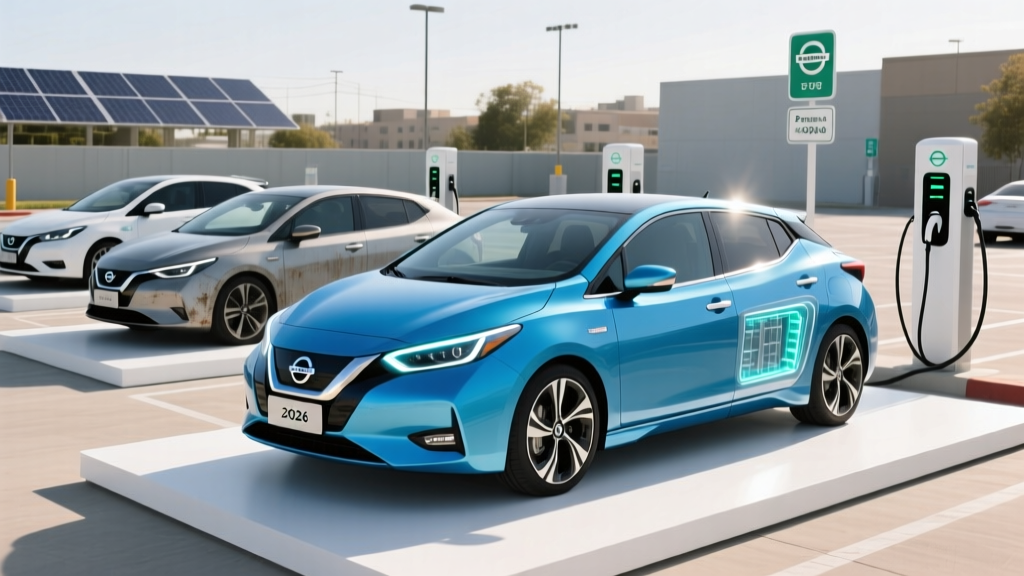
The Nissan Leaf holds a unique place in EV history as the world's first mass-market battery electric vehicle, launching in the U.S. for the 2011 model year with a then-impressive 73 miles of EPA range. Over 15 years and multiple distinct generations, the Leaf evolved from a compliance car into a legitimate daily driver — yet it remains one of the most polarizing EVs on the market due to its air-cooled battery, CHAdeMO connector, and increasingly dated fast-charging speeds. For 2026, the Leaf soldiers on as a value-oriented EV commuter, but understanding the differences between its generations is critical before buying new or used.
Nissan Leaf Generations at a Glance: ZE0, ZE1, and the 2026 Carryover
The Leaf's production history breaks cleanly into two major platform generations, with the second generation receiving a substantial mid-cycle refresh. Here's how they stack up across the metrics that matter to actual owners:
| Generation | Model Years | Battery (Usable kWh) | EPA Range | Max DC Charge Rate | 0-60 mph | Base MSRP (Launch) |
|---|---|---|---|---|---|---|
| ZE0 (Gen 1) | 2011–2017 | 24 / 30 kWh (NMC) | 73–107 mi | 50 kW (CHAdeMO) | 9.9–11.5 sec | $32,780 (2011) |
| ZE1 (Gen 2) | 2018–2023 | 40 / 62 kWh (NMC) | 149–226 mi | 50–100 kW (CHAdeMO) | 6.5–7.9 sec | $29,990 (2018) |
| ZE1 Refresh (2024–2026) | 2024–2026 | 62 kWh (NMC) | 212–226 mi | 100 kW (CHAdeMO) | 6.5 sec | $28,140 (2026 S trim) |
The jump from ZE0 to ZE1 in 2018 was transformative: Nissan moved from a 24 kWh battery to 40 kWh standard and optional 62 kWh (the "Leaf Plus"), nearly tripling range in the top trim. The 2024 refresh added updated safety tech, a revised infotainment system, and simplified trims, but the fundamental hardware — including the passive air-cooled battery thermal management — carried over unchanged.
2026 Nissan Leaf: Range, Efficiency, and Real-World Expectations
For 2026, Nissan offers the Leaf in two trims: the base S with a 40 kWh battery (149 miles EPA) and the SV Plus with a 62 kWh pack (212 miles EPA). The higher-spec SV Plus remains the volume seller and the only trim we'd recommend for anyone with a commute exceeding 40 miles round-trip.
Real-World Range vs. EPA Sticker: 2026 Leaf SV Plus
EPA Combined: 212 miles (62 kWh battery)
Real-World Highway (70 mph, 75°F): ~175–185 miles
Real-World Highway (32°F, no heat pump): ~140–155 miles
City/Commuter (mixed, mild weather): ~215–230 miles
The Leaf lacks a heat pump — it uses resistive PTC heating, which can cut range by 25–35% in sustained cold weather below freezing. Highway driving at 75+ mph also exposes the Leaf's boxy aerodynamics, with efficiency dropping from 111 MPGe combined to roughly 95 MPGe at sustained interstate speeds. Owners in cold climates should budget at least 30% range loss in winter.
Efficiency for the SV Plus is rated at 111 MPGe combined (30 kWh/100 miles) according to fueleconomy.gov. That's competitive with the Chevrolet Bolt EUV (109 MPGe) but trails the Hyundai Kona Electric (120 MPGe) and Tesla Model 3 RWD (132 MPGe). The 40 kWh S trim rates slightly better at 123 MPGe combined due to lower mass, but the smaller battery makes that efficiency harder to leverage in practice.
Charging: The Leaf's Persistent CHAdeMO Limitation
Charging remains the Leaf's most significant competitive weakness in 2026. While the rest of the industry has standardized on CCS1 or Tesla's NACS connector, Nissan continues with CHAdeMO — a connector standard that Electrify America, the largest U.S. DC fast-charging network, does not support. CHAdeMO chargers are increasingly rare outside legacy installations and certain regional networks.
| Charging Method | Power / Rate | Time (10–80% or Full) | Miles Added per Hour |
|---|---|---|---|
| Level 1 (120V household) | 1.4 kW | ~44 hours (full, 62 kWh) | ~4 mi/hr |
| Level 2 (240V, 32A home charger) | 6.6 kW (7.2 kW max onboard) | ~9.5 hours (full, 62 kWh) | ~22 mi/hr |
| DC Fast (CHAdeMO, 50 kW station) | 50 kW peak | ~60 min (10–80%, 62 kWh) | ~125 mi/hr (peak) |
| DC Fast (CHAdeMO, 100 kW station) | 100 kW peak (SV Plus only) | ~45 min (10–80%, 62 kWh) | ~180 mi/hr (peak) |
The SV Plus can accept up to 100 kW on a compatible CHAdeMO station, but sustained charge rates taper significantly past 60% SoC due to the passive thermal management system. In warm weather, expect peak rates around 70–85 kW for the first 15–20 minutes, then a steady decline. In cold weather without preconditioning (the Leaf lacks active battery preconditioning for charging), DC fast-charging speeds can be halved — a phenomenon known colloquially as "Rapidgate," first documented by Leaf owners in 2018 and never fully resolved by Nissan.
Home Level 2 charging is straightforward. The Leaf's 6.6 kW onboard charger (7.2 kW on some trims) means a standard 32-amp Level 2 wallbox will fully recharge the 62 kWh pack overnight. This is the primary use case the Leaf was designed around, and it works well for homeowners with garage or driveway access.
Performance and Driving Dynamics
The 2026 Leaf SV Plus produces 214 horsepower and 250 lb-ft of torque from a single front-mounted electric motor driving the front wheels. The 0–60 mph sprint takes approximately 6.5 seconds — adequate for highway merging and passing but not sporty by 2026 EV standards (the Tesla Model 3 RWD does it in 5.8 seconds, the Hyundai Ioniq 5 in 5.0 seconds with AWD).
The Leaf's ride quality is genuinely comfortable, with soft damping that absorbs urban potholes better than many firmer-riding EV competitors. Steering is light and numb, and the low center of gravity from the floor-mounted battery keeps body roll reasonable. Regenerative braking via the "e-Pedal" mode enables one-pedal driving, though it doesn't bring the car to a complete hold on steep grades — you'll still need the friction brakes occasionally.
Cargo space is a practical 23.6 cubic feet behind the rear seats (30.0 cu ft in pre-refresh models due to a slightly different load floor), expanding to 38.5 cubic feet with the 60/40 split rear seats folded. Rear legroom measures 33.5 inches — adequate for adults on shorter trips but tight for taller passengers on longer journeys. The Leaf is a five-seat compact hatchback, not a crossover, and that shows in interior volume.
Pricing, Trims, and Federal Tax Credit Eligibility
For 2026, the Nissan Leaf starts at $28,140 for the S trim (40 kWh, 149-mile range) and $36,540 for the SV Plus (62 kWh, 212-mile range), including destination charges. Both trims are eligible for the full $7,500 federal EV tax credit under IRS §30D, subject to buyer income limits and point-of-sale transfer availability. With the credit applied, the Leaf S drops to an effective $20,640 — one of the cheapest new EVs available in the United States.
| Trim | MSRP | Federal Credit (§30D) | Effective Price | Eligibility Notes |
|---|---|---|---|---|
| Leaf S (40 kWh) | $28,140 | $7,500 | $20,640 | MSRP under $55K cap; buyer MAGI must be ≤$150K single / $300K joint |
| Leaf SV Plus (62 kWh) | $36,540 | $7,500 | $29,040 | Same income/MSRP caps; battery sourcing requirements apply |
Critical caveats: Under current IRS §30D rules, the buyer's modified adjusted gross income cannot exceed $150,000 (single) or $300,000 (married filing jointly). The vehicle's MSRP must be under $55,000 for passenger cars (the Leaf qualifies easily). Additionally, the battery must meet critical mineral and component sourcing thresholds that phase in annually — Nissan has confirmed the 2026 Leaf meets current-year requirements, but always verify at point of sale. The credit can now be transferred to the dealer at purchase, reducing your out-of-pocket cost immediately rather than waiting for tax filing.
Battery Longevity, Degradation, and Warranty
The Leaf's air-cooled battery is its most debated engineering choice. Unlike the liquid-cooled packs in the Tesla Model 3, Hyundai Ioniq 5, or Chevrolet Equinox EV, the Leaf relies on passive convection to manage cell temperature. This simplifies the vehicle (fewer parts to fail, lower weight, lower cost) but accelerates degradation in hot climates and during repeated DC fast-charging sessions.
Nissan's battery warranty covers 8 years/100,000 miles against capacity loss below 9 bars out of 12 on the dashboard capacity gauge (roughly equivalent to 65–70% state of health). For comparison, most competitors warrant 70% capacity retention over the same period using more precise percentage-based metrics. Real-world data from Leaf owners in moderate climates (Pacific Northwest, Northeast) shows typical 5-year degradation of 8–12%, while owners in Arizona, Texas, and the Southeast report 15–22% loss over the same period — a meaningful difference driven entirely by thermal exposure.
Replacement battery packs for the Leaf currently cost between $6,500 and $9,000 installed, depending on capacity and source. Nissan also offers a battery refurbishment program in some markets. The air-cooled design means there's no coolant to flush or thermal system to service — a genuine maintenance advantage, even if longevity is compromised in hot climates.
Tech, Safety, and Driver Assistance
The 2026 Leaf SV Plus includes Nissan's ProPILOT Assist, a Level 2 driver-assistance system combining adaptive cruise control with lane centering. It works adequately on marked highways but requires continuous hands-on-wheel supervision — this is not an eyes-off system like GM's Super Cruise or Ford's BlueCruise hands-free mode. The SAE automation level is firmly Level 2, meaning the driver is always responsible for vehicle operation.
The 8.0-inch touchscreen infotainment system supports wireless Apple CarPlay and wired Android Auto, with a 360-degree camera available on the SV Plus. Standard safety features include automatic emergency braking with pedestrian detection, lane departure warning, blind-spot monitoring, and rear cross-traffic alert. The Leaf earned a Top Safety Pick rating from IIHS in recent test years, though it has not been fully re-tested since the 2024 refresh.
Notable tech drawbacks: no over-the-air updates (dealer visits required for software), no vehicle-to-load (V2L) capability, no front trunk (frunk), and the CHAdeMO connector limits public charging network access. The Leaf also lacks a heat pump, which is increasingly standard on competitors in this price range.
Who Should Buy the 2026 Nissan Leaf (and Who Shouldn't)
Buy the Leaf If:
- You need the cheapest new EV possible after the $7,500 credit (under $21K for the S trim)
- Your daily commute is under 60 miles round-trip and you charge at home nightly
- You live in a moderate climate where extreme heat won't accelerate battery degradation
- You prioritize ride comfort and simplicity over performance and tech
- You rarely take road trips over 150 miles, or you have reliable CHAdeMO charger access along your routes
Look Elsewhere If:
- You need DC fast-charging on road trips (CCS/NACS networks are vastly more available)
- You live in a hot climate (Arizona, Texas, Florida) and plan to keep the car 8+ years
- You want a heat pump for cold-weather efficiency
- You need more than 212 miles of range or AWD capability
- You want hands-free highway driving assist (Super Cruise, BlueCruise)
Against key competitors, the Leaf faces stiff competition in 2026. The Chevrolet Bolt EV (reintroduced for 2026 on the Ultium platform with CCS charging and 258 miles of range) undercuts it on price after incentives while offering faster charging and a more modern platform. The Hyundai Kona Electric provides 261 miles of range, CCS charging, and available heat pump for roughly $34,000 before credits. The Tesla Model 3 RWD, while more expensive at ~$38,990 before credit, delivers 341 miles of range, Supercharger network access, and vastly superior DC charging speeds.
The Leaf's value proposition in 2026 is narrow but real: it's a proven, comfortable, simple EV commuter with low running costs and an aggressive post-credit price. If your use case fits within its limitations, it remains a rational purchase. If you need flexibility for road trips, cold-weather efficiency, or long-term battery confidence in hot climates, the competition has passed it by.
Pros
- Lowest effective price of any new EV after $7,500 credit
- Comfortable ride quality for urban and suburban driving
- Proven powertrain with 15 years of real-world reliability data
- Simple maintenance (no liquid cooling system to service)
- Standard ProPILOT Assist and comprehensive safety suite
- Eligible for full federal tax credit with point-of-sale transfer
Cons
- CHAdeMO connector severely limits DC fast-charging access
- Air-cooled battery degrades faster in hot climates
- No heat pump — significant cold-weather range loss
- Max 100 kW DC charging (competitors charge at 150–250 kW)
- Tight rear legroom and modest cargo volume for the segment
- No over-the-air updates, no V2L, no frunk
Frequently Asked Questions
What is the real-world range of the 2026 Nissan Leaf SV Plus?
The EPA rates the SV Plus at 212 miles combined. In real-world highway driving at 70 mph in mild weather, expect 175–185 miles. In cold weather (below freezing), range drops to approximately 140–155 miles due to the resistive heating system and lack of a heat pump. City commuters in moderate climates can sometimes exceed the EPA rating, achieving 215–230 miles.
How fast does the 2026 Leaf charge at home and on DC fast chargers?
On a Level 2 home charger (240V, 32A), the Leaf charges at up to 6.6 kW, adding about 22 miles of range per hour — a full charge takes roughly 9.5 hours for the 62 kWh pack. On DC fast chargers, the SV Plus peaks at 100 kW (CHAdeMO), with a 10–80% charge taking approximately 45 minutes on a compatible station. However, CHAdeMO stations are increasingly rare, and charge speeds taper significantly above 60% SoC.
Does the 2026 Nissan Leaf qualify for the federal EV tax credit?
Yes, both the Leaf S and SV Plus qualify for the full $7,500 federal tax credit under IRS §30D, provided the buyer's MAGI is under $150,000 (single) or $300,000 (married filing jointly), and the battery meets current-year critical mineral and component sourcing requirements. The credit can be transferred to the dealer at point of sale, reducing your purchase price immediately. Always confirm eligibility with your dealer and consult a tax professional.
Is the Nissan Leaf worth buying in 2026 vs. competitors?
The Leaf is worth considering if your priority is the lowest possible purchase price after incentives and your driving is mostly local commuting with home charging. However, the Chevrolet Bolt EV (258 mi, CCS, ~$27K after credit), Hyundai Kona Electric (261 mi, CCS, heat pump), and Tesla Model 3 RWD (341 mi, NACS/Supercharger) all offer superior range, charging infrastructure access, and modern features. The Leaf's CHAdeMO connector and air-cooled battery are significant long-term disadvantages.
How long will the Leaf's battery last?
Nissan warrants the battery for 8 years/100,000 miles against capacity loss below approximately 65–70% SoH. In moderate climates with mostly Level 2 home charging, owners report 8–12% degradation over 5 years. In hot climates (sustained temperatures above 90°F) or with frequent DC fast-charging, degradation can reach 15–22% over 5 years. A replacement pack costs $6,500–$9,000 installed.
Why does the Leaf still use CHAdeMO instead of CCS or NACS?
Nissan co-developed the CHAdeMO standard with Tokyo Electric Power Company in 2010, and the Leaf was designed around it from launch. Transitioning to CCS or NACS would require reengineering the vehicle's charge port, onboard systems, and battery management — investment Nissan has been unwilling to make for a model that may be replaced by a new-generation EV in the coming years. For 2026, this legacy connector is the Leaf's single biggest practical limitation.