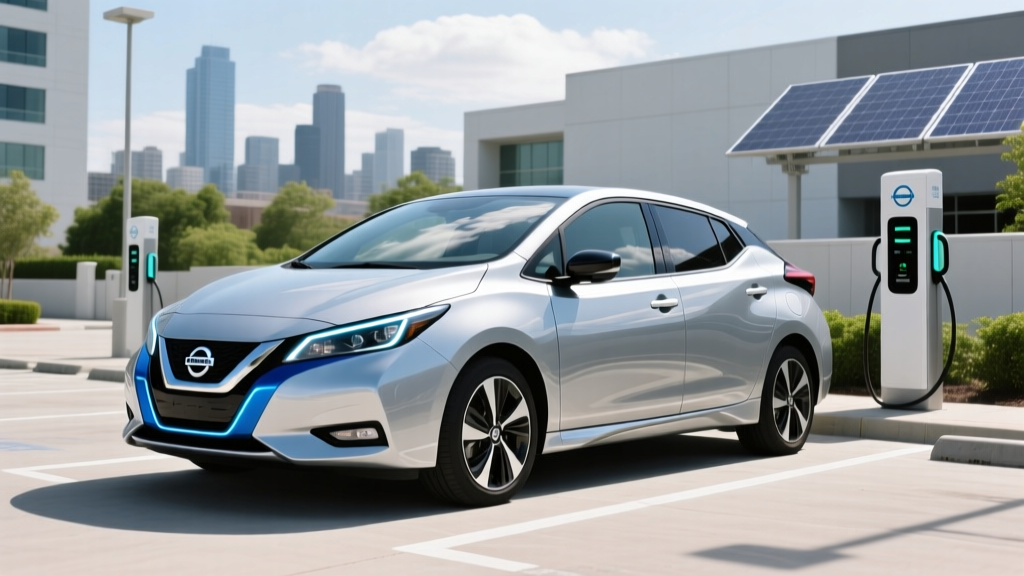
Quick Verdict: The Nissan Leaf Lease Equation in 2026
The 2026 Nissan Leaf remains one of the most accessible entry points into battery-electric ownership. With a starting MSRP around $29,135 for the S trim and an available federal tax credit of up to $7,500 via point-of-sale transfer, the effective entry price can dip below $22,000 for eligible buyers. But leasing introduces its own math — one that requires understanding residual values, money factors, and how the §30D credit flows through the lessor to you.
This guide dissects the real cost of a Nissan Leaf EV lease in 2026, from monthly payments and fuel savings to insurance premiums and what happens at lease-end. We use hard numbers, current IRS rules, and EPA data to give you a decision-ready framework.
2026 Nissan Leaf: Key Specs at a Glance
| Spec | Leaf S (40 kWh) | Leaf SV Plus / SL Plus (60 kWh) |
|---|---|---|
| EPA Range | 149 miles | 212 miles |
| Battery (usable) | ~39 kWh, LMO chemistry | ~58 kWh, LMO chemistry |
| DC Fast Charge (peak) | 50 kW (CHAdeMO) | 100 kW (CHAdeMO) |
| 10–80% DCFC Time | ~40 min (est.) | ~45 min (est.) |
| Level 2 Charge Rate | 6.6 kW | 6.6 kW |
| Motor Output | 147 hp / 236 lb-ft | 214 hp / 250 lb-ft |
| 0–60 mph | ~7.9 sec | ~6.5 sec |
| EPA Efficiency | 111 MPGe combined | 109 MPGe combined |
| Base MSRP (2026) | ~$29,135 | ~$37,135 |
| Battery Warranty | 8 yr / 100,000 mi | 8 yr / 100,000 mi |
How a Nissan Leaf Lease Actually Works
When you lease a Leaf, Nissan Motor Acceptance Corporation (NMAC) or a third-party lessor purchases the vehicle and rents it to you for a fixed term — typically 36 months. Your monthly payment is driven by three factors:
- Capitalized cost: The negotiated price of the car (yes, you can and should negotiate this on a lease).
- Residual value: The projected worth of the Leaf at lease-end, set by the lessor as a percentage of MSRP. For a 36-month Leaf lease, residuals typically land around 45–52%.
- Money factor: The lease equivalent of an interest rate. Multiply by 2,400 to get an approximate APR. A 0.00125 money factor ≈ 3.0% APR.
Critically, the federal §30D tax credit can be applied by the lessor as a capitalized cost reduction, effectively lowering your monthly payment. Many Nissan dealerships pass this through as a "lease cash" incentive, though the exact mechanism varies by lessor and region.
Sample 2026 Leaf SV Plus Lease Estimate
| Lease Parameter | Estimate |
|---|---|
| MSRP | $37,135 |
| Negotiated Cap Cost | $35,500 |
| Federal Credit Applied (if eligible) | −$7,500 |
| Adjusted Cap Cost | $28,000 |
| Residual (48% of MSRP, 36 mo.) | $17,825 |
| Depreciation over 36 mo. | $10,175 |
| Monthly Depreciation | ~$283 |
| Monthly Finance Charge (MF 0.00125) | ~$57 |
| Est. Monthly Payment (before tax/fees) | ~$340 |
This is an illustrative estimate. Actual terms depend on credit tier, dealer negotiation, regional incentives, and lessor policies. Always confirm the money factor and residual with the finance desk.
Federal Tax Credit: Do You Qualify for §30D in 2026?
The federal EV tax credit under IRS §30D offers up to $7,500 for qualifying new clean vehicles. However, eligibility is a multi-layered gate. Here's the 2026 checklist:
- MSRP Cap: Vans/SUVs/pickups ≤ $80,000; sedans/other ≤ $55,000. The Leaf (hatchback) falls under the $55,000 cap — all trims qualify on price.
- Buyer Income Cap (Modified AGI): Single filers ≤ $150,000; Head of household ≤ $225,000; Joint filers ≤ $300,000.
- Battery Component Sourcing: A percentage of battery components must be manufactured or assembled in North America (threshold increases annually through 2029).
- Critical Minerals Requirement: A percentage of critical minerals must be sourced from the U.S. or FTA partners (threshold also increases annually).
- Final Assembly: Vehicle must undergo final assembly in North America. The Leaf is assembled in Smyrna, Tennessee — this requirement is met.
- Point-of-Sale Transfer: As of 2024, eligible buyers can transfer the credit to the dealer at purchase, receiving it as an immediate price reduction rather than a tax-time credit. This applies to leases as a cap cost reduction.
- Foreign Entity of Concern (FEOC) Restriction: Vehicles with battery components or critical minerals from FEOC entities (certain Chinese, Russian, North Korean, Iranian sources) are disqualified. This rule tightens annually.
The Leaf's sourcing challenge: Nissan's battery supply chain for the U.S.-market Leaf has historically relied on Envision AESC cells. As of 2026, verify with your dealer that the specific VIN qualifies for the full $7,500, the partial $3,750, or no credit — the fueleconomy.gov tax credit lookup is the authoritative source for per-model eligibility that updates as sourcing rules tighten.
5-Year Total Cost of Ownership: Leaf vs. Comparable Gas Hatchback
To understand whether a Nissan Leaf EV lease (or purchase) pencils out, we compare it against a realistic gas alternative — the 2026 Nissan Sentra (a similarly priced compact). We model 5 years / 75,000 total miles.
| Cost Category | 2026 Nissan Leaf SV Plus | 2026 Nissan Sentra SV (Gas) |
|---|---|---|
| Purchase / Effective Price (after credit) | $29,635 ($37,135 − $7,500) | $24,500 |
| Fuel / Energy (75,000 mi) | $3,375 (see math below) | $8,550 (see math below) |
| Maintenance (5 yr / 75k mi) | $1,800 | $4,200 |
| Insurance (5 yr avg.) | $9,500 | $7,250 |
| Depreciation (est. 5-yr) | $16,500 (est. 44% retention) | $11,000 (est. 55% retention) |
| Total 5-Year Cost | ~$60,810 | ~$55,500 |
| Cost Per Mile | ~$0.81 | ~$0.74 |
Leaf: 109 MPGe → ~31 kWh/100 mi. At a blended home rate of $0.145/kWh (U.S. average, per EIA data): 31 × $0.145 = $4.50/100 mi → $0.045/mile. Over 75,000 mi = $3,375.
Sentra: 32 MPG combined. At $3.65/gallon (2026 EIA projected avg.): $3.65 ÷ 32 = $0.114/mile. Over 75,000 mi = $8,513.
Fuel savings: ~$5,175 over 5 years. Public DC fast charging at $0.35–$0.48/kWh would raise the Leaf's cost if you rely heavily on road-trip charging, but the vast majority of Leaf owners charge at home.
Maintenance Savings Breakdown
| Maintenance Item | Leaf (EV) | Sentra (Gas) |
|---|---|---|
| Oil changes (75k mi) | $0 | $750 (10 × $75) |
| Transmission fluid | $0 | $200 |
| Brake pads (regen extends life) | $0–$200 | $600–$900 |
| Engine air filter | $0 | $150 |
| Spark plugs | $0 | $400 |
| Coolant, belts, misc. | $300 | $800 |
| Cabin air filter, wipers, tires (both) | $1,300 | $1,300 |
| Total Est. Maintenance | ~$1,800 | ~$4,200 |
Regenerative braking dramatically extends brake pad life — many Leaf owners report original pads beyond 80,000 miles. The single-speed reduction gear requires no fluid service in normal use.
Insurance Reality: Why EVs Cost More to Insure
EV insurance premiums typically run 15–25% higher than equivalent gas vehicles. For the Leaf, national average full-coverage premiums land around $1,800–$2,100/year depending on driver profile, compared to roughly $1,400–$1,600 for a Sentra. The reasons are structural:
- Higher repair costs: Battery pack proximity to collision zones means even moderate front/rear impacts can trigger costly high-voltage safety protocols or battery inspections.
- Specialized labor: Fewer body shops have EV-certified technicians, raising labor rates for EV claims.
- Total-loss thresholds: Insurers may declare an EV a total loss at lower damage thresholds if the battery enclosure is compromised.
- Higher replacement value: The Leaf's effective purchase price (even after credit) is higher than a Sentra's, increasing comprehensive/collision premiums.
Mitigation strategies: Shop quotes from GEICO, Progressive, State Farm, and EV-specialty carriers like Plug In America-partnered insurers. Bundling home/auto and maintaining a clean record narrow the gap. Some insurers now offer specific EV discounts.
Depreciation and Resale: The Leaf's Historical Weakness
Depreciation is the single largest ownership cost for any vehicle, and the Leaf has historically underperformed. Several factors explain this:
- CHAdeMO connector: As the industry has standardized on NACS (Tesla's connector, now adopted by Ford, GM, Hyundai, Rivian, and others) and CCS, CHAdeMO's public charging network has stagnated. This limits the Leaf's appeal to used buyers who rely on public infrastructure.
- Passive battery thermal management: The Leaf uses air-cooled batteries rather than active liquid thermal management. This has led to documented accelerated degradation in hot climates (Arizona, Texas, Southern California), suppressing used values.
- Rapid EV obsolescence: As newer EVs offer 300+ miles of range and 250 kW charging, a 212-mile Leaf with 100 kW max charging looks dated faster than a gas car of the same vintage.
For a 2026 Leaf SV Plus at $37,135 MSRP, industry projections suggest approximately 40–48% value retention after 5 years — translating to roughly $14,800–$17,800 in residual value. By comparison, a Toyota Corolla Hybrid retains closer to 55–60%.
State, Local, and Utility Incentives
Beyond the federal §30D credit, additional incentives can significantly reduce your effective cost. These vary enormously by jurisdiction and utility provider:
- State rebates: California's CVRP has been restructured under new equity-focused programs; Colorado offers up to $5,000 in state tax credits for EVs under certain MSRP thresholds; Massachusetts, New York, and Oregon have their own programs. Check your state's energy office or AFDC state incentive lookup for current amounts.
- Utility rebates: Many utilities offer $500–$1,500 rebates for purchasing an EV and/or installing a Level 2 home charger. Examples include PG&E, Con Edison, Xcel Energy, and Austin Energy. These are typically post-purchase rebates applied to your utility bill.
- HOV lane access: States like California, Colorado, and Virginia offer single-occupant HOV lane access for EVs — a significant time-savings incentive with real economic value for commuters.
- Home charging installation credits: The federal §30C Alternative Fuel Vehicle Refueling Property Credit offers up to $1,000 (residential) for home charger installation, subject to census-tract eligibility requirements.
Always verify incentive availability before purchasing — programs frequently sunset, exhaust funding, or change eligibility criteria mid-year.
Charging the Leaf: What You Need to Know
The Leaf's charging profile is one area where honest assessment matters. Here's the reality:
| Charging Level | Power (kW) | Miles Added Per Hour | Use Case |
|---|---|---|---|
| Level 1 (120V outlet) | 1.4 kW | ~4–5 mi/hr | Overnight top-up, low-mileage days |
| Level 2 (240V, 32A) | 6.6 kW | ~22–25 mi/hr | Primary home charging, full overnight charge |
| DC Fast (CHAdeMO, SV Plus) | Up to 100 kW peak | ~180 mi/hr at peak | Road trips; tapers significantly above 80% SoC |
The CHAdeMO constraint: The Leaf is the last major-market EV in the U.S. still using CHAdeMO for DC fast charging. While Electrify America and some regional networks maintain CHAdeMO connectors, the vast majority of new DCFC installations are NACS or CCS. On road trips, you may find fewer available stalls and longer wait times compared to NACS-equipped vehicles with Supercharger access. For a primarily home-charged commuter, this is a minor issue. For frequent road-trippers, it's a meaningful limitation.
Charge curve reality: The SV Plus peaks near 100 kW only at low state-of-charge (roughly 10–30% SoC) and optimal battery temperature. Above 60% SoC, the rate drops to 40–50 kW, and above 80%, it falls below 20 kW. A 10–80% session takes approximately 45 minutes under good conditions — plan for 55–60 minutes in cold weather when the battery is not preconditioned (the Leaf lacks active battery preconditioning for DCFC).
Decision Framework: Is the Leaf Lease Right for You?
- Your daily commute is under 80 miles round-trip and you can charge at home
- You qualify for the full or partial §30D credit and want to apply it as a cap cost reduction
- You want to avoid depreciation risk on a vehicle with historically weak resale values
- You prioritize low running costs (fuel + maintenance) over long road-trip capability
- Your state or utility offers additional rebates that stack with the federal credit
Look elsewhere if:
- You regularly drive more than 150 miles in a single day without overnight charging access
- You live in a hot climate and plan to keep the vehicle long-term (battery degradation risk with passive cooling)
- Road-trip charging convenience is a priority (CHAdeMO network is shrinking relative to NACS/CCS)
- You exceed the §30D income caps and cannot access state incentives to offset the price premium
- You need a vehicle with strong resale value for future trade-in equity
Frequently Asked Questions
How much does it really cost to own a Nissan Leaf over 5 years?
Based on our analysis, a 2026 Leaf SV Plus purchased at an effective price of ~$29,635 (after the $7,500 federal credit) costs approximately $60,810 over 5 years and 75,000 miles when including fuel, maintenance, insurance, and depreciation. That's roughly $0.81 per mile all-in. Leasing changes the math — you pay monthly for 36 months without absorbing long-term depreciation, but you also build no equity and face mileage restrictions (typically 10,000–15,000 miles/year).
Do I qualify for the $7,500 federal tax credit on a Leaf lease?
Possibly, but it's not automatic. You must meet the income caps ($150K single / $300K joint), the vehicle must meet battery sourcing requirements (which vary by VIN and production date), and the lessor must pass the credit through as a cap cost reduction. The commercial clean vehicle credit (§45W) can sometimes allow lessors to claim the credit on leased vehicles with fewer restrictions, but this is lessor-dependent. Confirm eligibility on fueleconomy.gov and with your dealer's finance department before signing.
How much do I save on fuel and maintenance compared to a gas car?
Approximately $5,175 in fuel and $2,400 in maintenance over 5 years / 75,000 miles, for a combined savings of around $7,575. These savings are real but must be weighed against higher insurance costs (~$2,250 more over 5 years) and potentially higher depreciation. The net ownership savings versus a comparable gas hatchback narrows to roughly $2,000–$3,000 over 5 years — meaningful but not transformative.
Are EVs more expensive to insure?
Yes, typically 15–25% more than comparable gas vehicles. For the Leaf, expect to pay roughly $350–$500 more per year in insurance premiums compared to a Nissan Sentra. This is driven by higher repair costs, specialized labor requirements, and the vehicle's higher replacement value. Shopping multiple carriers and bundling policies can reduce the gap.
How well does the Nissan Leaf hold its value?
The Leaf has historically retained 40–48% of its MSRP after 5 years, which is below the industry average for compact cars (typically 50–60%). Contributing factors include the CHAdeMO connector's declining network support, passive battery cooling concerns in hot climates, and rapid advancement in competing EVs. This weaker depreciation profile actually makes leasing more attractive — you don't bear the resale risk.
Can I charge a Leaf at Tesla Superchargers?
Not directly. The Leaf uses CHAdeMO for DC fast charging and J1772 for Level 2. Tesla Superchargers use NACS. There is no widely available, reliable CHAdeMO-to-NACS adapter as of 2026. However, you can use a J1772 adapter to charge at Tesla Destination Chargers (Level 2, slower). For DC fast charging, you'll rely on Electrify America, EVgo, ChargePoint, and other networks that maintain CHAdeMO connectors — though availability is shrinking.
What happens at the end of a Leaf lease?
You have three options: (1) Return the vehicle and walk away (subject to excess wear and mileage charges — typically $0.15–$0.25 per mile over the limit). (2) Purchase the vehicle at the pre-set residual price if the buyout is attractive relative to market value. (3) Lease or purchase a new vehicle, potentially rolling any equity (unlikely with the Leaf's depreciation profile) into the next deal. If the used EV market has softened further, returning the car and walking away is the most common and financially sound choice.