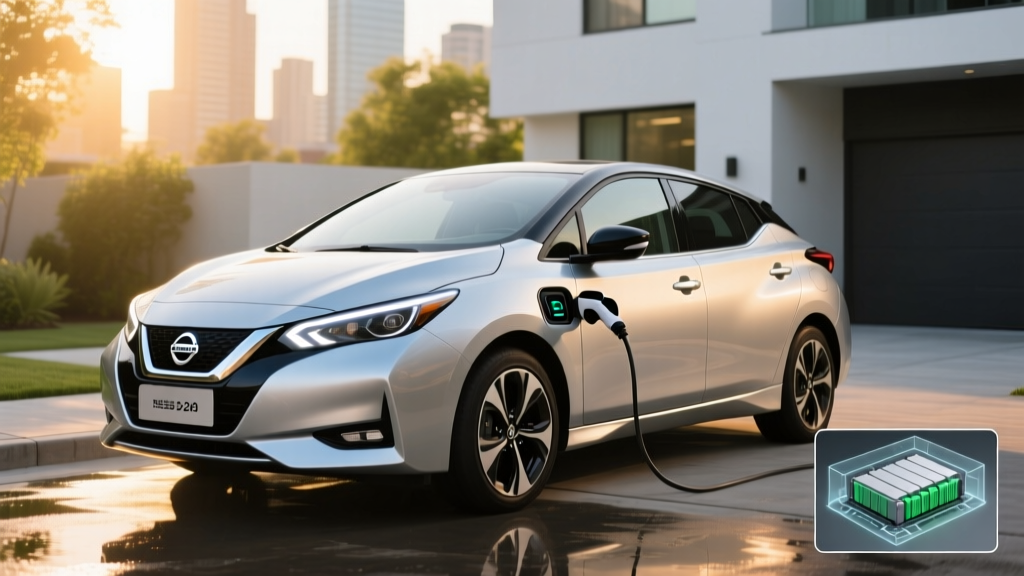
The Nissan Leaf holds a unique place in EV history: it was the first mass-market battery-electric vehicle sold in the United States when it debuted for the 2011 model year. Now in its second generation (introduced for 2018 and refreshed several times since), the Leaf continues into 2026 as one of the most affordable new EVs available. But affordability comes with engineering trade-offs that every prospective buyer needs to understand — particularly around the Nissan Leaf's electric motor (there is no internal combustion engine), its battery options, its aging CHAdeMO charging connector, and its passive battery thermal management system.
This review covers the 2026 Nissan Leaf's powertrain, real-world range, charging performance, pricing, and ownership economics so you can decide whether it still earns a spot in your garage or driveway.
What Replaces the Engine in the Nissan Leaf?
Searches for "Nissan Leaf engine" are common, but the Leaf has never had one. It is a pure battery-electric vehicle (BEV), meaning it uses an electric motor powered by a lithium-ion battery pack instead of an internal combustion engine. There is no gasoline tank, no exhaust system, and no oil to change.
The 2026 Leaf is offered in two powertrain configurations across its trim levels:
| Specification | Leaf S / SV (40 kWh) | Leaf SV PLUS / SL PLUS (60 kWh) |
|---|---|---|
| Motor Type | AC synchronous electric motor | AC synchronous electric motor |
| Horsepower | 147 hp | 214 hp |
| Torque | 236 lb-ft | 250 lb-ft |
| Drivetrain | Front-wheel drive (FWD) | Front-wheel drive (FWD) |
| Battery Capacity (usable) | 40 kWh | 60 kWh |
| Battery Chemistry | NMC (nickel manganese cobalt) | NMC (nickel manganese cobalt) |
| 0–60 mph | ~7.9 seconds | ~6.5 seconds |
| EPA Range | 149 miles | 212 miles |
| Combined MPGe | 111 MPGe | 104 MPGe |
| Energy Consumption | 30 kWh/100 mi | 32 kWh/100 mi |
| Top Speed | ~90 mph (electronically limited) | ~98 mph (electronically limited) |
The standard Leaf uses a 110 kW (147 hp) motor driving the front wheels. The PLUS variant upgrades to a 160 kW (214 hp) motor, also front-wheel drive. Neither configuration offers all-wheel drive. The electric motor delivers peak torque from zero RPM, which gives the Leaf responsive acceleration around town — the 214-hp PLUS model pulls away from stoplights with genuine urgency.
Unlike some competitors that have moved to heat-pump-based climate systems, the Leaf still relies on a resistive PTC heater for cabin warmth. This matters for range in cold weather, as resistive heating draws significantly more energy from the battery than a heat pump would.
Real-World Range: What to Expect Beyond the EPA Sticker
- Leaf S/SV (40 kWh): EPA 149 mi — expect ~120–135 mi on the highway, ~100–115 mi in freezing temperatures with cabin heat.
- Leaf SV PLUS/SL PLUS (60 kWh): EPA 212 mi — expect ~175–195 mi highway, ~145–165 mi in freezing temperatures.
Source: EPA Fuel Economy
The EPA combined range figures are measured under controlled laboratory conditions that blend city and highway driving at moderate temperatures. In practice, several factors compress the Leaf's real-world range:
Highway driving: The Leaf's aerodynamic profile is decent but not class-leading, and electric motors are less efficient at sustained high speeds than in stop-and-go city traffic. At 70–75 mph on the interstate, expect to lose roughly 10–15% versus the EPA combined figure.
Cold weather: This is the Leaf's most significant real-world weakness. Because the battery pack uses passive air cooling rather than an active liquid thermal management system, the battery cannot precondition itself optimally. Combined with the energy-hungry PTC cabin heater, winter range loss of 25–35% is common in sub-freezing climates. Owners in northern states should plan routes around the 40 kWh model's ~100-mile winter range.
Battery degradation: The passive thermal system also means the battery runs hotter in summer and colder in winter, accelerating long-term capacity loss compared to liquid-cooled packs. Early Leaf owners reported 10–20% capacity loss over 5–7 years. Nissan's battery warranty (detailed below) provides a safety net, but degradation is a factor for used-vehicle buyers and long-term owners.
Charging Speed: CHAdeMO in an NACS World
Charging is where the 2026 Leaf shows its age most clearly. The Leaf uses the CHAdeMO DC fast-charging connector, a standard that was once widely deployed but has been largely superseded by CCS1 and, increasingly, the Tesla NACS (SAE J3400) connector across North America.
| Charging Level | Leaf S/SV (40 kWh) | Leaf SV PLUS/SL PLUS (60 kWh) |
|---|---|---|
| Level 1 (120V, 12A) | ~1.4 kW / ~5 mi/hr | ~1.4 kW / ~4 mi/hr |
| Level 2 (240V, 30A) | 6.6 kW / ~22 mi/hr | 6.6 kW / ~20 mi/hr |
| Level 2 (240V, full charge time) | ~7.5 hours (0–100%) | ~11 hours (0–100%) |
| DC Fast Charge (CHAdeMO) | 50 kW peak | 100 kW peak |
| DC Fast 10–80% (est.) | ~40 minutes | ~45 minutes |
| Connector (DC) | CHAdeMO | CHAdeMO |
| Connector (AC) | J1772 | J1772 |
DC fast charging reality: The standard 40 kWh Leaf maxes out at just 50 kW on a CHAdeMO charger — adequate for topping up but painfully slow for road trips. The PLUS model peaks at 100 kW, which is respectable but still trails competitors like the Hyundai Ioniq 5 (240 kW on CCS/NACS) or the Chevrolet Equinox EV (150+ kW). Worse, the Leaf's passive thermal management causes the battery to heat up during fast charging, triggering charge-rate throttling on consecutive DC sessions. If you attempt two back-to-back fast charges on a road trip, the second session will be noticeably slower.
CHAdeMO network availability: While Electrify America, EVgo, and some ChargePoint stations still have CHAdeMO connectors, new installations overwhelmingly favor NACS and CCS. The number of CHAdeMO stalls is shrinking relative to the total DC fast-charging network. This is a practical concern for Leaf owners who rely on public charging — you may arrive at a station only to find that the one or two CHAdeMO cables are occupied or out of service, while a dozen NACS/CCS stalls sit open.
Home Level 2 charging: The onboard 6.6 kW charger is adequate for overnight replenishment. A full charge of the 60 kWh battery takes about 11 hours at 6.6 kW, which works fine for daily commuting if you plug in each evening. Home Level 2 installation typically costs $500–$2,000 depending on your electrical panel's proximity to the charger location, per U.S. Department of Energy guidance.
Pricing, Trims, and Federal Tax Credit Eligibility
The 2026 Nissan Leaf remains one of the most affordable new EVs in the U.S. market. Here is the current trim-level pricing:
| Trim | Battery | Base MSRP | Est. After §30D Credit* |
|---|---|---|---|
| S | 40 kWh | $28,140 | ~$20,640 |
| SV | 40 kWh | $29,140 | ~$21,640 |
| SV PLUS | 60 kWh | $36,190 | ~$28,690 |
| SL PLUS | 60 kWh | $38,440 | ~$30,940 |
*Estimated prices assume the buyer qualifies for the full $7,500 federal tax credit under IRS §30D. Eligibility depends on multiple requirements — see checklist below. Destination charges, dealer fees, and state/local taxes not included. Prices and credit rules subject to change; verify with the IRS and your tax professional before purchasing.
Does the 2026 Nissan Leaf qualify for the federal EV tax credit? The Leaf's MSRP falls well under the §30D cap of $55,000 for sedans/hatchbacks. However, eligibility also depends on:
- Buyer income caps: Modified adjusted gross income (MAGI) must not exceed $150,000 (single), $225,000 (head of household), or $300,000 (joint filers).
- Battery component sourcing: A percentage of battery components must be manufactured or assembled in North America, and critical minerals must be sourced from the U.S. or free-trade-agreement partners. These thresholds tighten annually. Check the DOE/IRS qualifying vehicle list for the current status of each Leaf trim.
- Point-of-sale transfer: As of 2024, buyers can transfer the credit to the dealer at purchase, reducing the out-of-pocket price immediately rather than waiting to claim it on their tax return.
- VIN verification: The dealer must provide a seller report with the vehicle's VIN to the IRS at the time of sale.
The Leaf's Japanese manufacturing origin has complicated its §30D eligibility in recent years as battery-sourcing rules tightened. Confirm current eligibility for your specific model year and trim before relying on the credit in your purchase budget.
Interior, Cargo, Technology, and Safety
The Leaf is a five-seat compact hatchback. Its interior is functional but reflects the vehicle's age — the platform dates to 2018, and while Nissan has updated infotainment and safety features, the cabin materials and layout feel a generation behind newer EVs.
Passenger and cargo dimensions:
- Front headroom: 39.6 in / Front legroom: 42.1 in
- Rear headroom: 37.3 in / Rear legroom: 33.5 in
- Cargo behind rear seats: 23.6 cu ft
- Cargo with rear seats folded: 30.0 cu ft (to window line)
Rear legroom is tight for taller adults, and cargo capacity trails competitors like the Chevrolet Bolt EUV (which offers more than 56 cu ft with seats folded). The Leaf also lacks a front trunk (frunk), which many newer EVs provide.
Infotainment: All trims include an 8-inch touchscreen with Apple CarPlay and Android Auto (wireless on upper trims). The SV PLUS and SL PLUS add navigation and a Bose premium audio system. The interface is straightforward but not as responsive or visually polished as systems from Hyundai, Kia, or Tesla.
Driver assistance (ProPILOT Assist): Available on SV and standard on PLUS trims, ProPILOT Assist is a Level 2 driver-assistance system combining adaptive cruise control with lane-centering steering. It works well on marked highways but requires continuous driver supervision — this is not a self-driving system. The Leaf also includes Nissan Safety Shield 360 (automatic emergency braking, lane departure warning, blind-spot monitoring, rear cross-traffic alert, and rear automatic braking) as standard equipment.
ProPILOT Assist requires the driver to keep hands on the steering wheel and eyes on the road at all times. It does not handle city streets, construction zones, or adverse weather autonomously. The driver is legally and practically responsible for vehicle operation.
Warranty and Battery Longevity
Nissan provides the following warranty coverage for the 2026 Leaf:
- New-vehicle limited warranty: 3 years / 36,000 miles
- Powertrain warranty: 5 years / 60,000 miles
- Lithium-ion battery capacity warranty: 8 years / 100,000 miles (guarantees the battery will retain at least 66% of original capacity — i.e., no more than 9 bars of degradation on the 12-bar display)
The 66% capacity retention threshold is less generous than some competitors who guarantee 70% retention. Given the passive thermal management, buyers in hot climates (Arizona, Texas, the Southeast) should monitor battery State of Health (SoH) using the Leaf's dashboard bar display or third-party apps like Leaf Spy, which reads detailed battery telemetry via the OBD-II port.
If the battery degrades beyond the warranty threshold, a replacement battery pack costs roughly $6,500–$9,000 for the 40 kWh pack and $8,000–$12,000+ for the 60 kWh pack, based on recent dealer and aftermarket pricing. Refurbished packs are sometimes available at lower cost.
How Does the Leaf Compare to Key Competitors?
| Spec | Nissan Leaf PLUS | Chevrolet Bolt EV | Hyundai Kona Electric |
|---|---|---|---|
| EPA Range | 212 mi | 259 mi | 261 mi |
| Battery | 60 kWh NMC | 65 kWh NMC | 64.8 kWh NMC |
| DC Fast Charge | 100 kW (CHAdeMO) | 55 kW (CCS) | 100+ kW (CCS/NACS) |
| Horsepower | 214 hp | 200 hp | 201 hp |
| 0–60 mph | ~6.5 sec | ~6.5 sec | ~7.0 sec |
| Base MSRP | $36,190 | ~$26,500 | ~$32,975 |
| Thermal Mgmt | Passive (air) | Active (liquid) | Active (liquid) |
| Connector | CHAdeMO | CCS/NACS adapter | CCS/NACS |
The Leaf's combination of CHAdeMO, passive thermal management, and lower range makes it difficult to recommend over the Bolt EV (cheaper, longer range, better thermal management) or the Kona Electric (better charging network access, liquid-cooled battery). The Leaf's main advantage is its low entry price on the S trim and its availability at Nissan dealerships nationwide.
- Choose the Leaf S (40 kWh) if: You need the cheapest possible new EV for a short commute (under 40 miles round-trip), you charge at home every night, you live in a mild climate, and you rarely take road trips.
- Choose the Leaf SV PLUS if: You want 200+ miles of range for a moderate commute, you value a traditional dealership purchase experience, and you accept the CHAdeMO limitation for occasional road trips.
- Look elsewhere if: You regularly drive in extreme heat or cold, you need fast public charging for road trips, you want the latest infotainment and driver-assist tech, or you plan to own the vehicle for 10+ years and worry about long-term battery degradation.
Pros and Cons at a Glance
Pros
- Among the lowest starting MSRPs of any new EV (~$28,140)
- Spacious cargo area for a compact hatchback (23.6 cu ft)
- Standard Nissan Safety Shield 360 suite across all trims
- Responsive electric motor torque for city driving
- Widely available at Nissan dealerships nationwide
- One-pedal driving via e-Pedal mode with strong regen
Cons
- CHAdeMO connector — shrinking public charging network
- Passive air-cooled battery — poor extreme-weather performance
- Resistive cabin heater — significant winter range loss
- Only 149 mi EPA range on the base 40 kWh model
- DC fast charging throttles on repeated sessions (heat buildup)
- Aging platform — interior and tech feel dated vs. newer EVs
- No frunk; less total cargo space than Bolt EUV or Ioniq 5
- Battery warranty threshold (66%) less generous than some rivals
Frequently Asked Questions
Does the Nissan Leaf have a gas engine?
No. The Nissan Leaf is a fully electric vehicle (BEV) powered by an AC synchronous electric motor and a lithium-ion battery pack. It has no internal combustion engine, no gas tank, and no tailpipe emissions.
What is the real-world range of the 2026 Nissan Leaf?
The EPA rates the 40 kWh Leaf at 149 miles combined and the 60 kWh PLUS at 212 miles combined. In real-world highway driving, expect roughly 120–135 miles (40 kWh) or 175–195 miles (60 kWh). In freezing weather with cabin heat, those figures drop to approximately 100–115 miles and 145–165 miles, respectively.
How fast does the Nissan Leaf charge at home and on DC fast chargers?
On a 240V Level 2 home charger, the Leaf charges at 6.6 kW, adding roughly 20–22 miles of range per hour. A full charge takes about 7.5 hours (40 kWh) or 11 hours (60 kWh). On a CHAdeMO DC fast charger, the standard Leaf peaks at 50 kW and the PLUS at 100 kW, with 10–80% charges taking approximately 40–45 minutes.
Does the 2026 Nissan Leaf qualify for the $7,500 federal EV tax credit?
Eligibility depends on the buyer's income (MAGI caps apply), the vehicle's MSRP (the Leaf is under the $55,000 sedan cap), and battery component/critical mineral sourcing requirements that change annually. The Leaf's Japanese manufacturing complicates eligibility under current rules. Verify the current status on fueleconomy.gov and consult a tax professional before purchasing.
Is the Nissan Leaf worth buying in 2026 vs. competitors?
The Leaf S at ~$28,140 is one of the cheapest new EVs available and makes sense as a dedicated commuter car with home charging in a mild climate. However, the CHAdeMO connector, passive battery cooling, and limited range on the base model are significant drawbacks. The Chevrolet Bolt EV, Hyundai Kona Electric, and newer affordable EVs generally offer better range, liquid-cooled batteries, and access to the growing NACS/CCS charging network. The Leaf is a budget play — evaluate it strictly on price and your specific use case.
How long will the Nissan Leaf battery last?
Nissan warrants the battery for 8 years or 100,000 miles against capacity loss below 66%. Real-world degradation depends heavily on climate and charging habits. In mild climates with mostly Level 2 charging, owners report 85–90% capacity after 5 years. In hot climates with frequent DC fast charging, degradation can reach 15–25% over the same period. The passive air-cooling system is the primary contributor to accelerated degradation.
Can I use a Tesla Supercharger with the Nissan Leaf?
No. The Leaf uses the CHAdeMO DC fast-charging standard, which is incompatible with Tesla's NACS (North American Charging Standard) connectors. There is no widely available CHAdeMO-to-NACS adapter. Leaf owners must use CHAdeMO-equipped stations from networks like Electrify America, EVgo, and ChargePoint.