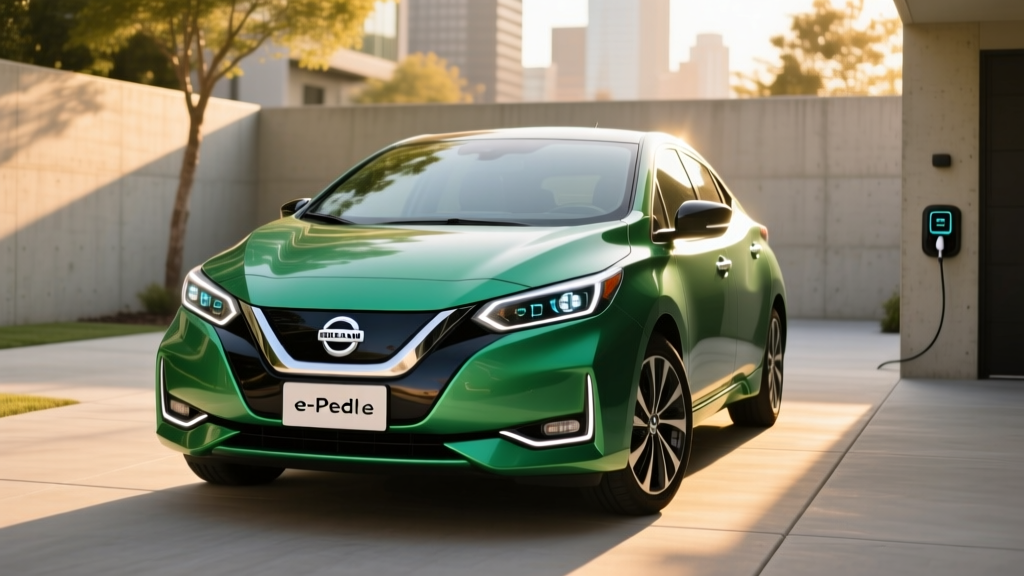
The 2026 Nissan Leaf and the e-Pedal Experience
The Nissan Leaf holds a unique place in EV history as the vehicle that kickstarted the modern mass-market electric car segment back in 2011. For 2026, the Leaf carries over with two battery options, a refined version of Nissan's signature e-Pedal one-pedal driving system, and a starting price that undercuts most rivals. But in an era of 300+ mile EVs with NACS charging ports and 200 kW DC fast-charge capability, where does the Leaf stand?
This review breaks down every number that matters — from EPA range to real-world highway efficiency, from CHAdeMO charging limitations to the exact tax credit math — so you can decide if the Leaf's value proposition still holds up.
Range, Battery, and Efficiency: What the Numbers Say
The 2026 Leaf is offered in two configurations: the standard-range Leaf S with a 40 kWh battery pack and the extended-range Leaf SV Plus with a 60 kWh pack. Both use NMC (nickel manganese cobalt) lithium-ion chemistry, which provides higher energy density than LFP but requires more careful thermal management.
| Spec | Leaf S (40 kWh) | Leaf SV Plus (60 kWh) |
|---|---|---|
| Battery Capacity (usable) | 40 kWh | 60 kWh |
| Chemistry | NMC | NMC |
| EPA Estimated Range | 149 miles | 212 miles |
| MPGe (city / hwy / combined) | 123 / 99 / 111 MPGe | 121 / 98 / 110 MPGe |
| Energy Consumption | 30 kWh/100 mi | 31 kWh/100 mi |
Source: fueleconomy.gov
How the e-Pedal System Actually Works
Nissan's e-Pedal is one of the original one-pedal driving implementations in the EV market, and it remains a standout feature of the Leaf. When activated, lifting off the accelerator engages aggressive regenerative braking — up to 0.2g of deceleration — that can bring the car to a complete stop without touching the brake pedal. The system holds the car stationary on inclines, functioning as a hill-hold assist.
Compared to the regen settings in a Tesla or Hyundai Ioniq 5, the Leaf's e-Pedal is notably more aggressive at low speeds, making stop-and-go traffic nearly effortless. The regen taper near a full stop is smooth, avoiding the lurching sensation some EVs produce. However, e-Pedal does not replace the friction brakes entirely — emergency stopping still requires the brake pedal, and the system disengages above certain deceleration thresholds.
For new EV owners transitioning from a gas car, e-Pedal has a learning curve of roughly 15–30 minutes. After that, most drivers find it more relaxing than traditional two-pedal driving, and the energy recaptured meaningfully extends city range.
Charging Speed: The CHAdeMO Factor
This is where the 2026 Leaf requires the most careful consideration. Nissan continues to use the CHAdeMO DC fast-charging standard, while the broader industry — led by Tesla's NACS and adopted by Ford, GM, Rivian, Hyundai, and most others — has standardized on NACS (or CCS1 as an interim). Electrify America, the largest US public charging network, has largely shifted new installations to NACS/CCS, and CHAdeMO availability at new stations is limited.
| Charging Level | Leaf S (40 kWh) | Leaf SV Plus (60 kWh) |
|---|---|---|
| Level 1 (120V household) | ~1.4 kW / ~4 mi/hr | ~1.4 kW / ~4 mi/hr |
| Level 2 (240V home/public) | 6.6 kW / ~22 mi/hr | 6.6 kW / ~22 mi/hr |
| DC Fast Charge (peak) | 50 kW (CHAdeMO) | 100 kW (CHAdeMO) |
| 10–80% DC Fast Charge Time | ~40 minutes | ~45 minutes |
| Full Level 2 Charge (0–100%) | ~7 hours | ~11.5 hours |
The SV Plus's 100 kW peak DC rate sounds adequate, but the charge curve tells a more nuanced story. The Leaf sustains roughly 70–80 kW between 10–50% state of charge, then tapers significantly. The 10–80% time of approximately 45 minutes trails competitors like the Hyundai Kona Electric (~43 min at 100+ kW) and falls well behind 800V architecture vehicles that achieve 10–80% in 18 minutes.
For daily use, home Level 2 charging at 6.6 kW fully replenishes the SV Plus overnight. At roughly $0.14/kWh national average, a full charge costs about $8.40 — equivalent to roughly 2 cents per mile driven, compared to 10–12 cents per mile for a 30 MPG gas car at $3.50/gallon.
CHAdeMO infrastructure warning: Before purchasing a Leaf, verify CHAdeMO charger availability in your area using apps like PlugShare. While CHAdeMO stations still exist, the trend is clearly toward NACS. Adapters from CHAdeMO to NACS are available but add cost (~$200–$400) and can reduce peak charge rates.
Performance, Drivetrain, and Interior Space
The Leaf is a front-wheel-drive EV — an increasingly rare layout as most new EVs default to rear-wheel or all-wheel drive. This affects handling dynamics (mild understeer under hard acceleration) but has no practical impact on daily commuting.
| Spec | Leaf S | Leaf SV Plus |
|---|---|---|
| Horsepower | 147 hp | 214 hp |
| Torque | 236 lb-ft | 250 lb-ft |
| 0–60 mph | ~7.9 seconds | ~6.5 seconds |
| Drivetrain | FWD | FWD |
| Cargo Volume (rear seats up) | 23.6 cu ft | 23.6 cu ft |
| Cargo Volume (rear seats folded) | ~30.0 cu ft | ~30.0 cu ft |
| Rear Legroom | 33.5 in | 33.5 in |
| Curb Weight | ~3,480 lbs | ~3,780 lbs |
The SV Plus's 214 hp and 6.5-second 0–60 time provide confident highway merging. The 23.6 cubic feet of cargo space behind the rear seats is competitive with compact hatchbacks, though the Leaf lacks a front trunk (frunk) — the space is occupied by power electronics. Rear legroom at 33.5 inches is adequate for adults on shorter trips but tight for taller passengers on longer drives.
Technology and Driver Assistance
The 2026 Leaf includes Nissan's ProPILOT Assist, a Level 2 driver-assistance system that combines adaptive cruise control with lane-centering steering. It works well on marked highways but requires hands on the wheel and does not support hands-free operation like GM's Super Cruise or Ford's BlueCruise. The 8-inch infotainment touchscreen supports wireless Apple CarPlay and wired Android Auto. A 360-degree Around View Monitor is available on higher trims.
Pricing, Tax Credits, and Ownership Costs
The Leaf's pricing remains its strongest competitive advantage. Here is the 2026 trim breakdown:
| Trim | MSRP | Est. §30D Credit | Effective Price |
|---|---|---|---|
| Leaf S (40 kWh) | ~$28,140 | Up to $3,750–$7,500* | ~$20,640–$24,390 |
| Leaf SV Plus (60 kWh) | ~$36,140 | Up to $3,750–$7,500* | ~$28,640–$32,390 |
*Federal tax credit caveats (IRS §30D): The full $7,500 credit requires meeting both critical-mineral and battery-component sourcing thresholds, which shift annually. The Leaf's battery sourcing has historically qualified for the partial $3,750 credit (critical minerals only) in recent years, though Nissan has been working to increase domestic sourcing. Additionally, buyer income caps apply ($150,000 single / $300,000 joint AGI), and the vehicle MSRP must not exceed $55,000 for sedans/hatchbacks. The credit can now be transferred to the dealer at point of sale as an immediate price reduction. Always verify current eligibility on IRS.gov and consult a tax professional.
Warranty Coverage
Nissan provides a battery capacity warranty of 8 years / 100,000 miles, guaranteeing the pack will retain at least 66% of its original capacity (9 bars out of 12 on the dashboard capacity gauge). The powertrain warranty covers 5 years / 60,000 miles, and the basic vehicle warranty is 3 years / 36,000 miles. The 66% retention threshold is less generous than the industry-standard 70% used by most competitors.
Pros and Cons: An Honest Assessment
Pros
- Low starting MSRP — one of the cheapest new EVs available
- e-Pedal provides excellent one-pedal driving feel
- Comfortable ride quality for city commuting
- ProPILOT Assist included on most trims
- Proven platform with 15+ years of real-world data
- Strong federal tax credit potential reduces effective price significantly
Cons
- CHAdeMO connector — shrinking public charging network
- Modest DC fast-charge speed (100 kW peak, slow taper)
- 212-mile max range limits road-trip practicality
- No liquid battery thermal management (passive air cooling)
- FWD only — no AWD option for snow-belt buyers
- Battery warranty retention threshold (66%) below industry norm
- No frunk; limited rear-seat legroom
Leaf vs. the Competition: Is It Worth Buying?
The Leaf's most direct competitors in the affordable EV hatchback space include the Hyundai Kona Electric, Chevrolet Bolt EV/EUV (if still available or as a used option), and the upcoming next-generation models from various brands. Here is how the Leaf SV Plus stacks up on key metrics:
| Metric | Nissan Leaf SV Plus | Hyundai Kona Electric |
|---|---|---|
| EPA Range | 212 mi | ~261 mi |
| DC Fast Charge (peak) | 100 kW (CHAdeMO) | ~100+ kW (CCS/NACS) |
| Connector | CHAdeMO | NACS (2025+ models) |
| Starting MSRP | ~$36,140 | ~$33,000–$37,000 |
| Battery Thermal Mgmt | Passive (air) | Active (liquid) |
The Kona Electric offers significantly more range, a future-proof charging connector, and active liquid battery thermal management — all for a comparable or slightly lower price. The Leaf's advantages are its lower entry price on the S trim, the mature e-Pedal system, and Nissan's widespread dealer network for service.
Who Should Buy the 2026 Nissan Leaf?
The Leaf is the right choice if:
- You commute under 80 miles round-trip and charge at home nightly
- Budget is your top priority and you want the lowest-cost new EV after tax credits
- You primarily drive in city and suburban environments where e-Pedal and regenerative braking maximize efficiency
- You have verified CHAdeMO charger access for occasional longer trips, or you don't plan to road-trip frequently
Look elsewhere if:
- You need 250+ miles of range for regular highway trips
- You want access to the Tesla Supercharger network via native NACS
- You live in an extreme-heat or extreme-cold climate where active battery thermal management matters
- You need AWD for winter driving
Frequently Asked Questions
What is the real-world range of the 2026 Nissan Leaf SV Plus?
The EPA rates it at 212 miles, but sustained highway driving at 70+ mph yields approximately 170–190 miles. In cold weather below freezing, expect 150–170 miles. City driving with e-Pedal engaged in mild weather can exceed 220 miles on a charge.
Does the Nissan Leaf qualify for the federal EV tax credit?
The Leaf qualifies for a partial or full §30D credit depending on current battery-sourcing rules. Historically, it has received $3,750 (critical minerals portion). Buyer income caps ($150K single / $300K joint) and the $55,000 MSRP cap for hatchbacks apply. Verify current eligibility at IRS.gov. The credit can be applied at point of sale as an instant discount.
How fast does the Leaf charge at home and on DC fast chargers?
Home Level 2 charging at 6.6 kW adds roughly 22 miles per hour, fully charging the SV Plus in about 11.5 hours. DC fast charging peaks at 100 kW (SV Plus) via CHAdeMO, achieving 10–80% in approximately 45 minutes. The standard Leaf S peaks at just 50 kW.
Is the e-Pedal system the same as one-pedal driving?
Yes. Nissan's e-Pedal uses aggressive regenerative braking to slow and stop the car when you lift off the accelerator, enabling single-pedal operation in most driving scenarios. It holds the car at a complete stop on hills. The friction brake pedal is still required for emergency stops.
Is the Nissan Leaf worth buying over the Hyundai Kona Electric or other rivals?
If budget is paramount and your driving is mostly local, the Leaf S at ~$28,140 (potentially ~$20,640 after credit) is hard to beat. For buyers who need more range, faster charging, and a future-proof connector, the Kona Electric or a similarly equipped NACS-compatible EV is the stronger long-term choice. The Leaf's CHAdeMO connector is its biggest strategic liability as the charging infrastructure moves decisively to NACS.
How long will the Leaf battery last?
Nissan warranties the battery for 8 years/100,000 miles at 66% capacity retention. Real-world data from earlier Leaf generations shows gradual degradation of approximately 10–15% over 5–7 years for moderate use. The passive air-cooling system means degradation may accelerate in very hot climates. Replacement battery costs range from $6,500–$9,000 depending on capacity and labor.