If you are researching the Nissan Leaf distance capability in 2026, you are likely weighing it against a new wave of longer-range, faster-charging rivals. The Leaf remains one of the most affordable new electric vehicles on the U.S. market, but its age is starting to show—particularly in charging architecture and battery chemistry. This review breaks down exactly how far the Leaf can travel, what you will actually experience on the road, and whether it still earns a spot in your driveway.
2026 Nissan Leaf: Quick Verdict
The 2026 Nissan Leaf is a competent, value-oriented commuter EV that excels in city driving and short-to-medium commutes. Its two battery options—the standard 40 kWh pack and the larger 60 kWh pack—deliver EPA-estimated ranges of 149 and 212 miles respectively. Real-world highway and cold-weather driving will reduce those figures noticeably. The Leaf's biggest liability in 2026 is its CHAdeMO DC fast-charging connector, which is increasingly sidelined as the industry standardizes on NACS (Tesla's North American Charging Standard). If your daily driving stays under 80 miles round-trip and you can charge at home, the Leaf's low entry price and available federal tax credit make it a strong budget pick.
| Spec | Leaf S (40 kWh) | Leaf SV Plus (60 kWh) |
|---|---|---|
| EPA Range | 149 miles | 212 miles |
| Battery Capacity (usable) | 40 kWh | 60 kWh |
| Battery Chemistry | NMC (Lithium-ion) | NMC (Lithium-ion) |
| Horsepower | 147 hp | 214 hp |
| Torque | 236 lb-ft | 250 lb-ft |
| Drivetrain | FWD | FWD |
| 0–60 mph | ~7.9 sec | ~6.5 sec |
| Max DC Fast Charge | 50 kW (CHAdeMO) | 100 kW (CHAdeMO) |
| Level 2 Charge Rate | 6.6 kW | 6.6 kW |
| EPA Efficiency | 111 MPGe (30 kWh/100mi) | 104 MPGe (32 kWh/100mi) |
| Cargo Volume | 23.6 cu ft (rear seats up) | 23.6 cu ft (rear seats up) |
| Base MSRP | $28,140 | $36,190 |
Real-World Range: What the EPA Sticker Doesn't Tell You
The EPA publishes laboratory-derived range estimates, but every EV owner quickly learns that real-world Nissan Leaf distance varies significantly based on speed, temperature, terrain, and climate-control use. Here is what you can actually expect.
- EPA Estimate: 212 miles
- Mixed city/highway (65–75°F): ~185–200 miles
- Sustained highway (70+ mph): ~165–180 miles
- Cold weather (20–35°F, heater on): ~130–155 miles
The 40 kWh Leaf S sees proportionally similar reductions from its 149-mile EPA baseline—expect roughly 110–130 miles in mixed real-world driving and as low as 85–100 miles in freezing conditions.
The Leaf uses a passive air-cooling system for its battery pack rather than the active liquid thermal management found in rivals like the Hyundai Kona Electric or Chevrolet Bolt EV. This means the battery heats up more during sustained highway driving or fast charging, which can further reduce range and trigger charge-rate throttling on longer trips. In summer heat above 95°F, expect a similar 10–15% range reduction as the system protects the cells.
For a data-driven perspective, the U.S. Department of Energy's fueleconomy.gov lists the 2026 Leaf SV Plus at 104 MPGe combined (32 kWh per 100 miles). That efficiency figure is respectable for its class but trails the most aerodynamically optimized competitors.
Charging Speed: The Leaf's Biggest 2026 Limitation
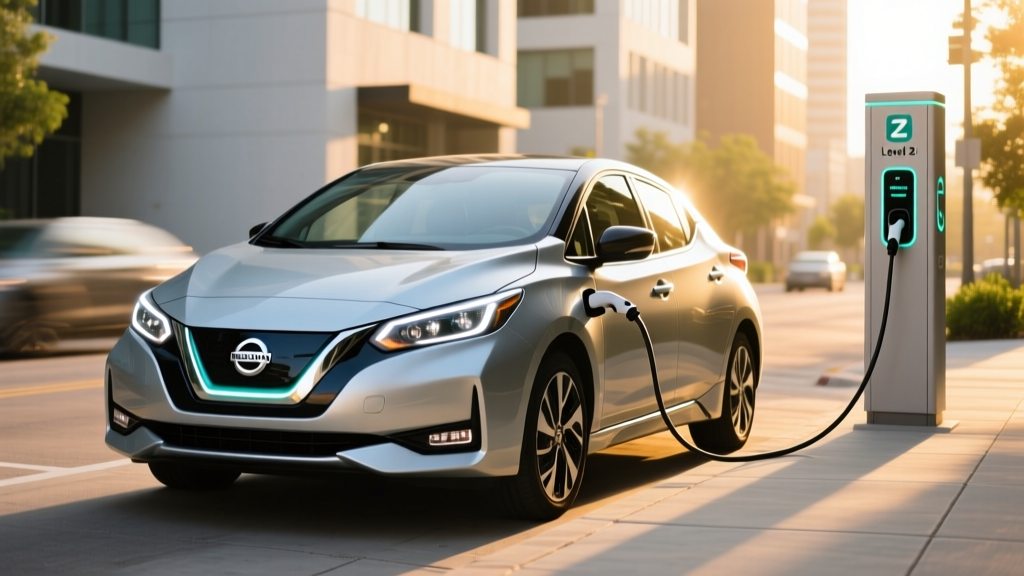
Charging is where the Leaf's age becomes most apparent. Nissan has retained the CHAdeMO DC fast-charging connector, while virtually every other automaker has adopted or is transitioning to NACS. This matters because CHAdeMO stalls are becoming rarer at public charging stations.
| Charging Level | Power / Rate | Leaf S (40 kWh) | Leaf SV Plus (60 kWh) |
|---|---|---|---|
| Level 1 (120V household) | ~1.4 kW | ~3–4 miles/hr | ~3–4 miles/hr |
| Level 2 (240V home/public) | 6.6 kW | ~20 miles/hr (full in ~7 hr) | ~25 miles/hr (full in ~9.5 hr) |
| DC Fast Charge | 50 kW (S) / 100 kW (SV Plus) | 10–80% in ~60 min | 10–80% in ~45 min |
The SV Plus's 100 kW peak DC rate sounds adequate, but the real-world charge curve tells a different story. The Leaf's passive battery cooling means the pack heats up during fast charging, causing the charge rate to taper aggressively above 60–70% state of charge. In warm weather, expect the sustained average rate between 10–80% to be closer to 55–65 kW rather than the advertised 100 kW peak. On back-to-back fast charges (like a road trip with multiple stops), the taper becomes even more pronounced as battery temperature climbs.
For home charging, the onboard 6.6 kW charger is standard across trims. A full Level 2 installation (240V, 30–40 amp circuit) will recharge either Leaf overnight. Home Level 2 charging is where the Leaf makes the most sense—plug in at night, wake up to a full battery, and never visit a public charger for daily use.
One practical note: if you are considering the Leaf and rely on the Tesla Supercharger network, you will need a CHAdeMO-to-NACS adapter or must seek out the dwindling number of CHAdeMO-equipped stations. Check PlugShare for CHAdeMO availability along your regular routes before committing.
Performance, Interior, and Technology
The Leaf SV Plus's 214 horsepower and 250 lb-ft of torque deliver brisk acceleration for a front-wheel-drive compact hatchback. The 0–60 mph time of approximately 6.5 seconds is quick enough for confident highway merging. The base S model's 147 hp is adequate for city commuting but feels strained during loaded highway passing maneuvers.
Regenerative braking in the Leaf is managed through Nissan's e-Pedal mode, which provides strong one-pedal driving capability in stop-and-go traffic. However, unlike some competitors, e-Pedal does not bring the car to a complete hold indefinitely on inclines—you may need to use the brake pedal at stops on hills.
Interior Space and Cargo
The Leaf offers a practical hatchback layout:
- Cargo behind rear seats: 23.6 cu ft
- Cargo with rear seats folded: 38.5 cu ft
- Rear legroom: 33.5 inches
- Front headroom: 41.2 inches
These dimensions make the Leaf competitive with compact crossovers for grocery runs and weekend gear, though the battery placement does create a slightly raised cargo floor. There is no front trunk (frunk)—the space under the hood houses conventional electronics and the charge port.
Infotainment and Driver Assistance
For 2026, the Leaf features an 8-inch touchscreen (SV Plus) with wireless Apple CarPlay and wired Android Auto, a 6-speaker audio system, and Nissan's ProPILOT Assist. ProPILOT Assist is a Level 2 driver-assistance system (per SAE classification) combining adaptive cruise control and lane-centering. It requires continuous driver supervision—hands on the wheel, eyes on the road. This is not autonomous or "self-driving" capability.
Standard safety features include automatic emergency braking with pedestrian detection, blind-spot warning, rear cross-traffic alert, and lane-departure warning. The Leaf has historically performed well in NHTSA crash testing, earning 5-star overall ratings in prior model years.
Pricing, Trims, and Federal Tax Credit Eligibility
The Leaf's value proposition starts with its MSRP and is enhanced—if you qualify—by the federal EV tax credit under IRS §30D.
| Trim | Base MSRP | Est. Federal Credit (§30D) | Effective Price* |
|---|---|---|---|
| Leaf S (40 kWh) | $28,140 | Up to $7,500 | ~$20,640 |
| Leaf SV Plus (60 kWh) | $36,190 | Up to $7,500 | ~$28,690 |
*Effective price assumes full §30D credit eligibility. Actual credit depends on battery-sourcing compliance, buyer income, and tax liability. Confirm at IRS.gov.
§30D Tax Credit Requirements
Not every buyer will qualify for the full $7,500 credit. Key eligibility rules for 2026 include:
- MSRP cap: The Leaf qualifies (well under the $55,000 sedan/hatchback cap).
- Buyer income cap: Adjusted gross income must not exceed $150,000 (single), $225,000 (head of household), or $300,000 (joint filers).
- Battery sourcing: A percentage of critical minerals and battery components must be sourced from the U.S. or free-trade-agreement countries. The Leaf's battery supply chain has historically met partial requirements—check the DOE's qualifying vehicle list for the current credit amount, which may be $3,750 or $7,500 depending on sourcing compliance.
- Point-of-sale transfer: As of 2024, eligible buyers can transfer the credit to the dealer at purchase, reducing the upfront cost rather than waiting for a tax refund.
Consult a tax professional for your specific situation—credit eligibility involves personal tax liability and cannot be guaranteed by any vehicle review.
Ownership Costs: Warranty, Efficiency, and Long-Term Value
Battery and Powertrain Warranty
Nissan provides the following coverage for the 2026 Leaf:
- Limited battery warranty: 8 years / 100,000 miles (capacity retention guarantee—Nissan warrants the battery against dropping below a specified capacity threshold, historically 9 bars out of 12 on the battery health gauge)
- EV system warranty: 5 years / 60,000 miles
- Bumper-to-bumper: 3 years / 36,000 miles
- Powertrain: 5 years / 60,000 miles
The Leaf's passive air-cooled battery has historically shown more degradation than liquid-cooled competitors, particularly in hot climates. Early-generation Leafs (2011–2017) experienced notable capacity loss, but Nissan's newer 40 kWh and 60 kWh packs have demonstrated improved longevity. Still, owners in Arizona, Texas, or the Southeast should monitor battery health closely and park in shade or a garage when possible.
Charging Cost vs. Gasoline
At the U.S. average residential electricity rate of approximately $0.16/kWh (2026 EIA data), fully charging the 60 kWh Leaf SV Plus costs roughly $9.60, yielding about 200 miles of range. That equates to ~$0.048 per mile. A comparable gasoline hatchback getting 30 MPG at $3.50/gallon costs ~$0.117 per mile. Over 15,000 miles per year, the Leaf saves approximately $1,035 in fuel costs annually.
Who Should Buy the 2026 Nissan Leaf?
- Your daily round-trip commute is under 60 miles
- You have reliable home Level 2 charging
- You want the lowest possible new-EV purchase price
- You rarely take road trips over 120 miles one-way
- Your commute is 60–100 miles round-trip
- You want more passing power (214 hp vs 147 hp)
- You need the flexibility for occasional 150+ mile trips
- You value faster DC charging (100 kW vs 50 kW)
- You rely on the Tesla Supercharger network (NACS)
- You regularly drive in extreme heat or cold
- You need DC fast charging under 30 minutes for road trips
- You want liquid-cooled battery longevity
Pros and Cons at a Glance
- Among the most affordable new EVs in the U.S. market
- Comfortable ride quality for city and suburban driving
- Practical hatchback cargo space (23.6 cu ft)
- ProPILOT Assist is a competent Level 2 system
- Eligible for up to $7,500 federal tax credit (subject to sourcing rules)
- Low operating cost (~$0.05/mile on home electricity)
- CHAdeMO connector is becoming obsolete—fewer public stations
- Passive air-cooled battery limits fast-charge speed and hot-climate longevity
- DC fast charging (10–80%) takes 45–60 minutes—slow for 2026
- No all-wheel-drive option
- Real-world highway range drops significantly below EPA estimate
- Interior materials and infotainment feel dated vs. newer rivals
Frequently Asked Questions
What is the real-world distance the Nissan Leaf can travel on a full charge?
The 60 kWh Leaf SV Plus achieves an EPA-estimated 212 miles, but expect approximately 185–200 miles in mixed driving, 165–180 miles on sustained highway trips, and 130–155 miles in cold weather. The 40 kWh Leaf S delivers a real-world 110–130 miles in typical conditions from its 149-mile EPA rating.
How fast does the Nissan Leaf charge at home and on DC fast chargers?
On a Level 2 home charger (240V, 6.6 kW), the SV Plus adds about 25 miles of range per hour and fully charges in roughly 9.5 hours. On a DC fast charger, the SV Plus peaks at 100 kW via CHAdeMO, reaching 10–80% in approximately 45 minutes—though passive battery cooling causes significant tapering, so real-world sessions may take longer.
Does the 2026 Nissan Leaf qualify for the $7,500 federal EV tax credit?
The Leaf qualifies on MSRP grounds (under the $55,000 cap), but the actual credit depends on battery-critical-mineral and component sourcing compliance, which can result in either $3,750 or $7,500. Buyer income caps also apply ($150K single / $300K joint). Verify current eligibility on fueleconomy.gov and consult a tax professional.
Is the Nissan Leaf worth buying compared to the Chevy Bolt EV or Hyundai Kona Electric?
The Leaf wins on base price and comfort but loses on charging speed, connector availability, and battery thermal management. The Bolt EV (if still available new or certified pre-owned) offers similar range with CCS charging and liquid cooling. The Kona Electric provides NACS compatibility and better highway efficiency. If CHAdeMO infrastructure is strong in your area and your budget is tight, the Leaf remains viable. Otherwise, newer platforms offer more future-proof ownership.
How long will the Nissan Leaf battery last before needing replacement?
Nissan warrants the Leaf battery for 8 years / 100,000 miles against excessive capacity loss. Based on historical data from 40 kWh and 60 kWh packs, most owners report 85–90% capacity retention at the 5-year / 60,000-mile mark under moderate-climate conditions. Hot-climate degradation can be more pronounced due to the passive cooling system. A full battery replacement, if needed out of warranty, typically costs between $6,500 and $9,000 depending on pack size and labor.
Can I use Tesla Superchargers with the Nissan Leaf?
Not directly. The Leaf uses the CHAdeMO connector, while Tesla Superchargers use NACS. As of 2026, no official Nissan-provided CHAdeMO-to-NACS adapter exists for DC fast charging, though third-party solutions may emerge. For now, Leaf owners must rely on Electrify America, EVgo, and other networks that still maintain CHAdeMO stalls—availability of which is declining.