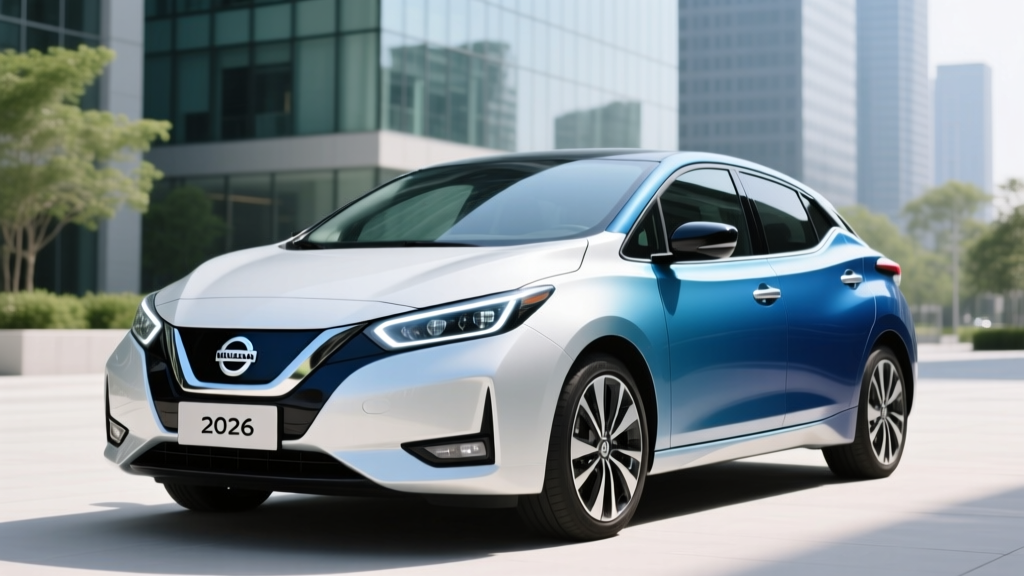
The Nissan Leaf holds a unique place in EV history as one of the first mass-market electric cars, and the 2026 model continues to serve a specific buyer: the budget-conscious commuter who prioritizes low running costs over cutting-edge fast-charging performance. But with newer competitors offering NACS connectors, 300+ mile ranges, and liquid-cooled batteries, does the Leaf still make sense? This review breaks down every dimension, spec, and ownership cost you need to evaluate before signing.
2026 Nissan Leaf Dimensions & Exterior Specs
The Leaf's footprint is firmly in the compact hatchback category — smaller than a Tesla Model Y or Hyundai Ioniq 5, but comparable to the Chevrolet Bolt EV (now discontinued). Here are the exact exterior measurements for the current-generation Leaf:
| Measurement | Specification |
|---|---|
| Overall Length | 176.4 in (4,481 mm) |
| Overall Width (excl. mirrors) | 70.5 in (1,791 mm) |
| Overall Height | 61.5 in (1,562 mm) |
| Wheelbase | 106.3 in (2,700 mm) |
| Ground Clearance | 5.9 in (150 mm) |
| Curb Weight (S / SV) | 3,486 – 3,644 lbs |
| Curb Weight (SL Plus) | 3,933 lbs |
| Front Track | 60.6 in |
| Rear Track | 61.2 in |
These dimensions make the Leaf notably easy to park in tight urban spaces. At 176.4 inches long, it's roughly 18 inches shorter than a Model Y and 8 inches shorter than the Ioniq 5. The 5.9-inch ground clearance is adequate for most driveways and speed bumps but limits any rough-road capability.
Interior Dimensions: Passenger & Cargo Space
Inside, the Leaf offers surprisingly generous room for its exterior footprint, though it shows its platform age in a few areas — particularly the rear seat center hump from the battery placement.
| Measurement | Specification |
|---|---|
| Front Headroom | 41.2 in |
| Rear Headroom | 37.3 in |
| Front Legroom | 42.1 in |
| Rear Legroom | 33.5 in |
| Front Hip Room | 51.5 in |
| Rear Hip Room | 50.0 in |
| Front Shoulder Room | 54.3 in |
| Rear Shoulder Room | 52.5 in |
| Cargo Volume (rear seats up) | 23.6 cu ft |
| Cargo Volume (rear seats folded) | 30.0 cu ft |
| EPA Passenger Volume | 92.4 cu ft |
| Seating Capacity | 5 passengers |
The 23.6 cu ft of cargo space behind the rear seats is competitive for the class — roughly on par with a Volkswagen Golf and slightly more than the Bolt EV offered (16.9 cu ft). Fold the 60/40 split rear seats and you get 30.0 cu ft, enough for a week's groceries or two large suitcases. The load floor isn't perfectly flat due to the under-floor battery, which is worth noting if you plan to slide in bulky items.
Rear legroom at 33.5 inches is the Leaf's weakest interior dimension. Adults over 6 feet will find their knees close to the front seatbacks on longer trips. For families with rear-facing child seats, the Leaf's rear space is tight compared to the Ioniq 5 (39.4 in rear legroom) or Model Y (41.6 in).
Battery, Range & Efficiency
The 2026 Leaf is offered with two battery pack sizes depending on trim:
| Spec | Leaf S / SV (Standard) | Leaf SL Plus |
|---|---|---|
| Battery Capacity (usable) | 40 kWh | 60 kWh |
| Battery Chemistry | NMC (laminated lithium-ion) | NMC (laminated lithium-ion) |
| EPA Range | 149 miles | 212 miles |
| EPA Combined MPGe | 111 MPGe | 104 MPGe |
| Energy Consumption | 30 kWh/100 mi | 32 kWh/100 mi |
| Thermal Management | Passive air cooling | Passive air cooling |
The Leaf uses NMC (nickel manganese cobalt) chemistry in laminated pouch cells — a design Nissan has used since the original 2011 Leaf. While NMC offers good energy density, the passive air-cooling approach means the battery is more susceptible to temperature-driven degradation and charging slowdowns than liquid-cooled competitors. Nissan does include a battery capacity warranty (detailed below) to mitigate long-term concerns.
Charging Speed: DC Fast Charge & Home Level 2
This is the area where the Leaf's age shows most clearly. It remains one of the last EVs sold in the US with a CHAdeMO DC fast-charging connector rather than CCS1 or the increasingly dominant NACS (Tesla-style) plug.
| Charging Level | 40 kWh (S/SV) | 60 kWh (SL Plus) |
|---|---|---|
| Level 1 (120V household) | ~2 kW / ~5 mi/hr | ~2 kW / ~4 mi/hr |
| Level 2 (240V, 6.6 kW onboard) | 6.6 kW / ~18 mi/hr | 6.6 kW / ~16 mi/hr |
| Level 2 full charge (0-100%) | ~7.5 hours | ~11 hours |
| DC Fast Charge (CHAdeMO peak) | 50 kW | 100 kW |
| DC 10-80% time (est.) | ~40 minutes | ~45 minutes |
| Charge Port | CHAdeMO + J1772 | CHAdeMO + J1772 |
Key charging realities for Leaf buyers:
- CHAdeMO infrastructure is shrinking. Electrify America has transitioned to CCS/NACS-only new installations. Your DC fast-charging options are increasingly limited to older stations. This is the single biggest practical concern for Leaf ownership in 2026.
- The 50 kW peak on the 40 kWh model is painfully slow by modern standards. A Hyundai Ioniq 5 peaks at 240 kW and hits 10-80% in 18 minutes. The Leaf 40 kWh takes more than twice as long.
- The 100 kW peak on the 60 kWh model is more usable, but the passive cooling means sustained rates drop quickly — expect an average of 50-65 kW over the full 10-80% session, not a sustained 100 kW.
- Home Level 2 at 6.6 kW is adequate for overnight charging. A full charge from empty takes 7.5-11 hours depending on battery size, which works perfectly for daily commuters who plug in at night.
For home charging, a 32-amp Level 2 wallbox on a 40-amp circuit will deliver the full 6.6 kW. Installation typically runs $500-$1,500 for the electrician work plus $300-$600 for the charger unit, assuming your electrical panel has capacity. Homes with older 100-amp service may need a panel upgrade ($1,500-$3,000).
Performance & Drivetrain
| Spec | Leaf S / SV | Leaf SL Plus |
|---|---|---|
| Motor Type | Single front-mounted AC synchronous | Single front-mounted AC synchronous |
| Drivetrain | FWD | FWD |
| Horsepower | 147 hp | 214 hp |
| Torque | 236 lb-ft | 250 lb-ft |
| 0-60 mph | ~7.9 seconds | ~6.5 seconds |
| Top Speed | 90 mph (electronically limited) | 98 mph (electronically limited) |
| Towing Capacity | Not rated | Not rated |
The Leaf is a front-wheel-drive, single-motor EV — no AWD option is available. The 147 hp base motor is adequate for city merging and suburban driving but feels strained during highway passing maneuvers at speed. The SL Plus's 214 hp and 250 lb-ft of torque provide noticeably stronger acceleration, making it the more confident choice for drivers who frequently join fast-moving freeways.
Instant torque delivery (236-250 lb-ft from 0 RPM) makes both versions feel quicker off the line than their 0-60 times suggest. Regenerative braking is adjustable via the e-Pedal mode, which enables near-one-pedal driving in city traffic — one of the Leaf's most praised features for daily commuting.
Pricing, Trims & Federal Tax Credit
| Trim | MSRP | Key Features |
|---|---|---|
| Leaf S | $29,135 | 40 kWh, 149 mi range, 8" touchscreen, ProPILOT Assist |
| Leaf SV | $33,535 | 40 kWh, 149 mi range, leatherette seats, 360° camera, fog lights |
| Leaf SL Plus | $37,285 | 60 kWh, 212 mi range, Bose audio, ProPILOT Assist 1.1, leather |
- Income caps: AGI must not exceed $150,000 (single), $225,000 (head of household), or $300,000 (married filing jointly)
- MSRP cap: Vans/SUVs/trucks capped at $80,000; other vehicles (including Leaf) capped at $55,000 — all Leaf trims qualify
- Point-of-sale transfer: As of 2024+, you can transfer the credit to the dealer for an immediate price reduction at purchase
- Tax liability: You must have sufficient federal tax liability to claim the credit if not transferred at sale
After the estimated $3,750 federal credit, the effective starting price for the Leaf S drops to approximately $25,385 — making it one of the least expensive new EVs available in the US market. The SL Plus at roughly $33,535 after credit remains competitive with base trims of the Hyundai Kona Electric and Chevrolet Equinox EV.
Technology, Safety & Driver Assistance
The 2026 Leaf comes with Nissan's ProPILOT Assist (SAE Level 2) on all trims, with the upgraded ProPILOT Assist 1.1 on the SL Plus. This system provides adaptive cruise control with stop-and-go, lane centering, and speed-limit recognition. Important: ProPILOT Assist is a driver-assist system, not autonomous driving — you must keep your hands on the wheel and eyes on the road at all times.
| Feature | Availability |
|---|---|
| Infotainment Screen | 8" touchscreen (S/SV), 12.3" (SL Plus) |
| Wireless Apple CarPlay / Android Auto | Standard all trims |
| NissanConnect EV Services | Standard (remote charge monitoring, climate pre-conditioning) |
| ProPILOT Assist (Level 2) | Standard all trims |
| ProPILOT Assist 1.1 (w/ Navi-link) | SL Plus only |
| Automatic Emergency Braking | Standard all trims |
| Blind Spot Warning / Intervention | Standard SV and SL Plus |
| Intelligent Around View Monitor (360°) | Standard SV and SL Plus |
| e-Pedal (one-pedal driving mode) | Standard all trims |
| Heat Pump | Not available (resistive heating) |
The absence of a heat pump is a notable drawback. Resistive cabin heating draws significantly more battery power in cold weather, contributing to the Leaf's steep winter range loss. Competitors like the Ioniq 5 and Tesla Model 3 use heat pumps that are 2-3x more efficient for cabin warmth.
The Leaf has earned strong safety marks. Check current ratings at NHTSA and IIHS before purchasing, as ratings update throughout the model year.
Warranty & Battery Longevity
| Coverage | Term |
|---|---|
| Basic (bumper-to-bumper) | 3 years / 36,000 miles |
| Powertrain | 5 years / 60,000 miles |
| Lithium-ion Battery Capacity | 8 years / 100,000 miles (below 9 bars of 12 on capacity gauge) |
| Battery Defect Coverage | 8 years / 100,000 miles |
| Corrosion | 5 years / unlimited miles |
| Roadside Assistance | 3 years / 36,000 miles |
Nissan's battery warranty guarantees the pack will retain at least 9 of 12 capacity bars (roughly 75% state of health) for 8 years or 100,000 miles. If it drops below that threshold, Nissan will repair or replace the battery. This is an industry-standard warranty term, though some competitors (Hyundai, Kia) offer 10-year/100,000-mile battery coverage.
Real-world battery degradation data from Leaf owners shows typical capacity loss of 10-15% over the first 5 years in moderate climates. However, Leafs in hot climates (Arizona, Texas, Southern California) have historically shown accelerated degradation — a known consequence of passive air cooling. If you live in a hot region, this is a material consideration.
Who Should Buy the 2026 Nissan Leaf?
- You commute 40-80 miles round trip and can charge at home overnight
- Your budget is under $30,000 (after tax credit) for a new EV
- You rarely take road trips over 150 miles
- You live in a mild climate (Pacific Northwest, Northern California, Northeast corridor)
- You value a compact, easy-to-park hatchback form factor
- You need reliable DC fast charging for road trips (CHAdeMO infrastructure is declining)
- You live in a hot climate (battery degradation risk with passive cooling)
- You need more than 150 miles of real-world range regularly
- You want AWD or strong highway passing power
- You plan to tow anything
✓ Pros
- Lowest-priced new EV after tax credit (~$25,385)
- Generous cargo space (23.6 cu ft) for the class
- e-Pedal one-pedal driving is excellent for city traffic
- ProPILOT Assist standard on all trims
- Proven, well-understood platform with extensive owner community
- Comfortable ride quality and quiet cabin at city speeds
✗ Cons
- CHAdeMO connector with shrinking DC fast-charge network
- Passive air-cooled battery — vulnerable in hot/cold extremes
- No heat pump — poor cold-weather efficiency
- Rear legroom (33.5 in) is tight for adults
- DC fast charging is slow vs. modern competitors (50-100 kW peak)
- FWD only — no AWD option
- Platform dates to 2018 with incremental updates
Frequently Asked Questions
What is the real-world range of the 2026 Nissan Leaf?
The 40 kWh Leaf S/SV delivers an EPA-estimated 149 miles, but expect 120-130 miles in real-world highway driving and as little as 95-110 miles in freezing temperatures. The 60 kWh SL Plus is EPA-rated at 212 miles, with real-world highway range of approximately 170-185 miles and cold-weather range of 135-160 miles. City driving in mild weather can match or slightly exceed the EPA numbers thanks to regenerative braking.
How fast does the Nissan Leaf charge at home and on the road?
At home on a Level 2 (240V) charger, the Leaf charges at 6.6 kW — adding roughly 16-18 miles of range per hour, with a full charge in 7.5-11 hours depending on battery size. On DC fast chargers (CHAdeMO), the 40 kWh model peaks at 50 kW (10-80% in ~40 minutes) and the 60 kWh model peaks at 100 kW (10-80% in ~45 minutes). Both are significantly slower than modern competitors like the Ioniq 5 (18 minutes) or Model 3 (15-20 minutes).
How much does the 2026 Nissan Leaf cost after the federal tax credit?
The base Leaf S starts at $29,135 MSRP. With the estimated $3,750 federal tax credit (subject to IRS §30D eligibility — income caps, tax liability, and battery-sourcing rules apply), the effective price drops to approximately $25,385. The range-topping SL Plus starts at $37,285, or roughly $33,535 after credit. All trims fall well under the $55,000 MSRP cap for non-SUV vehicles. Always confirm your personal eligibility at irs.gov or with a tax professional.
Does the Nissan Leaf qualify for the $7,500 federal EV tax credit?
The Leaf qualifies for up to $3,750 under current §30D rules — not the full $7,500. The credit amount depends on battery-critical-mineral sourcing and battery-component manufacturing requirements set by the IRS. The Leaf meets the critical-minerals requirement but not the full battery-component threshold, capping it at $3,750. Additionally, you must meet income caps ($150K single / $300K married filing jointly) and the vehicle must be under the $55,000 MSRP cap (all Leaf trims qualify). The credit can be transferred to the dealer at point of sale for an immediate price reduction.
Is the 2026 Nissan Leaf worth buying vs. competitors?
The Leaf's value proposition is almost entirely price-driven. At ~$25,385 after credit, it's among the cheapest new EVs you can buy. However, the Hyundai Kona Electric (~$33,000 MSRP, 261 mi range, CCS/NACS charging) and Chevrolet Equinox EV (~$33,000, 319 mi range, CCS) offer substantially more range, faster charging, and modern connectors — for roughly $7,000-$8,000 more. If your budget is strictly under $30,000 and you charge at home, the Leaf is a rational choice. If you can stretch to $33,000-$35,000, the competition offers meaningfully better long-term usability, particularly as CHAdeMO infrastructure continues to decline.
Why does the Nissan Leaf still use CHAdeMO instead of NACS or CCS?
The Leaf was designed around CHAdeMO when it launched in 2010, and Nissan has not re-engineered the platform for a different DC connector. With the industry rapidly standardizing on NACS (adopted by Ford, GM, Hyundai, and others for 2025+), the Leaf's CHAdeMO port is increasingly a liability. CHAdeMO-equipped DC stations are becoming harder to find as networks like Electrify America prioritize CCS/NACS. This is the most significant long-term ownership risk for the Leaf.
Sources: fueleconomy.gov, IRS §30D Clean Vehicle Credits, Nissan USA Leaf Specifications. All specifications and pricing reflect 2026 model year data available at time of publication. Tax credit rules are subject to change — verify current eligibility at irs.gov.