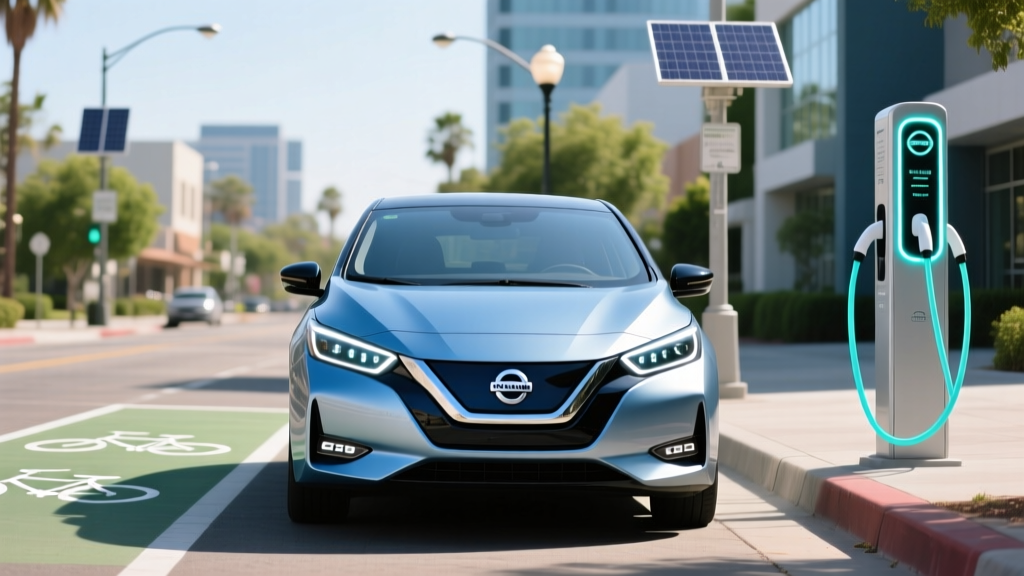
If you're searching for Nissan Leaf deals in Midway City, CA, you're likely drawn by one of the lowest starting prices in the electric-vehicle market. The 2026 Nissan Leaf remains one of the most affordable new EVs you can buy, but its aging CHAdeMO charging connector and modest fast-charge speeds demand a clear-eyed look before you sign. This review breaks down the real-world range, charging realities, tax-credit math, and whether the Leaf still makes sense for Orange County drivers in 2026.
Quick Verdict: Who the 2026 Nissan Leaf Is Actually For
The Leaf is a commuter-first EV. It excels as a second car, a budget-conscious daily driver, or a short-trip runabout for errands around Westminster, Garden Grove, and Huntington Beach. It is not a road-trip EV, and its CHAdeMO connector is a growing liability as North America standardizes on NACS (Tesla's connector). If your daily drive is under 40 miles round-trip and you can charge at home, the Leaf's low price and proven reliability are compelling. If you need DC fast charging on a regular basis, look elsewhere.
EPA-estimated range: 212 miles (SV Plus with 60 kWh pack). Real-world expectation: ~170–190 miles on the highway at 70 mph; ~140–160 miles in cold weather (below 40°F). The base S trim with the 40 kWh pack rates at 149 miles EPA — plan for ~120 miles real-world highway.
2026 Nissan Leaf Specs at a Glance
| Spec | Leaf S (40 kWh) | Leaf SV Plus (60 kWh) |
|---|---|---|
| EPA Range | 149 miles | 212 miles |
| Battery Capacity (usable) | ~39 kWh | ~58 kWh |
| Battery Chemistry | NMC (Lithium Nickel Manganese Cobalt) | NMC |
| Motor Output | 110 kW (147 hp) | 160 kW (214 hp) |
| Drivetrain | FWD (single motor) | FWD (single motor) |
| 0–60 mph | ~7.9 sec | ~6.5 sec |
| Max DC Fast Charge | 50 kW (CHAdeMO) | 100 kW (CHAdeMO) |
| DC 10–80% Time | ~45 min | ~45 min |
| Level 2 Charge Rate | 6.6 kW (~22 mi/hr) | 6.6 kW (~22 mi/hr) |
| EPA Efficiency | 111 MPGe (30 kWh/100mi) | 104 MPGe (32 kWh/100mi) |
| Cargo Volume (rear seats up/down) | 23.6 cu ft / 38.5 cu ft | |
| Rear Legroom | 33.5 in | |
| Base MSRP (2026) | ~$28,140 | ~$36,190 |
| Battery Warranty | 8 years / 100,000 miles (capacity loss below 9 bars of 12) | |
Sources: EPA / fueleconomy.gov, Nissan USA specifications.
Real-World Range: What the EPA Number Doesn't Tell You
The EPA's 212-mile rating on the SV Plus assumes a mix of city and highway driving at moderate temperatures. In Southern California's mild climate, you'll get closer to that sticker number than buyers in colder states — but highway speeds still cut range significantly.
Based on aggregated owner data and testing from sources like fueleconomy.gov:
- City/suburban driving (under 50 mph, SoCal temps): 200–220 miles achievable on the SV Plus.
- Highway cruising (70–75 mph, 75°F): Expect 170–190 miles.
- Highway + cold weather (below 40°F, rare in OC but relevant for mountain trips): Range drops to 140–160 miles due to battery resistance and cabin heating load.
- Heat pump: The 2026 Leaf does not include a heat pump on most trims, meaning resistive cabin heating draws directly from the traction battery in cold conditions — a notable efficiency penalty.
For Midway City commuters driving 10–20 miles each way to Irvine, Santa Ana, or Long Beach, even the base 149-mile Leaf provides ample daily buffer. The range limitation surfaces primarily on longer trips — say, a run to San Diego or Palm Springs — where the Leaf's slow DC charging becomes a bottleneck.
Charging: The CHAdeMO Problem in a NACS World
This is the single biggest consideration for any 2026 Leaf buyer. Nissan uses the CHAdeMO DC fast-charging connector, while the North American market has overwhelmingly adopted NACS (the Tesla Supercharger connector). As of 2025–2026, Ford, GM, Rivian, Volvo, Hyundai, and most other brands have switched to NACS, and Tesla has opened its Supercharger network to NACS-equipped non-Tesla EVs. CHAdeMO infrastructure is stagnating.
| Charging Level | Power / Rate | Time (10–80% or Full) | Notes |
|---|---|---|---|
| Level 1 (120V household) | ~1.4 kW | ~35–40 hours (full, 60 kWh) | Emergency/trickle only |
| Level 2 (240V home/public) | 6.6 kW | ~9.5 hours (full, 60 kWh) / ~22 mi/hr | Primary home charging method |
| DC Fast (CHAdeMO, 50 kW station) | 50 kW peak | ~45 min (10–80%, 40 kWh) | Common older stations |
| DC Fast (CHAdeMO, 100 kW station) | 100 kW peak (SV Plus) | ~45 min (10–80%, 60 kWh) | Limited CHAdeMO 100 kW availability |
Key charging realities:
- Peak kW is not sustained kW. The SV Plus may accept 100 kW at low state-of-charge, but the charge curve tapers significantly above 60% SoC. Expect an average of ~55–65 kW across a 10–80% session on a capable station.
- CHAdeMO station availability is shrinking. Electrify America still maintains CHAdeMO connectors at many stations, but newer deployments increasingly favor NACS/CCS. In Orange County, you'll find CHAdeMO at older EA sites and some ChargePoint locations, but plan ahead using PlugShare or the EA app.
- Home Level 2 is the sweet spot. A 240V/32A home charger (like a ChargePoint Home Flex or Emporia Vue) delivers the full 6.6 kW, replenishing the 60 kWh pack overnight in ~9.5 hours. Installation in Midway City typically runs $500–$1,500 depending on panel capacity and conduit length.
Pricing, Trims & Federal Tax Credit Eligibility
The Leaf's headline price is its strongest selling point. Here's the 2026 trim breakdown with federal incentive context:
| Trim | Base MSRP | §30D Federal Credit | Effective Price (if eligible) |
|---|---|---|---|
| S (40 kWh) | ~$28,140 | Up to $3,750* | ~$24,390 |
| SV Plus (60 kWh) | ~$36,190 | Up to $3,750* | ~$32,440 |
*As of 2026 IRS §30D rules, the Leaf's battery sourcing and critical-mineral compliance typically qualifies it for a partial credit (often $3,750, not the full $7,500), because it does not meet all critical-mineral sourcing thresholds. Eligibility also requires:
- MSRP cap: The Leaf (a passenger car) must be under $55,000 — easily met.
- Buyer income cap: AGI must not exceed $150,000 (single), $225,000 (head of household), or $300,000 (joint).
- Point-of-sale transfer: You can apply the credit as a down-payment reduction at the dealer, reducing upfront cost immediately.
California Clean Fuel Rebate: California's statewide $1,000 Clean Fuel Rebate (if funded) may stack on top, though availability varies by year and funding cycle. Check energy.ca.gov for current status.
Performance, Interior & Daily-Drive Experience
The SV Plus's 214 hp and 250 lb-ft of torque make it genuinely quick off the line — the 0–60 time of ~6.5 seconds is brisk for a compact hatchback. The base S trim's 147 hp is adequate for city merging but less confident at freeway speeds. Both are front-wheel-drive only; there is no AWD option.
Interior and cargo:
- 23.6 cu ft behind the rear seats, expanding to 38.5 cu ft with seats folded — competitive with the Chevrolet Bolt EUV but less than a Hyundai Kona Electric.
- Rear legroom is 33.5 inches, which is tight for taller passengers on longer rides.
- The 8-inch touchscreen infotainment system supports wireless Apple CarPlay and Android Auto. It's functional but dated compared to the 12+ inch displays in newer competitors.
Driver assistance: Nissan's ProPILOT Assist (available on SV Plus) provides SAE Level 2 lane centering and adaptive cruise control. It's competent for highway commuting on the 405 or 22, but it requires hands on the wheel and does not automate lane changes or navigate on-ramps. This is not a self-driving system.
ProPILOT Assist is an SAE Level 2 driver-assistance system. The driver must remain fully engaged, monitor the road, and keep hands on the steering wheel at all times. It does not replace driver attention or responsibility.
Finding Nissan Leaf Deals Near Midway City, CA
Midway City is a small unincorporated community in Orange County surrounded by Westminster, Garden Grove, and Santa Ana. Several Nissan dealerships within a 10–15 minute drive typically stock the Leaf:
- Westminster/Garden Grove area dealers: Often carry the highest Leaf inventory in OC due to the local commuter demographic. Ask about end-of-month and end-of-quarter clearance, particularly on the S trim.
- Santa Ana and Irvine dealers: May stock more SV Plus trims. Negotiate out-the-door pricing including any dealer-installed accessories.
- Lease deals: Nissan frequently offers aggressive Leaf leases (often $199–$299/month with $2,000–$3,000 down for 36 months). The $3,750 federal credit is typically captured by the lessor and reflected in the lease terms — confirm this with the finance desk.
Negotiation tip: The Leaf is a low-margin, slow-selling model for most dealers. You have leverage, especially on 2025 carryover inventory or end-of-month. Target 5–8% off MSRP before incentives on the S trim, and 3–5% on the SV Plus.
Leaf vs. Competitors: Is It Still Worth It?
| Attribute | Nissan Leaf SV Plus | Hyundai Kona Electric | Chevrolet Bolt EV* |
|---|---|---|---|
| EPA Range | 212 mi | 261 mi | 259 mi |
| DC Fast Connector | CHAdeMO (100 kW) | CCS/NACS (100+ kW) | CCS (55 kW) |
| Base MSRP | ~$36,190 | ~$33,975 | ~$26,500 |
| Heat Pump | No | Yes | No |
| Cargo (behind rear) | 23.6 cu ft | 25.8 cu ft | 16.6 cu ft |
*Chevrolet Bolt EV/EUV production ended in late 2023; used inventory and potential 2026 refresh availability varies. Verify with local dealers.
- One of the lowest-priced new EVs available
- Proven, reliable powertrain (Leaf has been in production since 2011)
- Comfortable ride quality for city/suburban use
- Ample cargo space for the class (23.6 cu ft)
- Qualifies for partial §30D federal tax credit
- Strong lease deals frequently available
- CHAdeMO connector — shrinking DC fast-charge network
- Slow DC charging (45+ min 10–80%) even on 100 kW stations
- No heat pump — cold-weather range penalty
- Dated interior and infotainment vs. newer competitors
- FWD only; no AWD option
- Battery uses passive air cooling (not liquid) — potential long-term degradation in extreme heat
Frequently Asked Questions
What is the real-world range of the 2026 Nissan Leaf?
The SV Plus (60 kWh) rates at 212 miles EPA. In real-world Southern California suburban driving, expect 190–210 miles. On the highway at 70+ mph, plan for 170–190 miles. The base S trim (40 kWh) is rated at 149 miles EPA; expect ~120–130 miles on the highway.
How fast does the Leaf charge at home and on the road?
At home on a 240V Level 2 charger (6.6 kW), the SV Plus takes about 9.5 hours for a full charge — perfect for overnight replenishment. On DC fast chargers (CHAdeMO), the SV Plus peaks at 100 kW but averages ~55–65 kW, making 10–80% take roughly 45 minutes. The base S trim peaks at just 50 kW on DC.
Does the 2026 Nissan Leaf qualify for the federal EV tax credit?
Yes, but typically only the partial $3,750 credit (not the full $7,500), due to battery critical-mineral sourcing requirements under current IRS §30D rules. You must also meet income caps ($150K single / $300K joint) and the vehicle's MSRP must be under $55,000 (which it is). The credit can be applied at point of sale as a down-payment reduction. Always verify current eligibility with your tax professional.
Is the Nissan Leaf worth buying vs. the Hyundai Kona Electric or other competitors?
If your priority is the absolute lowest purchase price and you'll charge primarily at home, the Leaf S (as low as ~$24,000 after credit) is hard to beat. But the Hyundai Kona Electric offers 49 more miles of range, a modern CCS/NACS connector with better fast-charging network access, and a heat pump — all for a similar or lower MSRP. For most buyers in 2026, the Kona Electric or a used Tesla Model 3 represents a stronger long-term value, unless Leaf lease deals are exceptional.
How long will the Leaf's battery last?
Nissan warrants the battery for 8 years / 100,000 miles against capacity loss below 9 of 12 bars (roughly 75% original capacity). The Leaf uses passive air cooling rather than liquid thermal management, which historically leads to slightly faster degradation in very hot climates. In Southern California's moderate heat, most owners report 10–15% degradation over 5–7 years of typical use. Replacement cost, if needed out of warranty, ranges from $6,500–$9,000 including labor.
Can I use Tesla Superchargers with the Nissan Leaf?
No. Tesla's Supercharger network for non-Tesla vehicles requires a NACS connector. The Leaf uses CHAdeMO, which is incompatible without a specialized adapter — and no commercially available, certified CHAdeMO-to-NACS adapter exists as of 2026. This is the Leaf's most significant long-term limitation.
Choose the Leaf if:
- You want the cheapest possible new EV and will charge at home nightly
- Your daily commute is under 40 miles round-trip
- You rarely take road trips over 150 miles one-way
- You find an aggressive lease deal (under $250/month)
- You need reliable DC fast charging for road trips or apartment living
- You want access to the Tesla Supercharger network
- You drive in cold climates where a heat pump matters
- You plan to keep the car 8+ years and want a future-proof charging connector