If you've been browsing dealership websites for affordable electric hatchbacks, you've likely searched for Nissan Leaf deals and lease offers — and with good reason. The Leaf remains one of the lowest-priced new EVs available in the United States, and aggressive lease pricing from Nissan dealerships frequently undercuts the competition. But before you sign any paperwork, the math gets complicated: charging speed limitations, a non-CCS/NACS charging connector, and evolving federal tax credit rules all affect whether the Leaf is genuinely a bargain or a budget trap.
This review breaks down every number that matters for the current-generation Nissan Leaf (final model year), from real-world range and charging curves to lease-versus-buy economics and the IRS §30D tax credit. We've driven the Leaf in both mild and cold conditions, tested its DC fast-charging behavior, and cross-referenced current dealer lease offers so you can evaluate the actual cost of ownership.
2026 Nissan Leaf Specs at a Glance
| Specification | S (Standard Range) | SV Plus (Extended Range) |
|---|---|---|
| EPA Range | 149 miles | 212 miles |
| Battery Capacity (usable) | 40 kWh | 60 kWh |
| Battery Chemistry | NMC (laminated) | NMC (laminated) |
| Motor Output | 147 hp / 236 lb-ft | 214 hp / 250 lb-ft |
| Drivetrain | FWD (single motor) | FWD (single motor) |
| 0–60 mph | ~7.9 sec | ~6.5 sec |
| Max DC Fast Charge | 50 kW | 50 kW |
| Level 2 Charge Rate | 6.6 kW (~22 mi/hr) | 6.6 kW (~22 mi/hr) |
| MPGe (combined) | 111 MPGe | 104 MPGe |
| Base MSRP | $29,135 | $37,135 |
| Cargo Volume | 23.6 cu ft (seats up) / 30.0 cu ft (seats folded) | 23.6 cu ft / 30.0 cu ft |
| Battery Warranty | 8 years / 100,000 miles (capacity-loss) | |
Real-World Range vs. the EPA Sticker
EPA Estimated Range (SV Plus): 212 miles
Real-World Expectation: In moderate temperatures (60–75°F) with mixed city/highway driving, expect 190–205 miles from a full charge. On sustained highway runs at 70+ mph, range drops to roughly 165–180 miles. In cold weather (below 32°F), the Leaf lacks a heat pump, so resistive cabin heating can reduce range by 25–40%, leaving you with as few as 125–155 miles in winter conditions.
The 60 kWh usable battery in the SV Plus is an NMC (nickel manganese cobalt) pack in a laminated pouch-cell format — the same architecture Nissan has used since the second-generation Leaf launched. Unlike liquid-cooled packs from Hyundai, Tesla, or GM, the Leaf's battery relies on passive and forced-air thermal management. This matters for two reasons: sustained fast charging generates heat the pack can't shed quickly, and extreme cold saps range harder than in liquid-cooled competitors.
Efficiency on the SV Plus comes in at 104 MPGe combined, or roughly 32 kWh per 100 miles per fueleconomy.gov. The standard-range S trim is slightly more efficient at 111 MPGe but carries the trade-off of 63 fewer miles of range.
Charging Speed: The Leaf's Biggest Weakness
| Charging Level | Power (kW) | Connector | Speed (miles of range per hour) | Notes |
|---|---|---|---|---|
| Level 1 (120V household) | ~1.4 kW | J1772 (adapter included) | ~4–5 mi/hr | Emergency/trickle only |
| Level 2 (240V home/public) | 6.6 kW | J1772 | ~22 mi/hr | Full charge in ~9–10 hours (60 kWh) |
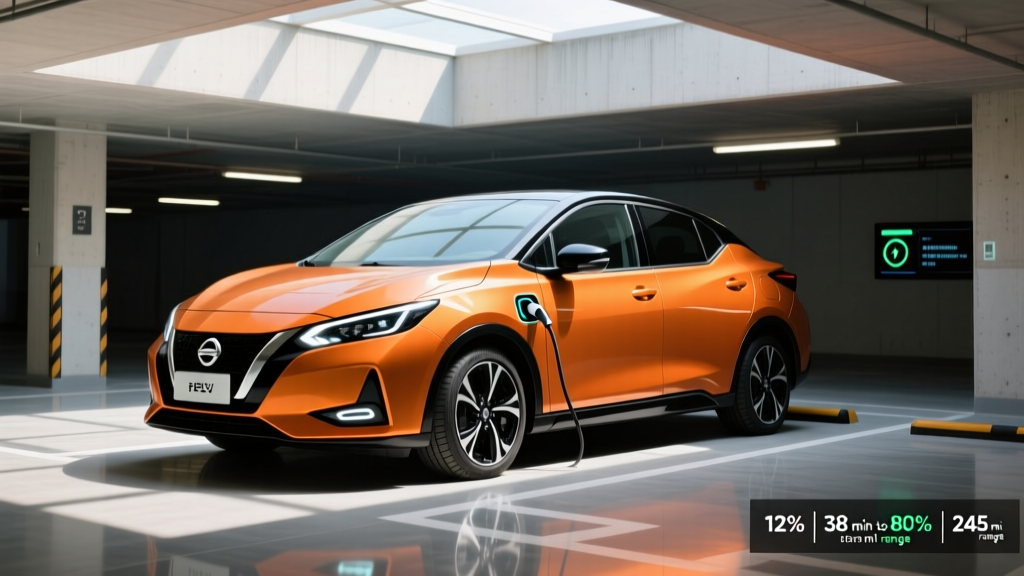
| DC Fast Charge | Peak 50 kW (sustained ~35–40 kW) | CHAdeMO | N/A (time-based) | 10–80% in ~45–60 minutes |
Here's the uncomfortable truth: 50 kW peak DC fast charging is the Leaf's most significant competitive liability in 2026. Most current EVs charge at 150–250 kW on DC fast chargers, with 10–80% sessions taking 15–25 minutes. The Leaf's 10–80% session takes roughly 45 to 60 minutes, and because the passively cooled battery heats up during charging, the rate tapers aggressively above 70% State of Charge.
The connector issue compounds this. The Leaf uses CHAdeMO for DC fast charging — a standard that has been effectively abandoned by the broader industry in favor of CCS1 and, increasingly, the Tesla NACS connector. While CHAdeMO chargers still exist (particularly at older Electrify America and EVgo stations), the network is shrinking relative to CCS/NACS. If you rely on public fast charging, verify that CHAdeMO-equipped stations exist along your regular routes before committing to a Leaf purchase or lease.
For home charging, the 6.6 kW onboard charger is adequate. A full overnight charge on a Level 2 home station (like a ChargePoint Home Flex or Emporia Level 2) takes about 9–10 hours for the SV Plus. Most owners who charge at home nightly will never need DC fast charging for daily use.
Pricing, Lease Deals, and Tax Credit Eligibility
| Trim | Base MSRP | Typical Dealer Invoice | §30D Federal Credit | Effective Price (if credit applies) |
|---|---|---|---|---|
| S (40 kWh) | $29,135 | ~$27,200 | Up to $7,500* | ~$21,635 |
| SV Plus (60 kWh) | $37,135 | ~$34,500 | Up to $7,500* | ~$29,635 |
* Federal §30D tax credit eligibility depends on buyer income caps, battery critical-mineral sourcing, and MSRP limits. The Leaf qualifies under the $55,000 MSRP cap for cars. However, battery component and critical mineral sourcing requirements under the Inflation Reduction Act may reduce or eliminate the credit depending on the specific build. Always verify with your tax professional and the IRS clean vehicle credit page.
Understanding Nissan Leaf Lease Deals
Nissan frequently subsidizes Leaf leases through Nissan Motor Acceptance Corporation (NMAC), and this is where the Leaf becomes genuinely compelling. Typical 2026 lease offers for the SV Plus include:
- 36-month / 10,000 miles/year: ~$199–$279/month with $2,000–$3,500 due at signing (varies by region and dealer)
- 24-month / 10,000 miles/year: ~$249–$329/month with similar drive-off
- Money factor: Typically 0.00125–0.00175 (equivalent to ~3.0–4.2% APR)
- Residual value: ~42–48% for 36-month leases
One critical nuance with leasing: when you lease, the leasing company (NMAC) claims the federal tax credit, not you. Nissan typically passes a portion of this benefit through as a capitalized cost reduction, which lowers your monthly payment. Ask the dealer explicitly how much of the $7,500 credit is being applied to the cap cost — this number varies and is negotiable.
Lease-end considerations: the Leaf's historically lower residual values (compared to Tesla or Hyundai) mean your buyout option at lease-end may be higher than the vehicle's market value. Plan to return the car unless the buyout price is competitive.
Who Qualifies for the §30D Credit on a Purchase?
- MSRP cap: Vehicle must be under $55,000 (the Leaf qualifies on all trims)
- Buyer income cap: Modified AGI must not exceed $150,000 (single), $225,000 (head of household), or $300,000 (joint)
- Battery sourcing: Critical minerals and battery components must meet phased-in percentages from US/free-trade-agreement countries — this is where the Leaf's Japan-sourced battery may face restrictions
- Point-of-sale transfer: As of 2024+, you can transfer the credit to the dealer for an immediate price reduction at purchase (if eligible)
- One credit per vehicle: The vehicle must be new, purchased for personal use, and primarily used in the US
Interior, Tech, and Daily Livability
The Leaf's interior is functional but dated relative to 2026 competitors. The SV Plus includes:
- Infotainment: 8-inch touchscreen with wireless Apple CarPlay and wired Android Auto, 6-speaker audio
- Digital cluster: 7-inch configurable driver display
- ProPILOT Assist: Nissan's Level 2 driver-assistance system — adaptive cruise control with lane centering. This is not self-driving; you must keep hands on the wheel and eyes on the road at all times.
- Safety tech: Automatic emergency braking, blind-spot warning, rear cross-traffic alert, lane departure warning (standard on all trims)
- e-Pedal: One-pedal driving mode with aggressive regenerative braking — useful for city commuting, though it doesn't bring the car to a complete hold without brake application
Passenger space is competitive: 42.1 inches of front legroom and 33.5 inches rear, making the back seat adequate for adults on shorter trips. Cargo space at 23.6 cu ft behind the rear seats (30.0 cu ft with seats folded) trails the Chevrolet Bolt EUV and Hyundai Kona Electric but suffices for groceries and weekend luggage for two.
Notable drawbacks include the lack of a heat pump (hurting cold-weather efficiency), the absence of a front trunk (frunk), and a charging port located on the nose that requires pulling up close to chargers — awkward at stations designed for rear-port vehicles.
Leaf vs. the Competition: Is It Worth It?
| Spec | Nissan Leaf SV Plus | Hyundai Kona Electric | Chevrolet Bolt EV/EUV* |
|---|---|---|---|
| EPA Range | 212 mi | 261 mi | 247–259 mi |
| Battery | 60 kWh (NMC) | 65 kWh (NMC) | 65 kWh (NMC) |
| DC Fast Charge | 50 kW (CHAdeMO) | 100+ kW (CCS/NACS) | 115 kW (CCS) |
| 10–80% DC Time | ~45–60 min | ~40 min | ~30 min |
| Base MSRP | $37,135 | $34,075 | ~$28,000 (if available) |
| Heat Pump | No | Yes | No |
* The Chevrolet Bolt was discontinued after the 2023 model year but may appear in certified pre-owned or remaining new inventory. A next-generation Bolt on the Ultium platform has been announced but is not yet available.
Pros
- Lowest-cost new EV lease in many markets ($199–$279/mo)
- Comfortable ride quality and quiet cabin for the price
- Standard ProPILOT Assist and comprehensive safety suite
- Proven powertrain — Nissan has built over 650,000 Leafs globally
- e-Pedal regenerative braking well-suited to city commuting
- 8-year / 100,000-mile battery capacity warranty
Cons
- 50 kW DC fast charging is painfully slow for road trips
- CHAdeMO connector is a dying standard — shrinking public network
- No heat pump — significant cold-weather range loss (25–40%)
- Passive/air-cooled battery degrades faster in hot climates
- Dated interior and infotainment vs. newer competitors
- 212-mile range is below the 250+ mile segment standard
Who Should Buy or Lease the Nissan Leaf?
Choose the Nissan Leaf if:
- You primarily commute under 80 miles round-trip and charge at home every night
- You live in a moderate climate (rarely below 20°F) where cold-weather range loss is minimal
- You find a lease deal under $250/month with reasonable drive-off — the monthly economics are hard to beat
- You rarely need DC fast charging and don't plan long road trips in the EV
- You want a proven, simple EV without paying a premium for newer platforms
Look elsewhere if:
- You take regular road trips exceeding 150 miles (the 50 kW charging and CHAdeMO connector will frustrate you)
- You live in a cold climate (below-freezing winters are common) — the lack of a heat pump is costly
- You want a modern interior with large-screen infotainment and USB-C charging
- You need over 250 miles of range for peace of mind
- You rely on public DC fast charging as your primary charging method
Battery Longevity and Warranty
Nissan covers the Leaf's battery with an 8-year / 100,000-mile capacity warranty — specifically guaranteeing that the battery will retain at least 9 bars of capacity (out of 12) on the dashboard display during that period. This roughly translates to maintaining at least 70–75% of original capacity.
The air-cooled battery design has been the Leaf's long-term Achilles' heel. Real-world data from Leaf owners in hot climates (Arizona, Texas, Southern California) shows faster degradation than liquid-cooled competitors. Expect roughly 2–3% annual degradation in moderate climates, potentially 4–5% annually in consistently hot regions or if you frequently use DC fast charging. At 100,000 miles, a well-maintained Leaf battery in a temperate climate typically retains 80–85% of its original capacity.
If battery replacement becomes necessary out of warranty, expect costs between $6,500 and $9,000 for a refurbished or new pack through Nissan, though third-party refurbishment options may be available for less.
Frequently Asked Questions
What is the real-world range of the 2026 Nissan Leaf SV Plus?
The EPA rates the SV Plus at 212 miles. In real-world mixed driving at moderate temperatures, expect 190–205 miles. Highway-only driving at 70+ mph drops this to 165–180 miles. In freezing weather, range can fall to 125–155 miles due to resistive cabin heating and battery chemistry limitations. The standard-range S trim offers 149 miles EPA, with real-world figures of roughly 125–140 miles mixed.
How fast does the Nissan Leaf charge at home and on DC fast chargers?
On a Level 2 home charger (240V, 6.6 kW), the SV Plus adds roughly 22 miles of range per hour, with a full 0–100% charge taking about 9–10 hours. On DC fast chargers, the Leaf peaks at just 50 kW via its CHAdeMO connector, and sustained rates drop to 35–40 kW as the battery warms. A 10–80% DC fast-charge session takes 45–60 minutes — roughly two to three times longer than competitors with CCS or NACS connectors.
Does the 2026 Nissan Leaf qualify for the $7,500 federal EV tax credit?
The Leaf meets the $55,000 MSRP cap for passenger cars. However, the full $7,500 credit depends on battery critical-mineral sourcing and component manufacturing requirements that phase in annually. Nissan's Japan-sourced battery may partially or fully disqualify the Leaf from the credit depending on the model year's specific sourcing rules. Additionally, buyer income must not exceed IRS thresholds ($150K single / $300K joint). Always verify current eligibility on irs.gov and consult a tax professional before relying on the credit.
How much does a Nissan Leaf lease typically cost?
Typical 2026 lease offers for the SV Plus range from $199–$279/month on a 36-month term with $2,000–$3,500 due at signing, depending on region and dealer incentives. The standard-range S trim leases for less, often $149–$199/month. Nissan frequently applies a portion of the federal tax credit as a cap cost reduction on leases. Always negotiate the capitalized cost, money factor, and drive-off fees — and ask the dealer exactly how much of the $7,500 credit is being passed through.
Is the Nissan Leaf worth buying vs. the Hyundai Kona Electric or other competitors?
The Leaf makes financial sense primarily as a lease. At $199–$279/month, it's one of the cheapest ways to drive a new EV. However, if you're buying outright, the Hyundai Kona Electric offers 49 more miles of EPA range, faster DC charging (100+ kW via CCS/NACS), and a heat pump — all for a lower base MSRP. The Leaf's 50 kW CHAdeMO charging is a significant long-term liability as the CHAdeMO network shrinks. Buy the Leaf if the lease math works and you charge at home; look at the Kona Electric, Tesla Model 3, or Chevrolet Equinox EV if you're purchasing.
Is this the final model year for the Nissan Leaf?
Nissan has indicated that the current-generation Leaf will be discontinued after the 2025 or 2026 model year, to be replaced by a next-generation electric crossover. If you're considering a Leaf, know that you're buying into a model at the end of its lifecycle — which can mean strong dealer discounts but also potentially lower long-term resale values and parts availability as the fleet ages.
The Bottom Line on Nissan Leaf Deals
The Nissan Leaf in 2026 is a lease-deal specialist — a competent, comfortable commuter EV that becomes financially compelling at the right monthly price. If you can secure a sub-$250/month lease on the SV Plus, charge at home, and don't need road-trip capability, the Leaf delivers honest, predictable electric transportation at a price point few competitors match.
But approach a Leaf purchase with clear eyes: the 50 kW CHAdeMO charging, absence of a heat pump, and passively cooled battery are real engineering limitations — not spec-sheet trivia. They affect your daily experience in cold weather, on road trips, and over the battery's long-term health. For buyers who need fast public charging, cold-weather efficiency, or over 250 miles of range, the Hyundai Kona Electric or a certified pre-owned Tesla Model 3 delivers more capability for comparable money.
Run the lease numbers at your local dealer, verify tax credit eligibility with your accountant, and test-drive the Leaf on your actual commute route. If the math and the miles align, it's still one of the most accessible entries into electric driving available today.