Quick Answer: Is a Nissan Electric Vehicle Right for You?
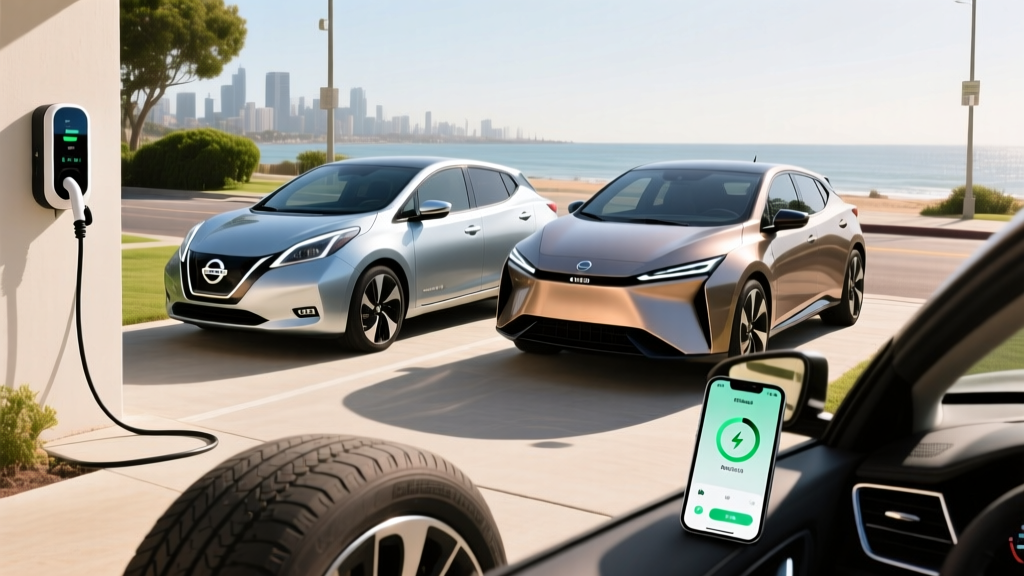
If you are shopping for a Nissan electric vehicle in 2026, you have two choices: the Leaf (a compact hatchback starting around $28,950, up to 212 miles EPA range) or the Ariya (a compact crossover SUV starting around $39,590, up to 304 miles EPA range). The Leaf is one of the most affordable new EVs on the market, making it ideal for commuting and city driving with home charging. The Ariya offers more space, faster DC charging, and available all-wheel drive for road trips and colder climates. Neither qualifies for the full $7,500 federal §30D tax credit at point of sale due to battery-sourcing requirements, so budget accordingly. Both use the CHAdeMO connector (Leaf) or CCS/NACS adapter pathways (Ariya), which affects your public-charging flexibility.
The 2026 Nissan EV Lineup: Leaf vs Ariya at a Glance
Nissan's electrified lineup remains focused on two dedicated battery-electric models. Here is how the core specifications compare for the current model year.
| Specification | 2026 Nissan Leaf (S / SV Plus) | 2026 Nissan Ariya (Engage+ / Evolve+) |
|---|---|---|
| Base MSRP | $28,950 (S) / $36,190 (SV Plus) | $39,590 (Engage+) / $47,190 (Evolve+ e-4ORCE) |
| EPA Range | 149 mi (S, 40 kWh) / 212 mi (SV Plus, 60 kWh) | 289 mi (Engage+, FWD) / 304 mi (Evolve+, FWD) / 272 mi (e-4ORCE AWD) |
| Battery (Usable) | 40 kWh / 60 kWh (NMC) | 63 kWh / 87 kWh (NMC) |
| Horsepower | 147 hp (S) / 214 hp (SV Plus) | 214 hp (FWD) / 389 hp (e-4ORCE AWD) |
| 0–60 mph | ~7.9 sec (S) / ~6.5 sec (SV Plus) | ~7.5 sec (FWD) / ~4.8 sec (e-4ORCE) |
| Max DC Fast Charge | ~50 kW (CHAdeMO) | ~130 kW (CCS) |
| 10–80% DC Charge Time | ~60 min (40 kWh) / ~60 min (60 kWh) | ~35 min (87 kWh) / ~30 min (63 kWh) |
| Level 2 AC Charge Rate | 6.6 kW (J1772) | 7.2 kW (J1772) |
| MPGe (Combined) | 111 MPGe (S) / 104 MPGe (SV Plus) | 101 MPGe (Evolve+ FWD) |
| Cargo Volume | 23.6 cu ft (rear seats up) | 22.8 cu ft (rear seats up) / 59.7 cu ft (folded) |
| Battery Warranty | 8 years / 100,000 miles | 8 years / 100,000 miles |
Sources: EPA fueleconomy.gov, Nissan USA
Real-World Range: What the EPA Sticker Doesn't Tell You
EPA range estimates are a useful baseline, but real-world results depend heavily on speed, temperature, and terrain. Here is what to actually expect from each model.
Nissan Leaf SV Plus (60 kWh)
EPA: 212 miles | Real-world highway (70 mph, moderate temps): ~165–180 miles | Cold weather (below 32°F, mixed driving): ~130–150 miles
The Leaf's smaller battery and lack of a heat pump mean cold-weather range loss can reach 30–35%. City driving with regenerative braking recovers more energy than sustained highway speeds.
Nissan Ariya Evolve+ FWD (87 kWh)
EPA: 304 miles | Real-world highway (70 mph, moderate temps): ~245–265 miles | Cold weather (below 32°F, mixed driving): ~200–225 miles
The Ariya's larger battery provides a more comfortable buffer. The available heat pump (standard on most trims) reduces cold-weather losses to roughly 20–25%, a meaningful advantage over the Leaf in northern climates.
For context, the average American drives about 37 miles per day according to FHWA data. Even the base Leaf's 149-mile EPA range covers a week of typical commuting, provided you can charge at home overnight.
Charging Realities: Home, Public, and the Connector Question
Charging infrastructure access is the single biggest ownership variable. Here is how Nissan's two EVs handle it.
| Charging Level | Leaf (60 kWh) | Ariya (87 kWh) | Miles Added per Hour |
|---|---|---|---|
| Level 1 (120V, 1.4 kW) | ~1.4 kW | ~1.4 kW | ~3–5 mi/hr (both) |
| Level 2 (240V, home/public) | 6.6 kW | 7.2 kW | ~20–25 mi/hr |
| DC Fast Charge (public) | ~50 kW peak (CHAdeMO) | ~130 kW peak (CCS) | Leaf: ~2–3 mi/min; Ariya: ~5–7 mi/min |
The CHAdeMO vs CCS/NACS Reality
The Leaf still uses the CHAdeMO DC fast-charging connector, a legacy standard that is increasingly scarce at new public charging stations. Most new DC fast chargers being deployed in the US feature CCS or NACS (Tesla's North American Charging Standard, now adopted by most automakers). While CHAdeMO chargers still exist at many Electrify America and EVgo stations, the network is not expanding for this connector type.
The Ariya launched with CCS1, and Nissan has announced adapter support for NACS (Tesla Supercharger access) for Ariya owners. This gives the Ariya a significantly stronger long-term public-charging outlook compared to the Leaf.
Home Charging Costs
Installing a Level 2 home charger (240V, 32–48 amp circuit) typically costs $500–$1,500 for the charger unit and $800–$2,500 for professional electrician installation, depending on whether your electrical panel needs an upgrade. If you need a 200-amp panel upgrade, add $1,500–$3,500. Always get a quote from a licensed electrician before purchasing equipment.
Nissan EV vs Gas Car vs Hybrid: The Cost Breakdown
Let's compare the real five-year ownership cost of a Nissan Ariya against a comparable gas-powered crossover (Nissan Rogue AWD) and a hybrid alternative (Toyota RAV4 Hybrid). This comparison assumes 15,000 miles per year, national average electricity and fuel prices, and standard financing.
| Cost Category | Nissan Ariya Evolve+ FWD | Nissan Rogue AWD (Gas) | Toyota RAV4 Hybrid AWD |
|---|---|---|---|
| Purchase Price (MSRP) | $47,190 | $35,250 | $38,450 |
| Federal Tax Credit (§30D) | $0–$3,750* | $0 | $0 |
| Fuel / Electricity (5 yr) | ~$4,500 (home charging)** | ~$9,400 (gas @ $3.40/gal, 28 MPG) | ~$6,700 (gas @ $3.40/gal, 39 MPG) |
| Maintenance (5 yr) | ~$1,800 | ~$3,600 | ~$3,200 |
| Insurance (5 yr avg) | ~$9,500 | ~$7,800 | ~$8,200 |
| Estimated Depreciation | ~$22,000 | ~$14,000 | ~$16,500 |
| Approx. 5-Year Total | ~$81,000–$85,000 | ~$56,000 | ~$60,000 |
*The Ariya's federal tax-credit eligibility depends on battery-sourcing and critical-mineral requirements under IRS §30D. As of 2026, many Nissan EVs do not qualify for the full $7,500 due to supply-chain sourcing rules. Check the IRS qualified vehicle list before purchasing. The credit may be transferred to the dealer at point of sale if eligible.
**Home electricity cost based on $0.16/kWh national average. Public DC fast charging can double or triple per-mile fuel costs.
The Ariya's fuel and maintenance savings are substantial — roughly $5,000 less in fuel and $1,800 less in maintenance over five years compared to the gas Rogue. However, the higher purchase price, steeper depreciation, and elevated insurance premiums (EV insurance averages 15–25% higher than comparable gas vehicles) narrow the gap significantly. The hybrid RAV4 sits between the two, offering strong fuel economy without the EV charging-infrastructure requirement.
Federal Tax Credits and Incentives: What Actually Applies
The federal EV tax credit under IRS §30D is complex and model-specific. Here are the current rules that affect Nissan electric vehicle buyers in 2026:
- Maximum credit: Up to $7,500 for new EVs ($4,000 for used EVs under §25E)
- MSRP cap: SUVs, vans, and trucks must be under $80,000; sedans and hatchbacks under $55,000 (both Nissan models qualify on price)
- Buyer income cap: AGI must not exceed $150,000 (single), $225,000 (head of household), or $300,000 (married filing jointly)
- Battery sourcing: A percentage of critical minerals and battery components must be sourced from the US or free-trade-agreement countries — this requirement phases up annually and is the primary reason many Nissan EVs currently receive partial or no credit
- Point-of-sale transfer: If eligible, you can transfer the credit to the dealer for an upfront price reduction rather than claiming it on your tax return
- FEOC restriction: Vehicles with battery components from a "foreign entity of concern" (certain Chinese, Russian, Iranian, and North Korean companies) are disqualified entirely
State and local incentives vary widely. California, Colorado, and several other states offer additional rebates, but amounts and eligibility differ by jurisdiction. Always verify current incentive availability through your state energy office or the AFDC state-law database.
Common Misconceptions About Nissan EVs
| Myth | Fact |
|---|---|
| "The Leaf battery will need expensive replacement within a few years." | Nissan's battery warranty covers 8 years/100,000 miles against capacity loss below ~65%. Real-world data from earlier-generation Leafs shows typical degradation of 10–20% over 8–10 years. The liquid-cooled batteries in current models degrade more slowly than the passively cooled originals. A replacement battery costs $6,500–$9,000 but is rarely needed within the warranty period. |
| "EVs are more expensive to own than gas cars, period." | It depends on your driving pattern and charging access. If you drive 15,000+ miles per year and charge primarily at home, the Ariya's fuel savings alone exceed $1,000/year. For low-mileage drivers without home charging, a hybrid or efficient gas car may be cheaper overall. |
| "You can't take a Nissan EV on a road trip." | The Ariya (272–304 mi EPA) handles road trips with planning, using DC fast charging every 2.5–3 hours at 130 kW peak. The Leaf is less suited for long highway trips due to its 50 kW CHAdeMO charge rate and shrinking connector availability. |
| "All EVs qualify for the $7,500 tax credit." | Fewer than half of new EVs on the US market qualify for the full credit in 2026 due to battery-sourcing rules. Check the IRS qualified list before assuming eligibility. |
| "Nissan ProPILOT Assist is self-driving." | ProPILOT Assist is an SAE Level 2 driver-assistance system. It provides adaptive cruise control and lane centering, but the driver must remain fully engaged, hands on the wheel, and eyes on the road at all times. It is not autonomous driving. |
SAE Automation Level Reminder
Level 2 (Partial Automation): The system can steer and accelerate/brake under certain conditions, but the driver must continuously supervise. Nissan ProPILOT Assist, Tesla Autopilot, Ford BlueCruise, and GM Super Cruise are all Level 2. Only driverless robotaxi services like Waymo operate at Level 4 in geofenced areas.
Decision Framework: Which Nissan EV (or Alternative) Fits You?
Choose the Nissan Leaf if:
- You need the most affordable new EV available (under $30K base)
- Your daily driving is under 50 miles round-trip
- You have reliable Level 2 home charging
- You primarily drive in a city or suburban environment
- You rarely take road trips over 120 miles one-way
- You live in a mild climate where cold-weather range loss is minimal
Choose the Nissan Ariya if:
- You need crossover SUV space for a family (up to 59.7 cu ft cargo)
- You want 250+ real-world miles of range for occasional road trips
- You need AWD (e-4ORCE) for snow or rain
- You want faster DC charging (130 kW vs the Leaf's 50 kW)
- You want access to Tesla Superchargers via NACS adapter
- You live in a cold climate and value the available heat pump
Consider a Hybrid Instead if:
- You cannot install a home charger (apartment, street parking only)
- You frequently drive 300+ miles in rural areas with limited DC fast charging
- Your budget is under $35,000 and you need AWD
- You want to eliminate charging-planning entirely
First-Time EV Buyer Checklist
If this is your first electric vehicle purchase, work through these practical items before signing:
- Verify home charging feasibility: Do you have a garage, driveway, or dedicated parking spot with access to a 240V outlet (NEMA 14-50)? If not, get an electrician quote for a Level 2 install before buying. A standard 120V outlet (Level 1) adds only 3–5 miles per hour — sufficient for the Leaf if you drive under 30 miles daily, but inadequate for the Ariya's larger battery.
- Check your electrical panel: Most homes need a 200-amp panel to support a 48-amp Level 2 charger alongside existing loads. Older homes with 100-amp panels may need an upgrade ($1,500–$3,500).
- Map your public charging options: Use PlugShare or the EV charging network apps to confirm DC fast chargers exist along your common routes. If you own a Leaf, filter specifically for CHAdeMO availability — it is declining.
- Get insurance quotes before purchase: EV insurance premiums are typically 15–25% higher than equivalent gas vehicles. Shop multiple insurers; some offer EV-specific discounts.
- Confirm tax-credit eligibility: Do not assume you qualify. Check the IRS qualified vehicle list, verify your AGI, and confirm the specific VIN's battery-sourcing status with the dealer.
- Understand the warranty: Nissan covers the battery for 8 years/100,000 miles against capacity loss. The basic vehicle warranty is 3 years/36,000 miles, and the powertrain is 5 years/60,000 miles.
Frequently Asked Questions
Is the Nissan Leaf being discontinued?
Nissan has indicated that the current-generation Leaf will eventually be replaced by a new EV built on the CMF-EV platform (the same architecture as the Ariya). As of 2026, the Leaf remains on sale, but future models are expected to adopt the NACS connector and offer improved range and charging speeds. If you buy a current Leaf, be aware that CHAdeMO infrastructure will continue to shrink.
How much does it cost to charge a Nissan Ariya at home?
The Ariya's 87 kWh battery (usable capacity approximately 84 kWh) costs about $13.44 to charge from empty to full at the US national average of $0.16/kWh. In practice, most owners charge from 20–80% daily, costing roughly $8–$10 per session. Over a year of 15,000 miles at 3.0 miles/kWh, expect about $800–$1,000 in home electricity costs.
Can I use a Tesla Supercharger with a Nissan EV?
The Ariya can access Tesla Superchargers using a NACS adapter (Nissan has confirmed compatibility for recent model years). The Leaf uses CHAdeMO and cannot use Tesla Superchargers, as Tesla does not offer a CHAdeMO adapter. This is a significant long-term advantage for the Ariya.
What is the real-world battery degradation on a Nissan Leaf?
Early-generation Leafs (2011–2017) with passively air-cooled batteries experienced notable degradation, sometimes losing 20–30% capacity within 5–7 years in hot climates. The current-generation Leaf uses a more thermally stable battery design, and real-world reports suggest 10–15% degradation over 8 years under normal use. Nissan's warranty guarantees the battery will retain at least approximately 65% capacity for 8 years/100,000 miles.
Does the Nissan Ariya have a frunk (front trunk)?
No. Unlike some competitors (Hyundai Ioniq 5, Ford Mustang Mach-E, Rivian R1S), the Ariya does not have a front trunk. All cargo space is in the rear (22.8 cu ft behind the second row, 59.7 cu ft with seats folded).
Is Nissan ProPILOT Assist worth the upgrade?
ProPILOT Assist 1.1 (available on SV and above trims) provides competent adaptive cruise control with stop-and-go and lane centering for highway driving. It is an SAE Level 2 system — not self-driving — but it reduces fatigue on long trips. ProPILOT Assist 2.0 (on higher Ariya trims) adds hands-off driving under specific highway conditions (below 25 mph in traffic or on mapped divided highways), though eyes-on supervision is still required. It is a worthwhile feature if you commute on highways regularly.