Quick Verdict: The Original EV Bargain Still Has Bite
The 2023 Nissan Leaf remains the most affordable new electric vehicle you can buy in the United States, with a starting MSRP of $28,140 before any incentives. For city commuters who can charge at home, the Leaf delivers practical daily transportation with minimal fuss. But this pioneer shows its age in key areas: CHAdeMO fast-charging (increasingly rare at public stations), passive air-cooled battery thermal management, and real-world highway range that falls well short of EPA estimates.
If you drive fewer than 40 miles round-trip daily, have reliable home Level 2 charging, and rarely road-trip beyond 100 miles, the 2023 Leaf is a smart, economical choice. If you need frequent DC fast-charging on long trips or live in a hot climate where battery degradation accelerates, look at competitors with liquid-cooled batteries and CCS/NACS connectors.
2023 Nissan Leaf Specifications at a Glance
| Spec | Leaf S (40 kWh) | Leaf SV Plus / SL Plus (60 kWh) |
|---|---|---|
| EPA Range | 149 miles | 212 miles |
| Battery Capacity (usable) | ~39 kWh | ~59 kWh |
| Battery Chemistry | NMC (lithium-ion) | NMC (lithium-ion) |
| Thermal Management | Passive (air-cooled) | Passive (air-cooled) |
| Motor Output | 110 kW (147 hp) | 160 kW (214 hp) |
| Drivetrain | FWD | FWD |
| 0-60 mph | ~7.9 sec | ~6.5 sec |
| Max DC Fast Charge | 50 kW (CHAdeMO) | 100 kW (CHAdeMO) |
| Level 2 Onboard Charger | 6.6 kW | 6.6 kW |
| EPA Efficiency (Combined) | 111 MPGe | 109 MPGe |
| Base MSRP | $28,140 | $36,190 (SV Plus) |
Source: EPA Fuel Economy, Nissan USA specifications.
Real-World Range: What the EPA Sticker Doesn't Tell You
Leaf S (40 kWh): EPA 149 mi → Expect 120–130 mi on the highway at 70 mph; 90–110 mi in freezing weather with cabin heat.
Leaf SV/SL Plus (60 kWh): EPA 212 mi → Expect 175–190 mi highway; 140–160 mi in sub-30°F conditions.
The 2023 Leaf's EPA range figures are achieved under mixed city/highway driving at moderate temperatures. In practice, highway driving at sustained speeds above 65 mph cuts range by 15–20% compared to the sticker. Cold weather is the bigger penalty: lithium-ion cells lose efficiency below freezing, and the Leaf's resistive cabin heater (no heat pump) draws heavily from the traction battery. Owners in northern climates routinely report 30–40% range reduction on the coldest days.
The Leaf Plus's 212-mile EPA rating is genuinely useful for a daily commute plus errands, and the 60 kWh pack provides a comfortable buffer for most suburban drivers. But plan any road trip around the assumption that you'll realistically cover 170–180 miles between charges in fair weather, and significantly less in winter.
Charging: The CHAdeMO Problem and What It Means for You
The 2023 Leaf uses the CHAdeMO DC fast-charging connector — a standard that Nissan helped pioneer but that has largely lost the connector war in North America. As of 2026, the vast majority of new public DC fast chargers deploy CCS1 or NACS (Tesla Supercharger) plugs. CHAdeMO stalls still exist at older Electrify America, EVgo, and ChargePoint locations, but their numbers are shrinking relative to the total network.
| Charging Level | Power / Connector | Speed (Approx.) | Notes |
|---|---|---|---|
| Level 1 (120V) | ~1.4 kW / J1772 | ~4 mi/hr | Emergency/trickle only |
| Level 2 (240V) | 6.6 kW / J1772 | ~22–25 mi/hr | Full charge overnight (~8–10 hr for Plus) |
| DC Fast (Leaf S) | 50 kW / CHAdeMO | 10–80% in ~60 min | Low peak; heat-soak throttling common |
| DC Fast (Leaf Plus) | 100 kW / CHAdeMO | 10–80% in ~45 min | Peak rarely sustained; tapers above 60% SoC |
The Leaf Plus's 100 kW peak DC rate sounds respectable, but the passive air-cooling system means the battery heats up quickly during fast charging. After one or two consecutive DC sessions, the car's battery management system (BMS) throttles charge speed to protect the cells — a phenomenon owners call "Rapidgate." On a hot summer day, you may see peak rates closer to 60–70 kW even on a nominally 100 kW-capable stall. The charge curve tapers noticeably above 60% state of charge, making the final 20% painfully slow.
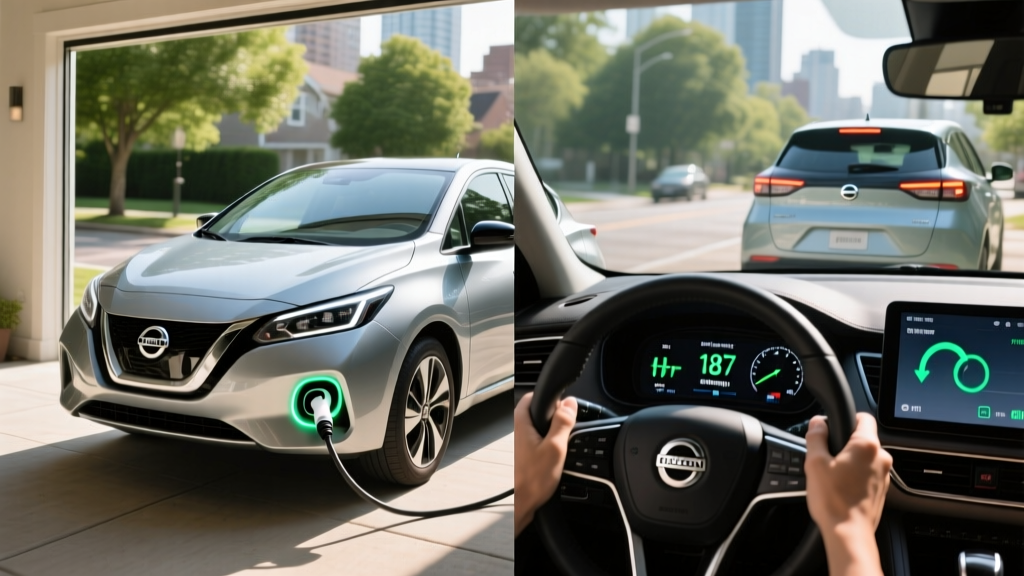
Home charging is the Leaf's sweet spot. A 6.6 kW Level 2 home charger (240V, 30-amp circuit) replenishes the 40 kWh pack in about 7 hours and the 60 kWh Plus pack in roughly 9–10 hours. For a daily commuter plugging in overnight, this is entirely adequate and costs roughly $0.12–0.15 per kWh depending on your utility — translating to about 3–4 cents per mile.
Performance, Efficiency, and Daily Drivability
The Leaf S's 147-hp motor provides adequate city acceleration but feels modest during highway merging. The Plus models, with 214 hp and 250 lb-ft of instant torque, are genuinely quick off the line — the 6.5-second 0-60 time puts it ahead of many compact gas hatchbacks. All trims are front-wheel drive; there is no AWD option.
Efficiency is a strong point. The Leaf S achieves 111 MPGe combined (roughly 30 kWh/100 mi), while the Plus returns 109 MPGe (~31 kWh/100 mi). These are competitive figures, reflecting the Leaf's relatively light curb weight (3,400–3,900 lbs depending on trim) and modest frontal area. The single-speed reduction gear and regenerative braking (with a B-mode for stronger regen, though not true one-pedal driving to a full stop on all trims) contribute to low energy consumption in stop-and-go traffic.
Pricing, Trims, and Federal Tax Credit Eligibility
| Trim | Base MSRP | Key Features |
|---|---|---|
| S (40 kWh) | $28,140 | 8" touchscreen, ProPILOT Assist, Apple CarPlay/Android Auto |
| SV (40 kWh) | $29,140 | Adds adaptive cruise, quick-charge port, fog lights |
| SV Plus (60 kWh) | $36,190 | Larger battery, 214 hp, 100 kW DC charging |
| SL Plus (60 kWh) | $38,190 | Leather, Bose audio, LED headlights, Around View Monitor |
Destination charge of ~$1,095 applies to all trims. Prices reflect 2023 MSRP as published by Nissan.
The 2023 Nissan Leaf may not qualify for the full $7,500 federal tax credit under current IRS §30D rules. Key hurdles:
- Battery sourcing: The Leaf's battery cells are manufactured in Japan and the UK. Under the Inflation Reduction Act's critical-mineral and battery-component requirements (phased in from 2023–2024), the Leaf has struggled to meet North American sourcing thresholds.
- MSRP cap: The Leaf clears the $55,000 sedan cap — no issue here.
- Income cap: Buyer AGI must not exceed $150,000 (single) / $300,000 (joint).
As of the 2023–2024 tax years, Nissan confirmed the Leaf qualifies for $3,750 (meeting critical-mineral requirements but not battery-component requirements). Always verify current eligibility on IRS.gov or with a tax professional before purchasing. Point-of-sale transfer is available if the vehicle qualifies.
Even at $3,750, the Leaf SV Plus drops to an effective price of roughly $32,440 — still undercutting nearly every competitor. Some states offer additional rebates (California's CVRP, for example, or utility company incentives), which can stack with the federal credit. Check your state's energy office for current programs.
Interior, Cargo, and Technology
The Leaf's cabin is functional rather than luxurious. Hard plastics dominate the lower dash and door panels, but the seats are comfortable for daily driving, and the layout is intuitive. The 8-inch touchscreen runs Nissan's infotainment system with wireless Apple CarPlay (on SV and above) and wired Android Auto. Physical knobs for climate control are a welcome ergonomic choice.
Cargo space: 23.6 cubic feet behind the rear seats, expanding to 31.6 cubic feet with the 60/40 split rear seats folded. This is competitive with compact hatchbacks, though the Leaf Plus's larger battery slightly reduces under-floor storage. Rear legroom is 33.5 inches — adequate for adults on shorter trips but tighter than a Hyundai Kona Electric or Chevrolet Bolt EUV.
ProPILOT Assist (standard on all trims) is Nissan's SAE Level 2 driver-assistance suite combining adaptive cruise control with lane-centering steering. It works well on marked highways but requires hands on the wheel and does not support hands-free driving or automated lane changes. It is not autonomous — the driver must remain fully engaged at all times.
Pros, Cons, and Who Should Buy the 2023 Leaf
- Lowest base MSRP of any new EV (from $28,140)
- Proven, long-running platform with widespread service knowledge
- Strong city efficiency (111 MPGe combined)
- Comfortable ride quality and quiet cabin at city speeds
- ProPILOT Assist standard on every trim
- Quick charge port standard on SV and above
- CHAdeMO connector — shrinking public charging access
- Passive air-cooled battery — heat-soak throttling on DC fast charging
- No liquid thermal management — accelerated degradation risk in hot climates
- Real-world highway range well below EPA estimates
- No heat pump — cold-weather range loss is severe
- Modest cargo space vs. newer EV crossovers
Ideal buyer: A single driver or couple with a predictable commute under 40 miles round-trip, home garage or driveway for Level 2 charging, and no regular need for road trips beyond ~100 miles. The Leaf S at $28,140 is a compelling second car or budget-conscious primary EV.
Look elsewhere if: You live in Arizona, Texas, or the Southeast where sustained high temperatures stress air-cooled batteries; you rely on public DC fast-charging for regular travel; or you need more than 200 miles of reliable real-world range for your lifestyle.
Battery Warranty and Long-Term Ownership
Nissan provides an 8-year/100,000-mile lithium-ion battery capacity warranty, guaranteeing the battery will retain at least 67.5% of its original capacity (roughly 9 bars out of 12 on the dash display) during the coverage period. The basic vehicle warranty is 3 years/36,000 miles, and the powertrain is covered for 5 years/60,000 miles.
The air-cooled battery design is the Leaf's most debated long-term ownership factor. Data from fleets and high-mileage owners shows that Leafs in temperate climates (Pacific Northwest, Northeast) retain battery health well — often losing only 10–15% capacity over 100,000 miles. In hot climates (Phoenix, Las Vegas), degradation can reach 20–30% over the same distance, especially for owners who frequently use DC fast charging. If you live in a hot region and plan to keep the Leaf beyond the warranty period, budget for the possibility of earlier-than-expected capacity loss.
2023 Nissan Leaf vs. Key Competitors
The Leaf's most direct competitors at this price point include the Chevrolet Bolt EV/EUV (discontinued after 2023 but available used), Hyundai Kona Electric, and Kia Niro EV. All three use CCS1 connectors, have liquid-cooled batteries, and offer comparable or better range. The Bolt EV, when it was available new, undercut the Leaf on price and offered 259 miles of EPA range with CCS charging — a significant advantage.
The Leaf's remaining edge is its rock-bottom entry price and Nissan's extensive dealer network for service. If you prioritize the lowest possible purchase price and your usage pattern fits within its limitations, the Leaf is still a rational choice. If charging flexibility and battery longevity matter more, the competition has pulled ahead.
Frequently Asked Questions
What is the real-world range of the 2023 Nissan Leaf?
The Leaf S (40 kWh) delivers roughly 120–130 miles on the highway in fair weather and 90–110 miles in freezing conditions. The Leaf Plus (60 kWh) achieves approximately 175–190 miles highway in moderate temperatures, dropping to 140–160 miles in deep cold. City driving with regenerative braking recovers more energy and typically yields results closer to the EPA estimates.
How fast does the 2023 Leaf charge at home and on the road?
At home on a 240V Level 2 charger (6.6 kW), the Leaf S fills in about 7 hours and the Plus in 9–10 hours — perfect for overnight charging. On DC fast chargers, the Leaf S peaks at 50 kW (10–80% in ~60 minutes) and the Plus at 100 kW (10–80% in ~45 minutes), though passive cooling causes throttling on repeated sessions.
Does the 2023 Nissan Leaf qualify for the $7,500 federal EV tax credit?
Under IRS §30D rules, the 2023 Leaf has qualified for $3,750 (meeting critical-mineral but not battery-component sourcing requirements). Eligibility depends on your income (AGI under $150K single/$300K joint) and the vehicle's MSRP (under the $55K sedan cap — the Leaf clears this). Always confirm current status at IRS.gov before purchasing.
Is the 2023 Leaf worth buying compared to other EVs?
Yes, if your priorities are the lowest purchase price, simple daily commuting, and home charging. No, if you need robust public DC fast-charging infrastructure, live in a hot climate, or regularly drive more than 180 miles between charges. Competitors with CCS connectors and liquid-cooled batteries offer better long-term versatility.
What connector does the 2023 Leaf use, and can I use Tesla Superchargers?
The 2023 Leaf uses CHAdeMO for DC fast charging and J1772 for Level 1/Level 2 AC charging. It cannot natively use Tesla Superchargers (NACS) or CCS1 stations. CHAdeMO-to-CCS adapters are not commercially available as of 2026. This is the Leaf's most significant limitation for buyers who rely on public charging networks.
How long will the Leaf's battery last?
Nissan warranties the battery for 8 years/100,000 miles at 67.5% capacity retention. Real-world data shows Leafs in moderate climates often retain 85–90% capacity at 100K miles, while hot-climate vehicles may see 70–80% retention. Avoiding frequent DC fast charging and keeping state of charge between 20–80% can extend battery life.