Quick Answer: Nissan's 2026 EV Lineup at a Glance
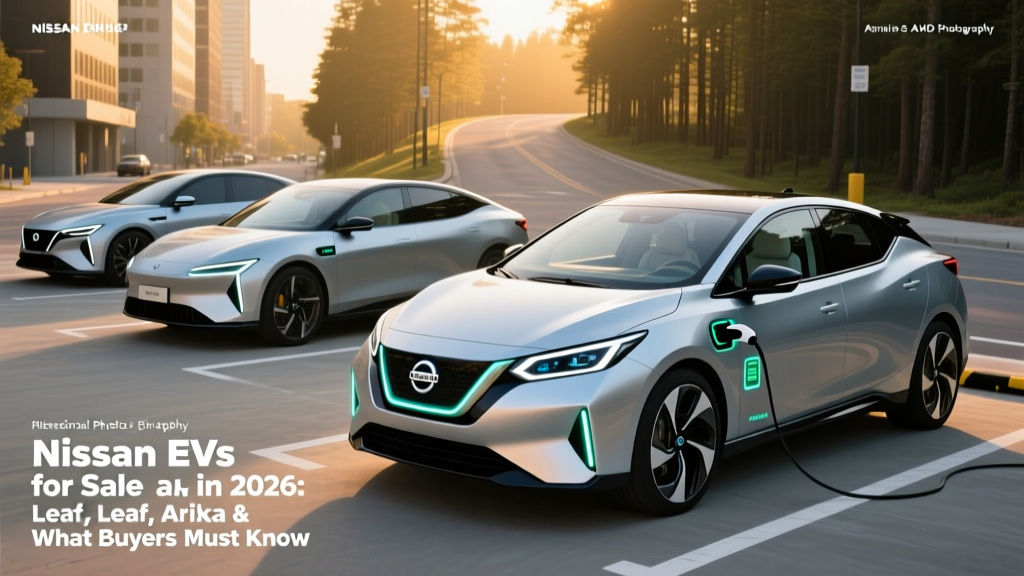
If you're searching for Nissan EVs for sale in 2026, you have two core options: the Nissan Leaf (compact hatchback, EPA-estimated up to 212 miles of range, starting around $28,140) and the Nissan Ariya (midsize crossover SUV, EPA-estimated up to 304 miles of range, starting around $39,590). The Leaf remains one of the most affordable new EVs in the U.S. market, while the Ariya competes directly with the Hyundai Ioniq 5, Tesla Model Y, and Ford Mustang Mach-E. Both use the CHAdeMO DC fast-charging connector (Leaf) or have transitioned toward broader compatibility, which is a critical factor for public charging access. Federal tax credit eligibility under IRS §30D varies by trim, battery sourcing, and your income — always verify current rules at irs.gov before purchasing.
The 2026 Nissan Leaf: Budget-Friendly EV With Caveats
The Nissan Leaf pioneered mass-market EVs over a decade ago, and the 2026 model continues as one of the lowest-priced new electric vehicles available. It comes in two battery configurations:
| Spec | Leaf S (40 kWh) | Leaf SV Plus (60 kWh) |
|---|---|---|
| EPA Range | 149 miles | 212 miles |
| Battery Capacity | 40 kWh (NMC) | 60 kWh (NMC) |
| Motor Output | 147 hp / 236 lb-ft | 214 hp / 250 lb-ft |
| 0-60 mph | ~7.9 sec | ~6.5 sec |
| DC Fast Charge (Peak) | 50 kW (CHAdeMO) | 100 kW (CHAdeMO) |
| 10-80% DC Charge | ~40 min | ~45 min |
| Level 2 Charge Rate | 6.6 kW | 6.6 kW |
| MPGe (Combined) | 111 MPGe | 104 MPGe |
| Starting MSRP | $28,140 | $36,140 |
| Battery Warranty | 8 yr / 100,000 mi | 8 yr / 100,000 mi |
Real-World Range Reality Check
The Leaf SV Plus carries an EPA rating of 212 miles, but expect 170-190 miles on the highway at 70+ mph, and potentially 140-160 miles in freezing temperatures. The smaller 40 kWh Leaf S (149 mi EPA) is best suited as a commuter car with a reliable home-charging setup — its real-world range may dip below 100 miles in winter highway driving.
The CHAdeMO Problem
Nissan has stuck with the CHAdeMO DC fast-charging standard while the broader industry — led by Tesla's NACS and adopted by Ford, GM, Hyundai, and others — has consolidated around NACS for 2025-2026 models. This matters practically: many newer public fast-charging stations prioritize NACS and CCS connectors, and CHAdeMO stalls are increasingly limited outside legacy networks like EVgo. If your road-trip routes lack reliable CHAdeMO infrastructure, the Leaf's 50-100 kW peak charge rate combined with connector scarcity can make longer trips frustrating.
The 2026 Nissan Ariya: Nissan's Serious EV Contender
The Ariya is where Nissan competes in the mainstream electric crossover segment. It rides on the Renault-Nissan-Mitsubishi CMF-EV platform, offers available e-4ORCE dual-motor all-wheel drive, and delivers meaningfully better range and charging performance than the Leaf.
| Spec | Ariya Venture+ (FWD) | Ariya Evolve+ (FWD) | Ariya Platinum+ (e-4ORCE AWD) |
|---|---|---|---|
| EPA Range | 304 miles | 289 miles | 267 miles |
| Battery (Usable) | 87 kWh (NMC) | 87 kWh (NMC) | 87 kWh (NMC) |
| Motor Output | 238 hp / 221 lb-ft | 238 hp / 221 lb-ft | 389 hp / 443 lb-ft |
| 0-60 mph | ~7.2 sec | ~7.2 sec | ~4.8 sec |
| DC Fast Charge (Peak) | 130 kW | 130 kW | 130 kW |
| 10-80% DC Charge | ~35 min | ~35 min | ~35 min |
| Level 2 Charge Rate | 7.2 kW | 7.2 kW | 7.2 kW |
| MPGe (Combined) | 101 MPGe | 98 MPGe | 93 MPGe |
| Starting MSRP | $39,590 | $43,190 | $51,090 |
| Battery Warranty | 8 yr / 100,000 mi | 8 yr / 100,000 mi | 8 yr / 100,000 mi |
The Ariya's 130 kW peak DC fast-charging rate is adequate but trails competitors like the Hyundai Ioniq 5 (up to 240 kW on 800V architecture) and the Tesla Model Y (up to 250 kW on V3 Superchargers). On a road trip, the Ariya's 10-80% session takes roughly 35 minutes — acceptable for a rest stop, but noticeably longer than the 18-minute sessions possible in the Ioniq 5 or Kia EV6. The charge curve tapers significantly above 80% State of Charge (SoC), so plan to charge to 80% and move on rather than waiting for a full battery.
Ariya Real-World Range Expectations
The Venture+ FWD's 304-mile EPA rating is strong, but highway driving at 75 mph typically yields 250-275 miles. In cold weather (below 32°F), expect a 20-30% reduction, bringing real range to 210-245 miles. The Ariya does not include a heat pump on all trims — verify this on the specific model year and trim you're considering, as a heat pump significantly reduces cabin-heating energy draw in winter.
Nissan EV vs. Gas and Hybrid: Cost Comparison
How do Nissan's EVs stack up against a comparable gas car or hybrid? Let's compare the Ariya Venture+ against the Nissan Rogue (gas compact SUV) and a Toyota RAV4 Hybrid over 5 years of ownership, assuming 15,000 miles per year.
| Cost Factor | 2026 Ariya Venture+ (EV) | 2026 Nissan Rogue SV (Gas) | 2026 RAV4 Hybrid XLE |
|---|---|---|---|
| Starting MSRP | $39,590 | $30,230 | $33,425 |
| Est. Federal Tax Credit | Up to $7,500* | $0 | $0 |
| Effective Purchase Price | ~$32,090* | $30,230 | $33,425 |
| Fuel/Energy (5 yr / 75k mi) | ~$3,750 (home L2, $0.14/kWh) | ~$9,375 (30 MPG, $3.75/gal) | ~$7,100 (39 MPG, $3.75/gal) |
| Maintenance (5 yr) | ~$1,500 | ~$3,500 | ~$3,200 |
| Insurance (5 yr avg) | ~$9,500 | ~$7,500 | ~$7,800 |
| 5-Year Total Cost | ~$46,840 | ~$50,605 | ~$51,525 |
*Federal tax credit eligibility under §30D depends on battery component sourcing, critical minerals requirements, MSRP caps ($80,000 for SUVs), and buyer income limits ($150K single / $300K joint). Verify at irs.gov and consult a tax professional. Point-of-sale transfer is available at participating dealers.
The Ariya's higher MSRP is substantially offset by the potential federal credit and dramatically lower fueling and maintenance costs. Over five years, the Ariya can save $3,700-$4,700 compared to the Rogue or RAV4 Hybrid — and savings grow further if gas prices rise or if you charge primarily on off-peak electricity rates below $0.10/kWh.
Real-World Ownership: What First-Time Nissan EV Buyers Must Know
Home Charging Is Non-Negotiable for Most Owners
Owning any Nissan EV without home charging access is possible but impractical for daily use. A Level 2 home charger (240V, 32-48 amps) adds roughly 20-25 miles of range per hour for the Ariya and about 15-20 miles per hour for the Leaf. A full overnight charge from 20% to 80% takes 6-8 hours on Level 2 — more than sufficient for daily commuting.
Installation costs vary widely:
- Simple install (panel nearby, 200-amp service, short wire run): $500-$1,200 for electrician labor plus $300-$600 for a quality Level 2 EVSE (e.g., ChargePoint Home Flex, Emporia Level 2).
- Complex install (panel upgrade to 200A, long conduit run, permit): $1,500-$3,500+ total.
Always hire a licensed electrician and pull a permit — unpermitted electrical work can void homeowner's insurance and create fire risk.
Cold Climate? Plan for Range Loss
Lithium-ion batteries lose efficiency in cold temperatures, and cabin heating draws significant energy. In sub-freezing climates, budget for 20-30% range reduction. The Ariya's available battery preconditioning feature (if equipped on your trim) warms the battery before fast charging, improving charge speeds in cold weather. The Leaf lacks active battery thermal management — a known limitation that accelerates long-term degradation in hot climates and slows charging in cold ones.
Insurance Costs Are Higher for EVs
EV insurance premiums run 15-25% higher than comparable gas vehicles due to higher repair costs, specialized parts, and battery replacement considerations. Get quotes from multiple insurers before purchasing — some companies (like State Farm and GEICO) have narrowed the EV insurance gap more than others.
Common Nissan EV Misconceptions: Myth vs. Fact
| Myth | Fact |
|---|---|
| "The Leaf battery will die in 5 years." | Nissan's battery warranty covers 8 years/100,000 miles against capacity loss below 70%. Real-world data shows most Leaf batteries retain 80-90% capacity after 5 years with normal use, though passive air-cooled thermal management (no liquid cooling) does accelerate degradation in extreme heat. |
| "Nissan EVs can't road trip." | The Ariya's 304-mile range and 130 kW charging make road trips viable with planning. Use apps like PlugShare or A Better Routeplanner to map CHAdeMO/CCS/NACS-compatible stations. The Leaf's 149-212 mile range and CHAdeMO-only connector make road trips more challenging but not impossible. |
| "Federal tax credits are gone for Nissan." | Credit eligibility under §30D changes based on battery sourcing rules updated periodically by the Treasury Department. Some Nissan trims may qualify for the full $7,500, partial credit, or none — always check the latest fueleconomy.gov listings and IRS guidance before purchasing. |
| "EVs cost more to maintain." | EVs eliminate oil changes, transmission fluid, spark plugs, and exhaust repairs. Brake pad life extends significantly due to regenerative braking. Tire replacement may come sooner due to higher vehicle weight and instant torque, but overall maintenance costs are 40-50% lower than gas vehicles. |
| "CHAdeMO is dead, so the Leaf is useless." | CHAdeMO infrastructure still exists on networks like EVgo and at many legacy stations. For a commuter who charges at home 90%+ of the time, CHAdeMO's shrinking public footprint matters less. But if you plan frequent road trips, the connector limitation is a real drawback. |
Decision Framework: Which Nissan EV (If Any) Is Right for You?
Choose the Nissan Leaf if:
- Your daily commute is under 60 miles round-trip and you have reliable Level 2 home charging.
- Budget is your top priority — the Leaf S at ~$28,140 MSRP (potentially ~$20,640 after full §30D credit) is among the cheapest new EVs available.
- You rarely take road trips over 150 miles, or you have a second gas/hybrid car for longer drives.
- You live in a moderate climate without extreme summer heat (the Leaf's passive battery cooling is less ideal in sustained 100°F+ environments).
Choose the Nissan Ariya if:
- You need crossover SUV cargo space (up to 57.7 cu ft with rear seats folded) and available AWD.
- You want 250+ miles of real-world highway range for occasional road trips.
- You're cross-shopping the Hyundai Ioniq 5, Tesla Model Y, or Ford Mustang Mach-E and want to compare pricing with the federal credit factored in.
- You value a quieter, more refined interior than the Leaf offers, with features like available ProPILOT Assist 2.0 (SAE Level 2 driver assistance — not self-driving).
Look elsewhere if:
- Fast-charging speed is critical to you — the Ariya's 130 kW peak trails the Ioniq 5's 240 kW capability.
- You need a truck bed, three-row seating, or towing capacity above 1,500 lbs.
- You live in a charging desert with minimal public infrastructure and no home charging option.
Frequently Asked Questions
Does the 2026 Nissan Leaf use NACS or CCS for charging?
Neither — the Leaf uses the CHAdeMO connector for DC fast charging and a J1772 connector for Level 1/Level 2 AC charging. Adapters exist (CHAdeMO-to-CCS and CHAdeMO-to-NACS), but they add cost ($200-$400), bulk, and may not be compatible with all stations. Nissan has not announced a NACS transition for the Leaf as of 2026.
What is the real cost per mile to drive a Nissan Ariya vs. a gas car?
At the U.S. average residential electricity rate of ~$0.16/kWh and the Ariya's efficiency of roughly 33 kWh/100 miles, home charging costs about $0.053 per mile. A comparable gas SUV at 28 MPG and $3.50/gallon costs $0.125 per mile. That's a 58% per-mile fuel savings with the Ariya when charging at home.
How long will the Ariya's 87 kWh battery last?
Nissan warranties the battery for 8 years or 100,000 miles against capacity dropping below 70%. Industry data from similar NMC batteries suggests 85-90% capacity retention at 100,000 miles under normal use. To maximize longevity, avoid routinely charging to 100% (set daily charge limit to 80%), minimize repeated DC fast charging, and avoid leaving the vehicle at very low or very high SoC in extreme temperatures for extended periods.
Is ProPILOT Assist on the Ariya self-driving?
No. ProPILOT Assist and ProPILOT Assist 2.0 are SAE Level 2 driver-assistance systems. They can manage steering, acceleration, and braking on highways under certain conditions, but the driver must remain fully attentive with hands on or near the wheel at all times. This is fundamentally different from Level 4 autonomous services like Waymo, which operate without a driver. See NHTSA's automated vehicle safety page for official definitions.
Can I get the $7,500 federal tax credit on a Nissan EV?
Eligibility under IRS §30D depends on multiple factors: the vehicle's battery components must meet domestic sourcing thresholds for critical minerals and battery manufacturing, the MSRP must not exceed $80,000 (SUVs/vans/pickups) or $55,000 (sedans), and your modified adjusted gross income must be under $150,000 (single) or $300,000 (joint). These rules are subject to change. Check the latest eligibility list at fueleconomy.gov and consult a tax professional for your specific situation. The credit can be transferred to the dealer at point of sale for an immediate price reduction at participating dealerships.
How does the Ariya compare to the Tesla Model Y?
The Model Y Long Range (EPA ~320 miles, ~$44,990 MSRP) offers more range, faster Supercharger access (250 kW peak, NACS), and a more extensive proprietary charging network. The Ariya Venture+ (304 miles, $39,590) is less expensive, offers a more traditional interior layout with physical climate controls, and some buyers prefer Nissan's dealership service network. If Supercharger access and charge speed are top priorities, the Model Y wins. If price, interior comfort, and dealer proximity matter more, the Ariya is competitive.