The Real Math Behind 2026 Nissan EV Deals
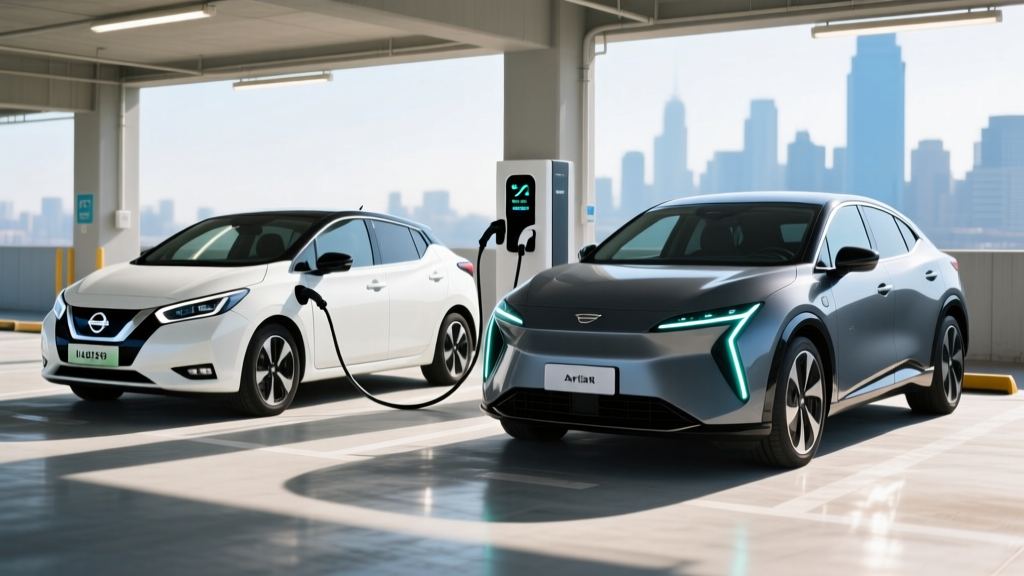
Nissan's current EV lineup — the refreshed 2026 Leaf and the 2026 Ariya crossover — frequently appears in promotional pricing, lease specials, and dealer incentive programs. But a sticker-price discount only tells part of the story. To evaluate whether Nissan EV deals actually save you money, you need a complete picture: purchase price after tax credits, home charging costs, insurance premiums, maintenance savings, and the depreciation hit that EVs typically take.
This guide runs the numbers on both Nissan EVs using 2026 model-year specs, current IRS §30D federal tax credit rules, and real-world ownership data. Whether you're eyeing a Leaf S at a bargain price or an Ariya Engage with a lease bonus, here's what ownership actually costs over five years.
2026 Nissan EV Lineup: Specs at a Glance
Before calculating costs, let's establish the hardware. Nissan offers two distinct EVs with very different battery chemistries, range profiles, and price points.
| Spec | 2026 Leaf S | 2026 Leaf SV Plus | 2026 Ariya Engage (FWD) | 2026 Ariya Evolve+ (AWD) |
|---|---|---|---|---|
| Base MSRP | ~$28,140 | ~$36,190 | ~$39,590 | ~$47,590 |
| Battery (usable) | 40 kWh (NMC) | 60 kWh (NMC) | 63 kWh (NMC) | 87 kWh (NMC) |
| EPA Range | ~149 mi | ~212 mi | ~216 mi | ~289 mi |
| Real-World Range* | ~115–130 mi | ~170–190 mi | ~175–195 mi | ~235–260 mi |
| Peak DC Charge | 50 kW (CHAdeMO) | 100 kW (CHAdeMO) | 130 kW (CCS) | 130 kW (CCS) |
| 10–80% DC Time | ~40 min | ~45 min | ~35 min | ~40 min |
| Level 2 Rate | 6.6 kW | 6.6 kW | 7.2 kW | 7.2 kW |
| Horsepower | 147 hp | 214 hp | 214 hp | 389 hp |
| 0–60 mph | ~7.9 sec | ~6.5 sec | ~7.5 sec | ~4.8 sec |
| MPGe (combined) | 111 MPGe | 104 MPGe | 101 MPGe | 95 MPGe |
| Battery Warranty | 8 yr / 100,000 mi | 8 yr / 100,000 mi | 8 yr / 100,000 mi | 8 yr / 100,000 mi |
Federal Tax Credit Eligibility for Nissan EVs (IRS §30D)
The federal EV tax credit under IRS §30D can reduce your effective purchase price by up to $7,500 — but eligibility is far from automatic. Battery-sourcing requirements, MSRP caps, and buyer income limits all apply. Here's what you need to know for 2026 Nissan models.
- MSRP Cap: Vans, SUVs, and pickups: ≤$80,000. Sedans and other vehicles: ≤$55,000. (The Ariya qualifies as an SUV; the Leaf as a sedan/hatchback.)
- Buyer Income Limits (MAGI): $300,000 joint filers / $225,000 head of household / $150,000 single.
- Battery Component Requirement ($3,750): A percentage of battery components must be manufactured or assembled in North America. Threshold increases annually.
- Critical Minerals Requirement ($3,750): A percentage of critical minerals must be sourced from the U.S. or a free-trade-agreement country. Threshold increases annually.
- Point-of-Sale Transfer: As of 2024, you can transfer the credit to the dealer at purchase, receiving the discount upfront rather than waiting to claim it on your tax return. The dealer must be IRS-registered.
- New Vehicle Requirement: Must be new (not previously titled) and purchased for personal use, not resale.
Source: IRS.gov — Clean Vehicle Credits. Rules are subject to change; consult a tax professional for your specific situation.
Which Nissan EVs Qualify?
The Leaf (MSRP under $55,000 across all trims) clears the price cap. However, Nissan's battery sourcing has historically been a challenge for full credit qualification. The Leaf's battery cells have been produced in multiple locations globally, and critical-mineral sourcing compliance depends on the specific model year's supply chain. Check the fueleconomy.gov tax credit database for the exact credit amount assigned to the specific 2026 Leaf trim you're considering.
The Ariya (classified as an SUV, $80,000 MSRP cap) also clears the price threshold on most trims, though the high-end Platinum+ e-4ORCE pushes close. Battery-sourcing compliance for the Ariya similarly varies — some trims may qualify for the full $7,500, others for $3,750, and some may not qualify at all depending on supply-chain shifts. Always verify on fueleconomy.gov before signing.
5-Year Total Cost of Ownership: Nissan Leaf vs. Ariya
Below is a realistic 5-year / 60,000-mile ownership projection for both Nissan EVs compared against a gasoline baseline (2026 Nissan Rogue AWD, ~30 MPG combined). Assumptions: 12,000 miles/year, home Level 2 charging at $0.14/kWh national average, gas at $3.40/gallon, insurance based on national EV averages.
| Cost Category | 2026 Leaf SV Plus | 2026 Ariya Evolve+ AWD | 2026 Rogue AWD (Gas Baseline) | |
|---|---|---|---|---|
| Base MSRP | $36,190 | $47,590 | $32,500 | |
| Est. Federal Tax Credit | –$3,750 to –$7,500 | –$3,750 to –$7,500 | $0 | |
| Effective Purchase Price | ~$28,690–$32,440 | ~$40,090–$43,840 | $32,500 | |
| Fuel/Energy (5 yr) | $2,880 | $4,050 | $6,800 | |
| Insurance (5 yr) | $9,500 | $11,250 | $7,500 | |
| Maintenance (5 yr) | $1,200 | $1,400 | $3,800 | |
| Est. Depreciation (5 yr) | ~$14,000 | ~$20,000 | ~$13,000 | |
| Total 5-Year Cost | ~$56,270–$52,520 | ~$76,790–$73,040 | ~$63,600 |
Charging Costs vs. Gas: The Per-Mile Reality
The single biggest ownership advantage of any EV is energy cost. Here's how the math works at the per-mile level.
| Vehicle | Energy Source | Efficiency | Cost Per Unit | Cost Per Mile |
|---|---|---|---|---|
| Leaf SV Plus | Electricity | 3.0 mi/kWh | $0.14/kWh (home avg) | $0.047 |
| Ariya Evolve+ AWD | Electricity | 2.7 mi/kWh | $0.14/kWh (home avg) | $0.052 |
| Rogue AWD | Gasoline | 30 MPG combined | $3.40/gallon | $0.113 |
At 12,000 miles per year, the Leaf SV Plus costs approximately $564/year to fuel at home, while the Rogue costs $1,360/year. That's roughly $796 in annual fuel savings with the Leaf — or nearly $4,000 over five years.
Important caveat: Public DC fast charging costs significantly more. Networks like Electrify America and EVgo typically charge $0.35–$0.55/kWh. If you rely primarily on public charging, the Leaf's per-mile cost rises to $0.12–$0.18/mile, erasing much of the savings advantage. Home charging access is essential to capturing EV fuel economics.
The CHAdeMO Problem for Leaf Owners
The 2026 Leaf still uses the CHAdeMO DC fast-charging connector, while the broader industry (including the Ariya) has standardized on CCS and the expanding NACS (Tesla Supercharger) network. CHAdeMO public charging infrastructure is shrinking relative to CCS/NACS, which can make road-trip charging more difficult for Leaf owners. If you plan to rely on public fast charging regularly, the Ariya's CCS compatibility is a meaningful practical advantage.
Maintenance Savings: Where EVs Quietly Win
EVs eliminate most routine powertrain maintenance. No oil changes, no spark plugs, no transmission fluid, no exhaust system repairs. Regenerative braking dramatically reduces brake pad wear — many EV owners report original brake pads lasting 80,000+ miles.
| Service Item | Nissan EV (Leaf/Ariya) | Nissan Rogue (Gas) |
|---|---|---|
| Oil Changes | $0 (none needed) | ~$600 (10 changes @ $60) |
| Brake Pads | ~$0–$200 (regen extends life) | ~$600–$900 (2 replacements) |
| Transmission Fluid | $0 | ~$200 |
| Cabin Air Filter | ~$150 | ~$150 |
| Tire Rotation/Replacement | ~$800 (EVs are heavier) | ~$600 |
| Coolant / Misc. | ~$100 | ~$300 |
| Total Maintenance | ~$1,050–$1,250 | ~$2,450–$2,750 |
Net maintenance savings over five years: approximately $1,200–$1,500. The one area where EVs can cost more is tires — the additional weight of the battery pack and instant torque accelerate tire wear. Budget for premium tires at 40,000–50,000 miles.
The Insurance Reality: Why EVs Cost More to Insure
This is where the honest math cuts against EVs. Insurance premiums for electric vehicles run 15–30% higher than equivalent gas vehicles, according to industry data. The reasons are structural:
- Higher repair costs: Battery pack damage in a collision can total a vehicle that would otherwise be repairable. Specialized high-voltage repair training is required.
- Higher vehicle values: Even after tax credits, EVs tend to have higher MSRPs than comparable gas models, raising comprehensive and collision premiums.
- Parts scarcity: EV-specific body panels and components can have longer lead times, increasing rental-car reimbursement costs for insurers.
- Specialized labor: Fewer body shops are certified for high-voltage system repairs, driving up labor rates.
For the Leaf SV Plus, expect annual premiums of approximately $1,800–$2,000 (national average for a driver with a clean record). The Ariya Evolve+ AWD, with its higher MSRP, typically runs $2,100–$2,400/year. The gas Rogue averages $1,400–$1,600/year.
Over five years, that insurance gap costs you an additional $2,000–$3,750 — a real offset against fuel and maintenance savings that many EV cost calculators conveniently omit.
Depreciation and Resale Value Trends
EV depreciation has historically been steeper than gasoline vehicles, though the gap has been narrowing as the market matures. Key factors affecting Nissan EV resale values:
- Battery health perception: Used EV buyers are cautious about battery degradation. Nissan's early Leaf models (2011–2017) suffered notable battery capacity loss in hot climates, creating lasting brand perception issues — even though the current liquid-cooled battery systems in the 2026 Leaf and Ariya are far more durable.
- Tax credit overhang: When new buyers receive a $7,500 credit, the effective purchase price drops, which resets the depreciation baseline. A used Leaf that sold for $36,000 new but cost the buyer $28,500 after credits will depreciate from that lower figure.
- Technology obsolescence: EV charging speeds and range improve rapidly. The Leaf's CHAdeMO connector and 100 kW peak charge rate will look increasingly dated as NACS/CCS chargers hit 350 kW+.
- Market competition: More affordable EVs entering the market (from Hyundai, Chevrolet, Tesla) apply downward pressure on used Nissan EV prices.
Realistic 5-year depreciation estimates: the Leaf SV Plus retains approximately 45–50% of its effective (post-credit) purchase price. The Ariya retains roughly 48–55%. By comparison, the gas Rogue retains approximately 55–60% of its MSRP. The Ariya holds value somewhat better than the Leaf, thanks to its crossover body style and CCS charging compatibility.
State, Local, and Utility Incentives
Beyond the federal §30D credit, many states, municipalities, and electric utilities offer additional incentives. These change frequently and depend entirely on your location. Examples of what may be available:
- State rebates: California (CVRP), Colorado, Massachusetts, New York, and others offer $1,000–$5,000+ in additional purchase rebates — often with their own income caps.
- Utility rebates: Many electric utilities offer $250–$1,500 rebates for home Level 2 charger installation, or discounted time-of-use electricity rates for EV charging.
- HOV lane access: Several states grant solo-occupant carpool lane access to EVs, a non-monetary benefit worth significant commute time.
- Registration fee offsets: Some states charge higher EV registration fees (to replace lost gas tax revenue), which can partially offset savings.
Check your state's energy office website and your local utility's EV programs page for current offerings. These incentives are jurisdiction-specific and subject to funding availability.
Nissan EV Deals: Lease vs. Buy Considerations
Nissan frequently promotes lease deals on both the Leaf and Ariya, sometimes with manufacturer-subsidized money factors or lease cash. There's a critical tax consideration here: under current IRS rules, the §30D credit applies to purchases, but a separate commercial clean vehicle credit (§45W) can apply to leased vehicles. Many automakers pass this benefit through as a "lease cash" incentive, effectively giving lessees the equivalent of the $7,500 credit regardless of battery-sourcing or income-limit restrictions.
If the Leaf or Ariya doesn't qualify for the full §30D purchase credit due to battery-sourcing rules, leasing may actually deliver a larger effective discount. Always compare the total lease cost (down payment + monthly payments × term + disposition fee + mileage overage risk) against the purchase-with-credit scenario before deciding.
Frequently Asked Questions
How much does it really cost to own a Nissan EV over 5 years?
For the 2026 Leaf SV Plus, total 5-year cost ranges from approximately $52,500 to $56,300, depending on your federal tax credit eligibility. The Ariya Evolve+ AWD runs $73,000–$76,800. The Leaf can beat a comparable gas crossover on total cost if you secure the full tax credit and charge primarily at home. The Ariya costs more overall but competes in a pricier segment where the fuel and maintenance gap narrows the difference.
Do I qualify for the federal tax credit on a Nissan Leaf or Ariya?
It depends on three factors: your modified adjusted gross income (under $150K single / $300K joint), the vehicle's MSRP (under $55K for Leaf, under $80K for Ariya), and whether the battery meets critical-mineral and component-sourcing thresholds for the model year. The Leaf SV Plus at ~$36,190 clears the MSRP cap. Qualification for the full $7,500 versus a partial $3,750 depends on Nissan's supply-chain compliance. Verify your specific trim on fueleconomy.gov and consult a tax professional.
How much do I save on fuel and maintenance with a Nissan EV?
Charging at home at $0.14/kWh, the Leaf SV Plus costs about $564/year in electricity versus $1,360/year in gasoline for a comparable Rogue — saving roughly $796 annually on fuel. Maintenance savings add another $250–$300 per year from eliminated oil changes, reduced brake wear, and fewer service visits. Combined annual savings: approximately $1,050–$1,100, or $5,250–$5,500 over five years.
Are Nissan EVs more expensive to insure?
Yes. Expect to pay 15–30% more for insurance on either the Leaf or Ariya compared to a gas-powered Nissan. Over five years, that translates to roughly $2,000–$3,750 in additional insurance costs. The primary drivers are higher repair costs for battery damage, elevated vehicle values, and a smaller network of certified high-voltage repair shops.
How well do Nissan EVs hold their value?
Nissan EVs depreciate faster than their gas counterparts, retaining roughly 45–55% of their post-credit purchase price after five years versus 55–60% for the Rogue. The Ariya holds value slightly better than the Leaf due to its crossover form factor and CCS charging standard. The Leaf's CHAdeMO connector is a growing liability in the used market as public CHAdeMO infrastructure continues to shrink relative to NACS and CCS networks.
Is the Nissan Leaf still worth buying in 2026?
The Leaf makes sense as a budget-friendly commuter EV if you can charge at home, drive under 100 miles daily, and don't need frequent DC fast charging. Its CHAdeMO connector and modest charge speeds (50–100 kW peak) limit road-trip practicality. If Nissan dealer incentives bring the effective price below $25,000 after credits, the Leaf becomes one of the cheapest new EVs available — and the 5-year operating savings are genuine. For road trips or apartment dwellers without home charging, the Ariya (or a competing CCS/NACS EV) is a more versatile choice.