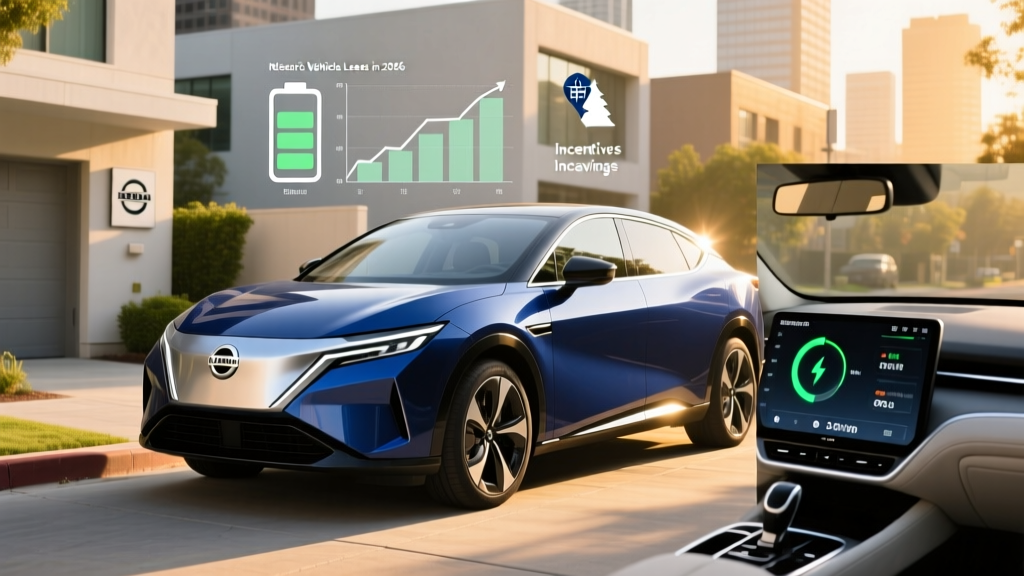
If you're researching a Nissan electric vehicle lease in 2026, you're likely weighing the Nissan Leaf and the Nissan Ariya against their gas-powered alternatives — and against each other. Nissan's EV lineup is compact but distinct: the Leaf remains one of the most affordable new EVs on the market, while the Ariya competes directly with midsize electric crossovers like the Hyundai Ioniq 5 and Ford Mustang Mach-E. But the sticker price is only the starting point.
This guide walks through the real math of owning or leasing a Nissan EV over five years — federal tax credits, state incentives, fuel savings, maintenance, insurance premiums, and the depreciation question that haunts every EV buyer. We'll use the 2026 Nissan Leaf SV Plus and the 2026 Nissan Ariya Engage as our reference trims, with concrete numbers from the EPA, IRS, and Nissan's current pricing.
Nissan's 2026 EV Lineup at a Glance
Before we get into ownership costs, here's what Nissan currently offers. Both models are available for purchase or lease through Nissan dealerships, and lease terms typically run 36 months with varying money-down options.
| Spec | 2026 Leaf SV Plus | 2026 Ariya Engage (FWD) |
|---|---|---|
| Base MSRP | ~$30,490 | ~$39,590 |
| Battery (usable) | 60 kWh (NMC) | 63 kWh (NMC) |
| EPA Range | 212 miles | 216 miles |
| Real-World Range (highway) | ~170–190 mi | ~180–195 mi |
| Motor Output | 214 hp | 214 hp |
| 0–60 mph | ~6.5 sec | ~7.5 sec |
| Max DC Fast Charge | 100 kW (CHAdeMO) | 130 kW (CCS/NACS adapter) |
| 10–80% DC Charge | ~40 min | ~30 min |
| Level 2 (240V) Rate | 6.6 kW | 7.2 kW |
| EPA Efficiency | 111 MPGe | 102 MPGe |
| Battery Warranty | 8 yr / 100,000 mi | 8 yr / 100,000 mi |
5-Year Total Cost of Ownership: Leaf vs. Ariya vs. Gas Baseline
To evaluate whether a Nissan electric vehicle lease (or purchase) makes financial sense, we need to look beyond monthly payments. Below is a 5-year / 75,000-mile total cost of ownership (TCO) estimate comparing the Leaf SV Plus, the Ariya Engage, and a gas-powered baseline — the 2026 Nissan Rogue SV AWD (~$32,000 MSRP, 33 MPG combined).
| Category | Leaf SV Plus | Ariya Engage | Rogue SV (Gas Baseline) |
|---|---|---|---|
| Purchase Price (after credit) | $22,990* | $32,090* | $32,000 |
| Fuel / Charging (75k mi) | $3,750 | $4,100 | $7,950 |
| Maintenance | $1,800 | $1,900 | $4,200 |
| Insurance (5 yr) | $8,500 | $9,200 | $7,000 |
| Depreciation (est.) | $9,500 | $12,800 | $11,200 |
| Total 5-Year TCO | $46,540 | $60,090 | $62,350 |
*Assumes full $7,500 federal tax credit eligibility. Actual credit depends on income, MSRP caps, and battery-sourcing compliance. See the tax credit section below for details.
The Leaf SV Plus, when eligible for the full credit, becomes the clear cost winner. Even the Ariya — which costs more upfront — edges out the Rogue over five years thanks to fuel and maintenance savings. But notice the insurance line: EVs consistently cost more to insure, and that eats into the savings. Let's break down each category.
Federal Tax Credit: Do You Qualify for §30D?
The federal IRS §30D Clean Vehicle Credit offers up to $7,500 for qualifying new EVs — but "up to" is the operative phrase. As of 2026, the credit is split into two $3,750 halves based on battery-sourcing requirements, and multiple eligibility gates must all be satisfied.
- Vehicle MSRP Cap: SUVs, vans, and pickups must be under $80,000; sedans and other body styles under $55,000. The Ariya (SUV classification) qualifies at ~$39,590. The Leaf (hatchback) qualifies at ~$30,490.
- Buyer Income Cap (Modified AGI): $300,000 for joint filers; $225,000 for head of household; $150,000 for single filers.
- Battery Component Manufacturing: At least 60% of battery components must be manufactured or assembled in North America (threshold increases annually through 2029).
- Critical Minerals Sourcing: At least 50% of critical minerals must be sourced from the U.S. or a free-trade-agreement partner (threshold also increases annually).
- Foreign Entity of Concern (FEOC) Exclusion: Battery components and critical minerals cannot be sourced from designated FEOCs (primarily targeting certain Chinese entities).
- Point-of-Sale Transfer: As of 2024, buyers can transfer the credit to the dealer at purchase, reducing the purchase price directly — even if you have no tax liability. This applies to leases as well, where the lessor (Nissan's financing arm) typically receives the credit and may pass it through as a capitalized-cost reduction.
Lease-specific nuance: When you lease a Nissan EV, the leasing company (technically the vehicle owner) claims the commercial clean vehicle credit under IRC §45W. In practice, most manufacturers factor this into lease pricing as a "lease cash" incentive or cap-cost reduction, effectively passing the $7,500 savings to you. However, this is not legally guaranteed — always ask the dealer whether the current lease offer includes the full credit as a cap-cost reduction before signing.
For the latest rules, consult the IRS Clean Vehicle Credits page, as sourcing thresholds and FEOC restrictions continue to tighten annually.
State, Local, and Utility Incentives
Beyond the federal credit, many states and utilities layer on additional savings — but these vary dramatically by ZIP code.
- State EV rebates: California (CVRP, up to $7,000 for income-qualified buyers), Colorado (up to $5,000), Massachusetts (MOR-EV, up to $3,500), New York (Drive Clean, up to $2,000). Many states offer no direct rebate.
- Utility rebates: Some utilities offer $500–$1,500 for EV purchase/lease plus $300–$800 for Level 2 home charger installation. Check with your local provider.
- HOV lane access: California, Colorado, Georgia, Maryland, and others grant single-occupant carpool-lane access to EVs — a significant time savings in metro areas.
- Registration fee surcharges: Some states (Ohio, Alabama, Arkansas) charge EVs higher annual registration fees ($100–$200) to offset lost gas-tax revenue.
Always verify current incentive availability with your state energy office and local utility. Programs expire, funding runs out, and eligibility rules change. For state-level information, the Alternative Fuels Data Center maintains a current database.
Charging vs. Gas: The Per-Mile Cost Math
This is where EVs earn their reputation for lower running costs — but the savings depend heavily on your electricity rate and charging habits.
| Scenario | Leaf SV Plus (111 MPGe) | Ariya Engage (102 MPGe) | Rogue SV (33 MPG) |
|---|---|---|---|
| Home charging @ $0.14/kWh (national avg.) | $0.042/mi → $3,150 total | $0.046/mi → $3,450 total | — |
| Public DC fast charging @ $0.40/kWh | $0.12/mi → adds ~$1,200 if used 20% of time | $0.13/mi → adds ~$1,300 | — |
| Gasoline @ $3.40/gal (national avg.) | — | — | $0.106/mi → $7,950 total |
Blended reality: Most EV owners charge at home 80–90% of the time. Using a blended rate (90% home at $0.14/kWh, 10% public DC at $0.40/kWh), the Leaf costs roughly $0.050/mile to fuel versus the Rogue's $0.106/mile. That's a savings of approximately $4,200 over 75,000 miles.
However, if you cannot install a home charger and rely exclusively on public DC fast charging at $0.35–$0.50/kWh, your per-mile cost jumps to $0.10–$0.15/mile — essentially matching or exceeding gasoline. Home charging access is the single biggest variable in EV economics.
Maintenance Savings: Where EVs Quietly Win
EVs have far fewer moving parts than internal-combustion vehicles. No oil changes, no spark plugs, no timing belts, no exhaust systems, and regenerative braking dramatically reduces brake-pad wear.
| Service Item | Nissan EV (Leaf/Ariya) | Gas Vehicle (Rogue) |
|---|---|---|
| Oil Changes | $0 | $600–$900 (8–10 changes) |
| Brake Pads | $0–$200 (regen extends life to 80k+ mi) | $400–$800 (2 sets) |
| Cabin Air Filter | $150–$250 | $150–$250 |
| Tire Rotation/Replacement | $1,200–$1,600 (EVs wear tires ~20% faster due to weight and instant torque) | $800–$1,200 |
| Coolant/Transmission Fluid | $100–$200 | $200–$400 |
| Wipers, 12V Battery, Misc. | $300–$500 | $300–$500 |
| Total (est.) | $1,750–$2,750 | $2,450–$4,050 |
The net maintenance savings for a Nissan EV over five years is approximately $1,000–$1,800. The biggest caveat: EV tires. The Leaf and Ariya are heavier than their gas equivalents (the Ariya Engage weighs ~4,400 lbs), and instant electric torque accelerates tread wear. Budget for one set of replacement tires during a 5-year ownership period, and consider EV-specific tire compounds (like the Michelin e.Primacy or Hankook iON evo) that are engineered for lower rolling resistance and noise.
Insurance Costs: The Uncomfortable Truth
EV insurance premiums are typically 15–30% higher than equivalent gas vehicles. According to industry data, the average annual EV insurance premium in 2025–2026 runs $1,700–$1,900 versus $1,300–$1,500 for a comparable gas crossover.
Why the premium?
- Higher repair costs: EV battery packs and power electronics are expensive to replace after collision damage. Even minor rear-end impacts can trigger battery-safety inspections costing thousands.
- Specialized labor: Fewer body shops have high-voltage-certified technicians, raising labor rates for EV repairs.
- Total-loss thresholds: Insurers are more likely to declare an EV a total loss after battery-adjacent damage, increasing claim payouts.
- Vehicle price: The Ariya's higher MSRP naturally commands higher premiums.
Over five years, expect to pay roughly $1,500–$2,200 more in insurance for the Leaf or Ariya compared to the Rogue. Always get quotes from your insurer before signing a lease or purchase agreement — some carriers (Geico, Progressive, State Farm) have narrowed the EV premium gap, while others haven't.
Depreciation and Resale Value: What to Expect
EV depreciation has been volatile. From 2022–2024, aggressive price cuts by Tesla and a flood of new EV models compressed resale values industry-wide. According to iSeeCars data, the average EV lost 49–55% of its value over three years in 2024–2025, compared to ~38% for the average gas vehicle.
For Nissan specifically:
- Leaf: Historically one of the steeper-depreciating EVs, partly due to its CHAdeMO connector (now a legacy standard), modest range, and passive battery cooling (which accelerates degradation in hot climates). Expect 5-year depreciation of 45–55%, or roughly $9,000–$12,000 on a $30,490 purchase (less if you received the full $7,500 credit, since your effective cost basis is lower).
- Ariya: Depreciates more in line with mainstream electric crossovers. Expect 40–48% over five years, or roughly $12,000–$16,000 on a $39,590 purchase. The CCS/NACS compatibility and more modern platform help.
Leasing as a depreciation hedge: If depreciation concerns you — and it should, given the rapid pace of EV technology advancement — leasing transfers that risk to the lessor. A 36-month Nissan EV lease with a realistic residual value protects you from unexpected value drops. The trade-off: you don't build equity, and you'll face disposition fees ($395–$595 typical) and mileage penalties ($0.15–$0.25/mile over the limit) at lease-end.
Lease vs. Buy Decision Framework
- You want to lock in the $7,500 credit as a cap-cost reduction without worrying about your personal tax liability
- You plan to upgrade every 3 years and don't want to manage resale or trade-in
- You're concerned about battery degradation or technology obsolescence
- Your annual mileage stays under 10,000–12,000 miles (to avoid penalty fees)
- You drive more than 12,000 miles/year (lease penalties add up fast)
- You qualify for the full §30D credit and have sufficient tax liability to use it (or use the point-of-sale transfer)
- You plan to keep the vehicle 5+ years, where the purchase economics improve significantly
- You want to modify the vehicle (aftermarket wheels, wraps, etc. — leases restrict this)
Frequently Asked Questions
How much does a Nissan electric vehicle lease cost per month in 2026?
Nissan lease offers fluctuate monthly and vary by region, dealer, and credit tier. As of early 2026, typical advertised lease deals for the Leaf S start around $249–$299/month with $2,500–$3,999 due at signing on a 36-month term. The Ariya Engage typically leases for $399–$499/month with similar money-down. Always confirm whether the advertised payment includes the $7,500 federal credit applied as a cap-cost reduction — some advertised prices assume it, others don't.
Does the Nissan Leaf qualify for the full $7,500 federal tax credit?
The Leaf's MSRP (~$30,490) falls well under the $55,000 sedan/hatchback cap, and its battery sourcing has generally met the critical-mineral and component-manufacturing thresholds for the full $7,500 in recent model years. However, your personal eligibility depends on your modified adjusted gross income (under $150,000 for single filers, $300,000 for joint). Verify current battery-sourcing compliance on the fueleconomy.gov credit lookup for the specific model year and trim you're considering.
Can I charge a Nissan Leaf or Ariya at Tesla Superchargers?
The Ariya uses the CCS standard and can access NACS (Tesla-style) Superchargers using a Nissan-provided or third-party NACS adapter — Nissan has confirmed Supercharger network access for Ariya owners. The Leaf, however, uses the CHAdeMO DC standard and cannot use Tesla Superchargers, even with an adapter. CHAdeMO infrastructure is declining, which is a significant consideration for Leaf road-trip viability.
What happens to the battery after the warranty expires?
Nissan's battery warranty covers capacity loss below 9 bars (out of 12) on the Leaf's battery health gauge — roughly equivalent to 65–70% state of health — for 8 years or 100,000 miles. Out-of-warranty battery replacement for the Leaf has historically cost $6,500–$9,000; the Ariya's larger pack could cost $10,000–$14,000. In practice, most NMC batteries retain 80–88% capacity at the 8-year mark under normal use. Avoid habitual DC fast charging above 80% SoC and prolonged storage at 100% to maximize longevity.
Is the Nissan Leaf being discontinued?
Nissan has announced that the current-generation Leaf will be replaced by a next-generation EV crossover, expected for the 2027 model year, likely built on the CMF-EV platform (shared with the Ariya) and equipped with a NACS/CCS charging port. If you're considering a Leaf lease now, be aware that the model is in its final production cycle, which may affect resale values. The Ariya is Nissan's strategic EV going forward.