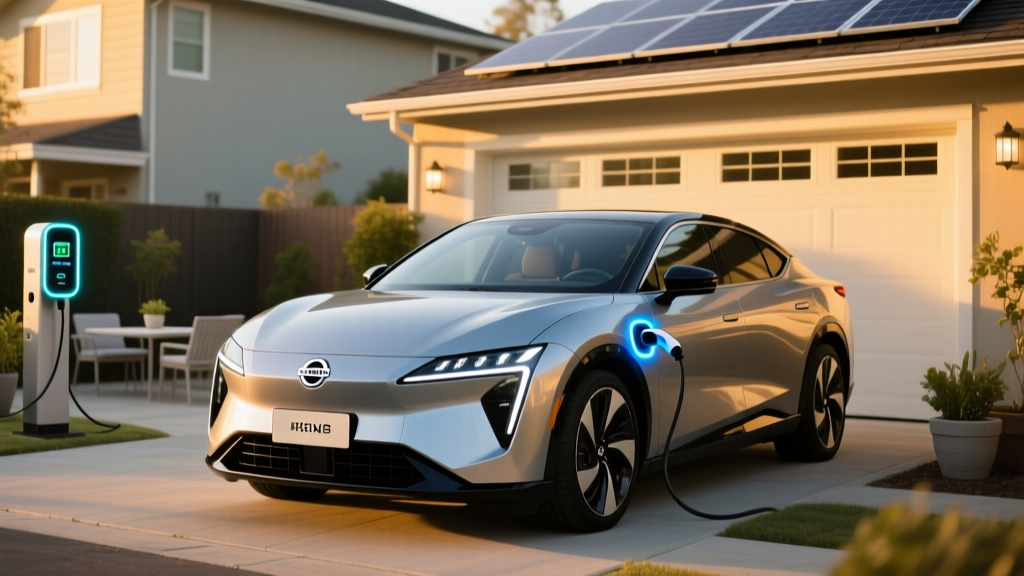
Quick Answer: The 2026 Nissan Ariya starts at $39,770 MSRP (Engage FWD) and reaches up to $55,170 (Platinum+ e-4ORCE AWD). With a 289–304 mile EPA range, a 63–87 kWh usable battery, and DC fast charging up to 130 kW, it competes directly with the Hyundai Ioniq 5, Ford Mustang Mach-E, and Volkswagen ID.4 in the mainstream electric crossover segment. Whether it qualifies as an "affordable EV" depends on your federal tax credit eligibility, home charging setup, and how you weigh its premium interior against its moderate charging speed.
What Makes the Nissan Ariya an Affordable EV Contender?
The Ariya occupies a specific niche: a midsize electric crossover with a luxury-leaning cabin, solid range, and pricing that undercuts premium rivals like the BMW iX or Mercedes EQB while staying within reach of mainstream buyers. Nissan positions the Ariya across five trims, with the base Engage FWD trim landing under $40,000 — a threshold that matters for both budget shoppers and federal tax credit MSRP caps.
For 2026, Nissan continues to offer two battery options: a 63 kWh usable (standard-range) pack on the Engage trim and an 87 kWh usable (extended-range) pack on Venture+, Evolve+, Empower+, and Platinum+ trims. Both use NMC (nickel manganese cobalt) lithium-ion chemistry, which prioritizes energy density over the cycle-life longevity of LFP packs found in some Tesla and Ford models.
| Spec | Engage FWD (Std Range) | Empower+ FWD (Ext Range) | Platinum+ e-4ORCE AWD |
|---|---|---|---|
| MSRP | $39,770 | $48,370 | $55,170 |
| EPA Range | 289 mi | 304 mi | 272 mi |
| Usable Battery | 63 kWh (NMC) | 87 kWh (NMC) | 87 kWh (NMC) |
| Horsepower | 214 hp | 238 hp | 389 hp |
| 0–60 mph | ~7.5 sec | ~7.2 sec | ~4.8 sec |
| Max DC Fast Charge | 130 kW | 130 kW | 130 kW |
| 10–80% DCFC Time | ~35 min | ~40 min | ~40 min |
| Level 2 (240V) Rate | 7.2 kW | 7.2 kW | 7.2 kW |
| MPGe (Combined) | 97 MPGe | 95 MPGe | 93 MPGe |
| Drivetrain | FWD | FWD | AWD (e-4ORCE) |
Real-World Range Expectations: The EPA rates the Ariya Empower+ FWD at 304 miles, but real-world highway driving at 70–80 mph typically yields 250–275 miles. In cold weather (below 32°F), expect a 15–25% reduction, bringing effective range to roughly 215–245 miles on the extended-range trims. The Ariya does not include a heat pump on base trims, which exacerbates cold-weather cabin heating energy draw. Plan road trips around 200–220 mile segments to preserve a safety buffer.
Nissan Ariya vs Gas SUV: The Real Cost Comparison
Shoppers cross-shopping the Ariya against gas midsize crossovers like the Toyota RAV4, Honda CR-V, or Nissan Rogue need to look beyond the sticker price. The Ariya's upfront cost is higher, but fuel and maintenance savings narrow the gap over five years — especially if you charge at home on a residential electricity rate.
| Cost Factor | 2026 Nissan Ariya Empower+ FWD | 2026 Nissan Rogue SV AWD (Gas) |
|---|---|---|
| MSRP | $48,370 | $32,500 |
| Fed. Tax Credit (§30D)* | Up to $7,500 (if eligible) | $0 |
| Effective Purchase Price | ~$40,870 | $32,500 |
| Annual Fuel/Energy Cost** | ~$620 (12,000 mi/yr) | ~$1,740 (12,000 mi/yr) |
| 5-Year Fuel/Energy Total | ~$3,100 | ~$8,700 |
| 5-Year Maintenance Est. | ~$1,200 | ~$3,000 |
| 5-Year Total Cost (excl. insurance) | ~$45,170 | ~$44,200 |
*Federal §30D tax credit eligibility requires meeting buyer income caps ($150k single / $300k joint), MSRP cap ($80k for SUVs), and battery critical-mineral/sourcing requirements. The Ariya's credit eligibility has fluctuated — always verify current status at irs.gov before purchasing.
**Energy cost assumes $0.16/kWh residential average and 3.1 mi/kWh efficiency. Gas cost assumes $3.50/gal and 33 MPG combined. Source: fueleconomy.gov.
The numbers show that even with the tax credit, the Ariya and Rogue land within $1,000 of each other over five years — but the Ariya delivers a quieter ride, instant torque, zero tailpipe emissions, and access to HOV lanes in many states. Without the tax credit, the Ariya costs roughly $8,500 more over five years, which is a meaningful premium for budget-focused buyers.
Charging the Ariya: Speeds, Costs, and Real-World Practicality
The Ariya's charging profile is its most debated spec. Its 130 kW peak DC fast-charging rate trails competitors like the Hyundai Ioniq 5 (240 kW with 800V architecture) and the Chevrolet Equinox EV (150+ kW). On a road trip, this means 10–80% in roughly 35–40 minutes, versus 18–20 minutes for the fastest rivals. For daily driving and home charging, this matters far less.
| Charging Level | Power | Miles Added per Hour | Typical Use Case |
|---|---|---|---|
| Level 1 (120V) | ~1.4 kW | ~4 mi/hr | Overnight trickle; emergency top-up |
| Level 2 (240V, 32A) | 7.2 kW | ~22 mi/hr | Home/work daily charging |
| DC Fast Charge | Up to 130 kW | ~180 mi in 30 min (peak) | Road trips; public stations |
Understanding kW vs kWh: kW (kilowatts) measures charging power — how fast energy flows into the battery. kWh (kilowatt-hours) measures battery capacity — how much energy the battery stores. The Ariya's 87 kWh battery charged at 7.2 kW (Level 2) takes about 12 hours from empty to full. At 130 kW (DCFC), the charge curve tapers significantly above 80% State of Charge, which is why manufacturers quote 10–80% times rather than 0–100%.
Home Charging Cost: A Level 2 home charger installation typically costs $800–$2,500 (charger hardware + electrician labor + permit), assuming your electrical panel has capacity. If you need a panel upgrade (200A service), add $1,500–$3,500. Charging at home at $0.16/kWh, a full 87 kWh charge costs roughly $13.92 — yielding 260+ real-world miles for less than 4 gallons of gas.
Public DCFC Cost: Networks like Electrify America and EVgo charge $0.35–$0.55/kWh in most markets. A 10–80% charge (~61 kWh on the extended-range Ariya) costs $21–$34 on the road. This erodes the cost advantage versus gas significantly, which is why home charging access is the single most important factor in EV affordability.
5-Year Total Cost of Ownership Breakdown
Let's model a realistic 5-year ownership scenario for the Ariya Empower+ FWD, assuming 12,000 miles/year, 80% home charging, and 20% public DC fast charging.
| Category | 5-Year Cost | Notes |
|---|---|---|
| Purchase (after $7,500 credit) | $40,870 | If §30D eligible; $48,370 if not |
| Home Charger Install | $1,500 | Level 2, no panel upgrade needed |
| Electricity (5 years) | $3,720 | Blended $0.19/kWh (home + public mix) |
| Maintenance | $1,200 | Cabin filter, wipers, brake fluid, tire rotation |
| Insurance (est.) | $9,500 | ~$1,900/yr — EVs often cost 10–20% more to insure |
| Tires (replacement set) | $1,100 | EV-specific tires wear faster due to torque + weight |
| Depreciation (est.) | -$18,000 | Ariya retains ~60% at 5 years; EV depreciation varies |
| Net 5-Year Cost | ~$39,890 | With tax credit; ~$47,390 without |
Insurance is the hidden cost many first-time EV buyers underestimate. The Ariya's insurance premiums run 10–20% higher than a comparable gas Rogue, driven by higher repair costs for battery-adjacent damage and EV-specific parts pricing. Always get an insurance quote before committing to a purchase.
Tire wear is another real-world expense. The Ariya's 4,400–4,800 lb curb weight and instant torque delivery accelerate tire wear compared to lighter gas crossovers. Budget for a replacement set of EV-optimized tires (like the Michelin Primacy or Hankook iON) around year 3–4.
Federal Tax Credit: Does the Ariya Qualify?
The §30D Clean Vehicle Credit can reduce your federal tax liability by up to $7,500, and as of 2024, buyers can transfer the credit to the dealer as a point-of-sale discount. However, eligibility is not guaranteed and depends on several factors that change periodically:
- MSRP Cap: The Ariya qualifies as an SUV under IRS rules, so the cap is $80,000 — all trims clear this easily.
- Buyer Income Cap: Adjusted gross income must not exceed $150,000 (single), $225,000 (head of household), or $300,000 (joint filers).
- Battery Sourcing: A percentage of critical minerals and battery components must be sourced from the US or free-trade-agreement countries. This requirement tightens annually and has disqualified several models in past years.
- Final Assembly: The Ariya is assembled in Japan, which previously disqualified it — but IRS rules now allow credits for vehicles assembled in countries with specific trade arrangements. Verify current status at fueleconomy.gov.
- Transfer at Sale: You can elect to transfer the credit to the dealer for an upfront price reduction, even if you have no federal tax liability (making it effectively a rebate).
Critical caveat: The Ariya's tax credit eligibility has been inconsistent due to its Japanese assembly and battery sourcing. Always confirm the specific trim and model year on the IRS qualified vehicle list before signing a purchase agreement. Do not rely on dealer assurances alone.
Common Misconceptions About the Ariya — Myth vs Fact
| Myth | Fact |
|---|---|
| "The Ariya charges as fast as a Tesla or Ioniq 5." | At 130 kW peak, the Ariya charges roughly 45–65% slower than 800V competitors. Road-trip stops take 35–40 min (10–80%), not 18–20. |
| "I'll get 304 miles on every charge." | EPA tests include mixed city/highway at moderate temps. Real highway driving yields ~250–275 mi; cold weather drops it to ~215–245 mi. |
| "EVs need no maintenance." | No oil changes, but the Ariya still requires cabin air filters, brake fluid checks, coolant service, wiper blades, and tire rotations. Budget ~$200–300/year. |
| "The battery will need expensive replacement." | Nissan warranties the battery for 8 years / 100,000 miles against capacity loss below 70%. NMC degradation data shows most EV batteries lose 10–15% capacity over 10 years — not catastrophic. |
| "I can't take road trips without a Tesla." | The Ariya uses the CCS1 connector and accesses Electrify America, EVgo, and ChargePoint networks. Tesla Supercharger access via adapter is expanding for CCS vehicles — check Nissan's current adapter program. |
| "ProPILOT Assist is self-driving." | ProPILOT Assist 2.0 is an SAE Level 2 driver-assistance system. It handles steering and speed on mapped highways but requires hands-on or eyes-on supervision at all times. It is not autonomous. |
SAE Automation Level — Nissan ProPILOT Assist 2.0: This is a Level 2 system. The driver remains fully responsible for vehicle operation and must maintain awareness. Level 2 systems can manage steering and acceleration simultaneously under specific conditions, but they do not replace the driver. Level 4 (true driverless) is currently limited to geofenced robotaxi services like Waymo in select cities.
Who Should Buy the Nissan Ariya — Decision Framework
Choose the Ariya if:
- You have access to Level 2 home or workplace charging (this is non-negotiable for affordability).
- You prioritize interior quality and ride comfort over maximum charging speed.
- Your daily commute is under 80 miles round-trip (most buyers).
- You want a premium-feeling EV without paying luxury-brand prices ($55k+).
- You qualify for the §30D tax credit, bringing the effective price closer to $40k.
- You value Nissan's dealer network for service accessibility in your area.
Look elsewhere if:
- You take frequent road trips of 300+ miles and need the fastest possible DC charging (consider Ioniq 5, Ioniq 6, or EV6 with 800V architecture).
- You live in an apartment without charging access and rely exclusively on public charging — the 130 kW cap means longer waits.
- You need a third row or maximum cargo space (the Ariya offers 22.8 cu ft behind the rear seats; the VW ID.4 offers 30.3 cu ft).
- You want LFP battery chemistry for maximum cycle-life longevity (consider Tesla Model Y RWD or Ford Mustang Mach-E Select).
- Cold-weather range is critical and you need a heat pump — verify whether the 2026 Ariya includes one on your chosen trim.
Frequently Asked Questions
What is the Nissan Ariya's real-world range in winter?
In temperatures below freezing, expect the Ariya's extended-range trims to deliver 215–245 miles of real-world range, a 15–25% reduction from the 304-mile EPA estimate. Cold temperatures increase battery internal resistance and cabin heating demand. Preconditioning the battery while plugged in (using the Nissan app) helps mitigate some loss by warming the pack before departure.
Does the Ariya support NACS (Tesla Supercharger) connectors?
As of 2026, the Ariya ships with a CCS1 charge port. Nissan has announced plans to adopt NACS on future models, and current CCS vehicles may access Tesla Superchargers via a Nissan-approved adapter — but confirm adapter availability and Supercharger compatibility for the Ariya specifically before relying on this for road trips. The CCS public charging network (Electrify America, EVgo) remains robust in most metro areas.
How long will the Ariya's battery last before replacement?
Nissan warranties the traction battery for 8 years or 100,000 miles, guaranteeing it will retain at least 70% of original capacity. Industry data from similar NMC packs (Leaf, Bolt, Model 3) suggests 10–15% degradation over 10 years and 100k–150k miles under normal use. Full battery replacement, if ever needed outside warranty, costs an estimated $12,000–$18,000 at current pricing — but most EV batteries outlast the vehicle's economic life.
Can I charge the Ariya on a standard 120V outlet?
Yes, but slowly. Level 1 charging at 120V delivers roughly 4 miles of range per hour — a 12-hour overnight session adds about 48 miles. This works for low-mileage drivers (under 30 miles/day) but is impractical as a primary charging method for most owners. A 240V Level 2 installation is strongly recommended and adds roughly 22 miles per hour of charging.
Is the Ariya a good first EV for someone new to electric cars?
The Ariya is a strong first-EV choice if you can install a Level 2 home charger. Its driving dynamics feel familiar (smooth, quiet, conventional crossover proportions), the infotainment system uses a straightforward dual-screen layout, and Nissan's dealer network provides accessible service. The main learning curve involves understanding charging logistics and range planning for longer trips — which applies to all EVs, not just the Ariya.
How does the Ariya's insurance cost compare to a gas SUV?
Based on national averages, expect to pay $1,700–$2,200/year for Ariya insurance, roughly 10–20% more than a comparably priced gas SUV. Higher repair costs for battery-adjacent damage, EV-specific parts, and the vehicle's higher purchase price all contribute. Get quotes from at least three insurers before purchasing — some companies (like GEICO and Progressive) offer EV-specific discounts.
Sources: fueleconomy.gov (EPA range and MPGe data), irs.gov (§30D tax credit rules), nhtsa.gov (safety ratings).