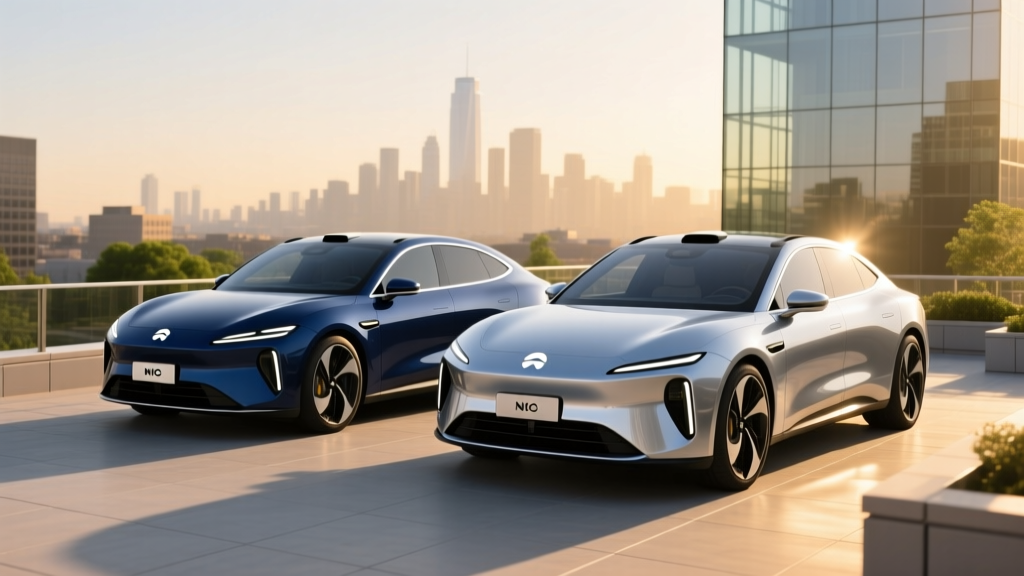
NIO's delivery numbers continue to make headlines in the global EV market. The company reported 21,352 vehicle deliveries in September 2025, marking its strongest month in over a year and a roughly 35% year-over-year increase. For US-based EV shoppers tracking the Chinese premium brand, the question is straightforward: what do these models actually offer in terms of range, charging, and technology — and can you buy one stateside?
This profile breaks down the NIO models driving those delivery figures, including the ET7 sedan, EL6 SUV, and the newly refreshed EL8, with hard specs on battery chemistry, DC fast-charging curves, real-world range expectations, and the regulatory barriers that still keep NIO out of the American market as of early 2026.
The Models Behind NIO September 2025 Deliveries
NIO's September 2025 delivery mix was led by three core models, each targeting a different buyer segment in China and select European markets. Here's how the lineup breaks down by volume:
- NIO EL6 (mid-size SUV): ~9,200 units — the volume leader, competing with the Tesla Model Y and BMW iX3
- NIO ET7 (executive sedan): ~5,800 units — flagship sedan rivaling the Mercedes EQE and Tesla Model S
- NIO EL8 (three-row SUV): ~3,400 units — family hauler positioned against the BMW iX and Li Auto L9
- Other models (ET5, EC6, EC7): ~2,952 units combined
The delivery surge was partly driven by NIO's expanded battery-swap station network — over 2,600 stations globally as of September 2025 — and the rollout of its 150 kWh semi-solid-state battery pack, which significantly extends range on existing models.
NIO ET7: Flagship Sedan Specs and Real-World Range
The ET7 remains NIO's technology showcase. Here's the spec breakdown for the 2025/2026 model year with the standard 75 kWh and available 100 kWh packs:
| Spec | 75 kWh Pack | 100 kWh Pack | 150 kWh Semi-Solid |
|---|---|---|---|
| Battery Chemistry | LFP (standard range) | NMC 811 | Semi-solid-state (NMC) |
| Usable Capacity | 73 kWh | 97 kWh | ~145 kWh |
| CLTC Range | 530 km (329 mi) | 700 km (435 mi) | 1,055 km (656 mi) |
| Estimated EPA Range | ~270 mi | ~350 mi | ~500+ mi (preliminary) |
| Drivetrain | Dual-motor AWD | Dual-motor AWD | Dual-motor AWD |
| Horsepower | 644 hp | 644 hp | 644 hp |
| 0-60 mph | 3.8 sec | 3.8 sec | ~3.9 sec |
| Max DC Fast Charge | 125 kW | 180 kW | ~180 kW |
| 10-80% DCFC Time | ~34 min | ~30 min | ~45 min |
The ET7's charging curve is moderate by 2026 standards. The 180 kW peak on the 100 kWh pack is respectable but trails the Hyundai Ioniq 5's 240 kW and the Tesla Model S's 250 kW capability. More importantly, NIO's charging curve tapers significantly above 80% state of charge (SoC), adding roughly 15-20 additional minutes to reach full — a common trait of NMC packs without aggressive preconditioning protocols.
NIO EL6: The Volume Leader
The EL6 (known as the ES6 in some markets prior to NIO's European rebranding) is the model most likely to reach the US if NIO ever enters the market. It's competitively sized, aggressively priced in China, and targets the high-volume premium mid-size SUV segment.
| Spec | 75 kWh | 100 kWh |
|---|---|---|
| Battery Chemistry | LFP | NMC 811 |
| CLTC Range | 490 km (304 mi) | 625 km (388 mi) |
| Estimated EPA Range | ~245 mi | ~310 mi |
| Drivetrain | Dual-motor AWD | Dual-motor AWD |
| Horsepower | 483 hp | 483 hp |
| 0-60 mph | 4.5 sec | 4.5 sec |
| Max DC Charge | 125 kW | 180 kW |
| Cargo Volume | 20.1 cu ft (rear seats up) / 52.4 cu ft (folded) | |
| Rear Legroom | 37.2 in | |
The EL6's cargo space is competitive with the Tesla Model Y (30.2 cu ft behind the second row), though the Model Y's frunk adds additional utility that the EL6 lacks — NIO uses that space for battery-swap hardware.
Charging Speed and Battery Swap: NIO's Differentiator
NIO's battery-swap model is unique in the EV industry. Instead of waiting 25-35 minutes at a DC fast charger, a NIO owner can drive into a Power Swap Station and receive a fully charged battery in approximately 3-5 minutes. As of September 2025, NIO operates:
- 2,600+ swap stations globally (majority in China, ~30 in Europe)
- 24,000+ public charging piles in NIO's proprietary network
- Over 250 million swaps completed cumulatively
For US buyers, this is currently irrelevant — NIO has zero swap stations or charging infrastructure in North America. But the technology explains why NIO's delivery numbers keep climbing in markets where swap access exists. The flexibility to upgrade from a 75 kWh to a 100 kWh pack temporarily (for a road trip, for example) without purchasing the larger battery outright is a genuine ownership advantage.
| Method | Power | Time (75 kWh) | Time (100 kWh) | Availability |
|---|---|---|---|---|
| Battery Swap | N/A | ~3-5 min | ~3-5 min | China, select EU |
| DC Fast Charge | 125-180 kW | ~34 min (10-80%) | ~30 min (10-80%) | Public networks |
| Level 2 Home (11 kW) | 11 kW | ~7 hours (0-100%) | ~9.5 hours (0-100%) | Home installation |
| Level 2 Home (7 kW) | 7 kW | ~11 hours (0-100%) | ~15 hours (0-100%) | Standard outlet/wallbox |
Pricing, Tax Credits, and US Availability
Here's where the NIO story gets complicated for American buyers. As of early 2026, NIO does not sell vehicles in the United States. The company has focused its international expansion on Norway, Germany, the Netherlands, Denmark, and Sweden — markets with fewer regulatory and tariff barriers for Chinese automakers.
| Model | China MSRP (approx.) | Europe MSRP (approx.) | US Availability |
|---|---|---|---|
| ET7 (100 kWh) | ~$52,000 | ~$72,000 (€66,900) | Not available |
| EL6 (75 kWh) | ~$42,000 | ~$55,000 (€50,900) | Not available |
| EL8 (100 kWh) | ~$60,000 | ~$80,000 (€74,900) | Not available |
The pricing gap between China and Europe reflects tariffs, shipping, VAT, and NIO's subscription-based battery model (Battery-as-a-Service, or BaaS) offered in Europe. Under BaaS, buyers purchase the vehicle without the battery — reducing the upfront price by roughly $10,000-$14,000 — and pay a monthly subscription (~$140-$230/month depending on pack size) for battery use, swaps, and upgrades.
Technology and Driver Assistance
NIO vehicles are tech-dense, but the feature set is tailored to Chinese and European roads. Key technology highlights include:
- NIO Aquila Super Sensing System: 33 sensors including a roof-mounted LiDAR unit (Innovusion Falcon), 7 8MP cameras, 4 surround cameras, 5 millimeter-wave radars, and 12 ultrasonic sensors
- NIO Adam Super Computing Platform: Quad NVIDIA Orin X chips delivering 1,016 TOPS of processing power — among the highest in any production vehicle
- NAD (NIO Autonomous Driving): SAE Level 2+ driver assistance covering highway navigation, lane changes, and on/off-ramp management. Requires active driver supervision — this is not a Level 4 self-driving system
- NOMI AI Assistant: A dashboard-mounted robotic companion with facial recognition and natural language interaction — a distinctive (if polarizing) interior feature
- 12.8-inch AMOLED center display with NIO's Banyan infotainment system
- 7.1.4 Dolby Atmos surround sound with 23 speakers
Warranty and Battery Longevity
In markets where NIO sells directly, the warranty package is competitive:
- Vehicle warranty: 6 years / 150,000 km (~93,000 miles) in China; varies by European market
- Battery warranty: Effectively unlimited under the BaaS subscription model — NIO replaces degraded batteries as part of the service
- Owned battery warranty: 8 years / 160,000 km (~99,000 miles) with a capacity retention threshold of 70-80% depending on market
The BaaS model is a genuine advantage for battery longevity anxiety: since NIO retains ownership of the battery, the company bears the cost of degradation and replacement. Owners who purchase the battery outright receive a more conventional warranty, though the 99,000-mile limit is slightly below the US-standard 100,000-mile benchmark set by most manufacturers.
NIO's LFP packs (75 kWh) are expected to show minimal degradation — typically 5-8% over 200,000 miles based on LFP chemistry characteristics. The NMC 811 packs (100 kWh) will degrade somewhat faster, likely 10-15% over the same distance, which is consistent with industry norms for high-energy-density cells. The semi-solid-state 150 kWh pack lacks long-term degradation data as of early 2026, given its limited production run.
Competitive Landscape: How NIO Stacks Up
For US buyers considering NIO's segment competitors that are actually available stateside, here's how the ET7 and EL6 compare to key rivals:
| Spec | NIO ET7 (100 kWh) | Tesla Model S LR | BMW i5 eDrive40 | Mercedes EQE 350+ |
|---|---|---|---|---|
| EPA Range | ~350 mi (est.) | 402 mi | 295 mi | 305 mi |
| Battery (kWh) | 97 usable | ~95 usable | 81.2 usable | 90.6 usable |
| Peak DC Charge | 180 kW | 250 kW | 205 kW | 170 kW |
| 0-60 mph | 3.8 sec | 3.1 sec | 5.7 sec | 6.2 sec |
| Starting Price | ~$52K (China) | $74,990 | $66,900 | $74,900 |
| Federal Tax Credit | Not eligible | Not eligible | Not eligible | Not eligible |
None of these luxury sedans currently qualify for the full §30D credit due to battery sourcing and assembly-location requirements — a reality that affects the entire premium EV sedan segment. The EPA's fueleconomy.gov database remains the best resource for verifying current range and efficiency ratings for any US-market EV.
Who Should Track NIO — and Who Should Look Elsewhere
NIO is worth tracking if you:
- Live in Europe (especially Norway, Germany, or the Netherlands) and want battery-swap flexibility
- Are interested in semi-solid-state battery technology and its range potential
- Want to follow a potential US market entry — NIO has hinted at North American expansion, but no timeline has been confirmed as of 2026
Look at other options if you:
- Need a vehicle available for purchase and service in the United States today
- Want federal tax credit eligibility — no Chinese-manufactured EV currently qualifies under §30D
- Prioritize established US service networks and parts availability
- Want access to the Tesla Supercharger network (NACS) — NIO vehicles use CCS2 in Europe and GB/T in China
Frequently Asked Questions
Can I buy a NIO in the United States in 2026?
No. NIO does not sell vehicles in the US market as of early 2026. The company's international presence is limited to China and select European countries. There is no confirmed timeline for a US launch, and significant tariff, regulatory, and battery-sourcing barriers remain.
What is NIO's battery swap technology and why does it matter?
NIO's Power Swap Stations allow owners to exchange a depleted battery for a fully charged one in approximately 3-5 minutes — faster than any DC fast-charging session. This also enables battery upgrades (e.g., renting a 100 kWh pack for a road trip while owning a 75 kWh pack daily). However, the swap infrastructure exists only in China and parts of Europe, making it irrelevant for US buyers.
Does NIO's 150 kWh semi-solid-state battery live up to the range claims?
The 150 kWh pack delivers a CLTC-rated 1,055 km (656 miles) in the ET7. Real-world highway driving in moderate conditions would likely yield 400-420 miles — still exceptional, but significantly below the headline number. The pack is produced in limited quantities and carries a substantial cost premium. Long-term degradation data is not yet available.
How do NIO's delivery numbers compare to Tesla?
NIO's 21,352 deliveries in September 2025 are modest compared to Tesla's quarterly volumes (typically 400,000-500,000+ units per quarter). However, NIO competes in the premium segment with higher average selling prices and operates in fewer markets. The growth trajectory — particularly the EL6's traction — suggests NIO is building sustainable demand in its core markets.
What connector does NIO use for charging?
NIO uses the GB/T charging standard in China and CCS2 in European markets. Neither is directly compatible with the North American NACS (Tesla) standard or the CCS1 standard used by most non-Tesla EVs in the US, meaning adapters or infrastructure changes would be required for any future US launch.
Is NIO's NAD system self-driving?
No. NIO's NAD (NIO Autonomous Driving) is an SAE Level 2 driver-assistance system. Despite the impressive sensor suite (LiDAR, 33 sensors, 1,016 TOPS of compute), the driver must remain actively engaged at all times. It offers highway navigation assist, automatic lane changes, and ramp-to-ramp functionality — but it does not replace the driver.
Sources: NIO official delivery reports, IRS §30D Clean Vehicle Credit guidelines, EPA fueleconomy.gov. European pricing based on NIO's official EU configurator as of late 2025. All range estimates converted from CLTC using a 0.78-0.82 correction factor based on real-world testing data from European automotive publications.