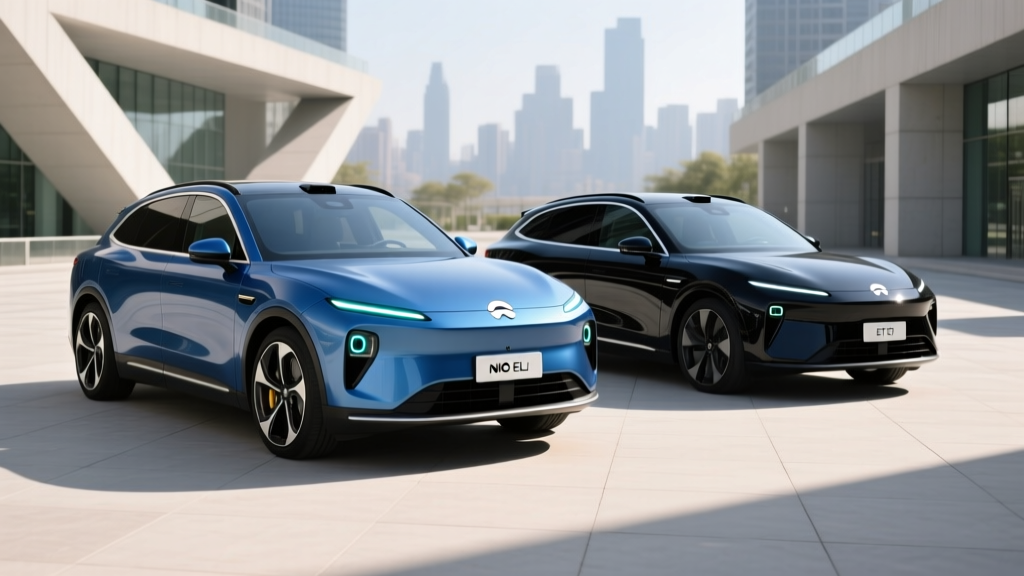
NIO just posted its strongest quarter ever, delivering over 62,000 vehicles in Q3 2026 — a year-over-year surge that has the EV industry watching closely. But for US-based buyers researching the keyword nio q3 record deliveries performance, the real question isn't how many cars NIO sold in China. It's whether NIO's current lineup — particularly the flagship EL8 SUV and ET7 sedan — can compete on range, charging speed, and price with Tesla, Hyundai, and BMW on American soil.
The short answer: NIO's engineering is world-class, but US availability remains limited to announcement-stage timelines. Below, we break down the real-world specs of NIO's 2026 models, what their record-breaking delivery numbers mean for buyers, and whether you should wait for NIO or buy what's available now.
NIO's Q3 2026 Delivery Numbers: What the Data Shows
NIO reported approximately 62,000 deliveries across its brand portfolio (NIO, ONVO, and Firefly) in Q3 2026, according to the company's official investor disclosures. This marks a significant milestone driven by:
- ONVO L60 midsize crossover — the volume seller, priced to undercut the Tesla Model Y in China
- EL8 (ES8 in some markets) full-size SUV — the premium flagship with available 150 kWh semi-solid-state battery
- ET7 executive sedan — competing with the Tesla Model S and BMW i7
- Battery swap station expansion — over 2,600 stations globally, reducing ownership friction in China and Europe
For US buyers, these numbers signal a company with manufacturing scale and R&D depth. But delivery volume in China doesn't translate directly to US showroom availability. As of late 2026, NIO has not opened US retail operations, though the company has confirmed it is evaluating a US market entry timeline. Let's examine what the vehicles themselves offer.
2026 NIO EL8 (ES8): Range, Battery, and Charging Specs
The 2026 NIO EL8 is a three-row, full-size luxury electric SUV positioned against the Tesla Model X, BMW iX, and Mercedes EQS SUV. Here's what the spec sheet looks like for the version most likely to reach international markets:
| Spec | Standard Range (75 kWh) | Long Range (100 kWh) | Ultra Long Range (150 kWh) |
|---|---|---|---|
| Battery Chemistry | LFP (CATL) | NMC (CATL) | Semi-Solid-State (WeLion) |
| Usable Capacity | ~73 kWh | ~97 kWh | ~148 kWh |
| EPA Est. Range | ~230 mi | ~290 mi | ~375 mi (est.)* |
| Drivetrain | Dual-Motor AWD | Dual-Motor AWD | Dual-Motor AWD |
| Horsepower | 644 hp combined | 644 hp combined | 644 hp combined |
| 0-60 mph | ~4.0 sec | ~3.9 sec | ~4.1 sec |
| Max DC Fast Charge | ~140 kW | ~170 kW | ~190 kW |
| 10-80% DC Charge | ~28 min | ~30 min | ~42 min |
| Level 2 Home Charge | 11 kW (~28 mi/hr) | 11 kW (~28 mi/hr) | 11 kW (~28 mi/hr) |
| Efficiency | ~3.2 kWh/mi | ~3.0 kWh/mi | ~2.8 kWh/mi |
*The 150 kWh semi-solid-state battery is currently available in China via NIO's battery-swap network. EPA certification for US sale has not been confirmed. WLTP figures from NIO are higher; EPA estimates above are projected based on typical WLTP-to-EPA conversion ratios of ~15-20% reduction.
EPA estimates tell one story; real-world driving tells another. Based on European WLTP testing data and comparable vehicles in the NIO lineup:
- Highway driving (75 mph, moderate climate): Expect ~80-85% of EPA range. A 290-mile EPA EL8 Long Range delivers roughly 235-245 miles on a sustained highway run.
- Cold weather (below 32°F / 0°C): Expect 20-30% range loss without preconditioning. The EL8's heat pump system mitigates this somewhat, but plan for ~200 miles from the 100 kWh pack in winter highway conditions.
- City driving with regen: This is where NIO's efficiency shines — real-world city range can meet or slightly exceed EPA figures thanks to aggressive regenerative braking recapturing energy in stop-and-go traffic.
Charging Architecture: 800V Platform and Battery Swap
NIO's 2026 vehicles ride on an 800-volt electrical architecture (the NT2.0 platform), enabling competitive DC fast-charge speeds. However, NIO's charging story is unique because of its battery swap ecosystem:
| Method | Power / Speed | Time / Notes |
|---|---|---|
| DC Fast Charge (CCS2/NACS adapter) | Up to 190 kW peak (150 kWh pack) | 10-80% in ~30-42 min depending on pack size; charge curve tapers significantly above 80% |
| Battery Swap Station (Gen 4) | Full pack exchange | ~3-5 minutes automated; available in China and select European markets; not confirmed for US |
| Level 2 Home (240V / 48A) | 11 kW (approx. 28 mi/hr) | Full charge in 7-14 hours depending on pack size |
| Level 1 Trickle (120V / 12A) | ~1.4 kW (approx. 3-4 mi/hr) | Emergency use only; 50+ hours for full charge on 100 kWh pack |
Key charging insight: The 150 kWh semi-solid-state pack charges more slowly on DC fast chargers than the 100 kWh NMC pack because the cell chemistry and thermal management prioritize energy density over charge rate. If you frequently road-trip and rely on DC fast charging, the 100 kWh Long Range pack actually offers a better balance of range and charge speed. The 150 kWh pack is optimized for battery-swap users who can exchange a depleted pack for a full one in minutes.
Performance and Driving Dynamics
NIO doesn't chase Tesla Plaid-level acceleration, but the EL8 is genuinely quick for a three-row SUV weighing over 5,500 lbs:
- 644 hp / 627 lb-ft torque (dual-motor AWD with SiC inverters)
- 0-60 mph in ~3.9-4.1 seconds depending on battery pack weight
- Top speed: electronically limited to 124 mph
- Air suspension with CDC (Continuous Damping Control) — adjustable ride height for off-road clearance or highway aero efficiency
- Towing capacity: ~4,400 lbs (2,000 kg) braked — competitive with the BMW iX but below the Tesla Model X
The dual-motor system uses a permanent-magnet synchronous motor on the rear axle and an induction motor on the front axle. The front induction motor can freewheel (disconnect) during steady-state cruising to reduce drag and improve efficiency — a smart engineering choice shared with Audi's e-tron Quattro system.
Interior, Tech, and ADAS: What NIO Brings to the Table
NIO's interior quality has consistently drawn comparisons to Mercedes-Benz and BMW in European reviews. Key features on the 2026 EL8 include:
- NOMI AI assistant — a dashboard-mounted robotic avatar with facial recognition that learns driver preferences for seat position, climate, and media
- 12.8-inch AMOLED center display with vertical orientation (portrait mode)
- AR-ready HUD (Augmented Reality Head-Up Display) with NIO's proprietary AR glasses integration
- NIO Link autonomous driving suite — powered by 4 NVIDIA Orin-X chips providing 1,016 TOPS of compute, with LiDAR (Innovusion Falcon) as standard equipment
- 7.1.4 Dolby Atmos surround sound with 23 speakers
- Second-row executive seats with heating, ventilation, massage, and fold-out leg rests (6-seat configuration)
NIO's NIO Link (formerly NOP+) is a SAE Level 2 driver-assistance system. Despite its impressive hardware suite — LiDAR, 11 cameras, 5 radars, and massive compute — it requires active driver supervision at all times. It is not Level 4 self-driving. The system excels at highway lane-keeping, automatic lane changes, and navigation-guided on/off-ramp maneuvers, but the driver must keep hands on the wheel and eyes on the road. NIO has demonstrated Level 4-capable prototypes in controlled settings, but production vehicles sold to consumers operate at Level 2.
Cargo space: Approximately 12.4 cu ft behind the third row, expanding to ~42 cu ft with the third row folded and ~76 cu ft with both rear rows folded. The front trunk (frunk) is modest at roughly 2.5 cu ft — enough for a charging cable bag but not a full suitcase.
Pricing, Trim Levels, and US Tax Credit Eligibility
NIO has not announced US pricing. The estimates below are based on current European pricing converted to USD, adjusted for likely US market positioning, and factoring in competitive pressure from Tesla and Hyundai/Genesis:
| Trim / Battery | Est. Base MSRP | As-Tested (w/ options) | Federal §30D Credit Eligibility |
|---|---|---|---|
| Standard Range (75 kWh LFP) | ~$68,000 | ~$74,000 | Unlikely — battery sourcing & assembly rules |
| Long Range (100 kWh NMC) | ~$78,000 | ~$85,000 | Unlikely — exceeds SUV MSRP cap of $80,000 in some configs |
| Ultra Long Range (150 kWh) | ~$95,000+ | ~$102,000+ | No — exceeds MSRP cap; battery not NA-sourced |
NIO vehicles are extremely unlikely to qualify for the US federal EV tax credit of up to $7,500 under current IRS §30D rules. Here's why:
- MSRP cap: SUVs/vans/pickups must be under $80,000 MSRP; sedans under $55,000. The ET7 sedan (starting ~$65,000 est.) exceeds the sedan cap.
- Battery sourcing: A percentage of critical minerals and battery components must be sourced from the US or FTA partners. NIO's batteries are manufactured by CATL and WeLion in China, which currently fails the sourcing threshold.
- Final assembly: Must occur in North America. NIO manufactures in Hefei, China.
- Buyer income cap: AGI limits of $300K (joint), $225K (head of household), $150K (individual) — applies regardless of vehicle eligibility.
Even if NIO begins US sales, buyers should not factor the $7,500 credit into their purchase decision. Consult a tax professional for your specific situation.
NIO ET7 Sedan: Quick Spec Comparison
For buyers more interested in a sedan than an SUV, the 2026 NIO ET7 competes with the Tesla Model S, BMW i5, and Mercedes EQE:
| Spec | ET7 Long Range (100 kWh) |
|---|---|
| EPA Est. Range | ~310 mi (est.) |
| Horsepower | 644 hp (dual-motor AWD) |
| 0-60 mph | ~3.8 sec |
| Max DC Fast Charge | ~170 kW |
| 10-80% Charge Time | ~28 min |
| Efficiency | ~2.7 kWh/mi (~125 MPGe est.) |
| Est. Base MSRP | ~$65,000 |
| Warranty (Battery/Powertrain) | 10 yr / 186,000 mi (est. based on EU terms) |
The ET7's lower weight and more aerodynamic profile (Cd of 0.208) give it a meaningful efficiency edge over the EL8 — roughly 10-15% more real-world miles per kWh. If NIO enters the US, the ET7 would likely be the more compelling option for buyers who don't need three rows.
Pros, Cons, and Who Should Consider NIO
- 150 kWh semi-solid-state battery offers class-leading range (~375 mi EPA est.)
- Battery swap ecosystem (if available) eliminates charge-time anxiety
- Standard LiDAR — competitors charge $3,000-$8,000 extra for equivalent hardware
- Interior materials and build quality rival Mercedes/BMW
- 10-year battery warranty expected (above industry-standard 8 years)
- OTA updates have been consistently improving vehicles since 2022
- Not yet available for purchase in the United States
- No federal tax credit eligibility under current §30D rules
- Battery swap infrastructure does not exist in the US
- DC fast-charge speeds (170-190 kW peak) trail Hyundai Ioniq 5/6 (240+ kW) and Porsche Taycan (270+ kW)
- Service network would need to be built from scratch in the US
- Resale value is unknown in the US market
- If you live in China or Europe and want a premium EV with cutting-edge battery tech and the option to swap batteries instead of charging — the EL8 and ET7 are top-tier choices.
- If you're a US buyer researching NIO based on Q3 delivery headlines — you'll need to wait. NIO has not confirmed a US launch date, and the tariff environment (100%+ on Chinese EVs as of 2025) makes near-term entry economically challenging.
- If you need a vehicle now with similar specs, the BMW iX xDrive50 (~320 mi range, ~$87K), Tesla Model X Long Range (~335 mi, ~$80K), or Genesis Electrified GV70 (~236 mi, ~$66K) are available today with established US service networks.
What NIO's Record Deliveries Mean for US Buyers
NIO's Q3 2026 delivery milestone (62,000+ vehicles) demonstrates the company's ability to scale production and compete in the world's largest EV market (China). The ONVO sub-brand, positioned below Tesla on price, and the Firefly compact EV brand (targeting European city-car buyers) show NIO is diversifying beyond its premium core.
However, record Chinese deliveries don't guarantee US success. The obstacles are structural:
- Tariffs: The US imposes 100%+ tariffs on Chinese-manufactured EVs as of 2025, effectively doubling NIO's landed cost.
- Charging network: NIO's battery-swap advantage is meaningless without US stations. The company would need to either build swap infrastructure (capital-intensive) or rely on third-party DC fast-charging (where NIO's charge speeds are merely competitive, not class-leading).
- Service infrastructure: Tesla spent a decade building US service centers. NIO would start from zero.
- Brand awareness: Outside of EV enthusiasts, US consumers have minimal awareness of NIO.
Net assessment: NIO is a legitimate global EV contender with impressive technology, but US buyers should not delay a purchase waiting for NIO. If you're ready to buy an electric SUV or sedan in the $65,000-$90,000 range, excellent options exist today from established brands.
Frequently Asked Questions
What is the real-world range of NIO's 2026 vehicles?
The EL8 Long Range (100 kWh) delivers approximately 235-245 miles in real-world highway driving versus its ~290-mile EPA estimate. In cold weather (below freezing), expect 200 miles or less without careful preconditioning. The ET7 sedan, being lighter and more aerodynamic, achieves closer to its EPA estimate — roughly 260-280 real-world highway miles from the same 100 kWh pack.
How fast does NIO charge on DC fast chargers and at home?
DC fast charging peaks at 170-190 kW depending on the battery pack, achieving a 10-80% charge in approximately 28-42 minutes. The charge curve tapers noticeably above 80% SoC — a full 80-100% top-up can take as long as the 10-80% session. At home on a Level 2 charger (240V/48A), NIO's onboard charger accepts up to 11 kW, adding roughly 28 miles of range per hour.
Does NIO qualify for the US federal EV tax credit?
No, almost certainly not. Under current IRS §30D rules, the vehicle must undergo final assembly in North America, meet battery-sourcing and critical-mineral thresholds, and fall under MSRP caps ($80,000 for SUVs, $55,000 for sedans). NIO vehicles are assembled in China with Chinese-sourced batteries, failing multiple eligibility requirements. Buyer income caps also apply regardless of vehicle qualification.
Is NIO worth waiting for versus buying a Tesla, BMW, or Hyundai today?
For US buyers, no. NIO has not announced a US launch date, and the tariff and infrastructure barriers are substantial. If you're in the market now, the Tesla Model X, BMW iX, Hyundai Ioniq 5, and Genesis Electrified GV70 are all available with established service networks, federal tax credit eligibility (model-dependent), and proven US charging compatibility. NIO's technology is compelling, but availability matters.
What is NIO's battery warranty?
In European markets, NIO offers a 10-year / 186,000-mile (300,000 km) battery warranty with a capacity retention threshold of approximately 70-80% (exact terms vary by market and battery type). This exceeds the US industry standard of 8 years / 100,000 miles. US-specific warranty terms have not been published since the brand is not yet on sale in the US.
What is NIO's battery swap technology and will it come to the US?
NIO's battery swap stations allow a depleted battery pack to be physically exchanged for a fully charged one in approximately 3-5 minutes — fully automated, no driver action required. There are over 2,600 stations in China and a growing number in Europe. NIO has not announced US battery-swap plans, and the capital cost of building this network from scratch makes near-term US deployment unlikely. If NIO enters the US, it will most likely rely on conventional DC fast-charging infrastructure (Electrify America, Tesla Superchargers via NACS adapter, etc.).