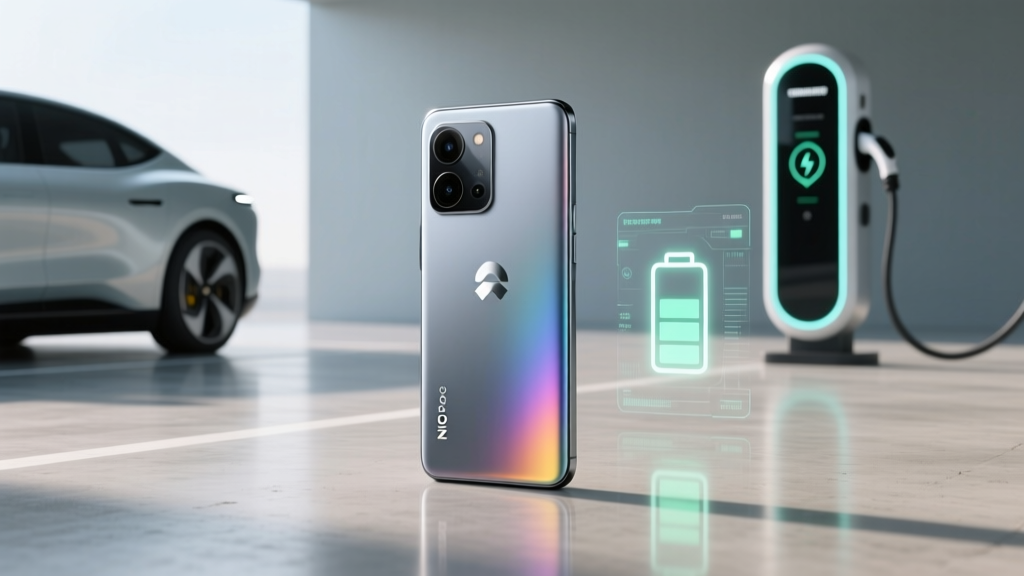
NIO makes electric vehicles — the ET7 sedan, the ES8 SUV, the ET9 flagship. But since late 2023, the Chinese automaker has also made a smartphone. The NIO Phone isn't a generic Android device with a car-brand sticker slapped on it. It's a purpose-built handset designed to serve as a seamless extension of NIO's vehicle ecosystem, functioning as a digital key, a secondary infotainment controller, and a remote vehicle-management tool.
For US-based EV shoppers, the NIO Phone raises an immediate question: NIO doesn't sell cars in America, so why should you care? The answer depends on whether you're tracking NIO's potential market entry, evaluating how deeply phone-car integration can go, or simply comparing the NIO Phone's approach to the Apple CarPlay/Android Auto paradigm that dominates the US market. This review breaks down the NIO Phone's hardware, software, vehicle integration, and practical value.
NIO Phone Hardware Specifications
The NIO Phone is a flagship-tier Android smartphone. Its hardware competes directly with the Samsung Galaxy S23 Ultra and OnePlus 11 — not surprising, given that NIO recruited talent from the smartphone industry (including former Meitu executive Li Bin overseeing the project). Here's what's inside:
| Specification | NIO Phone (1st Gen) |
|---|---|
| Processor | Qualcomm Snapdragon 8 Gen 2 |
| Display | 6.81-inch AMOLED, 2K (3089×1440), 120Hz LTPO |
| RAM / Storage | 12GB / 256GB or 16GB / 512GB (1TB edition available) |
| Rear Cameras | 50MP main (Sony IMX890) + 50MP ultrawide + 12MP telephoto (2x) |
| Battery | 5,200 mAh, 66W wired fast charging, 50W wireless |
| OS | SkyUI (Android 13 base, bloatware-free) |
| NFC / UWB | Yes — digital car key with UWB precision |
| Weight | 212g |
| Dedicated Car Button | Yes — physical side button for vehicle controls |
The standout hardware feature is the dedicated physical car-control button on the left side of the phone. Press it once to unlock your NIO vehicle; press and hold to activate remote climate preconditioning; double-press to summon the car in a parking lot. This button works even when the phone screen is off and, critically, even when the phone battery is dead — the NFC/UWB chip draws residual power for up to 48 hours after the phone shuts down.
Vehicle Integration: What the NIO Phone Actually Does
The NIO Phone's value proposition isn't raw hardware — it's how deeply it integrates with NIO vehicles. Here's the functional breakdown:
Digital Key with UWB Precision
Ultra-Wideband (UWB) technology allows the phone to communicate with the car with centimeter-level spatial accuracy. As you approach your NIO vehicle, the car detects the phone's exact position and unlocks the correct door. Walk away, and it locks. No fumbling for a fob, no pulling out the phone. This is the same UWB technology Apple uses for AirTags, but applied to vehicle access.
Infotainment Mirroring and Control
When you enter a NIO vehicle, the phone's interface can mirror onto the car's center display — not as a clunky screen-cast, but as a native-feeling extension. You can browse navigation on the phone and push it to the car screen, manage media, adjust vehicle settings (suspension height, drive mode, regen strength), and even use the phone as a rear-seat entertainment controller for NIO's NOMI robot assistant.
Remote Vehicle Management
The NIO Phone app provides real-time vehicle telemetry: remaining range (in km), battery State of Charge (SoC), tire pressures, cabin temperature, and charging status. You can precondition the cabin, activate the seat heaters, or start a charging session remotely. For NIO's battery-swap stations, the phone can queue you for a swap and notify you when it's your turn.
Seamless Navigation Handoff
Set a destination on your phone while walking to the car, and the navigation transfers to the vehicle's display the moment you sit down. Arrive and exit the car, and the last-mile walking directions appear on the phone. This handoff is instantaneous — no Bluetooth pairing delay, no app launching.
Pricing and Availability
The NIO Phone launched in China in September 2023 and received a second-generation update in late 2024. Pricing in the Chinese market:
| Model | RAM/Storage | Price (CNY) | Approx. USD |
|---|---|---|---|
| NIO Phone (Gen 2) Standard | 12GB / 256GB | ¥6,499 | ~$900 |
| NIO Phone (Gen 2) Pro | 16GB / 512GB | ¥6,899 | ~$955 |
| NIO Phone (Gen 2) Edition | 16GB / 1TB | ¥7,499 | ~$1,040 |
NIO vehicle owners in China receive a subsidy that effectively reduces the phone price by approximately ¥3,000–¥5,000 depending on their NIO loyalty tier, making the effective cost as low as ~$480 for existing owners.
How the NIO Phone Compares to US Alternatives
The NIO Phone's approach raises a broader question: is a dedicated automaker phone better than the Apple/Google ecosystem most US drivers rely on? Here's how the integration models compare:
| Feature | NIO Phone + NIO Vehicle | iPhone + CarPlay / Digital Key | Android + Android Auto / Digital Key |
|---|---|---|---|
| UWB digital key | Native, car-specific button | Available on BMW, Hyundai, Genesis (CCC Digital Key) | Available on select BMW, Hyundai models |
| Deep vehicle settings control | Full — suspension, drive modes, regen, swap queue | Limited — mostly infotainment + climate via app | Limited — app-based, varies by brand |
| Nav handoff (phone ↔ car) | Seamless, instant | Possible via CarPlay but not native | Possible via Android Auto but not native |
| Battery-swap / charging integration | Native queue management | N/A | N/A |
| Works with multiple car brands | No — NIO only | Yes — hundreds of models | Yes — hundreds of models |
| OS updates / longevity | Uncertain — NIO's commitment TBD | 5-7 years (Apple) | 3-7 years (varies by OEM) |
The takeaway: the NIO Phone offers deeper integration with one brand at the cost of ecosystem lock-in. Apple CarPlay and Android Auto offer broader compatibility with less depth. For a NIO owner in China, the phone is genuinely useful. For everyone else, it's a technology demonstration of what phone-car integration could look like if automakers controlled the full stack.
SkyUI Software: Clean but Unproven
NIO built SkyUI on top of Android 13 with a stated philosophy of "zero ads, zero bloatware." In practice, the OS is clean — no pre-installed third-party apps, no system-level advertisements (a common complaint with Chinese Android skins like MIUI and ColorOS). The interface is fast, the animations are smooth, and the NIO-specific vehicle integration layer is well-designed.
However, SkyUI faces the same challenge as every small-scale Android fork: long-term software support. NIO has committed to 3 years of OS updates and 4 years of security patches. That's adequate but falls short of Samsung's 7-year commitment for the Galaxy S24 series and Google's 7-year pledge for the Pixel 8. If you're spending $900+ on a phone, you want it to last.
The camera system is competent but not class-leading. The Sony IMX890 sensor produces good daylight shots with accurate color, but low-light performance and video stabilization lag behind the iPhone 15 Pro and Galaxy S24 Ultra. NIO is a car company first; computational photography isn't their core competency.
Who Should Buy the NIO Phone?
✓ Worth it if:
- You own a NIO vehicle in China and want the deepest possible phone-car integration
- You use NIO's battery-swap network and want queue management on your phone
- You value a bloatware-free Android experience and don't mind a smaller ecosystem
- You want a physical car-control button that works without unlocking the phone
✗ Skip it if:
- You live outside China (no vehicle integration, limited cellular support, no warranty)
- You need best-in-class camera performance
- You want guaranteed long-term OS support (5+ years)
- You drive a non-NIO vehicle — the car-specific features become irrelevant
- You prefer iOS or are locked into the Apple/Google ecosystem
What the NIO Phone Signals for the EV Industry
NIO isn't the first automaker to dabble in consumer electronics — recall the Porsche Design phones and the Tesla-branded accessories. But the NIO Phone represents something different: a strategic bet that the phone-car interface is a competitive moat worth owning.
The logic mirrors Apple's vertical integration philosophy. By controlling both the phone and the car, NIO can deliver experiences that third-party platforms (CarPlay, Android Auto) can't replicate: instant navigation handoff, UWB-based spatial awareness, battery-swap queueing, and vehicle-setting adjustments that go beyond what standard Bluetooth APIs allow.
For US consumers watching from afar, the NIO Phone is a preview of where the industry might head. Polestar has explored phone-car integration. Xiaomi, which launched the SU7 EV in 2024, already has a massive smartphone ecosystem to leverage. The convergence of phone and car is happening — NIO is simply further along than most Western automakers.
Frequently Asked Questions
Is the NIO Phone available in the United States?
No. The NIO Phone is sold only in China. NIO has not announced plans to sell the phone — or its vehicles — in the US market as of 2026. You can import one, but you'll lose warranty coverage, vehicle integration (no US NIO cars), and some cellular band support.
Does the NIO Phone work with non-NIO vehicles?
As a smartphone, yes — it runs Android and works with any Bluetooth-equipped car for calls, media, and standard apps. However, the vehicle-specific features (UWB digital key, deep settings control, battery-swap queueing, navigation handoff) only function with NIO vehicles.
How does the NIO Phone compare to using CarPlay or Android Auto?
CarPlay and Android Auto project your phone's apps onto the car screen but don't deeply integrate with vehicle systems. The NIO Phone goes further: it controls suspension settings, drive modes, regen levels, and battery-swap logistics — things CarPlay/Android Auto can't touch. The tradeoff is that CarPlay/Android Auto work with hundreds of car models; the NIO Phone works with one brand.
Will NIO release a second-generation phone?
NIO released the second-generation NIO Phone in late 2024 with an upgraded Snapdragon 8 Gen 3 processor and improved cameras. The company has indicated it will continue iterating on the device annually, though specific 2026 model details have not been confirmed.
Is the NIO Phone eligible for any US tax credits?
No. The IRS §30D federal tax credit applies to qualified plug-in electric vehicles, not consumer electronics. Smartphones do not qualify regardless of their vehicle-integration features. See IRS guidelines on clean vehicle credits for eligible vehicle categories.
What happens to the digital key if the NIO Phone battery dies?
NIO designed the NFC/UWB chip to draw residual power for approximately 48 hours after the phone battery is fully depleted. During this window, the phone can still unlock and start the vehicle. After 48 hours, you'll need to charge the phone or use a backup key fob.
Bottom Line
The NIO Phone is the most compelling argument yet for automaker-built smartphones — if you own a NIO vehicle. Its UWB digital key, physical car-control button, and deep vehicle-systems access demonstrate what phone-car integration looks like when one company controls both ends. For US buyers, it remains a fascinating case study rather than a purchasable product. Watch for Xiaomi, Polestar, and potentially Tesla to pursue similar strategies in Western markets.