The Onvo L60: Nio's Tesla Model Y Challenger Explained
Nio launched its Onvo sub-brand in 2024 with a single mission: undercut the Tesla Model Y on price while matching it on space, efficiency, and technology. The Onvo L60 is a midsize electric crossover built on Nio's 900-volt architecture, offering a 60.6 kWh LFP (lithium iron phosphate) battery as standard with an optional larger pack, battery-swap capability, and aggressive pricing in the Chinese market. For US-based EV shoppers tracking global competition — or considering an import — this profile covers every spec that matters: real-world range expectations, charging speeds, battery chemistry trade-offs, and the likelihood of seeing the Onvo L60 on American roads.
As of early 2026, the Onvo L60 is sold exclusively in China and select export markets. It is not available for purchase in the United States, and Nio has not announced a US launch timeline for the Onvo brand. This review uses manufacturer-published data and Chinese-market testing (CLTC cycle) with conversions and real-world adjustments relevant to US readers.
Range, Battery, and Efficiency
The L60's battery pack uses BYD-sourced LFP cells in a cell-to-body (CTB) integration, which improves structural rigidity and packaging efficiency but makes individual cell replacement impractical. LFP chemistry offers a longer cycle life (typically 3,000+ full cycles before 80% capacity retention) and better thermal stability compared to NMC (nickel manganese cobalt), though at the cost of lower energy density and reduced cold-weather performance.
A long-range variant with an 85 kWh NMC pack is available in China, rated at roughly 730 km (454 miles) CLTC — translating to an estimated EPA-equivalent of 340–360 miles. Nio also offers a 150 kWh semi-solid-state battery for temporary rental via its swap network, though this is a premium add-on, not a purchase option.
| Attribute | Standard Range | Long Range |
|---|---|---|
| Battery Capacity (usable) | 60.6 kWh | 85 kWh |
| Chemistry | LFP (BYD) | NMC |
| CLTC Range | 555 km / 345 mi | 730 km / 454 mi |
| Estimated EPA-Equivalent Range | 270–290 mi | 340–360 mi |
| Efficiency (WLTP est.) | ~12.1 kWh/100 km | ~13.4 kWh/100 km |
| MPGe (est. EPA-equivalent) | ~120 MPGe combined | ~108 MPGe combined |
For context, the Tesla Model Y Long Range AWD achieves an EPA-estimated 308 miles from a ~75 kWh pack, making it slightly more efficient per kWh. The Onvo L60's 900V architecture, however, gives it a significant charging-speed advantage discussed below. (Source: fueleconomy.gov)
Charging Speed: 900V Architecture and Battery Swap
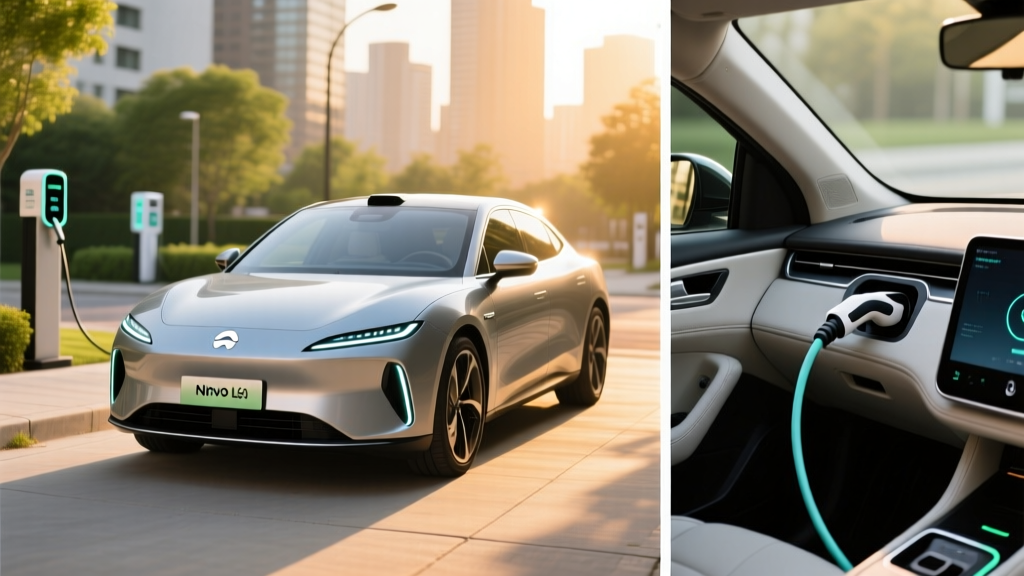
The Onvo L60's 900-volt electrical architecture is its standout engineering feature. Higher voltage allows faster charging at lower current, reducing heat and improving efficiency — the same principle behind the Hyundai Ioniq 5 and Porsche Taycan.
| Charging Level | Max Power | Speed / Time |
|---|---|---|
| Level 1 (120V household) | ~1.4 kW | ~4–5 mi/hr added |
| Level 2 (240V home/public) | ~11 kW (onboard charger) | ~30–35 mi/hr; full charge in ~6 hr |
| DC Fast Charge (peak) | ~250 kW (est.) | 10–80% in approximately 20–25 min |
| Battery Swap (Nio Power Swap) | N/A | ~3 minutes for full battery exchange |
The DC fast-charge peak of ~250 kW is achievable on compatible high-power chargers (350 kW-class stations). However, like all EVs, the L60's charge curve tapers significantly above 80% state of charge to protect the battery. Expect the final 20% to add roughly 15–20 additional minutes. On a typical 150 kW public charger, 10–80% will take closer to 30–35 minutes.
Nio's battery swap network — over 2,700 stations in China as of late 2025 — allows Onvo L60 owners to exchange a depleted pack for a fully charged one in roughly three minutes. This is a genuine differentiator in China but irrelevant to US buyers given Nio has no swap infrastructure outside China and select European markets.
Performance and Drivetrain
The standard Onvo L60 is rear-wheel drive with a single motor producing 326 horsepower (240 kW) and 305 Nm (225 lb-ft) of torque. Nio publishes a 0–100 km/h (0–62 mph) time of 5.9 seconds. A dual-motor AWD variant is available with a combined output of approximately 460 hp, cutting the 0–62 mph time to around 4.6 seconds.
| Variant | Drivetrain | Horsepower | Torque | 0–62 mph |
|---|---|---|---|---|
| Standard / Long Range RWD | Rear-Wheel Drive | 326 hp | 225 lb-ft | 5.9 sec |
| AWD (Long Range) | Dual-Motor AWD | ~460 hp | ~340 lb-ft | 4.6 sec |
These figures place the L60 squarely in Model Y territory (the Model Y Long Range AWD hits 60 mph in ~4.8 seconds). On-road, the L60 delivers smooth, linear acceleration typical of single-motor RWD EVs, with regenerative braking offering adjustable levels up to near one-pedal driving. The 900V system contributes to efficiency at sustained highway speeds, a factor often overlooked in spec sheets.
Pricing, Tax Credits, and US Availability
The Onvo L60 launched in China with a starting price of ¥149,900 (approximately $20,800 USD at early 2026 exchange rates) for the standard-range RWD model with battery-as-a-service (BaaS), where the battery is leased monthly rather than purchased outright. Purchasing the battery outright adds roughly ¥60,000–80,000 ($8,300–$11,100), bringing the total to approximately $29,100–$31,900 depending on trim.
| Configuration | Price (approx.) |
|---|---|
| Standard Range RWD (BaaS, battery lease) | $20,800 + ~$85/mo battery |
| Standard Range RWD (battery included) | $29,100 |
| Long Range RWD (battery included) | $31,900 |
| Long Range AWD (battery included) | $35,500 |
US Federal Tax Credit (§30D): Because the Onvo L60 is not sold in the United States, it is not eligible for the IRS §30D Clean Vehicle Credit. Even if imported, the credit requires the vehicle to be assembled by a manufacturer meeting battery-sourcing and critical-minerals thresholds, subject to MSRP caps ($80,000 for SUVs) and buyer income limits ($150,000 single / $300,000 joint). Chinese-manufactured EVs face additional complications under current sourcing rules that exclude battery components from "foreign entities of concern." (Source: IRS.gov)
For US buyers, the practical takeaway is that the Onvo L60's pricing is a China-market phenomenon. Comparable US-market vehicles — the Tesla Model Y ($44,990 base), Hyundai Ioniq 5 ($42,450 base), Ford Mustang Mach-E ($42,995 base) — are priced significantly higher but include US warranty coverage, service networks, and potential tax-credit eligibility.
Interior, Cargo, and Technology
The L60 rides on a 2,950 mm (116.1 in) wheelbase — longer than the Tesla Model Y's 113.8 in — translating to generous rear-seat legroom. Nio claims rear legroom of approximately 1,010 mm (39.8 in), competitive with midsize SUV benchmarks. Cargo volume behind the rear seats is rated at approximately 28.6 cu ft (810 liters), expanding to roughly 57 cu ft with seats folded. A small front trunk (frunk) adds an additional 1.8 cu ft.
The cabin centers on a 17.2-inch 3K AMOLED center display running Nio's Banyan 2.0 infotainment system, a 13-inch HUD (head-up display), and an 8-inch rear-seat entertainment screen. Notably, the L60 omits a traditional instrument cluster, relying entirely on the HUD and center screen — a design choice that divides opinion. Wireless Apple CarPlay and Android Auto are supported.
Driver assistance falls under Nio's Onvo Smart Driving suite, powered by a single Nvidia Orin X chip and 4D imaging radar. Features include adaptive cruise control, lane-centering assist, automated parking, and highway navigation assist. This is an SAE Level 2 system — the driver must remain attentive with hands on or near the wheel at all times. It is not autonomous driving.
Warranty and Ownership Considerations
In China, Nio provides the Onvo L60 with a 6-year/150,000 km (93,000 mile) vehicle warranty and an 8-year/160,000 km (99,000 mile) battery warranty with a guaranteed capacity retention threshold of 70%. For BaaS subscribers, battery health is Nio's responsibility — a swapped battery in poor condition is replaced by the network, effectively eliminating degradation concerns for the lessee.
US buyers have no Nio service network, parts supply, or warranty infrastructure to rely on. Importing an Onvo L60 would mean assuming all maintenance and repair risk independently — a significant deterrent beyond regulatory hurdles.
Pros, Cons, and Competitor Comparison
- Aggressive pricing undercuts Model Y by 30–40% in China
- 900V architecture enables competitive DC fast-charge speeds
- Battery swap eliminates degradation anxiety (BaaS model)
- Spacious cabin with class-leading rear legroom
- LFP chemistry offers long cycle life and thermal safety
- Modern infotainment with large AMOLED display and HUD
- Not available in the US; no announced US launch
- No US service network, parts, or warranty support
- CLTC range figures require significant downward adjustment for real-world EPA comparison
- LFP battery loses more capacity in extreme cold than NMC
- Single-motor RWD only for base model; AWD limited to long-range trim
- BaaS model means you never own the battery outright
Against the Tesla Model Y, the Onvo L60 wins on interior space, base price (in China), and battery-swap flexibility. It loses on global availability, Supercharger network access, proven long-term reliability data, and autonomous-driving feature depth (Tesla's FSD Supervised, while still Level 2, has broader operational coverage). For US buyers, the Model Y, Hyundai Ioniq 5, and Kia EV6 remain the practical benchmarks in this segment.
Who Should Consider the Onvo L60?
China-based EV buyers: The L60 is a compelling value proposition — particularly with the BaaS battery-lease model — for urban commuters and small families who want Model Y space at a fraction of the cost and access to Nio's swap network.
US-based EV shoppers: The Onvo L60 is not a purchase option. However, tracking its pricing and technology is valuable context for understanding competitive pressure on US-market EVs. Nio's 900V architecture, LFP adoption, and battery-swap model may influence vehicles that do reach American shores from other manufacturers.
Frequently Asked Questions
What is the real-world range of the Nio Onvo L60?
The standard-range L60 with its 60.6 kWh LFP battery is rated at 345 miles on the CLTC cycle. In real-world US-equivalent driving, expect approximately 270–290 miles in mixed conditions, 240–260 miles on highway-heavy trips, and 190–220 miles in cold weather (below 30°F). The long-range 85 kWh variant adds roughly 60–70 miles to each figure.
How fast does the Onvo L60 charge?
On a 350 kW-capable DC fast charger, the L60 peaks at approximately 250 kW and charges from 10–80% in roughly 20–25 minutes. On a typical 150 kW public charger, expect 30–35 minutes for 10–80%. Home Level 2 charging at 11 kW adds roughly 30–35 miles per hour, with a full charge taking about 6 hours.
Can I buy the Onvo L60 in the United States?
No. As of early 2026, the Onvo L60 is sold only in China and select international markets. Nio has not announced US availability for the Onvo brand, and importing one would face regulatory, warranty, and service challenges.
Does the Onvo L60 qualify for the US federal EV tax credit?
No. The §30D Clean Vehicle Credit requires the vehicle to be purchased new from a qualifying manufacturer for use in the US, meeting battery-sourcing and critical-minerals requirements. The Onvo L60 is not sold in the US and would not meet current sourcing rules due to Chinese battery component manufacturing.
Is the Onvo L60 better than the Tesla Model Y?
On price and interior space in China, the L60 has a clear edge. On global availability, charging network access, proven reliability, and advanced driver-assist coverage, the Model Y remains superior for most buyers outside China. The comparison depends entirely on market access.
What is Nio's battery-as-a-service (BaaS) model?
BaaS allows buyers to purchase the vehicle without the battery, paying a monthly lease fee (approximately ¥800–1,200/$110–$165 per month in China) for battery use. Benefits include no degradation risk, access to battery swaps, and the ability to upgrade battery capacity temporarily. The trade-off is that you never own the battery and monthly costs accumulate over time.