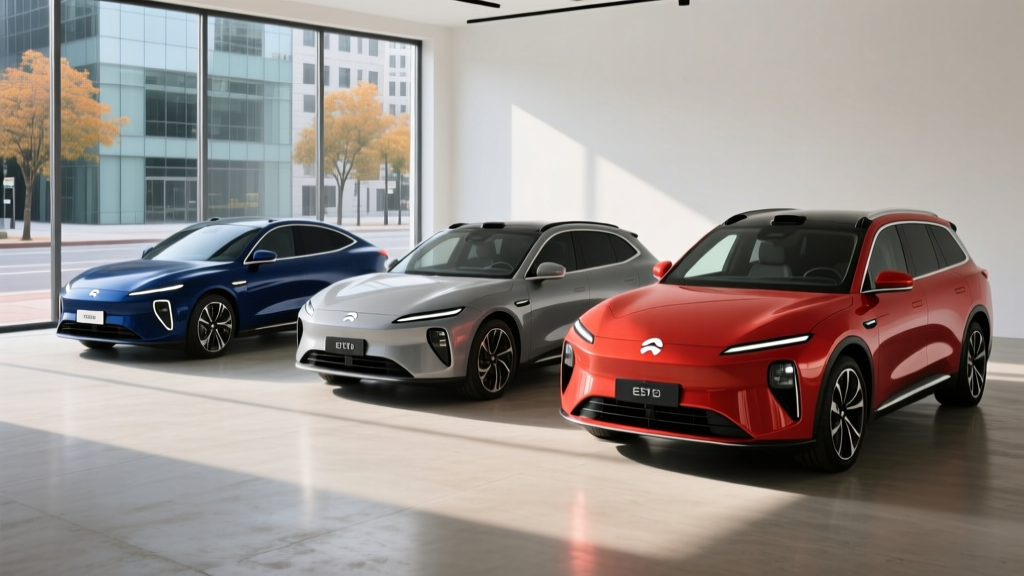
NIO's October 2025 delivery numbers drew industry attention for a reason: the Chinese automaker reported over 23,000 units delivered in a single month, continuing a streak of record-breaking figures throughout 2025. For US-based EV shoppers tracking the brand's potential stateside arrival, those numbers raise a practical question — what would you actually be buying, and how do NIO's models stack up against established competitors like Tesla, BMW, and Hyundai?
This profile breaks down NIO's most globally relevant models — the ET7 sedan, EL7 (ES7) SUV, and ET5 touring — with the exact specs, charging data, and ownership economics that matter to research-heavy buyers. Note: NIO has not officially launched in the US market as of early 2026, so pricing and federal tax credit eligibility discussed here are based on European and Chinese market data with projected US equivalents.
NIO's October 2025 Deliveries: By the Numbers
NIO reported 23,970 vehicle deliveries in October 2025, representing a year-over-year increase of approximately 47%. The breakdown across sub-brands tells the story of a company scaling aggressively:
- NIO brand (premium): ~14,200 units (ET7, ET5, ES8, EL7/ES7, EC7)
- ONVO (mass market, L60): ~8,100 units
- Firefly (compact, launched mid-2025): ~1,670 units
These figures matter to prospective buyers because delivery volume correlates with charging infrastructure investment, parts availability, and long-term brand viability. NIO's Power Swap station network exceeded 2,700 globally by October 2025, with over 250 in Europe. US infrastructure remains nonexistent — a critical ownership factor we'll address below.
NIO ET7: Flagship Sedan Specs and Real-World Range
The ET7 is NIO's Tesla Model S competitor — a large premium sedan with serious range credentials and a technology-forward cabin. Here's what the numbers look like for the long-range variant most likely to reach export markets:
| Specification | NIO ET7 (100 kWh Long Range) |
|---|---|
| EPA-estimated range | Not EPA-rated (WLTP: 580 km / ~360 mi) |
| Battery capacity | 100 kWh usable (NMC chemistry) |
| Drivetrain | Dual-motor AWD |
| Horsepower | 644 hp (480 kW) |
| 0-60 mph | 3.8 seconds |
| Max DC fast charge | ~180 kW peak |
| 10-80% DC charge time | ~32 minutes (estimated) |
| Level 2 home charge | 11 kW AC (~30 mi/hr) |
| Efficiency (WLTP) | ~17.2 kWh/100 km (~27.7 kWh/100 mi) |
| Length / Wheelbase | 199.8 in / 121.3 in |
| Cargo volume | ~18.7 cu ft (trunk) |
| Battery warranty | 8 years / 160,000 km (~100,000 mi) in EU |
NIO EL7 (ES7): The Mid-Size SUV Contender
The EL7 — badged ES7 in China — is NIO's answer to the BMW iX and Tesla Model X. It's a two-row mid-size SUV positioned below the three-row ES8, targeting buyers who want premium space without three-row bulk.
| Specification | NIO EL7 (100 kWh) |
|---|---|
| WLTP range | ~520 km / ~323 mi (est. EPA: 270-290 mi) |
| Battery capacity | 100 kWh usable (NMC) / 75 kWh option available |
| Drivetrain | Dual-motor AWD |
| Horsepower | 644 hp |
| 0-60 mph | 3.9 seconds |
| Max DC fast charge | ~180 kW peak |
| 10-80% DC charge time | ~30 minutes |
| Level 2 home charge | 11 kW AC (~25 mi/hr) |
| Cargo volume | ~22.5 cu ft (rear seats up) / ~55 cu ft (folded) |
| Legroom (rear) | ~37.4 inches |
The EL7's 75 kWh variant uses LFP (lithium iron phosphate) chemistry, which trades energy density for longevity and thermal stability. LFP cells tolerate regular 100% charging without accelerated degradation — a meaningful ownership advantage for daily commuters who can charge at home nightly. The 100 kWh NMC pack offers more range but benefits from 80-90% daily charge limits for long-term health.
Charging Reality: What NIO Owners Actually Experience
NIO's charging story has two distinct chapters depending on market:
Battery Swap (China, limited Europe): NIO's signature feature — swapping a depleted battery for a full one in ~5 minutes at a Power Swap station. This eliminates charging wait times entirely but requires proximity to a swap station. With zero US stations, this advantage is moot for American buyers.
Conventional Charging: Without swap access, NIO vehicles charge like any other EV. The ~180 kW peak DC rate is respectable but trails the 250+ kW capability of Hyundai's E-GMP platform (Ioniq 5/6) and Tesla's V3/V4 Superchargers. Here's how NIO's charging compares:
| Charging Level | Power | NIO ET7 Miles Added/Hour |
|---|---|---|
| Level 1 (120V household) | ~1.4 kW | ~3-4 mi/hr |
| Level 2 (240V home/public) | 11 kW | ~30 mi/hr |
| DC Fast Charge (peak) | ~180 kW | ~550 mi/hr (at peak, tapers above 80%) |
The charge curve matters: NIO's packs typically sustain peak rate to approximately 40-50% state of charge, then taper progressively. A 10-80% session takes ~30-32 minutes, but 80-100% can add another 25+ minutes. For road trips, plan stops around the 10-80% sweet spot.
Pricing, Tax Credits, and the US Availability Question
NIO has not announced US pricing or a firm stateside launch date. European pricing provides a reference point:
| Model | EU Price (approx.) | Projected US MSRP | §30D Credit Eligibility |
|---|---|---|---|
| ET7 (100 kWh) | €81,900 (~$89,000) | $75,000-$82,000 | Unlikely — exceeds sedan MSRP cap of $55,000 |
| EL7 (100 kWh) | €77,900 (~$85,000) | $70,000-$78,000 | Unlikely — exceeds SUV MSRP cap of $80,000 (borderline) |
| ET5 Touring | €54,900 (~$60,000) | $50,000-$55,000 | Possible — within sedan cap if sourcing rules met |
| ONVO L60 | Not sold in EU | $35,000-$42,000 (est.) | Potentially — price-competitive, sourcing unknown |
Federal tax credit eligibility under IRS §30D requires meeting multiple criteria simultaneously: MSRP below caps ($55,000 for sedans, $80,000 for SUVs/trucks), buyer income below thresholds ($150K single / $300K joint), and critical mineral + battery component sourcing from US or FTA-partner nations. NIO's Chinese battery supply chain (primarily CATL) would face significant hurdles under current sourcing requirements. Consult a tax professional before counting on any credit.
Tech, Driver Assistance, and Ownership Experience
NIO's technology stack is genuinely competitive with — and in some areas ahead of — established premium brands:
Infotainment: A 12.8-inch AMOLED center display runs NIO's Banyan system. The NOMI AI assistant (an animated dashboard robot) handles voice commands with contextual awareness. Wireless CarPlay and Android Auto are standard.
Driver Assistance (SAE Level 2): NIO's NOP+ (Navigate on Pilot Plus) uses a LiDAR sensor, 11 cameras, and 5 millimeter-wave radars. It handles highway lane changes, on/off-ramp navigation, and traffic jam assist. This is a Level 2 system — the driver must remain attentive with hands on or near the wheel at all times. It is not autonomous driving.
Unique Feature — Battery Swap: Where available, 5-minute battery exchanges eliminate charging downtime. NIO also offers Battery-as-a-Service (BaaS) in some markets, reducing purchase price by ~$14,000-$20,000 in exchange for a monthly battery subscription (~$140-$230/month). This model has not been announced for the US.
Notable Drawbacks:
- No US service network — any warranty work would require shipping or third-party arrangements
- No access to Tesla Supercharger network (NIO uses CCS2 in Europe; US models would likely use NACS or CCS1)
- Charging speed trails class leaders (Hyundai/Kia at 240+ kW, Tesla at 250 kW)
- Resale value entirely speculative for a brand without US track record
- Insurance costs unknown — likely elevated for a low-volume import
Who Should Consider NIO — and Who Should Wait
Choose NIO (when/if available in US) if:
- You prioritize battery swap technology and live near a future swap corridor
- You want premium sedan/SUV build quality at a price undercutting Mercedes EQS or BMW i7
- You're willing to accept early-adopter risk on service infrastructure and resale value
- The BaaS subscription model appeals to your ownership philosophy
Look at established competitors if:
- You need reliable service access and predictable resale value
- You want guaranteed federal tax credit eligibility
- Fast DC charging (250+ kW) is a priority for road trips
- You depend on NHTSA/IIHS safety ratings before purchasing
Frequently Asked Questions
What is the real-world range of NIO's EVs?
The ET7 (100 kWh) delivers an estimated 260-280 miles in real-world highway driving, dropping to 220-240 miles in cold weather. The EL7 SUV achieves roughly 230-260 miles highway. These figures fall short of the Tesla Model S (402 mi EPA) and are competitive with the BMW i5 (295 mi EPA).
How fast does a NIO charge at home and on the road?
At home on Level 2 (11 kW), expect roughly 30 miles of range per hour — a full overnight charge from 20-80% takes about 6 hours. On DC fast chargers, NIO peaks around 180 kW, reaching 10-80% in approximately 30-32 minutes. This is slower than Hyundai's E-GMP vehicles (18 minutes) but comparable to BMW's iX.
Does NIO qualify for the US federal EV tax credit?
Almost certainly not for current models. The ET7 and EL7 exceed MSRP caps, and NIO's Chinese battery supply chain (CATL) does not meet §30D critical mineral and component sourcing requirements. The lower-priced ONVO L60 might theoretically qualify on price, but battery sourcing remains a barrier. Always verify current rules at irs.gov and consult a tax professional.
Is NIO worth buying versus Tesla, BMW, or Hyundai?
For US buyers in 2026, the answer is: you can't buy one yet, and if you could, the lack of service infrastructure, uncertain tax credit eligibility, and speculative resale value make established competitors the safer choice. NIO's technology is genuinely competitive, but ownership logistics matter as much as specs. The Tesla Model S, BMW i5, Hyundai Ioniq 6, and Genesis Electrified G80 all offer proven US support networks.
Will NIO launch in the United States?
NIO has signaled interest in US market entry but has not announced a timeline, model lineup, or pricing. The brand is currently focused on Europe (Norway, Germany, Netherlands, Sweden, Denmark) and China. Any US launch would likely begin with the ET7 sedan or a mid-size SUV. Monitor NIO's investor relations and official press channels for announcements.
What is NIO's battery warranty?
In European markets, NIO provides an 8-year / 160,000 km (~100,000 mile) battery warranty covering defects and capacity retention below a specified threshold (typically 70-80% state of health). US warranty terms would be established at market entry. For reference, US federal law effectively mandates 8 years / 100,000 miles for EV battery coverage.