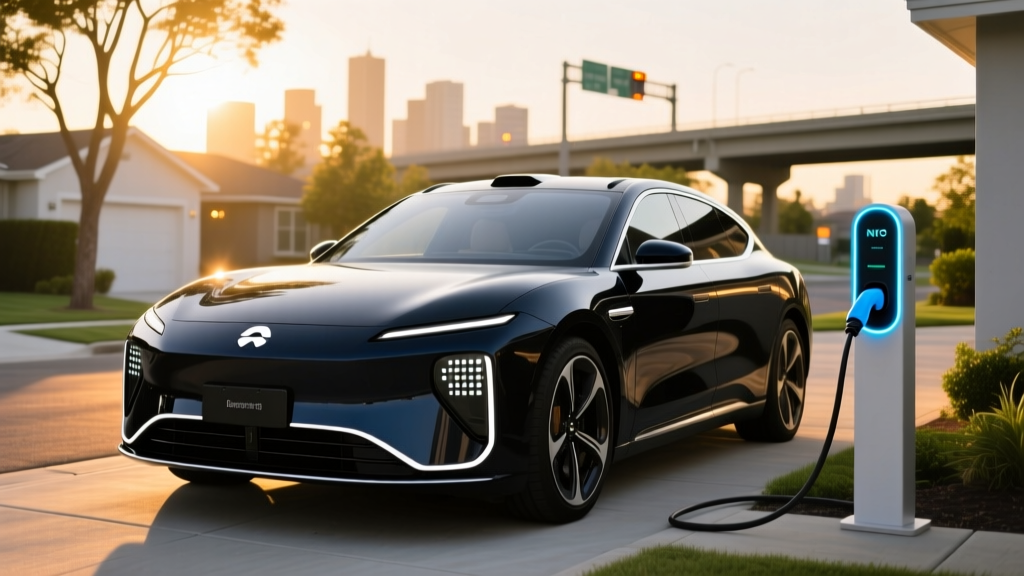
NIO closed out November 2025 with 28,328 vehicle deliveries — a monthly record that pushed the Chinese automaker's year-to-date volume past 200,000 units and signaled that its third-generation platform is resonating with buyers. For US-based EV shoppers watching from the sidelines, the headline raises an obvious question: when — and whether — these cars will arrive stateside, and what the specs actually look like under the hood.
This profile dissects NIO's current 2026 model-year lineup (the EL6 midsize SUV, ET7 sedan, and EL8 three-row SUV), translating WLTP figures to realistic EPA expectations, mapping out the battery-swap ecosystem, and sizing up federal tax credit eligibility under current IRS §30D rules.
NIO November 2025 Deliveries by the Numbers
NIO Inc. reported its November delivery figures in early December 2025, showing a roughly 31% year-over-year increase. The breakdown across its three brands:
- NIO brand (premium): 18,412 units — led by the EL6 and ET7
- ONVO (mass-market): 7,849 units — the L60 sedan gaining traction
- Firefly (compact, new): 2,067 units — first full month of deliveries
The volume matters because it proves NIO's NT 3.0 platform — introduced across 2025 model-year vehicles — has manufacturing maturity. For prospective buyers, platform maturity translates to fewer first-year build-quality surprises and a more established service network in markets where NIO operates.
2026 NIO Lineup: Range, Battery, and Real-World Expectations
NIO's 2026 models ride on the NT 3.0 architecture, which supports 800-volt electrical systems, silicon-carbide inverters, and the company's signature battery-swap capability. Below are the core specs for the three models most likely to reach international markets.
| Spec | EL6 (Midsize SUV) | ET7 (Sedan) | EL8 (3-Row SUV) |
|---|---|---|---|
| Battery (Standard) | 75 kWh (NMC) | 75 kWh (NMC) | 100 kWh (NMC) |
| Battery (Long Range) | 100 kWh (NMC) | 100 kWh (NMC) | 100 kWh (NMC) |
| Battery (Ultra Long Range) | 150 kWh (semi-solid) | 150 kWh (semi-solid) | 150 kWh (semi-solid) |
| WLTP Range (100 kWh) | ~385 mi | ~435 mi | ~370 mi |
| Est. EPA Range (100 kWh) | ~325 mi | ~365 mi | ~310 mi |
| Drivetrain | Dual-motor AWD | Dual-motor AWD | Dual-motor AWD |
| Horsepower | 483 hp | 644 hp | 670 hp |
| 0–60 mph | 4.5 sec | 3.8 sec | 4.1 sec |
| Max DC Charge Rate | ~240 kW | ~240 kW | ~240 kW |
| 10–80% DC Time | ~21 min (100 kWh) | ~21 min (100 kWh) | ~24 min (100 kWh) |
| Level 2 Home Rate | 11 kW (~37 mi/hr) | 11 kW (~40 mi/hr) | 11 kW (~35 mi/hr) |
| Efficiency (est.) | ~31 kWh/100 mi | ~28 kWh/100 mi | ~34 kWh/100 mi |
| Est. MPGe | ~108 MPGe | ~120 MPGe | ~99 MPGe |
Charging: 800V Architecture and Battery Swap
NIO's dual approach to replenishment — fast charging and battery swapping — sets it apart from every other automaker selling EVs today.
DC Fast Charging
All 2026 NIO models with the 100 kWh pack support up to ~240 kW peak DC fast charging via CCS2 (or NACS, depending on market). On a 350 kW charger, the 100 kWh pack reaches from 10% to 80% in approximately 21 minutes. However, like all NMC packs, the charge curve tapers sharply above 80% — a full 10–100% session takes closer to 38–42 minutes. The 75 kWh pack charges at roughly 190 kW peak, adding about 180 miles in 15 minutes.
Battery Swap Stations
NIO operates over 2,700 battery swap stations globally as of late 2025, with the vast majority in China. A swap takes approximately 3–5 minutes: you drive in, the system removes your depleted pack, and installs a fully charged one. This is NIO's killer differentiator in its home market — but it remains a major question mark for US buyers, as no swap stations currently exist in North America and NIO has not announced a US rollout timeline.
Home Level 2 Charging
NIO's onboard charger supports up to 11 kW AC (three-phase in Europe; US homes with split-phase 240V would see ~7.2–9.6 kW depending on circuit). On a 48-amp home charger (typical US Level 2 installation on a 60-amp circuit), expect roughly 30–37 miles of range per hour of charging — enough to fully replenish a 100 kWh pack overnight in about 10–12 hours.
Pricing, Trims, and Federal Tax Credit Eligibility
NIO does not currently sell vehicles in the United States, so official US MSRP figures do not exist. However, based on current European and Chinese pricing, plus expected import costs, here are estimated US price positions if NIO enters the market:
| Model | Est. Base Price | Est. As-Tested (Long Range) | Key Competitor |
|---|---|---|---|
| EL6 | ~$52,000 | ~$62,000 | Tesla Model Y, BMW iX3 |
| ET7 | ~$58,000 | ~$72,000 | Tesla Model S, BMW i5 |
| EL8 | ~$68,000 | ~$82,000 | Tesla Model X, Rivian R1S |
Interior, Tech, and Driver Assistance
NIO's cabin philosophy centers on what the company calls its "second living room" concept — and the 2026 models deliver on that promise with premium materials and distinctive tech.
Standout Features
- NOMI AI companion: An animated dashboard robot that handles voice commands, climate adjustments, and navigation with conversational AI — a genuine differentiator versus static voice assistants
- 15.6" AMOLED center display with vertical orientation (ET7/EL6) or horizontal (EL8)
- NIO Link ADAS: LiDAR-equipped (1x ultra-long-range roof-mounted unit) with 33 perception sensors supporting highway pilot, automated parking, and city navigation assist (in supported markets)
- 7.1.4 Dolby Atmos sound with 23 speakers standard on most trims
- Battery-as-a-Service (BaaS): In markets where offered, buyers can purchase the vehicle without the battery for ~$10,000–$14,000 less, then subscribe to a battery plan (~$140–$160/month for 100 kWh)
Notable Drawbacks
- Infotainment system currently lacks native Apple CarPlay/Android Auto integration (NIO uses its own ecosystem)
- Third-row space in the EL8 is tight — 28.3 inches of legroom, suitable for children only
- No confirmed US service center network or mobile service infrastructure
- ADAS features are geofenced; full city navigation assist requires HD map coverage unavailable outside China and select European cities
Cargo, Passenger Space, and Practicality
| Dimension | EL6 | ET7 | EL8 |
|---|---|---|---|
| Front Legroom | 41.3 in | 41.7 in | 41.5 in |
| Rear Legroom | 38.5 in | 37.8 in | 36.2 in (2nd row) |
| Cargo (behind 2nd row) | 20.1 cu ft | 15.8 cu ft (trunk) | 14.5 cu ft (behind 2nd) |
| Cargo (max, seats folded) | 51.8 cu ft | N/A | 48.2 cu ft (behind 1st) |
| Frunk | No | No | No |
The lack of a front trunk (frunk) across the lineup is a notable miss — the battery-swap mechanism occupies that space. The EL6's cargo area is competitive with the Tesla Model Y, but the ET7's trunk is smaller than the BMW i5's. The EL8's cargo volume behind the third row is limited; fold the third row and you get a usable 28.4 cu ft.
Warranty Coverage
In its current markets, NIO offers:
- Vehicle limited warranty: 6 years / 93,000 miles (150,000 km)
- Battery warranty: 10 years / unlimited miles for first owner (capacity retention guaranteed above 70% State of Health)
- BaaS subscribers: Battery is always under NIO's ownership; degradation is NIO's responsibility, and swap stations automatically cycle out packs that fall below health thresholds
These terms are competitive — particularly the unlimited-mileage battery warranty for first owners. Whether NIO would honor identical terms in the US market remains unconfirmed.
Who Should Buy a NIO — and Who Should Wait?
- You live in a market where NIO currently operates (China, Norway, Germany, Netherlands, Denmark, Sweden) and want battery-swap flexibility
- You prioritize premium cabin materials and distinctive tech (NOMI, Dolby Atmos) over brand cachet
- You drive in urban/suburban environments where the ADAS suite and ride comfort shine
- You're interested in the BaaS subscription model to lower upfront cost
- You're a US-based buyer — NIO has no confirmed American launch date, no service network, and no swap stations
- You need a proven public charging network (NIO relies on third-party chargers outside its swap ecosystem)
- You want federal tax credit certainty — Chinese battery sourcing likely disqualifies NIO under §30D
- You regularly tow — NIO does not rate these models for significant towing (no official tow rating published)
Pros, Cons, and the Bottom Line
Pros
- Battery swap in ~4 minutes (where stations exist)
- 800V architecture with ~240 kW DC charging
- Premium interior with NOMI AI and Dolby Atmos
- Competitive range with 100 kWh and 150 kWh options
- Strong first-owner battery warranty
- BaaS lowers purchase price significantly
Cons
- No US availability or confirmed timeline
- No frunk (battery swap hardware occupies space)
- Likely ineligible for $7,500 federal tax credit
- No Apple CarPlay / Android Auto
- ADAS geofenced to mapped markets
- Third row (EL8) cramped for adults
Frequently Asked Questions
What is the real-world range of NIO's 2026 models?
With the 100 kWh NMC pack, expect roughly 325 miles (EL6), 365 miles (ET7), and 310 miles (EL8) under EPA-equivalent testing. Real-world highway driving at 70+ mph reduces these by 8–12%. In cold weather below freezing, expect a 20–30% reduction. The optional 150 kWh semi-solid-state pack can push the ET7 past 500 miles in mild conditions but costs significantly more and has limited availability.
How fast does a NIO charge at home and on the road?
On a DC fast charger, NIO's 100 kWh pack peaks at ~240 kW and charges from 10–80% in about 21 minutes. At home on a 48-amp Level 2 charger (240V), you'll add roughly 30–37 miles of range per hour, fully recharging overnight in 10–12 hours. Battery swap, where available, takes 3–5 minutes for a full pack exchange.
Does NIO qualify for the US federal EV tax credit?
Almost certainly not under current IRS §30D rules. The credit requires battery components manufactured in North America and critical minerals sourced from the US or FTA partners. NIO's battery supply chain is predominantly Chinese. Additionally, MSRP caps ($55,000 sedans / $80,000 SUVs) and buyer income limits ($150K single / $300K joint) would further restrict eligibility. Always consult a tax professional.
Is NIO coming to the United States?
NIO has expressed interest in US market entry but has not announced a timeline. The company has prioritized European expansion (Norway, Germany, Netherlands, Sweden, Denmark) and its home market. Geopolitical tensions, tariff structures, and the need to build a service/swap-station network make a near-term US launch unlikely before 2028 at the earliest.
Is NIO worth buying versus Tesla, BMW, or Rivian?
In markets where NIO is available, the EL6 competes favorably with the Tesla Model Y on interior quality and ride comfort, though Tesla's Supercharger network and software ecosystem remain advantages. The ET7 targets the BMW i5 and Mercedes EQE on luxury, with NIO offering more standard features but less brand prestige. The EL8 undercuts the Rivian R1S and Tesla Model X on price but lacks their off-road capability and US service infrastructure. Your decision should hinge on which brand has a service presence in your area.
What is NIO's Battery-as-a-Service (BaaS)?
BaaS lets you buy the car without the battery, reducing the purchase price by roughly $10,000–$14,000 depending on pack size. You then pay a monthly subscription (~$140–$160/month for 100 kWh) that covers battery use, swap access, and degradation risk. It's an attractive model for buyers who want lower upfront cost and don't mind a recurring charge — similar to leasing a battery. BaaS is currently available in China and select European markets.